Stephen Devassy
Indian musician
Stephen Devassy is an Indian musician hailing from Palakkad, Kerala. He started his career at a very early age, and has performed on stage around the world. Stephen is the founder of Musik Lounge, an audio technology school and studio in Chennai.
Key Facts
Full Name: Stephen Devassy
Date of Birth: 23 February 1981
Place: Palakkad, Kerala, India
Occupation: Musician, Composer, Performer, Music Director, Educator
Known For: Stage performances, fusion music, keyboard mastery, film scoring, global concerts
Institution: Founder of Musik Lounge (Chennai)
Musical Roots
Stephen Devassy’s story begins in Palakkad, a region of Kerala known for its deep-rooted musical traditions. While the district has historically produced classical musicians, Devassy’s journey would take a different path, one that blended classical grounding with contemporary experimentation.
His schooling at Seventh Day Adventist School in Ottapalam and later studies at NSS College provided a conventional academic framework. But music, not academics, quickly became his defining pursuit. Early signs of his musical inclination were not subtle. Like many prodigies, Devassy displayed an instinctive understanding of melody and rhythm, but what set him apart was his ability to translate that instinct into performance at a very young age.
Kerala’s cultural ecosystem, where devotional music, film songs, and classical traditions coexist, offered him a wide palette. Instead of choosing one lane, Devassy absorbed all of it. That early openness would later become central to his identity as a fusion artist.
The Breakthrough and Early Career
Devassy’s first major break came at 18, an age when most musicians are still finding their footing. Working with Johny Sagarika on the album Ishtamannu, he handled orchestration for multiple tracks. It was a technical role, but one that required maturity beyond his years.
Soon after, he joined playback singer Hariharan on a European tour as a keyboard accompanist. Touring at that stage exposed him to professional performance environments, audience dynamics, and the discipline required for live shows. It was less about visibility and more about learning the mechanics of being on stage.
Another significant collaboration followed, with violin maestro L. Subramanian at the Lakshminarayana Global Music Festival. For a young musician, sharing space with such established figures is both validation and challenge. Devassy used it as a platform to refine his craft.
At 19, he co-founded the band Seven along with Franco Simon and Sangeeth Pavithran. Their album YehZindagani reflected an early attempt to engage with Indian pop, a genre that was still evolving at the time. While the band did not become a long-term project, it marked Devassy’s willingness to experiment beyond conventional formats.
Expanding Musical Horizons
Parallel to his performance career, Devassy began working as a music arranger for films, contributing to projects across Malayalam and Tamil cinema. This phase is often overlooked but crucial. Arrangement work demands precision, adaptability, and an understanding of how music supports narrative.
His debut as a music director came with Hariharan Pillai Happy Aanu (2003), marking his formal entry into film composition. Over time, he contributed to films such as Neerali (2018), Pakalum Paathiravum (2023), and Gumasthan (2024), among others.
However, Devassy never fully transitioned into being a conventional film composer. Unlike many of his contemporaries, he did not anchor his career solely in cinema. Instead, he maintained a parallel identity as a live performer, arguably his stronger domain.
The Performer: Stage as Identity
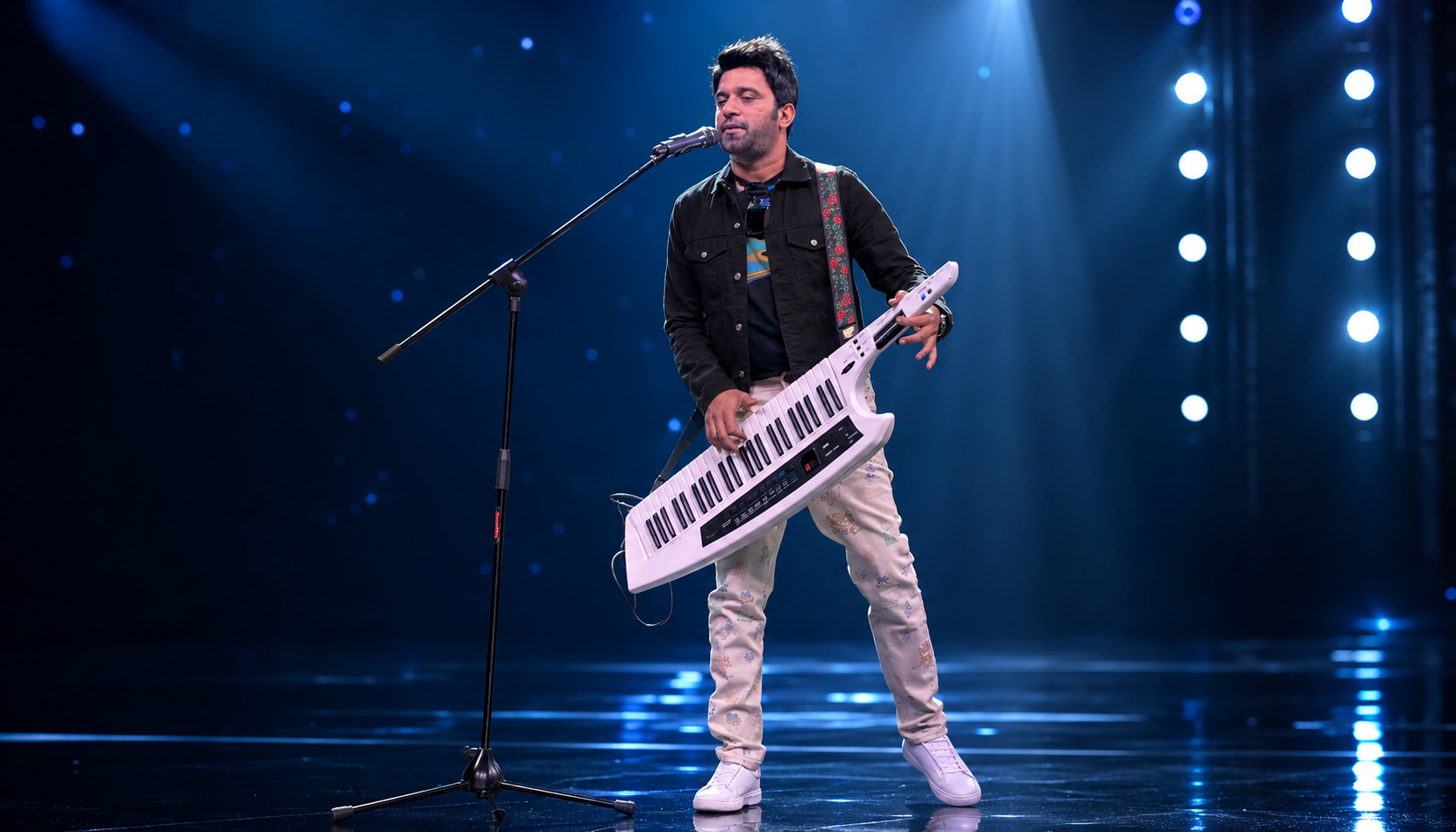
If there is a single thread that defines Stephen Devassy’s career, it is performance. His solo concerts are not structured like traditional recitals; they are immersive experiences. He treats the keyboard not just as an instrument but as an extension of his physical presence.
Technically, his playing combines elements of Indian classical ragas with Western harmonic structures. But what distinguishes him is not just technique, it is delivery. His performances are marked by high energy, improvisation, and an ability to read audience response in real time.
In India, instrumentalists rarely achieve mainstream visibility unless tied to classical traditions. Devassy has managed to break that pattern by positioning himself as a stage performer first and a composer second. This shift is significant. It reflects a broader evolution in Indian music culture, where live performance is gaining prominence alongside recorded music.
Spiritual and Fusion Music Contributions
Another dimension of Devassy’s work lies in spiritual and devotional music. As a member of Rexband, associated with the Jesus Youth movement, he has participated in gospel fusion performances that blend contemporary sounds with devotional themes.
One of the defining moments of this association came in 2002, when Rexband performed at World Youth Day in Canada before Pope John Paul II. Being part of that performance placed Devassy on an international platform at a relatively early stage in his career.
His work with Kosmic Music further explores this intersection of spirituality and sound. Projects like Sacred Chants incorporate Sanskrit slokas and Upanishadic verses into Western musical frameworks. This is not entirely new in Indian music, but Devassy’s approach is notable for its accessibility. He does not treat devotional music as rigid or purely traditional; instead, he reimagines it for contemporary audiences.
Albums and Musical Experimentation
Devassy’s album Romanza represents perhaps his most explicit attempt at crafting a personal musical statement. The album blends world music elements with piano-driven compositions, integrating Indian ragas into a contemporary soundscape.
Guest appearances by artists like Hariharan and Ouseppachan add depth, but the core of the album remains Devassy’s own musical voice. It reflects his interest in bridging genres rather than staying confined within them.
In many ways, Romanza encapsulates his broader approach to music, rooted in tradition but open to global influences.
Television and Public Persona
Devassy’s visibility has also been amplified through television. His role as a judge on shows like Superstar Junior, Top Singer, and Star Singer positioned him as a mentor figure within Kerala’s music ecosystem.
Unlike some television personalities who rely on performative criticism, Devassy’s approach tends to emphasise encouragement and technical guidance. This aligns with his broader identity as a musician invested in nurturing talent.
His participation in MasterChef UK (2018), where he trained public figures like Spencer Matthews and Frankie Bridge, adds another layer to his public persona, extending his reach beyond traditional music audiences.
Personal Life
Behind the stage persona, Devassy maintains a relatively grounded personal life. He married Jesna Joy on 16 November 2010. While not extensively publicised, his personal life reflects a balance that many performers struggle to maintain amid demanding careers.
Achievements and Recognition
Recognition has followed Devassy’s work, though it has often come from diverse quarters rather than a single institutional framework. Being featured on the cover of 5Talents Magazine in 2013 and receiving the Behindwoods Gold Mic Award in 2019 as an “Icon of Inspiration” reflect his influence across different segments of the music industry.
These recognitions, while important, are secondary to his primary achievement, sustaining relevance in a rapidly changing musical landscape.
Legacy and Cultural Impact
Stephen Devassy’s contribution to Indian music cannot be measured solely through albums or film scores. His real impact lies in redefining the role of the instrumental performer in a predominantly vocal music culture.
By building a career centered on live performance, he has opened pathways for younger musicians to think beyond playback singing or film composition. His work demonstrates that instrumental music can command mainstream attention, provided it is presented with conviction and innovation.
In Kerala, a state with a strong cultural identity, Devassy represents a modern extension of its musical tradition. He carries forward the region’s emphasis on technical excellence while adapting it to global contexts.
At a time when music consumption is increasingly digital and fragmented, his insistence on the live experience feels almost countercultural. Yet, it is precisely this commitment that sustains his connection with audiences.
Stephen Devassy remains an outstanding Malayali musician not just because of his skill, but because of his ability to evolve, adapt, and perform with a sense of immediacy that few in his field can replicate.
Achievements
Featured on Talents Magazine Cover Page With His Life Story – 2013
The Icon of Inspiration Music – Behindwoods Gold Mic Award – 2019