K.C. Rekha
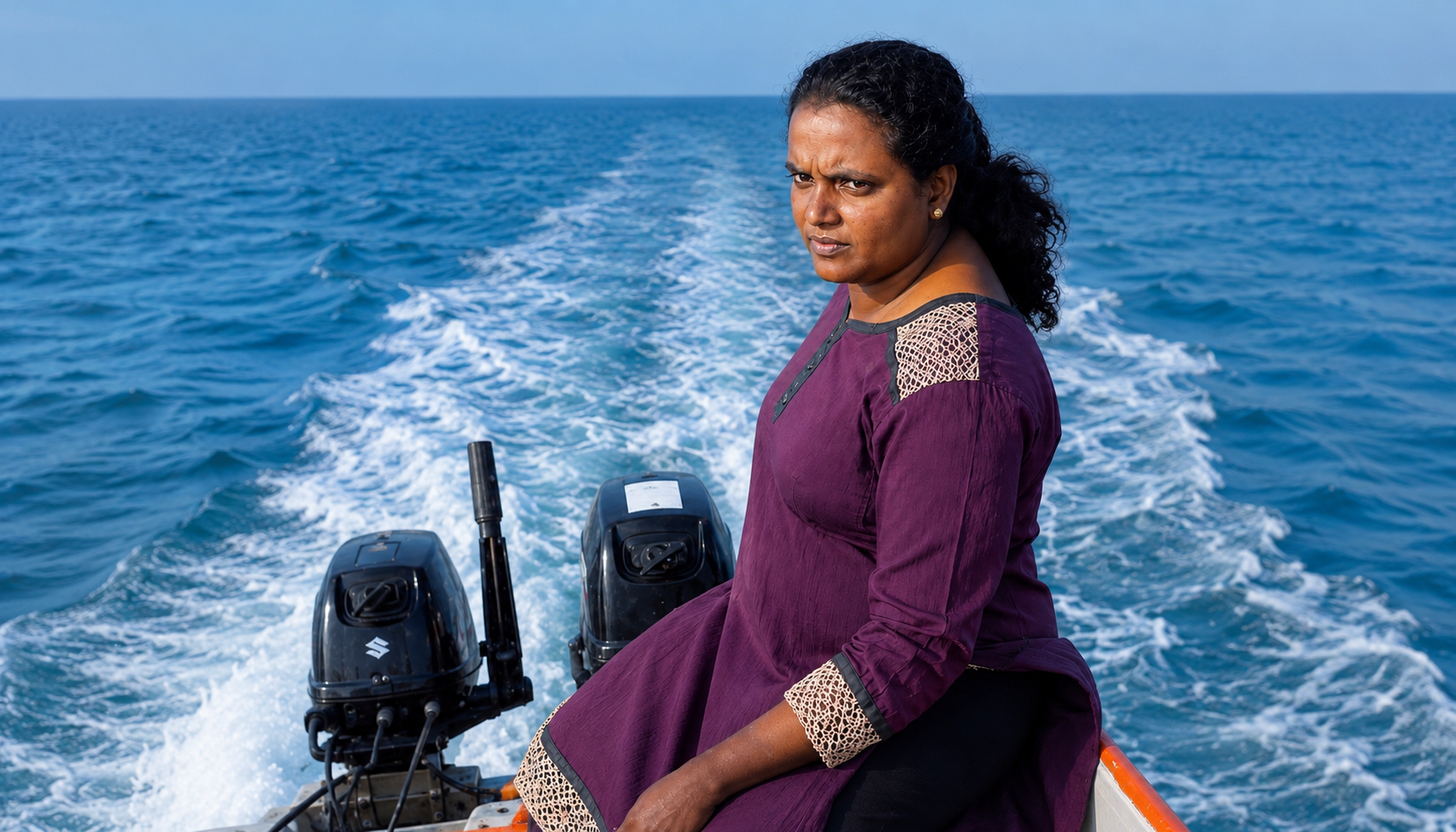
K. C. Rekha is India’s first licensed deep-sea fisherwoman who broke barriers in a field traditionally dominated by men. Hailing from Kerala, her journey reflects courage, determination, and a deep connection to the sea and coastal life.
40 Nautical miles ventured offshore
10+ Years at sea alongside her husband
India’s first officially licensed female deep-sea fisher
2017 Year CMFRI officially recognised her
She Went Out to Sea When No Woman Did
“Although the sea is considered mother and goddess, our society forbids a woman from entering the sea. I faced strong opposition… they even said it would destroy the sea.”
— K.C. Rekha
Origin: A Love Story, a Cross-Caste Marriage, and the Open Sea
Rekha K.C. did not grow up by the ocean. She was born and raised in Koorkenchery, an inland village in Kerala’s Thrissur district, far removed from the rhythms of the coast. It was in a Hindi language class — an ordinary evening course — that she met Karthikeyan, a fisherman from the coastal hamlet of Chettuva. They fell in love across caste lines. Both families objected furiously. The couple eloped, and Rekha moved to a house perched barely thirty metres from the crashing waves of the Arabian Sea.
Life in Chettuva was nothing like what she had known. But Rekha adapted with quiet determination. She helped mend nets, cleaned the day’s catch, and kept the household running while Karthikeyan worked the sea. For a while, the division of labour held. Then, everything changed.
Into the Water: Compulsion Before Courage
About ten years before her national recognition, Karthikeyan’s deckhand abruptly quit. Without money to hire a replacement — and with the family’s four daughters to feed — Rekha made a decision that would upend everything. She stepped onto the boat.
“I did not compel her to accompany me, but I was desperately in need of a helper. However, Rekha was quick enough to realise the situation and joined me uninvited.”
— Karthikeyan, her husband
The sea’s welcome was brutal. On her first day out, Rekha vomited continuously for three hours, eventually coughing up blood from the severity of the seasickness. The ordeal lasted weeks. But she refused to turn back. “I started learning everything from my husband and turned into a suitable help for him slowly,” she later said. Slowly became mastery. She studied fish movement, learned to read the sky and the swell, and could soon track shoals of sardine, tuna, mackerel, and sea bass without instruments.
Remarkably, the couple navigates the open sea without GPS or compass. They head out before dawn — often at 3 am — travel up to forty nautical miles offshore, and find their way back by the stars. The vessel itself is a twenty-year-old wooden boat powered by an outboard engine, modest and battered, but still seaworthy.
Against the Shore: A Village That Did Not Want Her at Sea
In coastal Kerala, the sea carries a dual symbolism: it is both goddess and provider. Fishermen leave at dawn while their wives stay on shore, praying to Kadalamma, the sea goddess, for their safe return. This was not tradition framed gently — it was enforced. Women had no place in the boat.
Chettuva’s residents made their disapproval loud and physical. Neighbours jeered. Some damaged the couple’s nets. Others warned that a woman on the water would anger the sea and bring ruin. Rekha pushed back with blunt clarity: “I don’t know why these kind of outdated beliefs still get prominence in our society. What will happen if a woman goes into the sea for fishing?”
Karthikeyan stood by her, publicly and privately. Over time — as the catch came in, as the family survived — the village’s hostility softened into begrudging respect, and eventually into pride.
Recognition: The Search That Found a Pioneer
India’s Central Marine Fisheries Research Institute (CMFRI) — the country’s premier marine research body, headquartered in Kochi — conducts extensive documentation of the fisheries sector. Yet when researchers began investigating women’s participation in deep-sea fishing, their records drew a blank.
“It was a tedious search. There are many women engaged in fishing in backwaters and rivers but no record of a woman’s presence in fishing along our coastline was available. We did an extensive search and finally spotted her.”
— Dr. A. Gopalakrishnan, Director, CMFRI
That search led to Chettuva, and to Rekha. On 5 May 2017 — coincidentally the couple’s wedding anniversary — CMFRI formally felicitated them and declared Rekha India’s first female deep-sea fisher. The Fisheries Department of Kerala swiftly followed by issuing her a fisherperson’s passbook and licence, entitling her to the government allowances available to sea fishers. It was the first such licence ever issued to a woman in the country.
The CMFRI also extended material support: cage farming equipment and fish seedlings were provided to establish a small aquaculture operation at the breakwater near their home, offering the family a more stable secondary income. Their eldest daughter, Maya Karthikeyan, received a scholarship of one lakh rupees to continue her education.
Timeline: A Life in Milestones
- Early 2000s: Rekha meets Karthikeyan during a Hindi language course in Thrissur. They marry against caste opposition and settle in Chettuva, a fishing village on the Arabian Sea coast.
- 2007–2008: After the family’s deckhand leaves and they cannot afford a replacement, Rekha joins Karthikeyan on the boat for the first time — her initial days marked by severe seasickness.
- 2016: Union Minister of State for Agriculture Sudarshan Bhagat felicitates Rekha at a CMFRI function — recognition that comes even before she holds an official licence.
- May 5, 2017: CMFRI officially recognises Rekha as India’s first deepwater fisherwoman on her wedding anniversary. The Kerala Fisheries Department issues her India’s first fisherwoman licence.
- 2018–2019: National media coverage follows. Rekha receives the Kairali People TV Jwala Award, presented by film actor Mammootty. Congress leader Rahul Gandhi publicly praises her during a Kerala visit.
- 2018 Kerala Floods: Catastrophic flooding damages the couple’s cage farm, setting them back significantly. The family is left with ongoing financial strain.
- 2020: The COVID-19 lockdown devastates the fishing economy. Rekha is sometimes forced to discard her catch at sea when no buyers can be found. Kerala’s marine fisheries sector loses an estimated ₹3,481 crore in 60 days.
The Fisherwoman: What the Sea Taught Her
Today, Karthikeyan says his wife is the better fisherman. “She can give you lessons on the habits and paths of fish such as sardine, tuna, mackerel and sea bass,” he says — a statement of quiet awe from a man who has spent his life at sea. Rekha can sense the presence of a shoal, swim against the current, and lay nets with the efficiency of a seasoned hand. She still didn’t know how to swim when she first began; she learned that too, eventually.
The family’s life remains materially precarious. Karthikeyan suffered a heart attack, and they have struggled to maintain medical insurance. The house stands perilously close to the shore. What Rekha wants most is practical: a new boat with a double outboard engine and fresh nets. “I am sure I can steer my family out of the financial mess and provide good education to my children,” she has said.
Yet she speaks about the sea the way others speak about a vocation they were born to. She rises before 3 am, goes out into the dark, and returns hours later to the tasks of home — four daughters, a husband’s health, nets that need mending. The celebrity that found her — the awards, the politicians, the cameras — sits lightly on someone who was simply trying to survive and ended up making history.
Significance: One Woman, a Mirror to Many
India’s fishing communities number in the millions, and women within them have always worked — gutting, sorting, drying, selling fish at market. But the sea itself, the act of going out on the open water to catch fish, has been almost exclusively male. The taboos are old and tenacious: that a woman’s presence on a boat invites bad luck, that the sea goddess will be offended, that a wife belongs on shore in prayer.
Rekha’s story is significant not only because she broke through these taboos, but because CMFRI’s researchers confirmed there was truly no precedent they could find in the documented record. Across millions of coastal fisherfolk, no woman before Rekha had been licensed to go deep-sea fishing on an outboard vessel in India.
Her recognition has not yet produced a wave of successors — as of the most recent reports, she remains the country’s only licensed female deep-sea fisher. But her existence in the record matters. The FAO has profiled her. Researchers cite her. Young women in coastal communities know her name. The idea that the sea is a place for women too is no longer entirely abstract — it has a face, a name, and a twenty-year-old wooden boat.