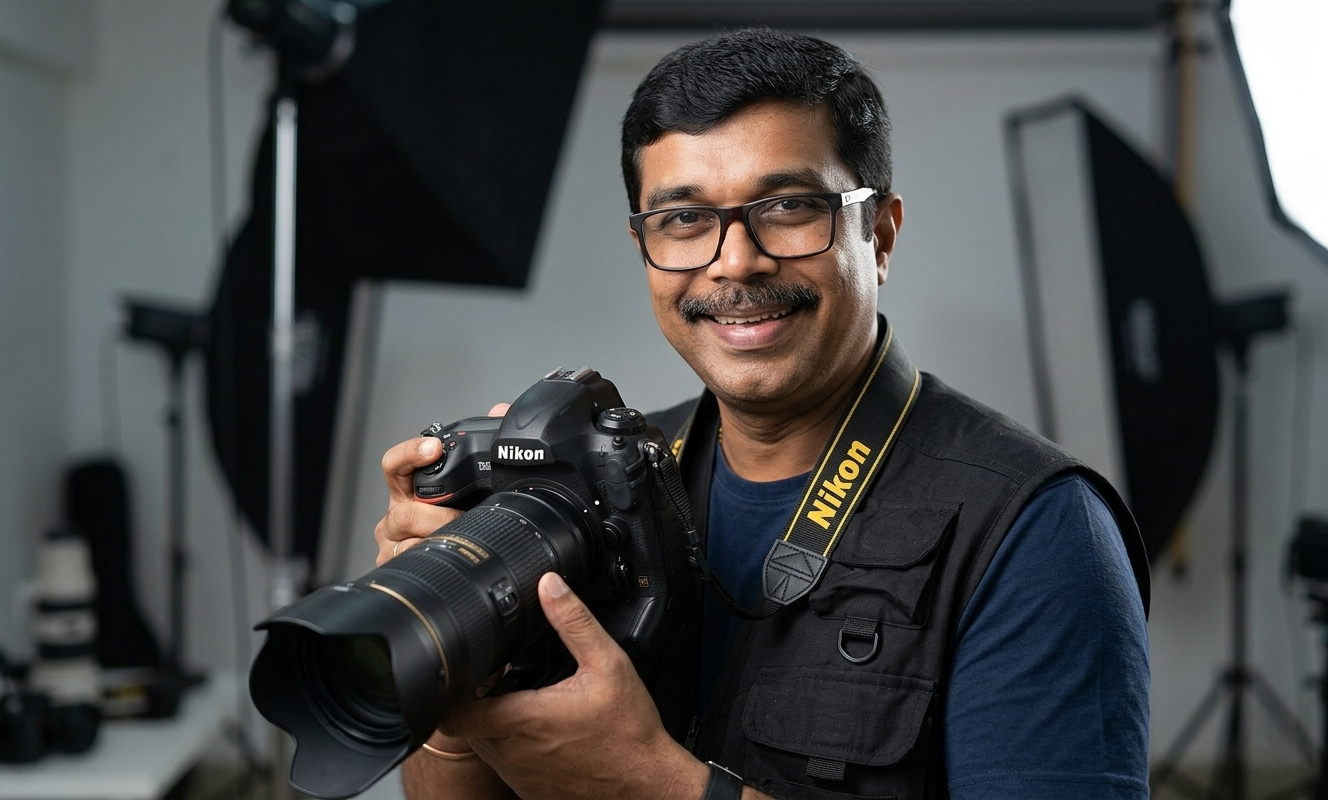
Jayaprakash Payyannur
Still photographer and visual storyteller in Malayalam cinema
Jayaprakash Payyannur is a still photographer who doesn’t just document a scene, but quietly waits for the split-second where staging fades and raw, honest human emotion takes over. Deeply rooted in the visual rhythms of Northern Kerala, his lens treats photography not as a technical exercise, but as an act of empathy that catches the fleeting, everyday moments that usually slip away unnoticed.
Full Name: Jayaprakash Payyannur
Known for: Still photographer and visual storyteller in Malayalam cinema
Place: Payyannur, Kerala, India
Profession: Still Photographer, Visual Archivist
Specialisation: Film still photography, celebrity portraits, behind-the-scenes visual documentation
Years active: 1990s–present
The Invisible hands of still photography
When audiences and critics speak authoritatively about the technical aspects of cinema, they often do not mention anything about the field of still photography. When a film is successful and its director, screenwriter and actors are celebrated, the hard work and sweat of so many technicians who worked day and night for that film goes unnoticed. Still photography is one such technical field.
At least some viewers have the misconception that the photographer on location is only for the purpose of cinema wall posters. But that’s not how things are. There are many still photographers who have gained fame in Malayalam cinema. Jayaprakash Payyannur is one of the names that deserves to be mentioned. Jayaprakash, who made his debut in Malayalam cinema with Mohanlal’s Narasimham, has worked as a cinematographer in over a hundred films. He is currently settled in Dubai and has been sharing pictures and experiences of old movies through his social media handle. He joins ETV Bharat to share the highlights.
From the friendship of masala dosa to the camera
In 1992, Jayaprakash turned to the art of Payyannur photography. At that time, he ran a small business and used to accompany the camera in his spare time during his busy schedule. Without any special academic training, he took up photography with the confidence given by his friend Krishnadas. It was my responsibility to provide the necessary pictures for Krishnadas’s article. With the help of a friend who has an understanding of the camera, I figured things out. Even the remuneration given to a friend who taught photography was just a ‘masala dosa’.
As soon as the camera started yielding to the breakthrough given by ‘Narasimham’, he started working for film magazines in Kerala. As part of this, he entered the cinema by visiting the locations and taking pictures. The turning point in his career came in 1999 when he went to cover the location of the film ‘Narasimham’ for the magazine ‘Screen’. At that time, he was working as a still photographer in the famous serial Ayyappan. Sunil Guruvayur is the cinematographer of Narasimham. He didn’t have any assistants with him when he was working on the film. So I was able to go to him, talk to him, and help him out. After taking pictures for the magazine, I gave my visiting card to Sunil Guruvayur and told him not to hesitate to inform me if there was any work related to photography.
A Letter Rewritten Verdict
On a typical day in October 1999, Jayaprakash received the letter. Though phone facilities were available at that time, letters were the preferred method of transmitting information. At a time when renowned still photographer Sunil Guruvayur was away from a schedule, getting an invitation to act as a substitute was one of the greatest joys of life. In the absence of Sunil Guruvayur, I was able to work as a still photographer for a few days in the film Narasimham. When I became an independent cinema style photographer, the first thing I had the good fortune to click was the face of Malayalam’s own Mohanlal.
From Narasimham to Us
After Narasimham, his first film as a full-time freelance still photographer was the film Aayirathil Oruvan, directed by Sibi Malayil. Kalabhavan Mani is the hero. But the film was released many years after the shooting. Before working as a freelance still photographer in the film Aayirathil Oruvan, Sunil worked as an assistant with Guruvayur in many films. The Tamil remake of the film Niram, Mazhathulli Kilukkam, Valyettan, Dadasaheb and many more. Even at that time, he had not given up his job as a photographer for magazines. Later, he became a freelance still photographer with the film Aayirathil Oruvan. After Aayirathil Oruvan, he also acted in the film Tilak directed by Sasishankar. I had created an album by combining all the pictures from the movie Aayirathil Oruvan. The album was kept in the office of producer Siyad Coker. David Kachappally, another famous producer in Malayalam, got the opportunity to watch the album from the office of Siyad Koker. Nammal, directed by Kamal, is perhaps the first big film in his career as a freelance photographer.
Still photographers were the biggest way to convey to the outside world the details of a film that was being filmed on marketing albums. Until a decade or fifteen years ago, people could only know about cinema through film magazines and other media. Moreover, the still photographer will create an album for all the movies. This album is the one that gives the distribution companies the opportunity to consider taking the film for distribution. The better the photos in the album, the easier we can find a distributor. That is, even the business affairs of a film can easily happen based on the creativity of the still photographer working on that film.
Cameraman’s Guide
In the days when film cameras were in use, we can’t watch the scenes shot in real time, or we can’t watch it in the same way as we do now in a digital camera after shooting. It will take at least two weeks for the film to be processed and viewed. You have to put it in a preview theater to watch these scenes. There, too, it is the still photographer who helps to get an idea of the shot taken by the cameraman and the director. The still camera is also the film when the film is working. But you can go to a nearby photo studio and take a photo print within hours. It is through this that the cameraman of the film gives an approximate clarity about the light and frame he has created for the film industry.
When shooting a scene for such a thing, the still photographer has to take pictures at the same focal length in the lightup set up by the cameraman of the film. Apart from this, the help of still photographers is also sought to ensure the accuracy of the continuity of the film. For example, a scene is depicted. The still photographer has to take pictures that show the costumes of the artists and junior artists there, the various properties on the table, and the lights. Maybe this scene stops shooting halfway through and then shoots days or weeks later. Then everything has to be recreated as it was before. Why should the make-up and hair of the artists be the same as they were when they were first shot? The pictures taken by the still photographer are often helpful in identifying it accurately. Now, other technicians don’t have to take the help of a photographer to do all these things. Everyone has a mobile phone, the technology that gets the output from the main camera, and the way it is edited on the spot. It has not been a long time since such technologies have happened in Malayalam. It’s 15 years at most.
The way pictures are taken in cinema
Until recently, the method of exclusive photoshoots seen in movies was not very important in Malayalam cinema. But he has done an exclusive photoshoot for the film ‘Nammal’. When a typical director takes a scene, a still photographer will take a closer look at what is happening there. It will be understood in which action to get pictures for a good poster. Accordingly, the pictures will be clicked. After taking a shot, the actors will re-enact the same scene if the still photographer asks them to. If there is a space constraint at the location where a scene is being shot, the actors will have the same scene shot in another place for the photo if the photographer asks for it. A still photographer will embark on such a mission only if those scenes seem so beautiful for the photo.
The golden feathers
He have always made an effort to make a difference. He had an insistence that our films should interact with the audience even after so many years. The pictures he takes are the common sense of a still photographer. His realization is the expressions of the actors seen in the poster. Still photography is not just a job. They have to breathe the movie. The shorter the gap between cinema and their minds, the better they can give to the audience. He has worked with director Kamal in about 15 films. The reason why directors constantly call people like him is because of the films we make. It’s our belief in our work. He worked with Kamal sir in many films like Swapnakkood, Perumazhakkalam, Manju Poloru Penkutty, Raja of Utopia, Nammal, Raa Pakal and many more. Films like Gaddama and Celluloid are the golden feathers of his career.
Final Click
Jayaprakash Payyannur has been living in Dubai for some time. He worked in films like Take Off and Meow, which were shot in Dubai. Jayaprakash Payyannur says that though he is thinking about retirement, the camera has become like an organ in his body. Jayapraksh’s travels, capturing different sights and different lives, cannot be confined to a single snap. Jayaprakash’s career has emerged from the world of difficulties through his own efforts. Jayaprakash is a photographer who runs around the wonderful city of Dubai with a unique camera eye. He is one of the busiest still photographers in the expatriate world today. One would be amazed when the varied moments are reborn as photographs through his camera lens. Such is the perfection and beauty of those pictures.