Kanayi Kunhiraman
Indian sculptor
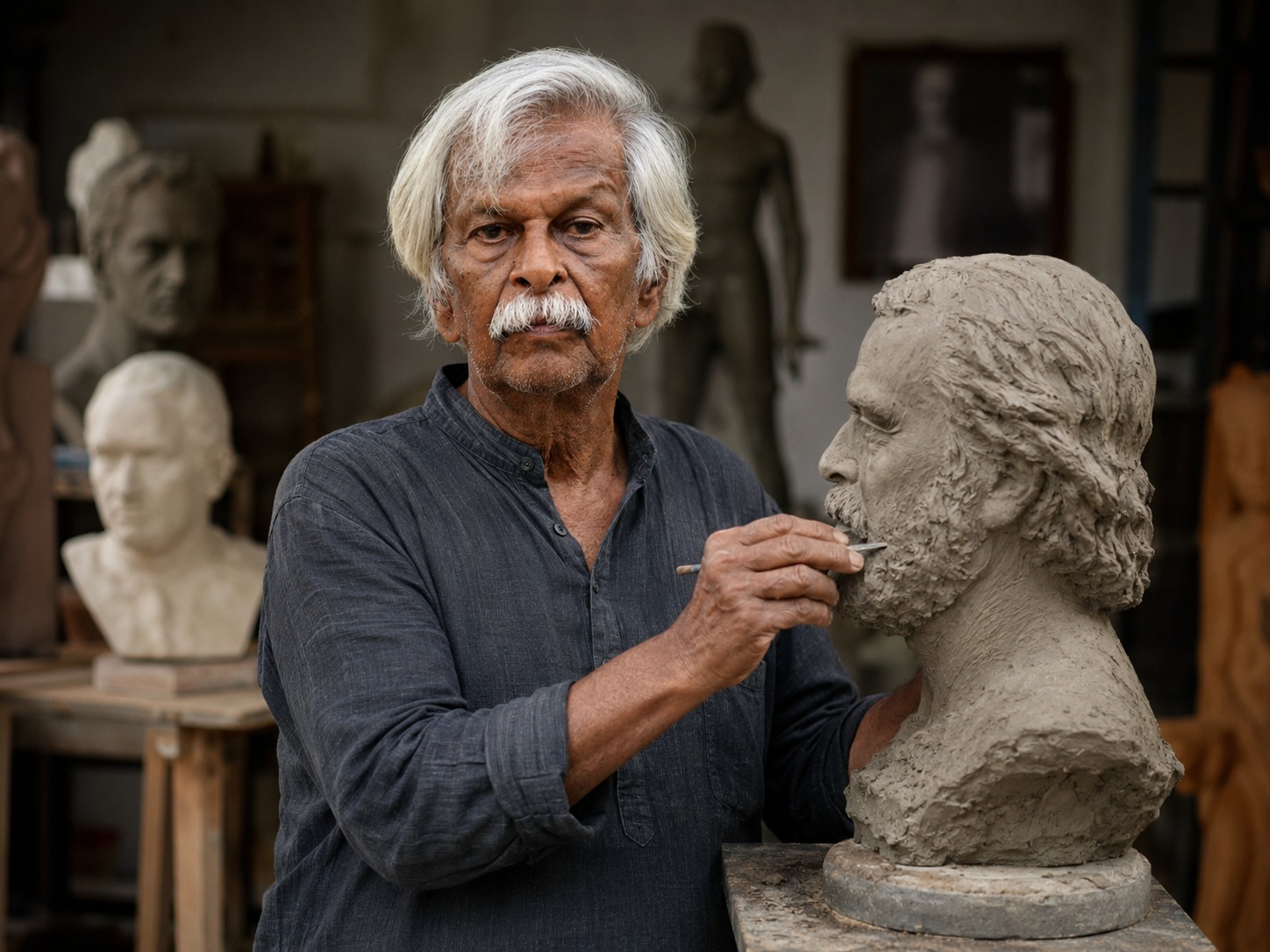
Kanayi Kunhiraman is an Indian sculptor, best known for his outsize sculptures such as Yakshi of Malampuzha Dam Gardens, Sagarakanyaka at Shankumugham Beach and Mukkola Perumal trinity in Kochi. Taught by K. C. S. Paniker, he is a former chairman of the Lalit Kala Academy, India’s national academy of fine arts.
Key Factors
Full Name: Kanayi Kunhiraman
Born: 25 July 1937
Birthplace: Kuttamath, Kanhangad, Kasaragod, Kerala
Occupation: Sculptor, Artist, Educator
Known For: Monumental public sculptures and modernist artistic vision
Mentor: K. C. S. Paniker
Awards: Raja Ravi Varma Award, Kerala Sree Award, Thikkurissy Award, MS Nanjunda Rao National Award
Positions Held: Former Chairman of Lalit Kala Akademi and Kerala Lalithakala Akademi
For generations of Malayalis, a visit to Malampuzha Dam Gardens meant standing before the massive Yakshi sculpture, its body stretched across the green lawns with startling confidence. Children climbed around it. Families photographed it. Tourists stared at it with fascination or discomfort. Some admired its beauty. Others once condemned it as immoral.
Yet almost everyone remembered it.
That ability to occupy public imagination is what separates Kanayi Kunhiraman from many of his contemporaries. His sculptures were never passive objects. They provoked response. They unsettled inherited moral codes. They insisted that art belonged not inside elite galleries alone, but in beaches, parks, roadsides, and civic spaces.
Kerala’s modern visual memory is impossible to imagine without him.
Childhood in Kasaragod and the Birth of an Artist
Kanayi Kunhiraman was born on 25 July 1937 in Kuttamath, near Kanhangad in Kasaragod district, in northern Kerala. The landscape of his childhood, coastal villages, laterite soil, temple rituals, myths, and folk textures, would quietly remain inside his artistic consciousness throughout his life.
But the path toward art was far from easy.
Like many young people from conservative rural families in mid-20th-century Kerala, he faced resistance when he showed interest in pursuing a creative life. Art was not viewed as a stable profession. Sculpture, even less so.
One figure changed the trajectory of his life: a schoolteacher named Krishnan Kutty, who recognised the boy’s talent and encouraged him to pursue it seriously. That encouragement became decisive. Without family support, Kunhiraman eventually left home and travelled to Madras, now Chennai, carrying little more than determination.
The journey itself has since become part of Kerala’s cultural folklore, the story of a young man leaving behind social certainty in pursuit of artistic freedom.
Chennai, K. C. S. Paniker, and Artistic Awakening
At the Government College of Fine Arts, Chennai, Kunhiraman entered a radically different world.
The institution was one of the most important centres of modern Indian art in the post-independence period, and it was here that he encountered K. C. S. Paniker, one of the defining artistic minds of twentieth-century South India.
Paniker’s influence on Kunhiraman went beyond technical instruction. He exposed students to the idea that Indian modernism did not need to imitate Europe blindly. Art could be experimental while remaining rooted in local memory, mythology, and cultural textures.
This philosophy would become central to Kunhiraman’s work.
Unlike sculptors who pursued polished academic realism, Kunhiraman became interested in expressive form, monumentality, and emotional presence. His sculptures did not merely depict bodies; they attempted to communicate energy, sensuality, tension, and cultural memory.
Madras in the 1960s was also intellectually alive. Literature, theatre, painting, cinema, and politics intersected intensely. Kunhiraman absorbed these currents while developing his own visual language.
England and Global Exposure
In 1965, Kunhiraman received a Commonwealth Scholarship to study at the Slade School of Fine Art in London.
The move exposed him to European modernism, post-war sculpture, and international artistic debates. Artists like Henry Moore and Barbara Hepworth had already redefined sculptural form in Britain, moving away from rigid realism toward abstraction and organic structure.
Yet what is remarkable about Kunhiraman is that global exposure did not erase his regional sensibility.
Instead of becoming stylistically Westernised, he returned with greater confidence in his own visual instincts. Kerala’s myths, bodies, rituals, and landscapes remained central to his imagination. But now they were filtered through a modern sculptural vocabulary that was international in confidence.
This balance, local memory with global modernism, became one of the defining strengths of his career.
The Yakshi Controversy and Cultural Shock
Few works in Kerala’s public art history have generated as much debate as Yakshi.
Commissioned for Malampuzha Dam Gardens after his return from Chennai, the sculpture depicted a reclining female figure, nude, sensuous, monumental, and unapologetically physical. Standing roughly 18 feet high, it immediately disrupted Kerala’s public cultural space.
Traditionalists reacted sharply.
Critics accused the sculpture of obscenity. Conservative voices questioned how such a figure could exist in a public park visited by families. The controversy reflected a deeper anxiety within Kerala society during the period, the tension between modern artistic expression and inherited moral conservatism.
But Kunhiraman refused compromise.
He argued, through both his work and interviews over the years, that the human body was not inherently shameful. Sensuality, fertility, and physicality were central aspects of life and mythology alike.
Over time, public perception changed dramatically.
What was once controversial gradually became iconic. Yakshi stopped being merely a sculpture and became part of Kerala’s emotional geography. Today, it is difficult to imagine Malampuzha without it.
The transformation of Yakshi from scandal to symbol mirrors Kerala’s own cultural evolution.
Sculpting Kerala’s Modern Visual Identity
After Yakshi, Kunhiraman continued creating works that reshaped Kerala’s public aesthetic imagination.
At Shankumugham Beach, his massive Sagarakanyaka, or Mermaid, emerged as another unforgettable landmark. Rising dramatically near the sea, the sculpture combines mythic imagination with monumental scale.
Unlike decorative civic sculptures, Kunhiraman’s works engage directly with environment. The Mermaid does not merely occupy the beach; it interacts with sky, sea, light, and weather.
His Mukkola Perumal sculpture in Kochi similarly demonstrates his interest in integrating mythology with modern urban identity. Environmental Pieces, Fertility, Amma, Akshara Shilpam, and installations at Veli Tourist Village reveal an artist constantly experimenting with texture, symbolism, and public interaction.
Concrete became one of his preferred materials not simply for affordability, but for its sculptural possibilities and permanence.
His sculptures often feel simultaneously ancient and futuristic, rooted in Kerala yet strangely universal.
Artist, Teacher, and Institution Builder
Kunhiraman was not only a sculptor but also an influential educator and institutional figure.
In 1976, he joined the College of Fine Arts in Thiruvananthapuram as head of the sculpture department and later served as principal. He eventually chaired the Kerala Lalithakala Akademi and also served as chairman of the national Lalit Kala Akademi.
These roles mattered because Kerala’s art ecosystem during the late twentieth century was still evolving institutionally. Kunhiraman became part of a generation that helped build serious conversations around modern art in the state.
Many younger sculptors and artists acknowledge his influence, not merely stylistically, but intellectually. He expanded what artists believed was possible within public art.
The Philosophy of Kanayi Kunhiraman
At the centre of Kunhiraman’s artistic philosophy lies a refusal of fear.
He rejected rigid distinctions between sacred and sensual, mythic and modern, local and global. The female body in his work is not passive ornamentation but expressive force. Nature appears not as scenery but as emotional landscape.
His sculptures frequently carry echoes of Kerala’s folk imagination while remaining unmistakably modernist in structure.
Critics have often noted that his works resist easy interpretation. They are emotional rather than explanatory. They ask viewers to experience scale, texture, movement, and tension physically.
That quality gives his public sculptures unusual longevity.
Awards, Recognition, and Legacy
Over the decades, Kanayi Kunhiraman received some of Kerala’s highest artistic honours, including the inaugural Raja Ravi Varma Award in 2005 and the Kerala Sree Award in 2022.
But perhaps his greatest achievement is less formal.
His sculptures entered everyday life.
Malayalis may not always know the language of modern art criticism, but they know Yakshi. They know the Mermaid at Shankumugham. They know the emotional sensation of standing before one of his gigantic forms.
That level of public intimacy is rare in contemporary art.
Reflection
Kanayi Kunhiraman did more than create sculptures. He altered the visual consciousness of Kerala itself. Through concrete, bronze, myth, sensuality, and fearless experimentation, he transformed public spaces into arenas of imagination and debate. His art challenged conservatism, expanded the possibilities of modern Indian sculpture, and gave Kerala some of its most enduring cultural landmarks.
Even today, long after the controversies faded, his works continue to stand against sea winds, monsoon rains, and passing generations, silent yet emotionally alive. And in that permanence lies the legacy of an outstanding Malayali artist who taught Kerala that public art could be bold, provocative, intimate, and unforgettable.
Awards and honours
2005 – Raja Ravi Varma Award
2006 – Thikkurissy Award
2018 – MS Nanjunda Rao National Award by Karnataka Chitrakala Parishath
2008 – Lalit Kala Akademi, the national academy of India for fine arts, published a book on Kunhiraman’s works
T. K. Ramakrishnan Award instituted by Abu Dhabi Sakthi Theatres
2022 – Kerala Sree award instituted by Government of Kerala