Shobana
Indian Actress & Classical Dancer
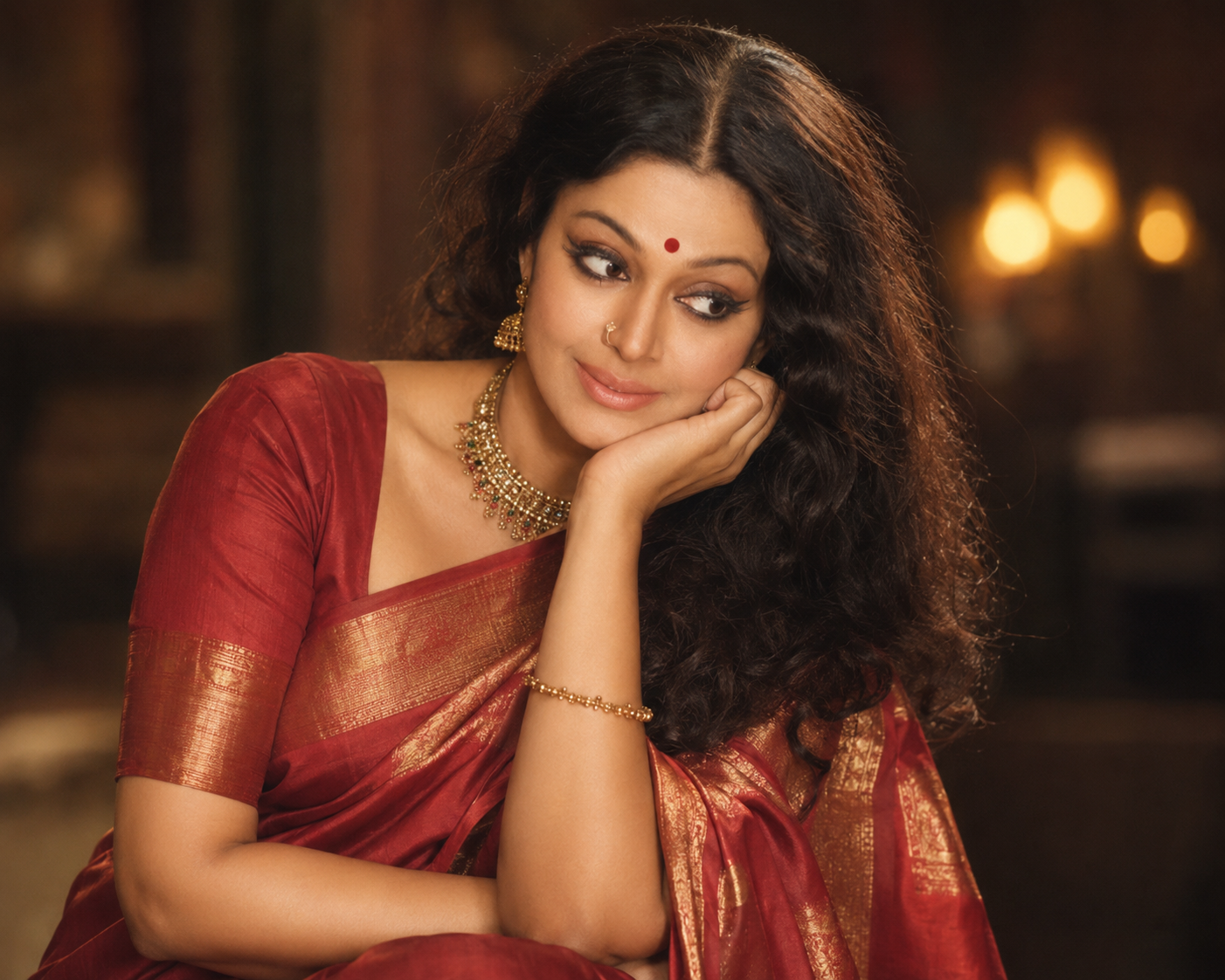
Shobana, is an Indian actress and Bharatanatyam dancer who has appeared primarily in Malayalam cinema, along with notable work in Tamil, Telugu, Hindi, English and Kannada films. She is a recipient of two National Film Awards, one Kerala State Film Awards and two Filmfare Awards South. Over the years, she established herself as one of the leading South Indian actresses. Shobana was born in Kerala to Chandrakumar Pillai and Anandam Chandrakumar Pillai. She is the niece of the renowned Travancore sisters—Padmini, Lalitha and Ragini—who were celebrated for their expertise in classical Indian dance. Actor Vineeth and actress Parvathy Kurup are her cousins.
Key Facts
Full Name: Shobana Chandrakumar Pillai
Born: 21 March 1970 (age 56)
Place: Trivandrum, Kerala, India
Occupations: Actress, Dancer, Choreographer
Years active: 1980–present
There are performers who become stars, and then there are artists who slowly transcend stardom itself. Shobana belongs firmly to the second category. For more than four decades, she has moved between cinema screens and classical dance stages with an outstanding grace that few Indian performers have sustained across generations. Whether appearing as the psychologically fractured Ganga in Manichitrathazhu, dancing under temple lights in a Bharatanatyam recital, or quietly mentoring students at her Chennai dance institution, Shobana has consistently projected something increasingly rare in contemporary celebrity culture, artistic discipline without noise.
Her career cannot be reduced to box-office success or awards alone. She emerged during a transformative era in South Indian cinema, balancing commercial popularity with emotionally layered performances that carried intelligence, restraint, and vulnerability. At the same time, she built a parallel identity as one of India’s most respected Bharatanatyam dancers, preserving classical traditions while bringing them to global audiences with elegance and precision.
What makes Shobana enduring is not simply talent. It is the unusual coherence of her artistic life. Across cinema, dance, and public life, she cultivated an identity rooted in silence, control, refinement, and deeply internalized artistry.
Early Life and Artistic Legacy
Shobana Chandrakumar Pillai was born on March 21, 1970, into a Malayali Nair family deeply connected to India’s classical performing arts tradition. Her artistic inheritance alone carried enormous cultural weight. She was the niece of the legendary Travancore sisters, Padmini, Lalitha, and Ragini, icons who helped shape the visual language of dance and femininity in Indian cinema during the mid-20th century.
Growing up within such a lineage meant that performance was never distant from daily life. Dance, expression, rhythm, costume, and rehearsal existed not as glamorous abstractions but as disciplined artistic practice. Her cousins included actor Vineeth and actress Parvathy Kurup, further embedding her within a family synonymous with South Indian arts.
Even as a child, Shobana displayed unusual composure before the camera. She appeared as a child artist in the Tamil film Mangala Nayagi and won recognition early, suggesting the arrival of a performer with uncommon screen presence.
Yet cinema alone did not define her upbringing.
Parallel to acting, she trained rigorously in Bharatanatyam under respected gurus including Chitra Visweswaran and Padma Subrahmanyam. That training would eventually shape not just her dance career, but her acting style itself.
Entry into Cinema
When Shobana entered Malayalam cinema as a leading actress through director Balachandra Menon’s April 18 in 1984, South Indian cinema was undergoing transition.
The industry still carried traces of melodramatic storytelling traditions from earlier decades, yet filmmakers were increasingly exploring psychological realism, urban anxieties, and emotionally nuanced female characters. Shobana arrived at precisely the right moment.
She possessed classical beauty, but unlike many actresses of the era, her performances carried intellectual sharpness beneath visual elegance. Directors quickly recognized her ability to shift between vulnerability and emotional authority.
The mid-1980s became extraordinarily prolific. In 1985 alone, she reportedly acted in sixteen films, an astonishing workload even by South Indian industry standards. Yet quantity never fully diluted her individuality onscreen.
Films such as Yathra, Kanamarayathu, Nadodikkattu, Vellanakalude Nadu, and Pappayude Swantham Appoos established her as one of Malayalam cinema’s defining female performers of the era.
Her presence extended beyond Kerala. Tamil audiences encountered her in films like Enakkul Oruvan and later Thalapathi, where she shared screen space with towering stars including Rajinikanth and Mammootty under the direction of Mani Ratnam.
In Telugu cinema too, she worked alongside major actors including Chiranjeevi and Mohan Babu, balancing commercial appeal with strong performance-oriented roles.
Unlike many contemporaries, Shobana never relied solely on glamour. Even in mainstream films, she projected emotional intelligence through stillness, voice modulation, and controlled expression.
Career Breakthrough and Stardom
By the early 1990s, Shobana had evolved into one of South India’s most respected actresses.
What distinguished her from many peers was versatility without fragmentation. She moved fluidly between comedy, psychological drama, romance, family cinema, and art-house storytelling.
In Innale, she portrayed emotional fragility with extraordinary restraint, earning her a Filmfare Award. Thenmavin Kombath revealed her gift for romantic drama, while films like Minnaram and Mazhayethum Munpe demonstrated warmth and emotional accessibility that connected deeply with audiences.
Yet beneath the popularity remained artistic rigor.
Her performances often carried subtle dance-derived precision. Gestures felt intentional. Eye movement carried emotional transitions. Silence itself became expressive. She understood rhythm inside scenes much like a dancer understands rhythm inside choreography.
This fusion of classical training and cinematic instinct eventually produced her most iconic role.
Manichitrathazhu and the National Award
Few performances in Indian cinema achieve the level of cultural permanence that Shobana reached in Manichitrathazhu.
Directed by Fazil and released in 1993, the Malayalam psychological drama became one of Indian cinema’s defining films. At its center stood Shobana’s portrayal of Ganga, a woman whose fractured psychological state gradually manifests through the terrifying alter ego of Nagavalli.
The performance remains astonishing even decades later.
Shobana approached the role not through theatrical excess but through controlled transformation. Her Bharatanatyam training became crucial here. The shifts in posture, gaze, neck movement, hand gestures, and facial expression during the Nagavalli sequences created an unsettling physical vocabulary unlike anything mainstream Indian cinema had previously seen.
Her performance balanced psychological realism with mythic intensity.
One moment she appeared fragile and emotionally wounded. The next, she radiated fury, sensuality, grief, and madness with hypnotic authority. Critics and audiences alike recognized the role as historic.
The National Film Award for Best Actress that followed did more than honour a successful performance. It permanently altered her artistic standing.
After Manichitrathazhu, Shobana became far more selective about cinema.
It was as though she understood that some performances redefine not only careers, but the emotional memory audiences carry of an actor forever.
Bharatanatyam and Kalarpana
If cinema made Shobana famous, dance made her complete.
Long before celebrity culture began romanticizing classical arts, Shobana approached Bharatanatyam with seriousness and discipline. Unlike actors who occasionally performed dance recitals as extensions of film fame, she built an independent identity within the classical arts ecosystem.
In 1994, she founded Kalarpana in Chennai, a Bharatanatyam institution that gradually became central to her artistic life.
The school reflected her philosophy toward dance, rigorous but adaptive, rooted in classical grammar yet emotionally contemporary. Over the years, Kalarpana evolved into more than a training space. It became an extension of Shobana’s artistic worldview.
Her performances abroad brought Bharatanatyam to audiences across the United States, Europe, Southeast Asia, Australia, and the Middle East. She collaborated with masters such as Zakir Hussain, Vikku Vinayakram, and Mandolin Srinivas, blending classical structure with experimental musical conversations.
Importantly, Shobana never reduced Bharatanatyam to museum art.
Her choreography respected tradition while allowing emotional accessibility for contemporary audiences. She treated dance as living expression rather than rigid preservation.
Selective Career Choices and Artistic Integrity
After achieving enormous cinematic success, Shobana gradually withdrew from the relentless pace of mainstream filmmaking.
The decision puzzled some industry observers at the time. Many actresses at the height of popularity pursued volume and visibility. Shobana chose distance instead.
But that distance became central to her mystique.
She appeared occasionally in carefully chosen films such as Mitr, My Friend, Makalkku, Thira, and later Varane Avashyamund. These performances reflected maturity rather than nostalgia-driven comeback culture.
Her artistic choices suggested refusal, refusal to overexpose herself, refusal to chase trends, refusal to dilute identity for visibility.
In an entertainment culture increasingly driven by constant publicity, Shobana maintained privacy with unusual discipline.
That restraint preserved her dignity as a public figure.
Awards and Recognition
Over the decades, Shobana’s recognitions reflected not only cinematic success but wider cultural influence.
Her two National Film Awards for Manichitrathazhu and Mitr, My Friend positioned her among India’s most respected performers. The Kerala State Film Award and Filmfare Awards South acknowledged her emotional range within Malayalam cinema.
The Government of India honoured her with the Padma Shri in 2006, recognizing her contribution to the arts beyond cinema alone.
Later recognitions, including the Kalaimamani award from Tamil Nadu, the Kerala Sangeetha Nataka Akademi Fellowship, and multiple honorary doctorates, reflected her stature within Indian cultural life.
In 2025, she received the Padma Bhushan, India’s third-highest civilian honour, affirming her enduring influence across generations of Indian performing arts.
These awards mattered because they recognized something larger than celebrity. They acknowledged a rare synthesis of cinematic brilliance and classical discipline.
Personal Life
Shobana’s personal life has remained strikingly private despite decades in public view.
She never allowed media culture to excessively intrude into her identity. That reserve, sometimes interpreted as mystery, appears instead as deliberate self-protection within an industry often hostile to boundaries.
In 2011, she adopted a daughter and embraced single motherhood quietly, without spectacle or public reinvention narratives.
That choice reflected a recurring pattern throughout her life, dignity over performance.
Even today, Shobana seems more interested in artistic continuity than celebrity preservation. She continues performing, teaching, choreographing, and nurturing younger dancers through Kalarpana.
The public may remember her as Nagavalli, as the heroine of beloved Malayalam classics, or as one of South India’s finest actresses. But perhaps her greatest achievement lies elsewhere.
She transformed herself from movie star into cultural institution without losing emotional authenticity along the way.
Reflection
In Indian performing arts, very few figures sustain relevance across cinema, dance, and cultural memory with equal authority. Shobana did. Through discipline, artistic intelligence, and extraordinary restraint, she created a body of work that feels timeless rather than nostalgic. Long after trends fade and industries transform, her performances continue to breathe with emotional precision and classical grace. That enduring presence is why Shobana remains not merely famous, but one of the most outstanding artistic figures modern Kerala and Indian cinema have produced.
Awards and recognitions
Titles and honours
- 2000 Grade A Top Doordarshan
- 2006 Padma Shri Government of India
- 2011 Kalaimamani Tamil Nadu Eyal Isai Nataka Manram, Government of Tamil Nadu
- 2012 Arch of Excellence All India Achievers Conference
- 2013 Kalarathna Kerala Sangeetha Nataka Academy
- 2018 Honorary doctorate (D.Litt) Vinayaka Mission’s Research Foundation
- 2019 Dr. MGR Educational and Research Institute
- 2022 Sree Sankaracharya University of Sanskrit
- 2025 Padma Bhushan Government of India
Film awards
- 1984 Filmfare Awards South Best Actress – Malayalam (Kanamarayathu) Nominated
- 1985 Filmfare Awards South Best Actress – Malayalam (Yathra) Nominated
- 1986 Filmfare Awards South Best Actress – Malayalam (Chilambu) Nominated
- 1988 Filmfare Awards South Best Actress – Telugu (Rudraveena) Nominated
- 1988 Filmfare Awards South Best Actress – Tamil (Idhu Namma Aalu) Nominated
- 1990 Filmfare Awards South Best Actress – Malayalam (Innale)
- 1990 Filmfare Awards South Best Actress – Telugu (Alludugaru) Nominated
- 1991 Filmfare Awards South Rowdy Gaari (Pellam) Nominated
- 1993 National Film Awards Best Actress (Manichitrathazhu)
- 1993 Kerala State Film Awards Best Actress (Manichitrathazhu)
- 1993 Kerala Film Critics Association Awards Best Actress (Manichitrathazhu & Meleparambil Anveedu Won)
- 1993 Filmfare Awards South Best Actress – Malayalam (Manichitrathazhu) Nominated
- 1994 Filmfare Awards South Best Actress – Malayalam (Thenmavin Kombath)
- 1996 Filmfare Awards South Best Actress – Malayalam (Kumkumacheppu) Nominated
- 1999 Filmfare Awards South Best Actress – Malayalam (Agnisakshi) Nominated
- 1999 Kerala Film Critics Association Awards Best Actress (Agnisakshi)
- 2002 National Film Awards Best Actress (Mitr, My Friend)
- 2005 Filmfare Awards South Best Actress – Malayalam (Makalkku) Nominated
- 2013 Vanitha Film Awards Best Actress (Thira)
- 2013 Filmfare Awards South Best Actress – Malayalam (Thira) Nominated
- 2021 South Indian International Movie Awards Best Actress – Malayalam (Varane Avashyamund)
- 2021-2022 Filmfare Awards South Best Actress – Malayalam (Varane Avashyamund)