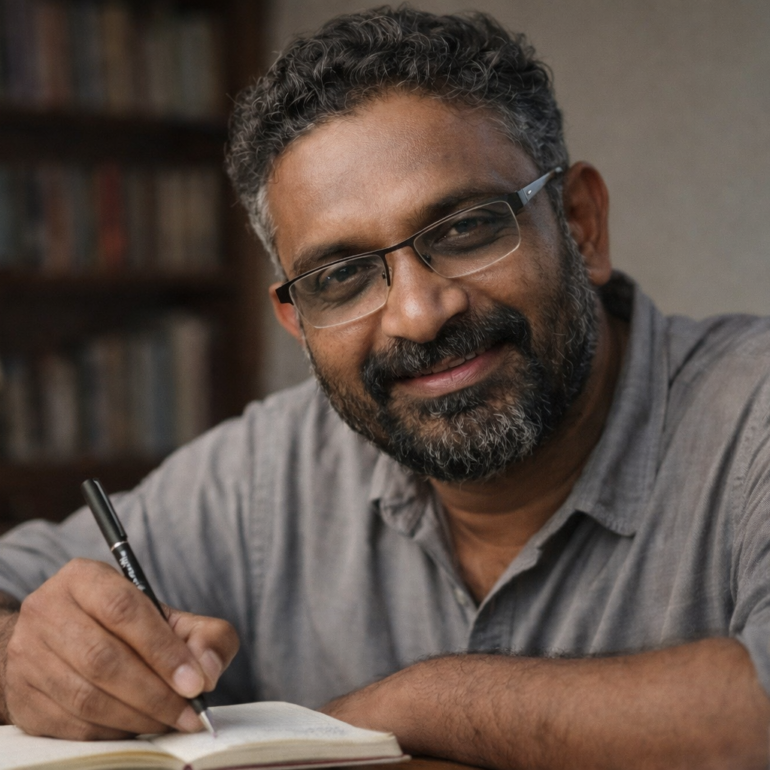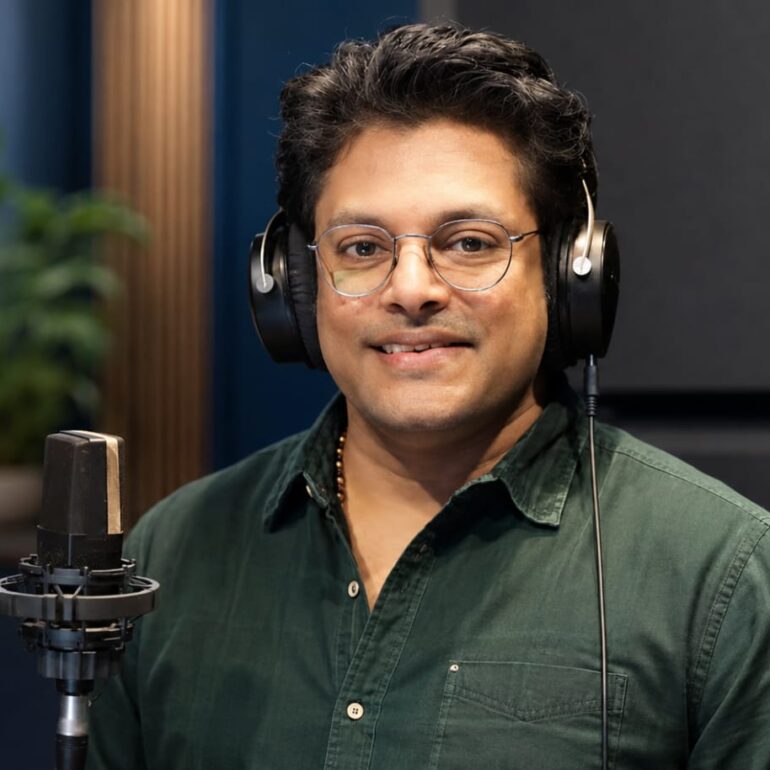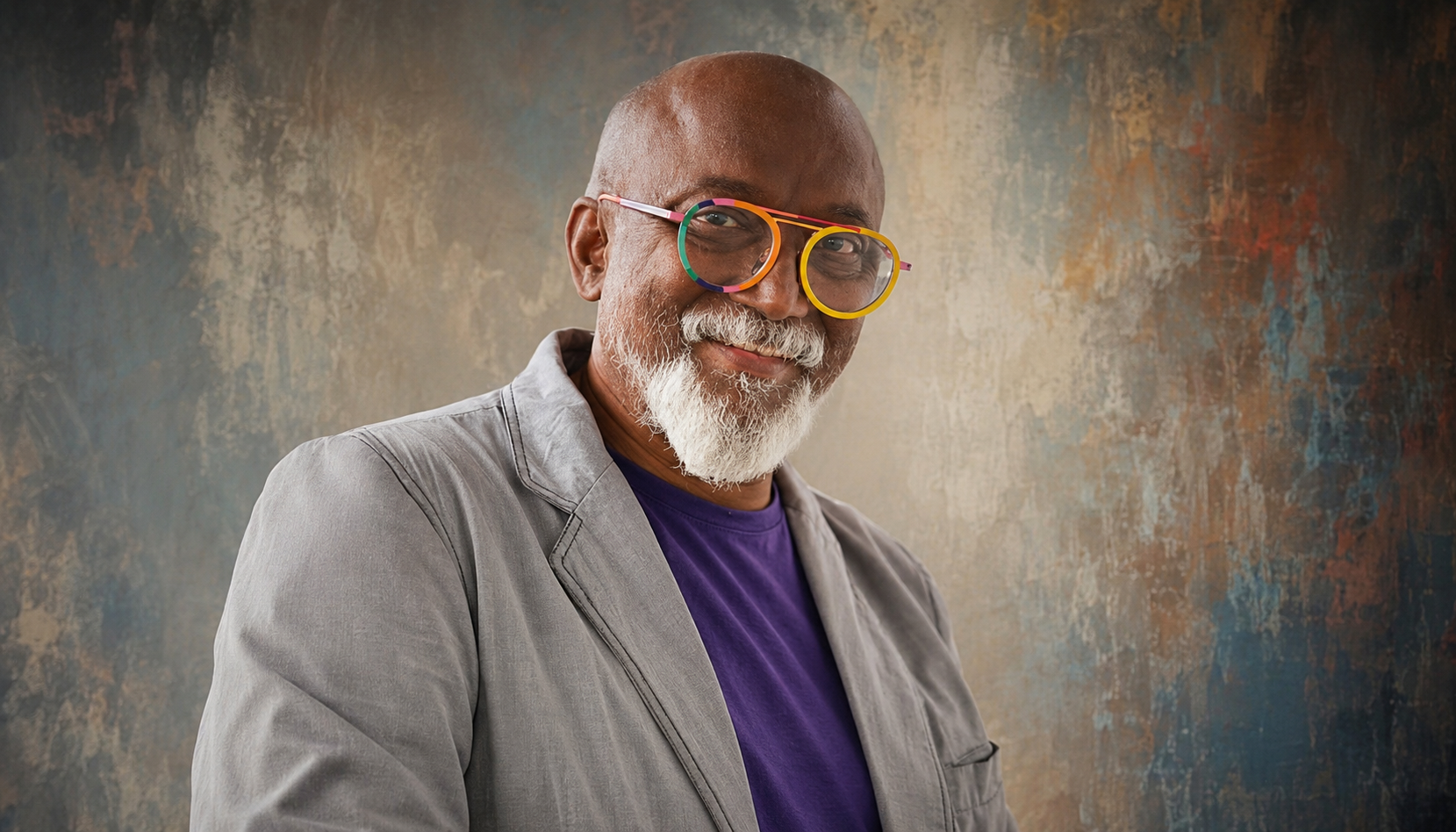
Bose Krishnamachari
Artist / Curator
Bose Krishnamachari (born 1963) is an Indian painter and art curator. Krishnamachari was born in the village of Mangattukara, near Angamaly, Kerala. He attended the Government Higher Secondary School in Puliyanam, before going on to complete a Bachelor of Fine Arts from Sir J. J. School of Art in Mumbai in 1991, and a Master of Fine Arts from Goldsmiths’ College, University of London in 2000. Bose is a founder member and President of the Kochi-Muziris Biennale. He has lived and worked in Mumbai since 1985.
Key Factors
Full Name: Bose Krishnamachari
Born: 1963
Birth Place: Mangattukara, near Angamaly, Kerala, India
Occupation: Painter, Curator, Cultural Organizer
Known For: Contemporary art practice and co-founding the Kochi-Muziris Biennale
Titles / Roles: Artist, Curator, Biennale Co-founder
Roots in Kerala
Long before he became a globally recognized figure in contemporary art, Bose Krishnamachari was a boy growing up in Mangattukara, a village near Angamaly in Kerala. The landscape around him was textured with monsoon skies, church festivals, everyday labor, political conversations, and the layered visual culture of Kerala’s public life.
Like many children from modest middle-class backgrounds in Kerala during the 1970s, his world was not immediately connected to elite art institutions or international galleries. He studied at Government Higher Secondary School in Puliyanam, where artistic ambition was far less visible than academic or professional expectations.
Yet Kerala itself quietly shaped his sensibility.
The state’s visual culture has always been unusually dense. Cinema posters, temple murals, political graffiti, religious iconography, communist symbolism, Kathakali colors, and literary culture coexist in public life with unusual intensity. Even before formal art education, Krishnamachari absorbed a world where imagery carried emotional and political power.
That atmosphere would later echo through his artistic practice.
Friends and critics have often described him as someone deeply aware of memory and environment, qualities that would become central not only to his paintings but to his curatorial philosophy.
Journey to Mumbai and Art Education
If Kerala gave Bose Krishnamachari emotional texture, Mumbai gave him scale.
Moving to Mumbai to study at the Sir J. J. School of Art marked a decisive turning point. The city in the 1980s was chaotic, ambitious, unequal, and creatively explosive. It exposed him to a rapidly shifting Indian art world shaped by modernism, commercial pressures, political upheaval, and global influence.
At J. J. School, he encountered not only technical training but also artistic debate. Indian contemporary art was undergoing transition. The older generation of post-Independence modernists had established reputations, while younger artists were beginning to experiment more aggressively with conceptual forms and international discourse.
Krishnamachari belonged to that emerging generation.
Mumbai also taught survival. Like many young artists, he navigated financial instability, competitive spaces, and uncertainty about the future. But those years sharpened both his artistic identity and his understanding of institutions.
Importantly, he developed an instinct not just for making art, but for building ecosystems around it.
That distinction would later define his career.
International Exposure and Goldsmiths, London
Krishnamachari’s artistic worldview expanded dramatically when he pursued a Master of Fine Arts degree at Goldsmiths, University of London.
London in the 1990s was one of the centers of global contemporary art. Experimental practices, conceptual installations, performance-based works, and interdisciplinary approaches were reshaping the art world. The influence of the Young British Artists movement was particularly strong, and galleries increasingly blurred the boundaries between art, politics, spectacle, and public engagement.
For an artist from Kerala who had already experienced Mumbai’s artistic ferment, London provided both challenge and validation.
At Goldsmiths, Krishnamachari encountered a global discourse where identity, migration, memory, and postcolonial questions were central. Rather than abandoning his Indian roots, this international exposure strengthened his understanding of how local histories could enter global conversations.
That perspective became crucial later during the creation of the Kochi-Muziris Biennale.
He understood something many cultural administrators often miss: global relevance does not come from imitation. It emerges when local histories are articulated with confidence and complexity.
Bose Krishnamachari as an Artist
Although public discussion around Bose Krishnamachari often focuses on his curatorial achievements, his identity as an artist remains fundamental.
His works frequently explore repetition, memory, materiality, and the sensory relationship between bodies and spaces. Critics have noted his use of intense color palettes, layered textures, and conceptual frameworks that resist simplistic interpretation.
One of the striking aspects of his practice is his refusal to remain stylistically fixed. Across exhibitions, he has moved between painting, installation, sculpture, and multimedia forms. Rather than treating art as static object-making, he often approaches it as an evolving dialogue between viewer, environment, and perception.
Food, labor, migration, urban experience, and political memory recur subtly in his work. His installations frequently invite viewers into participatory or immersive experiences rather than passive observation.
This conceptual flexibility helped him operate comfortably across Indian and international art spaces.
But perhaps more importantly, it shaped his later role as curator. He understood artists not as isolated creators but as participants in larger cultural systems.
The Kochi-Muziris Biennale Revolution
Few cultural initiatives in contemporary India have altered public imagination as dramatically as the Kochi-Muziris Biennale.
When Bose Krishnamachari and fellow artist Riyas Komu conceptualized the Biennale, the idea initially appeared almost impossible. India lacked a sustained international biennale comparable to Venice, São Paulo, or Documenta-level events. Funding structures were fragile, bureaucratic hurdles were immense, and skepticism surrounded the viability of large-scale contemporary art in Kerala.
Yet Krishnamachari persisted.
The first edition of the Biennale launched in 2012 across old warehouses, colonial structures, and heritage spaces in Kochi. Instead of constructing artificial gallery environments, the Biennale embraced the city itself as part of the exhibition experience.
That decision changed everything.
Suddenly Kochi became more than a tourist destination known for Chinese fishing nets and colonial history. It became an active contemporary cultural space attracting artists, curators, scholars, students, and visitors from around the world.
The Biennale’s impact extended beyond art circles.
Hotels, cafés, local businesses, heritage tourism, and creative industries benefited significantly. Young Malayalis who previously viewed contemporary art as distant or inaccessible began engaging with installations, discussions, performances, and public programming.
More importantly, the Biennale altered Kerala’s cultural self-perception.
It suggested that Kerala could produce not only literature and cinema, but also globally influential contemporary art discourse.
International media attention followed. Publications across Europe, Asia, and North America began recognizing Kochi as one of the world’s emerging art destinations.
At the center of that transformation was Bose Krishnamachari’s ability to combine artistic ambition with cultural strategy.
Leadership, Curatorship, and Cultural Influence
Krishnamachari’s influence extends beyond his own artistic output.
As curator and institution builder, he helped create networks connecting artists, audiences, governments, and international institutions. Young artists frequently describe the Biennale as transformative because it brought global contemporary art into direct dialogue with local realities.
Unlike conventional gallery systems often associated with exclusivity, the Biennale encouraged public participation. Schoolchildren, fishermen, tourists, academics, and local residents all entered spaces traditionally associated with elite art consumption.
This democratization of contemporary art became one of Krishnamachari’s most significant contributions.
He also helped shift conversations around cultural infrastructure in India. Art, in his vision, was not decorative. It was civic, political, educational, and economic.
Criticism, Challenges, and Public Debates
No major cultural institution emerges without criticism, and the Kochi-Muziris Biennale has faced several debates over the years.
Questions around funding transparency, administrative delays, political pressures, and sustainability periodically surfaced. Some critics questioned the accessibility of contemporary conceptual art itself, arguing that portions of the public remained alienated by highly abstract works.
Others debated whether large-scale biennales risked becoming cultural spectacles dependent on tourism and branding.
Krishnamachari has often responded by emphasizing process over perfection. Building a contemporary art institution in India, particularly outside Delhi or Mumbai, inevitably involved structural and logistical difficulties.
In many ways, the Biennale’s imperfections reflected the realities of constructing cultural infrastructure in a developing democracy.
Yet despite criticism, its continued survival and international relevance remain significant achievements.
Bose Krishnamachari as an Outstanding Malayali
Kerala has long celebrated writers, filmmakers, political thinkers, and musicians. Bose Krishnamachari expanded that tradition into contemporary global art.
What makes his journey resonate deeply among Malayalis is not only international recognition, but the fact that he repeatedly returned to Kerala as a cultural site worth investing in intellectually.
Rather than relocating permanently into detached global art circuits, he helped create an institution rooted in Kerala’s geography, memory, and public life.
For younger artists in the state, that example mattered enormously.
He showed that a Malayali artist could engage globally without abandoning local identity.
Legacy and Future
Today, Bose Krishnamachari occupies a rare position in Indian cultural life. He is simultaneously artist, curator, organizer, public intellectual, and institution builder.
The long-term significance of the Kochi-Muziris Biennale will likely extend far beyond exhibitions themselves. It has already reshaped conversations around heritage, urban culture, public participation, and contemporary Indian art.
Future generations may remember him not only for paintings or installations, but for changing the cultural imagination of Kerala itself.
From a village near Angamaly to international art circuits, Bose Krishnamachari’s journey reflects the possibility of building global relevance without erasing regional identity. Through vision, persistence, and cultural courage, he transformed Kochi into a site of artistic dialogue recognized across the world.
In doing so, he became far more than an artist. He emerged as an outstanding Malayali cultural architect whose influence will remain embedded in Kerala’s artistic history for decades to come.
Awards and honours
1985 – Kerala Lalithakala Akademi Award
1993 – British Council Travel Award
1996 – Mid-America Arts Alliance Award for Travel and Residency in the United States
1999–2000 – Charles Wallace India Trust Award
2001 – First runner up for the Bose Pacia Prize for Modern Art, New York
2009 – Guest of Honor at ARCO, Madrid, and curated the India Pavilion
2023 – Included by Art Review magazine in a list of the world’s most influential personalities in the field of art.