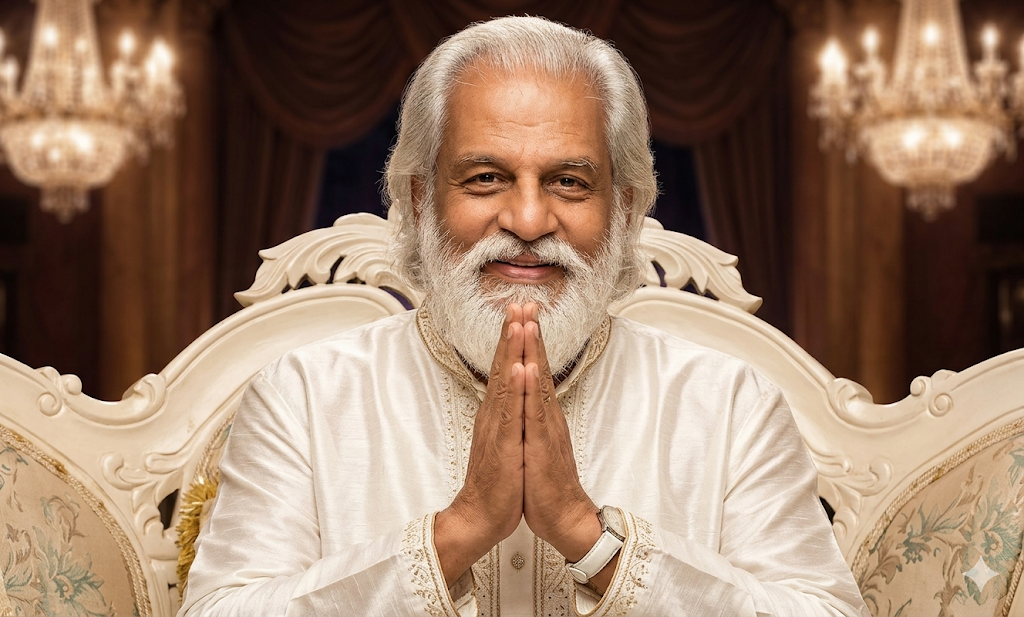
K. J. Yesudas
Born: 10 January 1940 (age 86)
Place: Fort Kochi, Kingdom of Cochin, British India
Known as: Ganagandharvan
Education: Swathi Thirunal College of Music, Thiruvananthapuram
Title: Singer, Composer, Music producer
Years active: 1961–present
Genres: Indian classical music, Playback singing
Instrument: Vocals
Sound Before Identity
There are voices that announce themselves, and there are voices that dissolve into the space they inhabit. K. J. Yesudas belongs to the latter. In a dimly lit concert hall, as the first note settles into the air, the boundaries between performer and listener begin to blur. The timbre is unmistakable, yet it resists spectacle. It carries weight without force, emotion without excess. Whether it is a film song drifting through a transistor radio or a kriti unfolding in measured phrases, the experience is less about hearing and more about inhabiting sound. It is an outstanding paradox, a voice trained in the rigor of Carnatic music, yet capable of entering the intimate, everyday spaces of millions without losing its structural integrity.
Discipline as Inheritance
Kattassery Joseph Yesudas was born in 1940 in Fort Kochi, Kerala, into a family where music was not merely a vocation but a discipline. His father, Augustine Joseph, was a respected classical musician and stage performer. From him, Yesudas inherited not just exposure to music, but a rigorous approach to it.
Training began early, and it was uncompromising. His father emphasized voice culture, sruti alignment, and the internalization of raga structures. This foundation was later formalized at institutions such as the Swathi Thirunal College of Music in Thiruvananthapuram, where he trained under distinguished gurus, including Chembai Vaidyanatha Bhagavatar’s lineage of pedagogy.
His early years were marked by both promise and hardship. Financial constraints and limited opportunities shaped a discipline that would later define his career. The idea of music as sadhana, sustained, disciplined practice, was not theoretical. It was lived.
Breakthrough and Rise in Playback Singing: Entering the Popular Imagination
Yesudas’s entry into playback singing in the early 1960s coincided with a transformative phase in South Indian cinema. His early recordings in Malayalam films did not immediately position him as a dominant voice, but they revealed something distinctive, a classical grounding that did not feel distant from cinematic needs.
The breakthrough came gradually, through collaborations with composers who recognized his ability to navigate complex melodic lines while maintaining emotional clarity.
By the 1970s, his voice had become central to Malayalam film music. From there, expansion into Tamil, Telugu, and Hindi cinema followed. Each industry presented its own linguistic and stylistic demands.
What is striking is how he adapted without dilution. His diction in multiple languages retained clarity, a critical factor in playback singing where lyrics carry narrative weight.
Songs such as “Gori Tera Gaon” in Hindi cinema or numerous Malayalam classics established him as a pan-Indian voice, not by abandoning regional identity, but by extending it.
The Voice: Technique and Musicality
To understand Yesudas is to understand the architecture of his voice.
- Timbre and Range
His timbre carries a natural warmth, neither overly bright nor heavily textured. This allows flexibility across genres. His range, particularly in the middle and upper registers, is controlled without strain.
- Gamakas and Ornamentation
His use of gamakas is precise, never excessive. In classical compositions, they adhere to raga grammar. In film songs, they are moderated, ensuring accessibility without loss of character.
- Bhava and Emotional Precision
Perhaps his most defining quality is bhava. Emotion in his singing is not imposed. It emerges from phrasing. A slight elongation of a note, a controlled glide between pitches, these create emotional resonance.
- Diction
Across languages, his pronunciation remains clear. This is not merely technical. It reflects respect for lyric and meaning.
Compared to contemporaries like S. P. Balasubrahmanyam, whose versatility leaned toward expressive fluidity, Yesudas maintained a more structured, classical orientation.
Classical Foundation and Devotional Music: The Spiritual Axis
Parallel to his film career, Yesudas sustained a deep engagement with Carnatic and devotional music.
His renditions of compositions by Tyagaraja, Muthuswami Dikshitar, and other composers reflect a fidelity to classical form. Yet, he also played a role in bringing these compositions to wider audiences.
Devotional albums, particularly in Malayalam, Tamil, and Sanskrit, became integral to his identity. These recordings often blurred the line between classical performance and popular listening.
The spiritual dimension of his music is not performative. It is embedded in his approach to singing, where discipline and devotion intersect.
In many ways, his devotional work reinforced his credibility as a classical musician, even as his playback career expanded.
Pan-Indian and Global Influence: A Voice Without Borders
Yesudas’s career extends beyond linguistic and national boundaries.
He has recorded in multiple Indian languages and performed extensively across the world, particularly for Indian diaspora communities. These performances are not merely concerts. They are cultural reconnections.
For listeners outside India, his music often becomes a bridge to cultural memory.
His ability to maintain consistency across such diverse contexts speaks to a disciplined vocal practice. Touring schedules, varying acoustics, and audience expectations require adaptability without compromising quality.
In this sense, he functions as a cultural ambassador, carrying not just songs but a tradition of singing.
Awards, Records, and Milestones: Recognition Across Decades
Yesudas’s career is marked by an extraordinary number of recognitions.
He has received multiple National Film Awards for Best Male Playback Singer, spanning different decades and languages. His honors include the Padma Shri, Padma Bhushan, and Padma Vibhushan, reflecting recognition at the highest national level.
The volume of his work is equally significant. With tens of thousands of recorded songs, his repertoire spans film music, classical compositions, devotional songs, and independent albums.
Yet, numbers alone do not define his career. What stands out is the consistency of quality across this volume.
Criticism, Evolution, and Longevity: Adapting Without Concession
No career of this scale is without critique.
Some critics have argued that his strong classical orientation occasionally limited his adaptability in changing musical landscapes, particularly during phases where film music shifted toward more experimental or Westernized styles.
However, such critiques overlook a key aspect of his longevity.
Yesudas did not attempt to fully align with every trend. Instead, he maintained a core identity while selectively adapting. This allowed him to remain relevant without dilution.
His later career includes collaborations that reflect this balance, engaging with contemporary composers while retaining his signature approach.
Longevity, in his case, is not the result of constant reinvention, but of sustained clarity.
Discipline and Distance
Yesudas’s public image is shaped by restraint.
He is known for a disciplined lifestyle, rooted in routine practice and a measured engagement with public life. Unlike many public figures, he maintains a certain distance, allowing the work to remain central.
His spirituality is often referenced, but it is expressed through practice rather than declaration.
This distance contributes to his aura. It keeps the focus on the voice rather than the persona.
The Endurance of Structure
K. J. Yesudas occupies a unique position in Indian music history.
He represents a bridge, between classical rigor and popular accessibility, between regional identity and national presence, between tradition and modernity.
For future generations of singers, his work offers a model of discipline. Not all will replicate his style, but many will engage with the standards he set.
His influence extends beyond specific songs. It shapes expectations, of diction, of musical integrity, of emotional precision.
What makes him timeless is not just the beauty of his voice, but the structure behind it. A system of training, practice, and understanding that sustains the sound.
It is an outstanding legacy, one that continues to resonate not because it adapts to every change, but because it remains anchored, allowing others to move around it while recognizing its permanence.
Awards and honours
1975 – Padma Shri
2002 – Padma Bhushan
2017 – Padma Vibhushan
National Film Award for Best Male Playback Singer a record 8 times by the Government of India
Kerala State Film Award for Best Singer a record 25 times,
2002 – J. C. Daniel Award
2010 – Swathi Sangeetha Puraskaram
Tamil Nadu State Film Awards 5 times for the best playback singer
1986 – Kalaimamani Puraskaram
2025 – M. S. Subbulakshmi Award
Andhra Pradesh State Film Awards 4 times for the best playback singer
Karnataka State Film Awards 2 times for the best playback singer
Karnataka Rajyotsava Award by the Government of Karnataka
West Bengal State Film Award for the best playback singer
Honorary doctorates from Annamalai University, Kerala University and MG University
Anandalok Best Male Playback Award 1 time for the best playback singer.
2002 – Sangeetha Kalasikhamani, by The Indian Fine arts Society, Chennai
2015 – Padmabhushan B. Sarojadevi National Award by Bharathiya Vidya Bhavan, Bangalore
Swaralaya Yesudas award