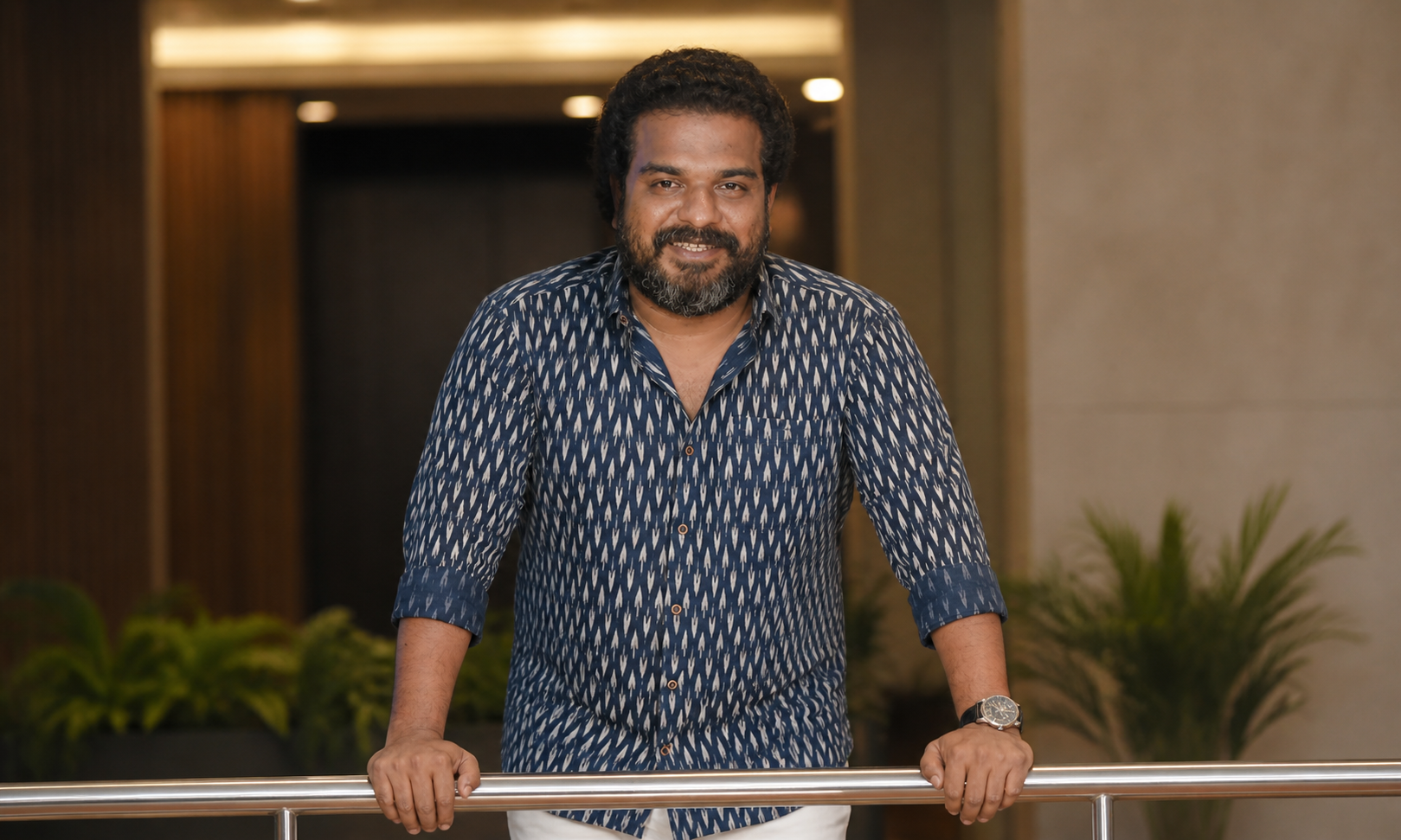
Dileesh Pothan
Dileesh Pothan stands at a rare intersection in Malayalam cinema, a filmmaker who reshaped narrative grammar while simultaneously emerging as one of the industry’s most quietly compelling actors. As a director, he is associated with a wave of storytelling that privileges realism, moral ambiguity, and everyday life. As an actor, he brings an unforced authenticity that mirrors the worlds he builds behind the camera. Over the past decade, Pothan has become an outstanding voice in contemporary Malayalam cinema, helping redefine how stories are told, and more importantly, whose stories are told.
Key Facts
Full Name: Dileesh Pothan
Date of Birth: February 19, 1981
Place of Birth: Kottayam district, Kerala, India
Title/Recognition: Filmmaker, actor, key figure in new-generation Malayalam cinema
Occupation: Film director, actor, producer
Known For: Maheshinte Prathikaaram, Thondimuthalum Driksakshiyum, Joji, collaborations with writer Syam Pushkaran, and nuanced character roles
A Frame from Mahesh’s Life
There is a moment in Maheshinte Prathikaaram when Fahadh Faasil’s character, Mahesh, stands in quiet humiliation after being beaten in public. It is not staged as spectacle. There is no dramatic score, no exaggerated reaction. Instead, the camera lingers, almost uncomfortably, on the aftermath, the silence, the bruised ego, the stillness of a small-town street that has witnessed something deeply personal.
That moment encapsulates what Dileesh Pothan brought into Malayalam cinema: a refusal to dramatize what is already human enough.
Roots in Kerala’s Cultural Soil
Born in Kottayam and raised in Kerala’s interior landscape, Pothan’s sensibility is deeply rooted in the textures of Malayali life. Unlike filmmakers who arrive with a cinematic vocabulary shaped by external influences, Pothan’s storytelling emerges from observation.
His upbringing in a state where literature, theatre, and cinema intersect has often been cited as a formative influence. Kerala’s cultural ecosystem, rich with political discourse and everyday narratives, seems to have shaped his instinct for grounded storytelling. His films rarely look outward; they look inward, at people, relationships, and the subtle hierarchies of society.
The Long Road into Cinema
Pothan did not arrive in the industry as a fully formed auteur. His early years were marked by gradual immersion. He worked as an assistant director under filmmakers like Aashiq Abu, gaining practical exposure to filmmaking processes.
This apprenticeship phase is critical to understanding his work. It allowed him to observe both the mechanics of filmmaking and the evolving tastes of Malayalam audiences. His transition into acting also began during this period, often in supporting roles that required restraint rather than flamboyance.
His directorial debut came relatively late, but when it arrived, it did not feel tentative.
A Debut That Reset Expectations
Maheshinte Prathikaaram (2016) was not just a successful debut; it was a tonal shift. Written by Syam Pushkaran, the film introduced a narrative style that was deceptively simple. It revolved around everyday events, a photographer, a minor altercation, a quiet revenge.
But beneath that simplicity lay a layered exploration of masculinity, pride, and social perception.
The film’s success was both critical and commercial. It resonated with audiences who saw themselves reflected on screen without exaggeration. Critics noted its understated humor and emotional precision, marking it as a departure from formula-driven storytelling.
The Signature: Realism Without Romanticism
Pothan’s subsequent films reinforced his directorial identity.
Thondimuthalum Driksakshiyum (2017) moved into more complex territory, exploring crime, morality, and institutional systems. The film’s treatment of law enforcement, particularly its portrayal of police procedures, was notable for its realism. Characters were not simplified into heroes or villains; they existed in morally ambiguous spaces.
Then came Joji (2021), loosely inspired by Shakespeare’s Macbeth. Set against a rural backdrop, the film examined ambition, familial dynamics, and psychological descent. Despite its literary inspiration, Joji remained firmly grounded in Kerala’s socio-cultural context.
Across these films, certain patterns emerge. Pothan avoids spectacle, prefers naturalistic performances, and relies on silence as much as dialogue. His collaboration with Syam Pushkaran is central to this approach, combining writing that is observational with direction that is restrained.
Actor and Director: Two Sides of the Same Lens
Parallel to his work as a director, Pothan has built a reputation as an actor. His performances in films like Kumbalangi Nights and Joji are marked by subtlety. He does not dominate scenes; he inhabits them.
What distinguishes him as an actor is the absence of performance in the conventional sense. There is no visible effort to “act.” Instead, his presence feels organic, almost incidental, which aligns with the realism he champions as a filmmaker.
Balancing these dual roles is not without challenges. Directing requires control, while acting often demands surrender. Yet, Pothan manages to navigate both, perhaps because his understanding of character is consistent across both disciplines.
Redefining the New Generation Wave
Malayalam cinema’s “new generation” movement is often associated with filmmakers who broke away from formulaic storytelling. While names like Lijo Jose Pellissery and Anjali Menon are frequently mentioned, Pothan’s contribution lies in refining this movement.
He did not just experiment with form; he normalized a different kind of storytelling.
His films demonstrated that audiences were willing to engage with slower narratives, morally complex characters, and unresolved endings. This had a ripple effect, encouraging other filmmakers to take similar risks.
Reception: Between Criticism and Acceptance
Pothan’s work has been widely discussed in both critical and popular spaces. Reviews often highlight his commitment to realism and his ability to extract nuanced performances from actors.
However, his films are not universally accessible. Their pacing and lack of conventional dramatic arcs can challenge audiences accustomed to mainstream cinema. This tension between critical acclaim and mass appeal is a recurring theme in discussions around his work.
Yet, the consistent success of his films suggests that Malayalam audiences are evolving alongside the filmmakers.
Malayali Identity on Screen
Perhaps the most defining aspect of Pothan’s cinema is its rootedness in Malayali identity. His films capture the rhythms of everyday life, the conversations, the silences, the social codes.
There is a specificity to his storytelling that resists generalization. His characters are not designed for universal relatability; they are deeply local. And it is precisely this specificity that makes them resonate more broadly.
In a cinematic landscape increasingly influenced by global trends, Pothan’s work serves as a reminder that authenticity can be a powerful narrative tool.
The Road Ahead
As Malayalam cinema continues to gain national and international attention, filmmakers like Dileesh Pothan occupy a crucial position. They are both creators and custodians, shaping the industry’s future while preserving its core identity.
His recent work, including collaborations as a producer, indicates an expanding role within the industry. By supporting new voices, he is contributing to a broader ecosystem rather than focusing solely on individual projects.
The question is not whether he will continue to make films, but how his storytelling will evolve in a changing cinematic landscape.
Reflection
Dileesh Pothan’s journey is not defined by rapid success or dramatic reinvention. Instead, it is marked by consistency, a steady commitment to a particular way of seeing the world. In an industry often driven by spectacle, he has chosen restraint. In narratives that demand resolution, he offers ambiguity. And in characters that could easily become archetypes, he finds nuance. That quiet, deliberate approach is what makes him not just relevant, but enduring, and in the truest sense, outstanding.