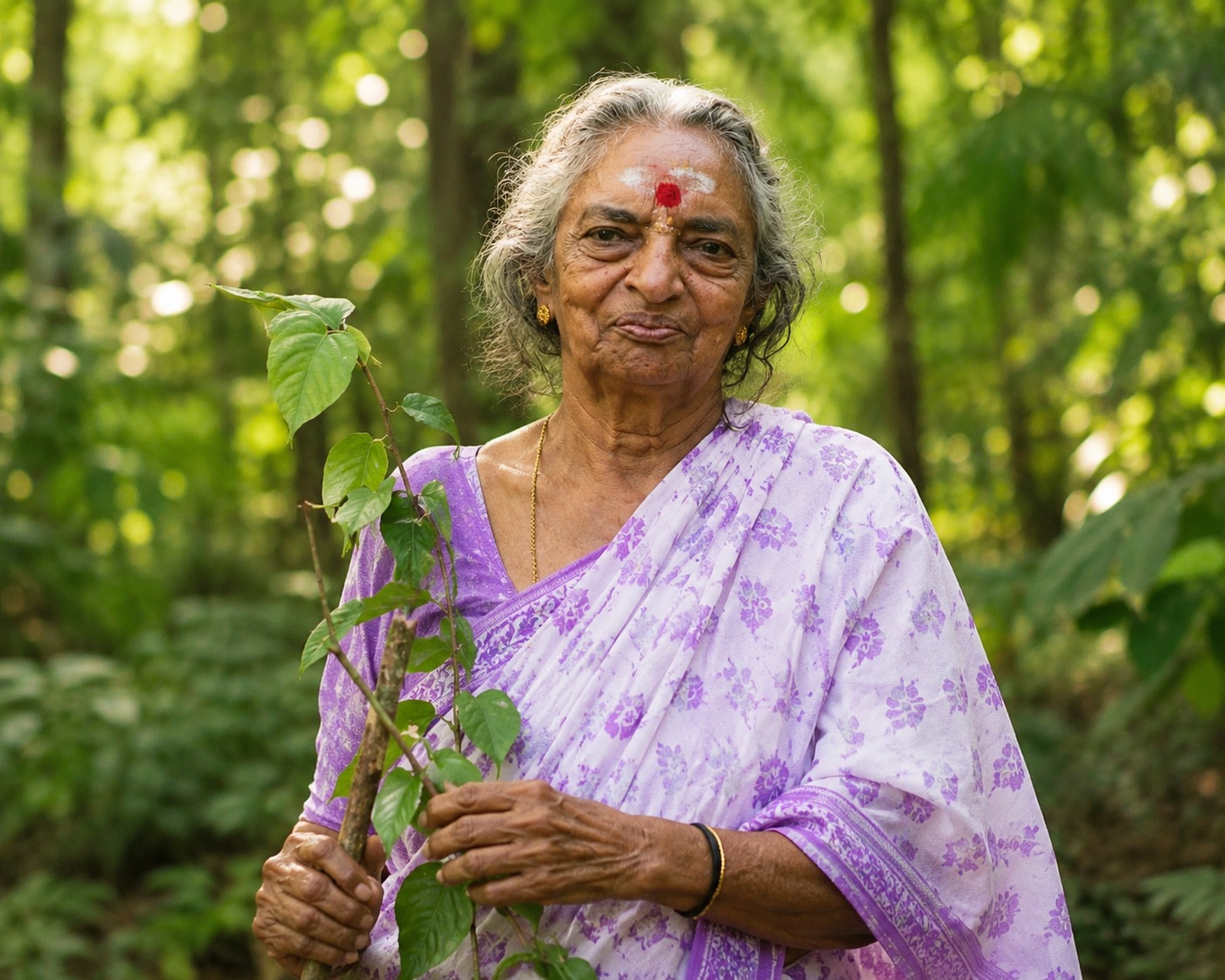
Kollakkayil Devaki Amma
Indian forester
Kollakkayil Devaki Amma is an Indian woman who began to grow a forest after a car crash prevented her from farming. The forest now covers 4.5 acres and has over 3,000 trees. Devaki Amma was born in Muthukulam in Alappuzha district, Kerala.
Key Factors
Full Name: Kollakkayil Devaki Amma
Born: c. 1934
Native Place: Muthukulam, Alappuzha, Kerala
Occupation: Environmental conservationist, farmer, forester
Known For: Creating a 4.5-acre forest after a life-changing accident
In an age when forests disappear faster than they grow, the story of Kollakkayil Devaki Amma feels almost improbable. Deep inside Kerala’s Alappuzha district, beyond busy roads and expanding settlements, an outstanding green world rises quietly from the earth, dense with birdsong, filtered light, and thousands of trees planted by the hands of one woman. There are no dramatic signboards announcing its importance. No carefully marketed eco-tourism spectacle. The forest simply exists, alive and breathing because Devaki Amma refused to surrender to despair after tragedy altered the course of her life.
What began as a deeply personal act of healing after a devastating accident slowly evolved into one of Kerala’s most remarkable examples of grassroots environmental restoration. Over more than three decades, Devaki Amma transformed barren land into a thriving 4.5-acre ecosystem containing over 3,000 trees and countless forms of life. In doing so, she became not only a protector of nature, but also a symbol of patience, ecological wisdom, and rural resilience.
Her journey is not the story of activism driven by slogans. It is the quieter story of persistence, soil, rainwater, shade, and time.
Grew a Forest
The first thing visitors notice inside Devaki Amma’s forest is the sudden change in temperature.
Outside, Kerala’s humidity presses heavily against the skin. Inside, the air softens beneath thick canopies of mahogany, tamarind, mango, pine, and countless other trees layered across the land like a living cathedral. Sunlight arrives in fragments through leaves. Birds move invisibly overhead. Fallen branches crack softly beneath footsteps.
The forest feels older than it is.
Amur falcons rest here during migration. Paradise flycatchers flash through the shadows. Emerald doves disappear into dense foliage. Bluethroats and black-winged stilts arrive like passing travelers carried by instinct across continents.
Nothing about the place resembles a planned plantation. It breathes with the irregular beauty of nature reclaiming space for itself.
And yet every inch of it carries human memory.
This entire ecosystem exists because one woman, physically broken after an accident, decided to plant a tree.
Then another.
Then thousands more.
Early Life and Roots in Kerala
Long before she became known nationally for environmental restoration, Devaki Amma belonged to Kerala’s deeply agricultural world.
She was born around 1934 in Muthukulam in Alappuzha district, a region shaped by paddy fields, waterways, monsoon rhythms, and intimate relationships with land. Rural Kerala during her childhood was defined less by mechanisation and more by inherited ecological knowledge. Farming was not merely occupation, it was identity.
Her love for plants reportedly began with her grandfather, whose influence introduced her to horticulture at an early age. That connection to soil and cultivation stayed with her throughout life.
After marrying Gopalakrishna Pillai, a teacher, she continued participating in agricultural work, especially paddy cultivation. The landscape around her was one where labour and nature existed in constant negotiation. People depended directly on rainfall, fertile earth, livestock, and seasonal cycles.
Nothing in those years suggested that Devaki Amma would one day become nationally recognized for conservation.
Her relationship with nature was still personal, practical, and rooted in everyday rural life.
Then came the accident that changed everything.
The Accident That Changed Everything
In 1980, Devaki Amma was involved in a serious car accident that left her bedridden for nearly three years.
For someone whose life revolved around movement, farming, and physical labour, the transformation was devastating. Recovery was slow and painful. Even after surviving the accident, she could no longer return to paddy farming in the same way.
The emotional impact of such a rupture is difficult to measure.
In rural agricultural communities, physical ability is deeply tied to dignity and self-worth. Losing the capacity to work the land often creates not only financial strain but psychological disorientation.
But somewhere during recovery, another possibility emerged.
Unable to return fully to the demanding labour of paddy cultivation, Devaki Amma turned toward tree planting in the land surrounding her home. At first, the act may have appeared modest, almost therapeutic. A way to remain connected to nature despite physical limitations.
Yet what began quietly soon evolved into life’s defining mission.
The accident took away one form of labour. In its place, it gave birth to another.
Building a Forest by Hand
Environmental restoration is often discussed through government policies, global climate summits, or billion-dollar initiatives.
Devaki Amma’s forest grew differently.
It grew tree by tree. Season by season. Year after year.
Working largely alone for more than three decades, she slowly transformed the landscape around her into a dense ecological sanctuary. There were no sophisticated irrigation systems or corporate sustainability campaigns behind the effort. Her methods remained rooted in rural practicality and patience.
She harvested rainwater. She used cows, buffaloes, and oxen in the work. She relied on organic rhythms rather than industrial shortcuts. The labour was physical, repetitive, and deeply demanding, especially for someone recovering from long-term injury.
Over time, the project expanded into a 4.5-acre forest containing more than 3,000 trees.
The scale becomes even more astonishing when one considers the years involved. Forests are built through patience that stretches beyond ordinary human timelines. A sapling planted today may not fully mature for decades.
Devaki Amma committed herself to that slow future.
Perhaps the most remarkable aspect of her work is that it emerged not from professional environmental training but from instinctive ecological understanding. She understood shade, soil retention, biodiversity, and water preservation through lived experience long before such language became fashionable in environmental discourse.
Her forest became both refuge and resistance, a rejection of ecological destruction through sustained personal care.
The Living Ecosystem She Created
Today, Devaki Amma’s forest functions as far more than a collection of trees.
It is an ecosystem.
Rare plants coexist with towering species like mahogany, pine, star trees, tamarind, mango, and krishnanal. Layers of vegetation create microhabitats for insects, birds, and small wildlife. Migratory species stop here during long journeys across continents.
Birdwatchers and environmental observers have noted the presence of Amur falcons, paradise flycatchers, emerald doves, bluethroats, and black-winged stilts within the forest.
That biodiversity carries profound ecological meaning.
Kerala, despite its rich environmental legacy, faces increasing pressure from urbanisation, land fragmentation, deforestation, and climate instability. Wetlands disappear. Traditional agricultural spaces shrink. Heat intensifies across expanding urban corridors.
In such a context, small privately nurtured ecosystems become environmentally significant far beyond their size.
Devaki Amma’s forest demonstrates how grassroots conservation can restore biodiversity even without institutional infrastructure. Her work also challenges modern assumptions that ecological restoration requires massive technological intervention.
Sometimes restoration begins with continuity, patience, and care sustained across decades.
Recognition and Awards
For many years, Devaki Amma’s work remained largely local knowledge, admired quietly by nearby communities and environmental observers.
Eventually, broader recognition followed.
She received the Social Forestry Award from Alappuzha district and the Bhumitra Puruskar from Vijnana Bharati. Kerala honoured her with the Hari Vyakti Puruskar in recognition of her environmental contribution.
National recognition arrived through the prestigious Indira Priyadarshini Vrikshamitra Award, one of India’s important honours for afforestation and environmental protection.
Later, she received the Nari Shakti Puraskar from President Ram Nath Kovind, acknowledging her extraordinary contribution as a woman environmentalist working at the grassroots level.
In 2026, her decades-long ecological labour received one of India’s highest civilian recognitions with the Padma Shri.
The award carried symbolic power.
At a time when environmental conversations are increasingly dominated by institutions, technology, and policy frameworks, the recognition of Devaki Amma affirmed something essential: ecological transformation can also emerge from ordinary citizens working quietly with extraordinary commitment.
Legacy and Meaning
Kollakkayil Devaki Amma’s story resists easy categorisation.
She is not merely a conservationist. Not merely a farmer. Not merely an award recipient.
She represents a deeper idea about humanity’s relationship with land.
In her forest, environmentalism does not appear ideological or performative. It appears intimate. Rooted in labour, grief, patience, and healing. The trees she planted were never simply environmental assets. They became companions in recovery, acts of renewal after physical suffering altered her life forever.
Her work also carries profound significance for women in conservation. Across rural India, countless women preserve seeds, water systems, forests, and agricultural knowledge without visibility or institutional recognition. Devaki Amma’s journey illuminates that often invisible ecological labour.
But perhaps the most moving aspect of her legacy is its silence.
The forest does not announce itself loudly. It grows quietly, season after season, sheltering birds and cooling air long after the woman who planted its first saplings became old.
And somewhere beneath those trees, among filtered light and drifting leaves, survives the extraordinary truth that one determined human being, armed only with patience and care, can still alter the fate of land itself.
Awards
Social Forestry Award by the Alappuzha district
Bhumitra Puruskar by Vijnana Bharati
Hari Vyakti Puruskar by the state of Kerala
Indira Priyadarshini Vrikshamitra award
Nari Shakti Puraskar
Padma Shri (2026)
Sixth Mar Thoma Award (2026)