
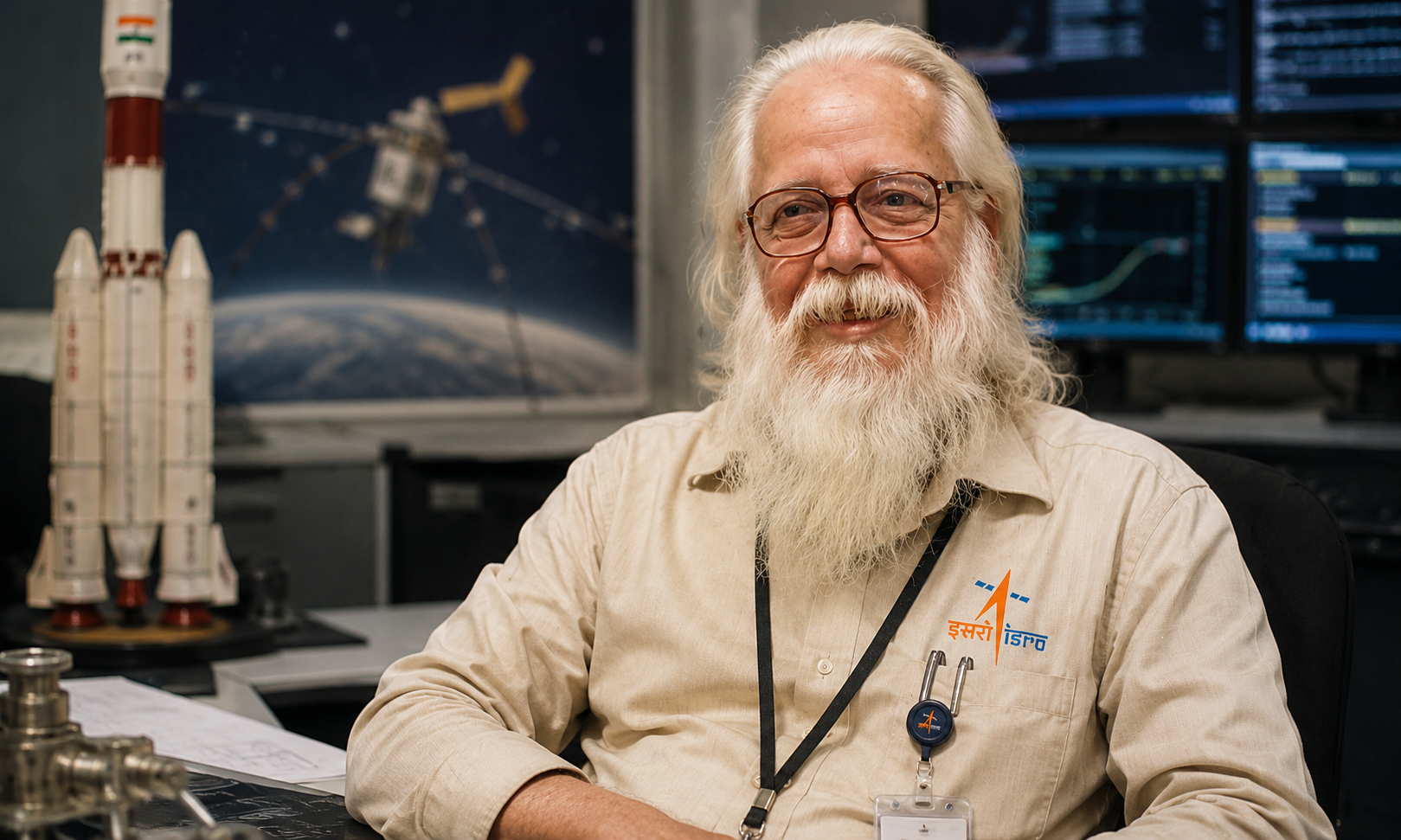
Nambi Narayanan
Indian scientist
Nambi Narayanan is an Indian aerospace scientist who worked for the Indian Space Research Organisation (ISRO). As a senior official at the ISRO, he was briefly in charge of the cryogenics division. Nambi Narayanan was born in Nagercoil, in the erstwhile Princely state of Travancore (present-day Kanyakumari District). He completed his schooling at Higher Secondary School, Nagercoil. He received a Bachelor of Technology in Mechanical Engineering from Thiagarajar College of Engineering, Madurai.
Key Factors
Full Name: Nambi Narayanan
Born: 12 December 1941
Place: Nagercoil, erstwhile Travancore Kingdom, British India
Occupation: Aerospace Engineer and Scientist
Organization: Indian Space Research Organisation (ISRO)
Known For: Contribution to liquid propulsion and cryogenic rocket technology, and the ISRO espionage case
Education: Thiagarajar College of Engineering, Princeton University
In the story of India’s space programme, there are names associated with triumph, vision, and national pride. Yet few lives capture the emotional cost of scientific ambition as powerfully as Nambi Narayanan. Once regarded as one of the brightest minds inside the Indian Space Research Organisation, he helped lay the foundations for India’s liquid propulsion and cryogenic rocket technology at a time when the country was struggling to build an independent space capability. But in 1994, at the height of his career, Narayanan was arrested in what became one of India’s most controversial espionage cases. Accused of selling state secrets, publicly humiliated, and subjected to years of suspicion before being exonerated, he became both a victim of institutional failure and a symbol of resilience. Decades later, India would honour him with the Padma Bhushan and revisit his story through cinema, finally recognising the outstanding scientist whose dignity survived one of independent India’s darkest miscarriages of justice.
A Scientist Before the Storm
Long before courtrooms, television debates, and political controversy entered his life, Nambi Narayanan belonged to a generation of Indian scientists driven by a near-utopian belief in national development through science.
Born in 1941 in Nagercoil, then part of the princely region associated with Travancore, Narayanan grew up during the final years of colonial India and the turbulent birth of the republic. His formative years unfolded in a country that was poor, newly independent, and desperate to build technological self-reliance.
That atmosphere shaped an entire generation of scientists.
After studying engineering at Thiagarajar College of Engineering in Madurai, Narayanan entered a scientific ecosystem still in its infancy. India’s space ambitions were then being shaped by visionary figures such as Vikram Sarabhai, who believed space technology was not a luxury for developing nations but a necessity.
Narayanan would later travel to the United States to study at Princeton University, where he specialised in chemical rocket propulsion. It was an extraordinary achievement for a young Indian engineer during that period.
More importantly, he returned.
That decision would define his life.
At a time when many highly trained Indian engineers chose careers abroad, Narayanan returned to India and joined ISRO, carrying expertise the country desperately needed. India’s space programme in the 1960s and 1970s was operating under severe technological limitations. Resources were scarce. International cooperation was uneven. Much of the infrastructure had to be built from scratch.
Narayanan entered this world not as a celebrity scientist, but as a builder.
Building India’s Rocket Future
If satellites became the visible symbols of India’s space ambitions, propulsion technology was the invisible engine beneath that dream.
Narayanan’s most significant contributions came in the field of liquid propulsion systems, a technological leap beyond the earlier solid-fuel systems that dominated India’s initial rocket efforts. Liquid propulsion offered greater efficiency, flexibility, and control, essential for increasingly ambitious launch missions.
Working closely with pioneering figures like A. E. Muthunayagam, Narayanan became central to India’s efforts to modernise rocket propulsion.
His work at ISRO’s Liquid Propulsion Systems Centre proved critical during a period when India faced global technological restrictions. Western nations were reluctant to share advanced aerospace technology with developing countries, especially technologies with strategic implications.
Cryogenic technology became the most sensitive frontier.
Cryogenic rocket engines use super-cooled liquid hydrogen and oxygen, enabling heavy payload launches into space. Mastering cryogenic propulsion meant strategic independence in satellite launching capability. For India, this was not merely scientific advancement; it was geopolitical autonomy.
Narayanan strongly advocated indigenous development while also working on international cooperation efforts, including interactions involving Russian cryogenic technology agreements during the post-Cold War era.
Inside ISRO, he developed a reputation for technical brilliance, confidence, and aggressive pursuit of technological advancement. Colleagues frequently described him as intellectually sharp and uncompromising.
But in 1994, everything collapsed.
The 1994 ISRO Espionage Case
The scandal began with arrests in Kerala involving Maldivian nationals. Soon, the investigation spiralled into allegations that classified ISRO documents had been leaked to foreign agents.
Nambi Narayanan was arrested by the Kerala Police.
The accusations were explosive.
He was accused of espionage, of selling strategic space secrets, of compromising India’s national security. The media frenzy that followed transformed him overnight from respected scientist to alleged traitor.
Television channels and newspapers amplified the allegations relentlessly. Public humiliation arrived before evidence did.
Narayanan later described the period as psychologically devastating. He alleged custodial torture and intense interrogation. His family also became collateral damage. Friends disappeared. Neighbours withdrew. Professional relationships collapsed.
In later interviews, he recalled how deeply humiliating it felt for his children and wife to witness the public spectacle surrounding his arrest.
The case struck at a particularly sensitive moment for India.
The country’s space programme symbolised national pride. Allegations of espionage inside ISRO created public panic and political controversy. The scandal quickly moved beyond criminal investigation into a theatre of media sensationalism, institutional conflict, and political speculation.
Yet even as the accusations intensified publicly, cracks in the investigation began emerging internally.
The evidence was weak.
Contradictions multiplied.
Eventually, the Central Bureau of Investigation took over the case and reached a dramatically different conclusion: the espionage allegations were baseless.
The CBI found no credible evidence supporting the accusations against Narayanan or the other scientists.
But by then, the damage had already been done.
Collapse of a Career, Rise of a Survivor
Although legally cleared, Narayanan’s professional life never fully recovered.
The years following the case became a long battle for justice, recognition, and dignity. He repeatedly argued that the false espionage allegations had not only destroyed careers but had also damaged India’s space programme itself by disrupting critical technological work.
His fight gradually evolved into a larger question about institutional accountability.
How could a scientist working on nationally significant projects be publicly destroyed without credible evidence?
The issue resurfaced repeatedly through court proceedings and public debate. In 2018, the Supreme Court of India strongly criticised the manner in which the case had been handled and awarded compensation to Narayanan for the “immense humiliation” he had suffered.
The judgment marked more than legal vindication.
It was moral recognition.
Narayanan remained outspoken about what he considered institutional silence from sections of the scientific establishment during his ordeal. He repeatedly questioned why stronger support had not emerged when the allegations first surfaced.
Yet even after decades of litigation and emotional exhaustion, he retained remarkable composure in public appearances.
There was anger in his words at times, but also restraint.
That restraint shaped public sympathy toward him.
Recognition, Redemption, and National Memory
By the late 2010s, public perception of Nambi Narayanan had shifted dramatically.
He was no longer widely viewed through the lens of suspicion, but through the lens of injustice.
In 2019, the Government of India awarded him the Padma Bhushan, formally acknowledging his contributions to science and engineering.
But perhaps the most culturally significant moment arrived through cinema.
R. Madhavan directed and starred in Rocketry: The Nambi Effect, a film based on Narayanan’s life. The film reintroduced his story to a younger generation and transformed the espionage case into a subject of national conversation again.
The film portrayed both his scientific contributions and the devastating human cost of the false allegations.
Its emotional impact was significant because the story itself already carried cinematic intensity: a brilliant scientist, national ambition, betrayal, humiliation, and eventual redemption.
Yet beyond cinema, the film also prompted broader reflection on how India treats its scientists, institutions, and truth itself.
Former ISRO chairman K. Kasturirangan and others from the scientific community publicly acknowledged Narayanan’s technical contributions more visibly during this later phase of his life.
The nation, slowly and imperfectly, was correcting its memory.
Nambi Narayanan as an Outstanding Malayali
Kerala has long produced scientists, thinkers, educators, and public intellectuals who shaped modern India. Nambi Narayanan belongs firmly within that tradition.
His story reflects several qualities deeply associated with Kerala’s intellectual culture: educational ambition, scientific curiosity, argumentative courage, and resilience in the face of institutional power.
But his life also reflects something more painful.
The ISRO espionage case became a reminder that highly educated democratic societies are not immune to media hysteria, political pressure, or institutional failure.
Narayanan’s dignity during this long ordeal became central to how many Malayalis viewed him. He did not disappear into silence. He continued to speak, write, question, and demand accountability.
That persistence mattered.
In Kerala’s public discourse, he gradually came to represent not merely scientific excellence, but moral endurance.
Reflection
Today, when India celebrates successful space missions and speaks confidently about technological self-reliance, the story of Nambi Narayanan stands quietly in the background, complicated, painful, and essential.
He helped build the scientific foundations of India’s rocket programme during a difficult era of limited resources and global restrictions. Yet the same nation that benefited from his expertise also allowed him to endure humiliation, suspicion, and institutional abandonment for years before acknowledging the injustice done to him.
That contradiction defines his legacy as much as his scientific achievements.
But history, over time, has a way of separating noise from truth.
Nambi Narayanan is now remembered not as the accused figure from newspaper headlines in 1994, but as a scientist who contributed significantly to India’s space ambitions and survived one of the gravest miscarriages of justice in modern Indian public life.
And in that survival, marked by intellect, endurance, and extraordinary dignity, he remains one of Kerala’s truly outstanding sons, a man whose life continues to force India to ask difficult questions about science, power, justice, and memory.