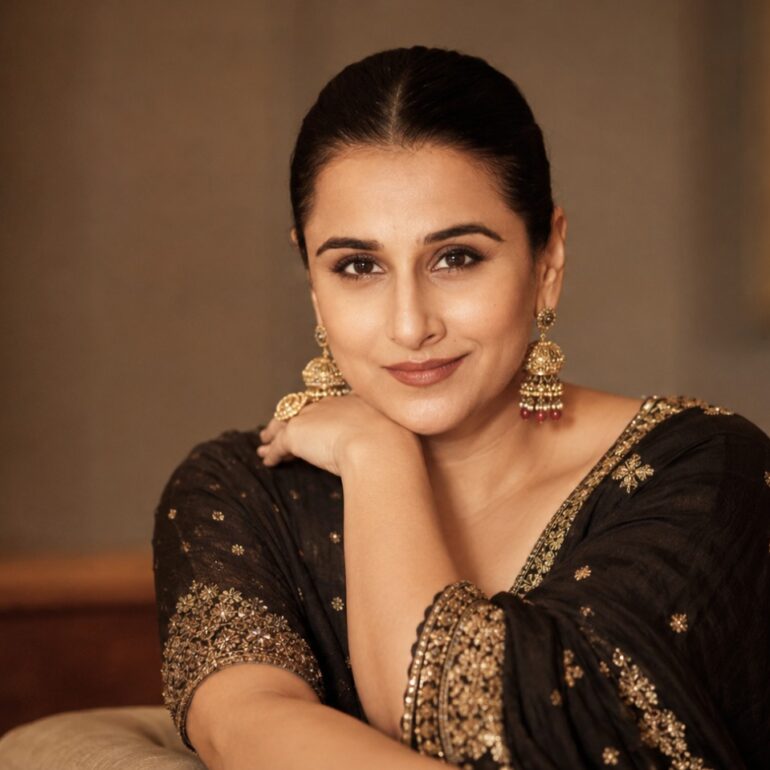
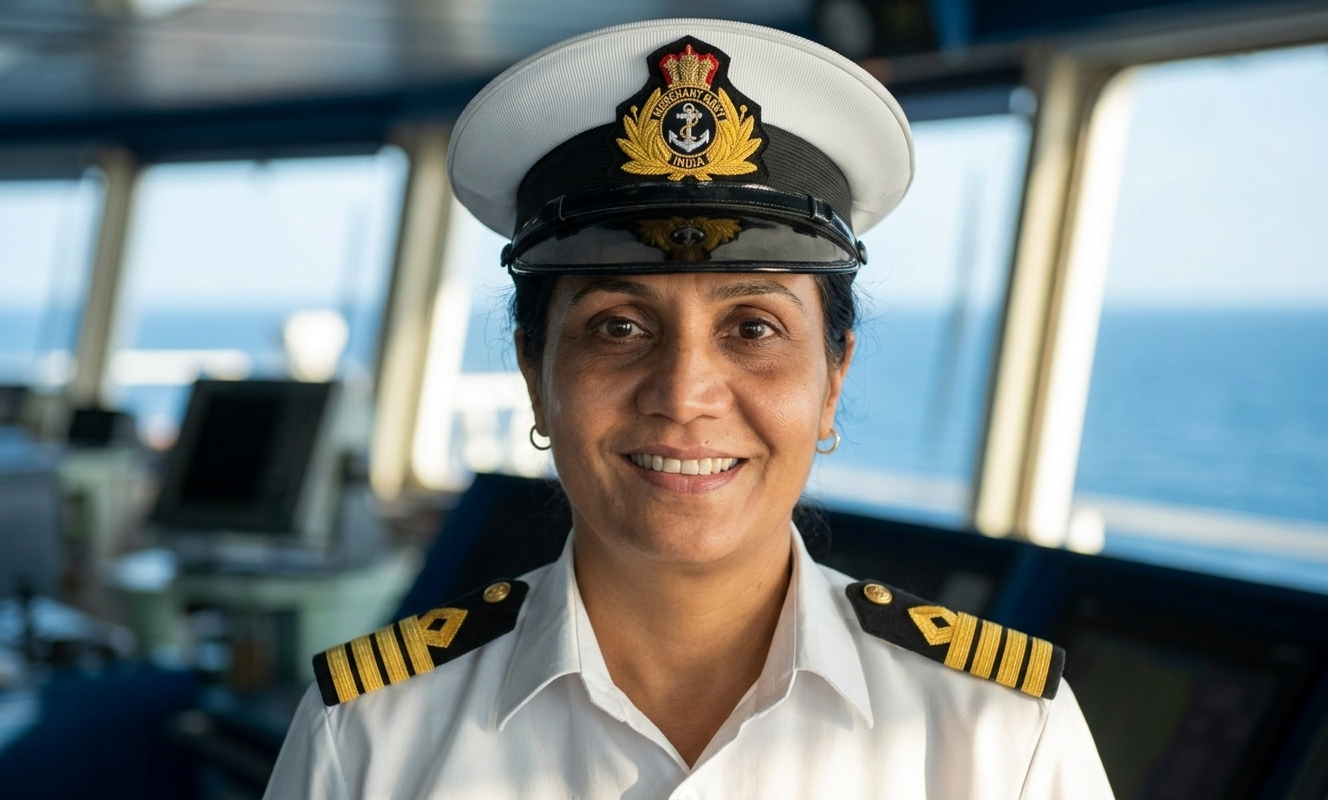
Captain Radhika Menon
Captain Radhika Menon is a pioneering Indian sea captain known for her leadership and courage in maritime rescue operations. She made history as the first woman recipient of the IMO Award for Exceptional Bravery at Sea, inspiring many in a field long dominated by men.
Place: Kodungallur, Kerala
Education: All India Marine College, Kochi
Title: Naval officer
Known for: First female captain of the Indian Merchant Navy
A Storm, a Signal, a Decision
The Bay of Bengal does not negotiate. When the storm rises, it does so with a kind of indifference that strips away hesitation. In June 2015, aboard the oil tanker Sampurna Swarajya, Radhika Menon was navigating precisely such waters, wind speeds surging, visibility collapsing, waves climbing into walls of force. Then came the distress signal. A small fishing vessel, engine dead, adrift in the storm, seven men clinging to survival. The protocol could have been caution. The safer decision could have been distance. Instead, she chose engagement. What followed was not spectacle but precision, risk calculated in real time. It was an outstanding moment of seamanship, not because it defied danger, but because it understood it completely and acted anyway.
A Life from the Coast
Radhika Menon’s story begins in Kodungallur, a historic coastal town in Kerala where the Arabian Sea is less an abstraction and more a daily presence. The rhythms of tide and trade, fishing boats and port histories, are woven into the region’s cultural memory.
Growing up in such a landscape does not automatically produce a mariner. But it does normalize the sea as something lived with, not merely observed. For Menon, this proximity translated into curiosity, and eventually, commitment.
Her formal entry into maritime life came through training at the All India Marine College in Kochi. At the time, maritime education in India was still overwhelmingly male-dominated. Women were rare not just at sea, but even in classrooms preparing for it.
Choosing this path was not framed as rebellion. It was, instead, a decision rooted in interest and persistence. Yet, in hindsight, it marked the beginning of a career that would steadily push against structural boundaries within one of the world’s most gender-segregated industries.
Entering a Man’s World
Menon began her career as a radio officer with the Shipping Corporation of India. This role placed her within the communication backbone of a vessel, responsible for maintaining contact, monitoring signals, and ensuring operational coordination.
The technical demands were rigorous. The social environment was, in many ways, more challenging.
The Merchant Navy has long been characterized by extended periods at sea, hierarchical command structures, and an entrenched masculine culture. For women entering this space, the challenges were not always overt, but they were persistent.
Isolation was one of them. Being the only woman on board, often for months at a stretch, required a recalibration of everyday interactions. There were expectations to prove competence repeatedly, to demonstrate that presence was not symbolic but functional.
Menon’s response was not confrontation but consistency.
She built credibility through performance, mastering technical requirements, understanding ship systems, and integrating into the operational rhythm of maritime life. Over time, skepticism gave way to professional recognition, not because the system changed, but because she navigated it effectively.
Climbing the Ranks
Progression in the Merchant Navy is not linear. It is cumulative.
Each rank, from second mate to chief mate, requires not just examinations but sea-time, documented experience under varied conditions. These are years measured not in promotions alone, but in voyages, watchkeeping hours, and operational responsibilities.
Menon advanced through this system steadily. She earned her certifications through rigorous testing, combining theoretical knowledge with practical seamanship. The process demands familiarity with navigation, cargo management, maritime law, meteorology, and crisis response.
In 2012, she achieved a milestone that had eluded Indian maritime history until then, becoming the country’s first female Merchant Navy captain.
This designation is not ceremonial. A captain, or master, holds ultimate authority and responsibility on board. The role encompasses navigation, crew management, cargo safety, and compliance with international maritime regulations.
For Menon, this was not just personal achievement. It marked a structural breach in a system where command positions had been exclusively male.
Command at Sea: Leadership Under Pressure
Command at sea is a form of leadership defined by isolation and consequence.
Unlike land-based management roles, decisions on a vessel cannot be deferred. Weather systems evolve rapidly. Mechanical failures escalate without warning. Communication with shore authorities can be delayed or limited.
A captain must operate within this uncertainty. Menon’s leadership style has been described as measured and disciplined. It emphasizes procedural adherence but allows for flexibility when conditions demand it.
Crew dynamics are central to this. A vessel is both a workplace and a living environment. Maintaining morale, ensuring discipline, and fostering trust are as critical as technical competence. For a woman captain, these dynamics can carry additional layers of scrutiny.
Yet, authority at sea is ultimately functional. It is earned through decisions that keep the ship and its crew safe. Over time, Menon’s command established itself through this principle, quiet, consistent, and effective.
The Rescue That Defined Her
The 2015 rescue in the Bay of Bengal is the event that brought Menon international recognition, but its significance lies in its execution.
The fishing vessel was in distress, engine failure, no propulsion, caught in a storm system with rapidly deteriorating conditions. The waves were high, the wind unpredictable, and visibility poor.
Approaching such a vessel carries inherent risk. A large tanker, like Sampurna Swarajya, has limited maneuverability in rough seas. Misjudgment can lead to collision, endangering both vessels.
Menon made the decision to proceed. The operation required precise navigation, positioning the tanker close enough to deploy rescue lines without compromising stability. Crew members worked under extreme conditions, throwing ropes, coordinating movements, and maintaining balance against the force of the sea.
All seven fishermen were rescued. No lives were lost. The vessel continued its journey.
In 2016, this act was recognized by the International Maritime Organization with the Award for Exceptional Bravery at Sea, making Menon the first woman globally to receive this honor.
Breaking Global Barriers
The significance of Menon’s recognition extends beyond the individual.
The maritime industry remains one of the least gender-diverse sectors globally. According to various estimates, women constitute less than 2 percent of the global seafaring workforce.
Within this context, Menon’s achievement disrupts entrenched narratives.
It challenges assumptions about who can command, who can lead under pressure, and who belongs in high-risk operational roles. It also places India within a broader conversation about gender inclusion in maritime professions.
However, symbolic breakthroughs do not automatically translate into systemic change. They create visibility. Whether that visibility leads to structural shifts depends on institutional response, policy frameworks, and sustained advocacy.
Beyond the Bridge: Advocacy and Impact
In recent years, Menon has extended her role beyond active command into advocacy.
She co-founded the International Women Seafarers Foundation (IWSF), an initiative aimed at supporting and encouraging women to pursue maritime careers. The foundation focuses on mentorship, training, and awareness, addressing both entry barriers and retention challenges.
This work is critical. The issue is not just recruitment, but sustainability. Women entering the industry often face conditions that make long-term careers difficult, lack of infrastructure, limited representation, and persistent biases.
Menon’s advocacy attempts to address these gaps, not through abstract policy debates alone, but through practical engagement with aspiring seafarers.
Public Recognition and the Weight of Symbolism
Menon’s contributions have been recognized with awards such as the Nari Shakti Puraskar, among India’s highest honors for women achievers.
Yet, recognition carries its own complexity. Public narratives often frame such figures as symbols, of empowerment, resilience, or national pride. While these narratives have value, they can also flatten the realities of professional life.
Menon’s career is not defined solely by milestones. It is built on years of routine, discipline, and incremental progress. The challenge lies in ensuring that recognition does not overshadow the structural work still required to make such careers accessible to others.
The Larger Question: Women at Sea
The presence of women in maritime professions raises broader questions about institutional design.
Ships are not inherently exclusionary. But the systems around them, training pipelines, workplace cultures, and logistical frameworks, have historically been.
Addressing gender imbalance requires more than individual success stories. It demands Policy interventions, Infrastructure adaptation and Cultural shifts within organizations.
Menon’s journey highlights both possibility and limitation. It demonstrates that barriers can be crossed, but also that they remain in place.
A Different Kind of Horizon
Captain Radhika Menon’s story is often told as a series of firsts, first woman captain, first woman recipient of a global maritime bravery award. These distinctions matter, but they are not the whole story.
What defines her career is not exception, but continuity.
Years at sea, decisions made in isolation, responsibilities carried without spectacle. The rescue in the Bay of Bengal is a moment of visibility within a larger pattern of professional competence.
Her legacy lies not just in breaking barriers, but in normalizing presence, in demonstrating that command at sea is not inherently gendered, but learned, practiced, and earned.
It is an outstanding shift, quiet but consequential, in how the horizon itself is imagined, not as a boundary, but as a space open to those willing to navigate it.
Achievements
2012 – Appointed as the captain of SCI ship in Indian Merchant Navy and became the first ever female captain of the Indian Merchant Navy
2012 – Took charge as the captain of the oil tanker Suvarna Swarajya, measuring 21,827 gross tons
2016 – International Maritime Organization Award (First woman to receive the IMO Bravery award)
2017 – Co-founded the International Women Seafarer’s Foundation (IWSF)
2019 – Honored by the Indian government as she featured in Bharat Ki Laxmi hashtag campaign which was introduced by the Indian Prime Minister Narendra Modi to celebrate the achievements of the Indian women as a part of the Mann Ki Baat series.