Vidya Balan
Indian actress
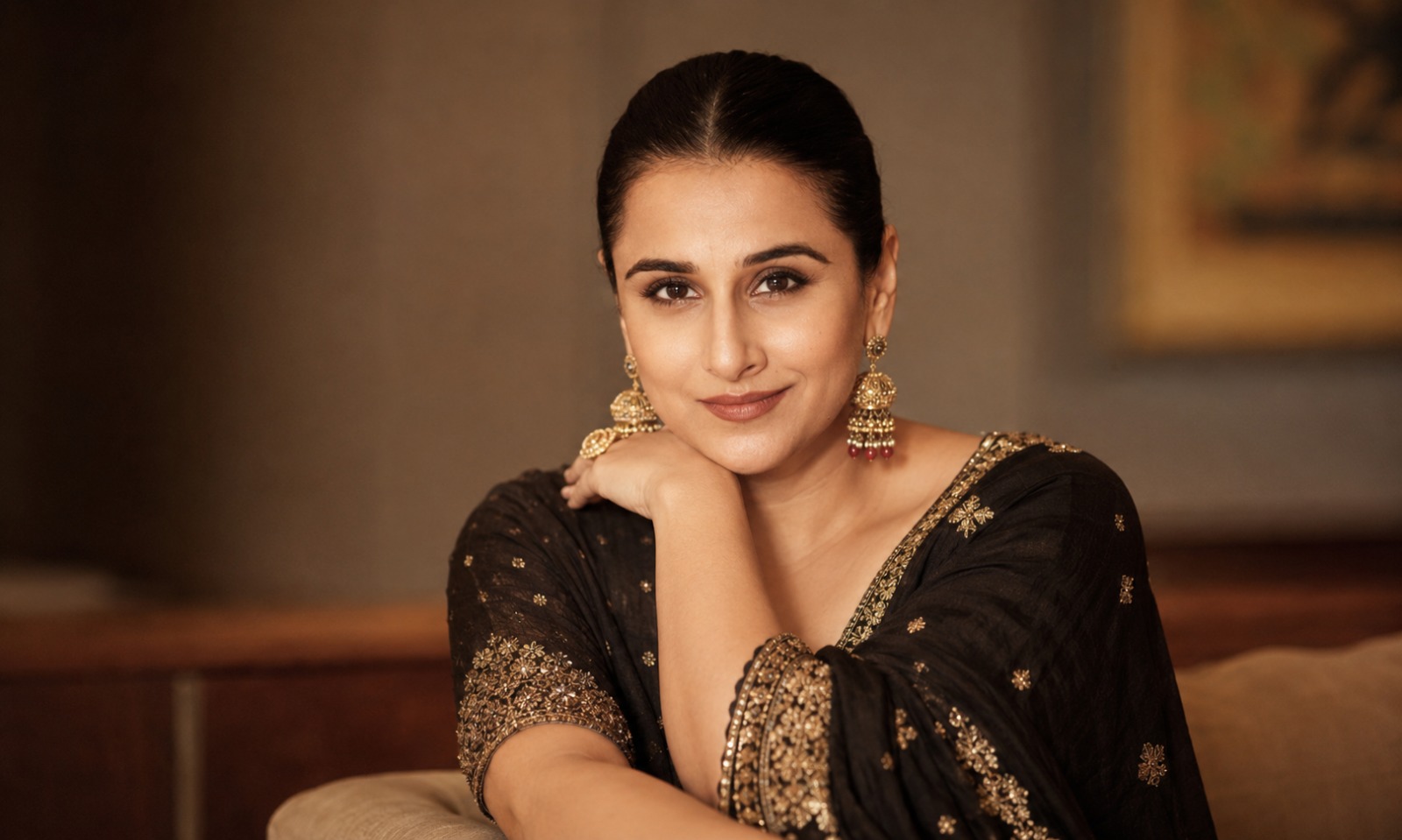
Vidya Balan (born 1 January 1979) is an Indian actress. Vidya was born in Mumbai into a Tamil Brahmin (Palakkad Iyer) family. Her father, P. R. Balan, worked as the executive vice-president of Digicable, and her mother, Saraswathy, is a homemaker. According to Vidya, they speak a mix of Tamil and Malayalam at her home in Palakkad, Kerala. Her elder sister, Priya Balan, works in advertising. Actress Priyamani is her second cousin. Vidya grew up in the suburban neighbourhood of Chembur and studied at St. Anthony Girls’ High School.
Key Factors
Full Name: Vidya P. Balan
Born: 1 January 1979
Occupation: Actress
Years Active: 1995–present
Major Awards: National Film Award, seven Filmfare Awards, Padma Shri
For decades, Hindi cinema revolved around heroes. Women danced around them, loved them, suffered for them, and disappeared when their narrative purpose ended. Then came Vidya Balan, an actress who quietly but radically shifted the centre of gravity.
Her rise was anything but smooth. Before she became one of the defining performers of contemporary Indian cinema, Vidya endured rejection after rejection. Malayalam and Tamil film industries branded her “unlucky”. Bollywood mocked her appearance, wardrobe, and refusal to conform to the emerging size-zero culture of the 2000s. Yet she survived because she possessed something more durable than glamour, conviction.
Vidya Balan transformed Hindi cinema not through rebellion alone, but through performance. Her women were emotionally layered, sexually autonomous, intellectually alive, and central to their own stories. She turned female-led cinema into commercial cinema at a time when the industry still doubted whether audiences would pay to watch a woman carry a film alone.
Rooted in Malayali cultural values yet entirely modern in spirit, Vidya emerged as one of India’s most respected actresses, not merely a star, but a cultural force who changed the way Bollywood imagined women.
Early Life and Malayali Identity
Vidya Balan was born into a Tamil Brahmin Palakkad Iyer family with deep roots connected to Kerala. Though she grew up in Mumbai’s suburban Chembur neighbourhood, Kerala remained emotionally present inside her home, through language, food, music, rituals, and cultural memory. She once remarked that Tamil and Malayalam flowed interchangeably in family conversations, creating a layered South Indian identity that stayed with her throughout her life.
Her upbringing was academically grounded and culturally rich. Her father worked in the corporate sector while her mother managed the household with quiet discipline. Vidya grew up in an environment where education mattered deeply, and she eventually pursued sociology at University of Mumbai after studying at St. Xavier’s College.
Cinema fascinated her early.
She admired actresses like Shabana Azmi and Madhuri Dixit, performers who balanced artistry with emotional accessibility. Even before fame, Vidya carried herself differently from many aspiring actresses around her. She was introspective, articulate, and visibly intellectual, qualities that would later distinguish her in Bollywood’s celebrity culture.
Her Malayali cultural grounding also shaped her emotional temperament. There was restraint in her performances, but also emotional intensity beneath the surface, something audiences instinctively connected with.
Dreams, Rejection, and the “Jinx” Phase
Before Vidya Balan became a symbol of female-led cinema, she became a symbol of rejection.
As a teenager, she appeared in the immensely popular sitcom Hum Paanch, playing the bespectacled Radhika. It brought recognition, but not the film career she dreamed of.
The real heartbreak came in the South Indian film industries.
Vidya was initially cast opposite Mohanlal in the Malayalam film Chakram. When the film was shelved due to production issues, whispers began circulating that she was “jinxed”. Producers who had signed her began replacing her. Tamil projects collapsed. Directors dropped her after initial schedules. One film after another disappeared beneath her feet.
For a young actress trying to establish herself, the humiliation was devastating.
She later spoke about how these repeated rejections shattered her confidence. At one point, the industry treated her almost like an omen of failure. Yet instead of disappearing, Vidya continued working, appearing in dozens of commercials and music videos directed by filmmakers like Pradeep Sarkar.
Those years hardened her emotionally.
The rejection phase also became foundational to her later choices. She learned early that acceptance in cinema was fragile and conditional. Instead of endlessly chasing approval, she slowly began searching for authenticity.
Breakthrough with Parineeta
Everything changed with Parineeta.
Directed by Pradeep Sarkar and produced by Vidhu Vinod Chopra, the film introduced Vidya to Hindi cinema as Lalita, a woman of grace, emotional intelligence, and quiet resilience.
At a time when Bollywood heroines were increasingly becoming hyper-stylised and westernised, Vidya’s Lalita felt startlingly rooted. She wore sarees naturally. Her femininity emerged through emotional presence rather than surface glamour. Critics immediately recognised something unusual in her performance. Variety called her an “acting revelation”.
More importantly, audiences believed her.
Vidya did not perform like someone trying to become a star. She performed like someone inhabiting emotional truth.
Parineeta announced the arrival of an actress who could carry emotional weight without theatricality. In retrospect, the film also introduced a new possibility for Bollywood heroines, one rooted in maturity and realism rather than decorative perfection.
Fighting Bollywood Beauty Standards
Success did not protect Vidya from ridicule.
In the late 2000s, Bollywood was obsessed with thinness, western glamour, and polished celebrity aesthetics. Vidya became an easy target. Her styling choices in films like Heyy Babyy and Kismat Konnection were mocked relentlessly. Fashion columns labelled her “frumpy”. Television debates dissected her body.
The criticism was often vicious.
But the deeper problem was that Vidya simply did not fit Bollywood’s dominant visual template. She had curves. She looked recognisably Indian. Sarees suited her more naturally than bodycon dresses. She spoke intelligently in interviews instead of cultivating glamour mystique.
Eventually, she stopped trying to become what the industry wanted.
That shift changed everything.
Vidya embraced sarees publicly and began presenting herself without apology. Designers and critics who once mocked her appearance started recognising that her confidence itself had become powerful. She represented a form of sensuality rooted in self-possession rather than manufactured glamour.
In many ways, Vidya became Bollywood’s first major post-size-zero female icon.
Reinventing the Hindi Film Heroine
Between 2009 and 2012, Vidya Balan completely transformed her career, and in the process, helped transform Bollywood itself.
Films like Paa, Ishqiya, No One Killed Jessica, The Dirty Picture, and Kahaani fundamentally altered how female protagonists functioned in Hindi cinema.
These women were not accessories to male narratives.
They were morally complicated, sexually autonomous, emotionally layered, and central to the storytelling itself.
In Ishqiya, Vidya weaponised sensuality with extraordinary confidence. In No One Killed Jessica, she portrayed grief and determination with restrained realism. In Paa, she played motherhood without melodrama.
But it was The Dirty Picture and Kahaani that truly changed the industry.
The Dirty Picture and Cultural Shockwaves
When Vidya agreed to play a character inspired by South Indian screen siren Silk Smitha in The Dirty Picture, many were stunned.
Mainstream Hindi actresses rarely embraced overt sexuality without apology, especially in roles centred entirely around female desire.
Vidya gained weight for the role. She laughed loudly, danced unapologetically, and inhabited Silk’s loneliness and hunger with astonishing fearlessness. The performance dismantled Bollywood’s sanitised idea of female sensuality.
The industry did not know how to process it initially.
Was it vulgar? Feminist? Exploitative? Empowering?
Perhaps it was all of those things at once.
What made Vidya extraordinary in the film was not simply boldness, but emotional vulnerability. Beneath Silk’s glamour existed pain, insecurity, ambition, and a desperate desire for love.
The performance won Vidya the National Film Award for Best Actress and permanently altered her position in Indian cinema.
Kahaani and the Rise of the Female Superstar
If The Dirty Picture proved Vidya’s fearlessness, Kahaani proved her box office power.
The film revolved entirely around her.
Set during Durga Puja in Kolkata, the thriller followed a pregnant woman searching for her missing husband. Bollywood rarely centred pregnant women in thrillers, and almost never positioned them as figures of power.
Vidya transformed pregnancy into narrative strength.
Her performance was remarkably controlled. She moved through Kolkata with quiet determination, carrying both vulnerability and hidden intelligence.
The success of Kahaani shattered a longstanding industry myth that female-led films could not become mainstream commercial successes.
Suddenly, actresses could open films.
Setbacks, Criticism, and Comebacks
Like many performers who redefine industries, Vidya eventually encountered backlash and fatigue.
Several films underperformed commercially. Projects like Hamari Adhuri Kahani and Bobby Jasoos failed to meet expectations. Critics began asking whether her era had passed.
Vidya responded not with reinvention through glamour, but with patience.
Her comeback arrived through films like Tumhari Sulu, where she played a middle-class housewife discovering confidence through late-night radio. The performance felt warm, lived-in, and deeply human.
Later films such as Sherni and Jalsa showed her adapting beautifully to streaming-era storytelling, quieter, subtler, morally ambiguous.
Few mainstream actresses from her generation navigated changing cinematic ecosystems with similar intelligence.
Vidya Balan Beyond Cinema
Off screen, Vidya cultivated an image rare in celebrity culture, thoughtful, articulate, politically aware, and culturally grounded.
She supported women’s empowerment initiatives, promoted sanitation campaigns through Swachh Bharat Abhiyan, advocated body positivity, and spoke openly about self-worth and societal pressure.
Her public speaking carried the same warmth visible in her performances. Unlike celebrities who cultivate distance, Vidya often appeared emotionally accessible.
That accessibility became central to her popularity.
The Outstanding Malayali Woman in Bollywood
Though she built her career in Hindi cinema, Vidya Balan’s Malayali cultural grounding remained unmistakable.
Malayali audiences recognised themselves in her intelligence, diction, emotional restraint, and rooted femininity. She brought a different kind of South Indian presence into Bollywood, not exoticised, not hyper-glamorous, but culturally confident.
In many ways, Vidya expanded the idea of what a Bollywood heroine could look and feel like.
She proved that intellect could coexist with sensuality. That maturity could coexist with stardom. That vulnerability could coexist with power.
And she did it without abandoning herself.
Legacy and Influence
There is a particular stillness that Vidya Balan brings to the screen. Not the stillness of passivity, but the quiet confidence of a woman entirely aware of her presence. In an industry that long demanded actresses to shrink themselves into decorative glamour, Vidya arrived with intelligence in her eyes, emotional depth in her performances, and a refusal to apologise for taking up space. She did not fit the traditional Bollywood mould of the mid-2000s heroine, and for years, the industry punished her for it. Yet the very qualities once criticised, her body language, her rootedness, her sarees, her emotional intensity, eventually became the foundation of one of the most transformative careers in modern Hindi cinema.
From the narrow lanes of Chembur to the global stage of Indian cinema, Vidya Balan’s journey has been one of reinvention, resilience, and extraordinary self-belief. With films like Parineeta, The Dirty Picture, Kahaani, and Tumhari Sulu, she altered the language of female stardom in Bollywood. More importantly, she became an outstanding Malayali woman whose individuality reshaped how women could exist on screen, sensual, flawed, intelligent, vulnerable, powerful, and gloriously human.
Today, it is impossible to discuss the evolution of women in Hindi cinema without discussing Vidya Balan.
The rise of female-led commercial films, the acceptance of actresses beyond conventional beauty standards, the emergence of mature female protagonists, all carry traces of her influence.
Actresses after her inherited a changed industry.
Vidya Balan did not merely succeed inside Bollywood’s system. She altered its emotional architecture.
What makes her legacy enduring is not just talent, but courage, the courage to fail publicly, to resist conformity, to age naturally, to choose performance over glamour, and to remain unmistakably herself in an industry built on reinvention.
That is why Vidya Balan continues to matter. Not simply as a star, but as an outstanding Malayali woman whose journey transformed Indian cinema’s imagination of women, power, beauty, and storytelling itself.
Awards and Nominations
Anandalok Awards
- 2004 – Best Actress – Bengali (Bhalo Theko)
- 2007 – Best Actress – Hindi (Bhool Bhulaiyaa)
Asian Film Awards
- 2012 – Best Actress (The Dirty Picture-Nominated)
Asia-Pacific Film Festival
- 2012 – Best Actress (Kahaani-Nominated)
Asia Pacific Screen Awards
- 2012 – Best Actress (The Dirty Picture-Nominated)
BIG Star Entertainment Awards
- 2010 – New Talent of the Decade – Female (Nominated)
- 2010 – Most Entertaining Film Actor – Female (Ishqiya)
- 2011 – Most Entertaining Film Actor – Female (The Dirty Picture)
- 2012 – Most Entertaining Actor in a Thriller Film – Female (Kahaani-Nominated)
- 2013 – Most Entertaining Actor in a Comedy Film – Female (Ghanchakkar-Nominated)
- 2014 – Most Entertaining Actor in a Comedy Film – Female (Bobby Jasoos-Nominated)
FICCI Frames Excellence Honours
- 2010 – Best Actress in a Leading Role (Paa)
- 2011 – Best Actress in a Leading Role (Ishqiya)
- 2012 – Best Actress in a Leading Role (The Dirty Picture)
Filmfare Awards
- 2006 – Best Female Debut (Parineeta)
- 2006 – Best Actress (Parineeta-Nominated)
- 2008 – Best Actress (Bhool Bhulaiyaa-Nominated)
- 2010 – Best Actress (Paa)
- 2011 – Best Actress (Ishqiya-Nominated)
- 2011 – Best Actress (Critics)
- 2012 – Best Actress (No One Killed Jessica-Nominated)
- 2012 – Best Actress (The Dirty Picture)
- 2013 – Best Actress (Kahaani)
- 2017 – Best Actress (Kahaani 2: Durga Rani Singh-Nominated)
- 2018 – Best Actress (Tumhari Sulu)
- 2018 – Best Actress (Critics) Nominated
- 2020 – Best Actress (Mission Mangal-Nominated)
- 2021 – Best Actress (Shakuntala Devi-Nominated)
- 2021 – Best Actress (Critics) Nominated
- 2022 – Best Actress (Sherni-Nominated)
- 2022 – Best Actress (Critics)
- 2025 – – Best Actress (Do Aur Do Pyaar-Nominated)
International Indian Film Academy Awards
- 2006 – Star Debut of the Year – Female (Parineeta)
- 2006 – Best Actress (Nominated)
- 2007 – Best Actress (Lage Raho Munna Bhai-Nominated)
- 2008 – Best Actress (Bhool Bhulaiyaa-Nominated)
- 2008 – Best Performance in a Negative Role (Bhool Bhulaiyaa-Nominated)
- 2008 – Best Supporting Actress (Guru-Nominated)
- 2010 – Best Actress (Paa)
- 2011 – Best Actress (Ishqiya-Nominated)
- 2012 – Best Actress (The Dirty Picture)
- 2013 – Best Actress (Kahaani)
- 2018 – Best Actress (Tumhari Sulu-Nominated)
- 2021 – Best Actress (Mission Mangal-Nominated)
- 2022 – Best Actress (Sherni-Nominated)
- 2025 – Best Supporting Actress (Bhool Bhulaiyaa 3-Nominated)
National Film Awards
- 2011 – Best Actress (The Dirty Picture)
People’s Choice Awards India
- 2012 – Favourite Actress (Kahaani-Nominated)
Producers Guild Film Awards
- 2006 – Best Actress (Parineeta-Nominated)
- 2006 – Best Female Debut
- 2011 – Best Actress – Special Honour (Paa)
- 2011 – Best Actress (Ishqiya)
- 2012 – Best Actress (The Dirty Picture)
- 2013 – Best Actress (Kahaani)
Screen Awards
- 2006 – Best Female Debut (Parineeta)
- 2010 – Best Actress – Popular Choice (Paa -Nominated)
- 2010 – Best Actress (Paa)
- 2011 – Best Actress (Ishqiya)
- 2012 – Best Actress (No One Killed Jessica-Nominated)
- 2012 – Best Actress (The Dirty Picture)
- 2012 – Best Actress – Popular Choice-Nominated
- 2013 – Best Actress – Popular Choice (Kahaani-Nominated)
- 2013 – Best Actress (Kahaani)
- 2017 – Best Actress (Tumhari Sulu)
Stardust Awards
- 2006 – Female Superstar of Tomorrow (Parineeta)
- 2007 – Female Superstar of Tomorrow (Lage Raho Munna Bhai-Nominated)
- 2008 – Best Supporting Actress (Guru-Nominated)
- 2010 – Female Star of the Year (Paa-Nominated)
- 2011 – Best Actress in a Thriller or Action (Ishqiya)
- 2011 – Female Star of the Year (Nominated)
- 2012 – Female Star of the Year (The Dirty Picture)
- 2012 – Best Actress in a Drama (No One Killed Jessica-Nominated)
- 2012 – Female Star of the Year (No One Killed Jessica-Nominated)
- 2013 – Female Star of the Year (Kahaani-Nominated)
- 2013 – Best Actress in a Thriller or Action (Kahaani, Bobby Jasoos-Nominated)
Zee Cine Awards
- 2006 – Best Female Debut (Parineeta)
- 2006 – Best Actress (Parineeta-Nominated)
- 2008 – Best Actress (Bhool Bhulaiyaa – Nominated)
- 2011 – Best Actress (Ishqiya)
- 2012 – Best Actress (The Dirty Picture)
- 1012 – Best Actress (Critics)
- 2013 – Best Actress (Kahaani)
- 2013 – Best Actress (Kahaani -Nominated)
- 2017 – Best Actress (Kahaani 2: Durga Rani Singh-Nominated)
- 2018 – Best Actor – Female (Viewer’s Choice)Tumhari Sulu -Nominated
- 2018 – Best Actor – Female (Jury’s Choice) Nominated
Other awards and honours
- 2014 – Padma Shri
- 2015 – Raj Kapoor Special Contribution Award
- 2016 – Female Empowerment Award in Indian Film Festival of Melbourne
- 2018 – Best Actress – Indian Film Festival of Melbourne (Tumhari Sulu-Nominated)