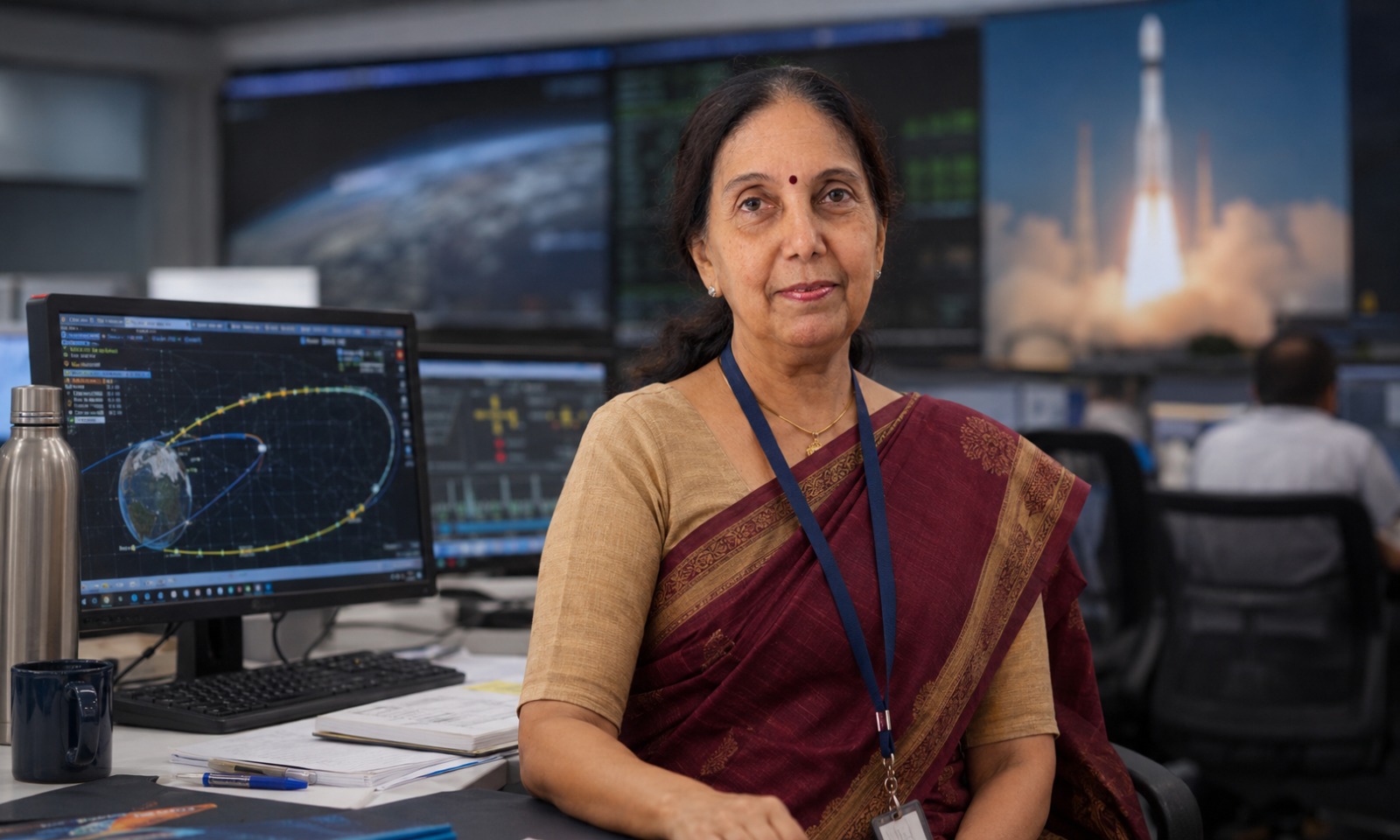
V. R. Lalithambika
Indian engineer/ ISRO Scientist
Dr. V. R. Lalithambika is an Indian engineer and scientist who has been working with the Indian Space Research Organisation (ISRO). She is a specialist in Advanced Launcher Technologies and was leading the Gaganyaan mission to send Indian astronauts to space by 2022. Lalithambika was born in 1962 in Thiruvananthapuram, Kerala, India. She studied B. Tech. in Electrical Engineering at the College of Engineering, Trivandrum and later pursued her M. Tech. in Control Engineering at the College of Engineering, Trivandrum. She worked at two colleges before joining ISRO. She did her Ph.D. while working with ISRO.
Key Factors
Full Name: Dr. V. R. Lalithambika
Born: 1962
Birth Place: Thiruvananthapuram
Occupation: Senior ISRO Scientist
In the early mornings of Thiruvananthapuram during the 1960s and 1970s, the skies above Kerala carried an unusual sense of anticipation. From the nearby shores of Thumba, sounding rockets rose into the atmosphere, carrying with them the ambitions of a young nation trying to carve its place in global space science. For many children, those launches were distant spectacles. For Dr. V. R. Lalithambika, they became the beginning of a lifelong fascination with engineering, mathematics, and the possibilities of human spaceflight.
Decades later, that curious girl from Kerala would stand among the most respected scientists in the Indian Space Research Organisation (ISRO), helping shape some of India’s most important launch vehicle programmes and eventually leading the country’s Human Spaceflight Programme connected to the historic Gaganyaan mission. Her journey reflects not only scientific brilliance, but also discipline, persistence, and an unwavering commitment to national technological self-reliance. In a field historically dominated by men, Dr. Lalithambika emerged as an outstanding Malayali scientist whose work became deeply woven into India’s modern space story.
Early Life and Childhood in Kerala
The story of Dr. Lalithambika begins in a Kerala that was itself entering a period of scientific awakening. Thiruvananthapuram, already known for its educational institutions and intellectual culture, was gradually becoming one of India’s most important centres for space research because of the establishment of the Thumba Equatorial Rocket Launching Station.
For a scientifically curious child growing up nearby, space research did not feel abstract.
It felt close.
The sounds, stories, and atmosphere surrounding Thumba quietly shaped her imagination from an early age. In interviews, Lalithambika has often spoken about how deeply her grandfather influenced her interest in science. He was not merely academically inclined; he was a mathematician, astronomer, and someone who built gadgets such as microscopes and lenses at home itself. Science, therefore, was not introduced to her as textbook theory. It was something tactile, alive, experimental.
Her father, too, was an engineer, further reinforcing an environment where curiosity and technical thinking were encouraged rather than restricted.
Kerala during those decades occupied a unique position in India’s social landscape. High literacy, strong public investment in education, and growing scientific awareness created conditions where young students increasingly imagined careers in engineering and research. Yet opportunities for women in advanced engineering fields remained limited compared to today.
For Lalithambika, pursuing science seriously required not only talent, but also determination to move through spaces where women were still significantly underrepresented.
Education and Academic Journey
Dr. Lalithambika studied Electrical Engineering at the College of Engineering Trivandrum, one of Kerala’s most respected technical institutions. Later, she pursued her M.Tech in Control Engineering at the same institution.
Control engineering may sound highly specialised to general readers, but in space science it is fundamental. Rockets travelling at immense speeds require extraordinarily precise guidance and control systems to ensure mission success. Tiny errors can lead to catastrophic failure. Mastering such systems demands advanced understanding of mathematics, electronics, aerodynamics, and computing.
At a time when engineering classrooms were overwhelmingly male, Lalithambika built her expertise through sustained academic excellence and technical discipline.
Before joining ISRO, she briefly worked in two colleges, gaining experience as an educator while continuing to deepen her technical understanding. But the pull of India’s expanding space programme remained strong.
Even after entering ISRO, she continued her academic journey and completed her Ph.D. while simultaneously handling the pressures of space research work. That combination of professional responsibility and continued scholarship reflected a trait colleagues frequently associate with her career, relentless intellectual commitment.
Entering ISRO and the Beginning of a Space Career
In 1988, Dr. Lalithambika joined the Vikram Sarabhai Space Centre in Thiruvananthapuram, the heart of India’s launch vehicle development programme.
The late 1980s were a defining period for Indian space science. ISRO was aggressively expanding indigenous launch capabilities while operating under technological limitations and international restrictions. India’s space programme could not simply purchase advanced technologies from abroad. It had to develop them independently.
Young engineers entering ISRO during this era became part of a national technological mission much larger than individual careers.
Lalithambika specialised in Advanced Launch Vehicle Technology, particularly rocket control, guidance, and simulation systems. These systems function as the “brain” of launch vehicles, continuously adjusting trajectory, orientation, and stability during flight.
Her work demanded extraordinary precision.
Unlike many scientific fields where errors can be corrected gradually, space missions offer little margin for failure. A launch unfolds within minutes. Years of work depend on systems functioning perfectly under extreme conditions.
Over time, Lalithambika became recognised not only for technical expertise, but also for leadership capabilities within highly complex engineering teams.
The Scientist Behind India’s Launch Vehicles
Across her ISRO career, Dr. Lalithambika contributed to several major Indian launch vehicle programmes that collectively transformed India into one of the world’s important spacefaring nations.
She worked on the Augmented Satellite Launch Vehicle, an early experimental programme that helped India learn critical technologies despite mixed mission outcomes. Failures within ASLV eventually contributed valuable lessons that strengthened later systems.
She later worked extensively on the Polar Satellite Launch Vehicle, or PSLV, widely considered one of ISRO’s greatest technological successes. The PSLV became internationally respected for reliability and cost-effectiveness, launching satellites for multiple countries and helping establish India’s global space reputation.
Her contributions also extended to the Geosynchronous Satellite Launch Vehicle programme, designed for heavier payload missions, and the ambitious Reusable Launch Vehicle initiatives exploring future reusable technologies.
In simplified terms, her work helped ensure that India’s rockets knew where to go, how to remain stable, and how to successfully deliver payloads into space.
Across more than 100 missions, Lalithambika became part of the engineering backbone supporting India’s expanding space ambitions.
Before moving to ISRO headquarters in Bengaluru, she served as Deputy Director overseeing control, guidance, and simulation systems at VSSC, one of the most technically demanding roles within launch vehicle engineering.
Leadership in the Gaganyaan Mission
If launch vehicle development established her scientific reputation, the Gaganyaan mission elevated Dr. Lalithambika into national prominence.
India’s decision to pursue independent human spaceflight represented a major leap in technological complexity. Sending astronauts safely into space involves challenges far beyond launching satellites. Human missions require life support systems, crew safety mechanisms, abort systems, advanced reliability standards, and integrated mission management at an entirely different level.
Dr. Lalithambika was appointed Director of the Indian Human Spaceflight Programme, placing her at the centre of one of modern India’s most ambitious scientific projects.
The symbolic significance of Gaganyaan extends beyond engineering.
Human spaceflight represents national confidence, technological maturity, and geopolitical prestige. Only a small number of countries have independently developed such capabilities.
Leading this programme required not only scientific expertise, but also administrative coordination, international cooperation, systems integration, and strategic vision.
Colleagues and observers often describe Lalithambika’s leadership style as methodical, calm, and intensely detail-oriented. Human spaceflight tolerates no shortcuts. Every component, simulation, and safety protocol requires exhaustive verification.
Under her leadership, the programme became not merely a technical exercise, but part of India’s larger scientific aspiration to move from emerging space power to advanced global space nation.
Breaking Barriers as a Woman Scientist
The rise of women scientists within ISRO has attracted increasing international attention in recent years, particularly after images of women engineers celebrating mission successes became globally iconic.
But those achievements emerged through decades of persistence by earlier generations of women scientists like Dr. Lalithambika.
When she entered engineering and advanced aerospace systems, female representation remained significantly limited. Technical leadership positions, especially within launch vehicle engineering, were overwhelmingly male-dominated.
Her career therefore carried both professional and symbolic significance.
For many young women in Kerala and across India, Lalithambika became proof that scientific leadership at the highest level was possible without abandoning intellectual seriousness or technical ambition.
Importantly, she never framed herself primarily through symbolic representation. Her authority emerged from competence, technical depth, and years of mission experience.
That may be precisely why her influence became so powerful.
She represented excellence first, inspiration naturally afterward.
Awards and Global Recognition
Across her long career, Dr. Lalithambika received several important recognitions reflecting both technical achievement and international respect.
She was awarded the Space Gold Medal in 2001 and later received the ISRO Individual Merit Award and ISRO Performance Excellence Award in 2013. These honours acknowledged not only scientific accomplishment, but contributions to mission success and technological innovation within India’s space programme.
She also received recognition from the Astronautical Society of India for excellence in launch vehicle technology.
One of the most internationally significant honours came in 2023, when France awarded her the prestigious Legion d’Honneur, the country’s highest civilian order.
The recognition reflected her role in strengthening Indo-French space cooperation, an increasingly important partnership within global space science.
Such honours matter because they position Indian scientists not merely as national contributors, but as influential figures within international scientific collaboration.
Personality, Vision, and Legacy
Those who have interacted with Dr. Lalithambika often describe her as intellectually rigorous yet deeply grounded.
Her career reflects a combination increasingly rare in modern public life, technical brilliance paired with institutional commitment. She belongs to a generation of scientists who viewed national scientific development not simply as career advancement, but as public service.
Throughout India’s long technological journey toward self-reliance in space research, scientists like Lalithambika quietly built systems, knowledge, and infrastructure that now support the country’s expanding ambitions.
Her legacy extends beyond individual missions.
It lives in India’s growing confidence in indigenous technology.
It lives in young women entering aerospace engineering classrooms without feeling out of place.
It lives in every student from Kerala who looks at rockets rising from Indian soil and believes such futures are possible.
And perhaps that is what makes Dr. V. R. Lalithambika such an outstanding Malayali scientist. Her journey connects Kerala’s intellectual traditions with India’s future-facing scientific imagination. From the childhood wonder inspired by Thumba’s rocket launches to the leadership of the Gaganyaan programme, she helped transform national dreams into engineering reality. In doing so, she became not only a scientist of extraordinary accomplishment, but also a lasting symbol of curiosity, discipline, and the power of knowledge to carry a nation beyond its earthly boundaries.
Awards
2001 – Space Gold Medal
2013 – ISRO Individual Merit Award
2013 – ISRO Performance Excellence Award
Astronautical Society of India award for excellence in launch vehicle technology
2023 – Legion d’Honneur (The highest French civilian order) for boosting space cooperation between India and France