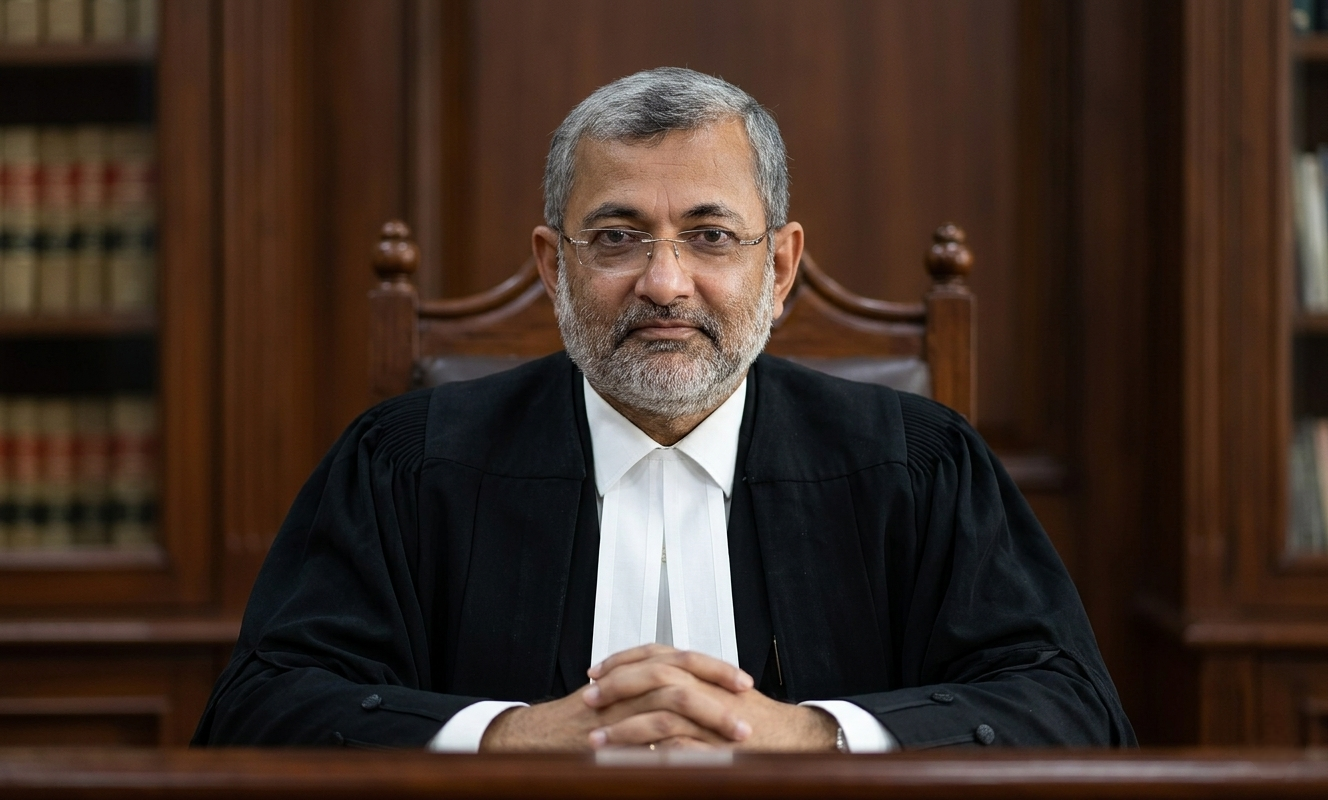
Justice Kurian Joseph
former judge of the Supreme Court of India
From the villages of Thrissur to the highest bench in the land — and then, to the most extraordinary press conference in Indian judicial history
Born: November 30, 1953
Place: Thannipuzha, Ernakulam, Kerala
“Conscience does not speak to endorse one’s good conduct; but when things go wrong, it always speaks; whether you listen or not. When things go wrong constitutionally, unless the conscience speaks, it is not good conscience — it will be accused of as numb conscience.”
— Justice Kurian Joseph, Manoj Narula v. Union of India
On the morning of January 12, 2018, the four most senior puisne judges of the Supreme Court of India walked to the residence of Justice Jasti Chelameswar and, in an act without precedent in the republic’s seventy-year judicial history, called a press conference. Among them stood Justice Kurian Joseph — Kerala-born, quietly devout, and possessed of what colleagues had long described as an outstanding moral compass. What those four men said that morning — that democracy itself was in peril, that sensitive cases were being routed to favourable benches, that the Chief Justice was not listening — cracked open something that the Indian legal establishment had long preferred to keep sealed. For Justice Kurian Joseph, it was an act he described afterward as one of no regret: “Whatever I did was very consciously, for a cause which was not targeted at any individual, but for putting in place a collective mechanism to assist the Chief Justice in running the affairs of the top court.” That a sitting Supreme Court judge would say such a thing in public, to the media, about his own institution, tells you something essential about the man.
A Clerk’s Son from Thannipuzha
Kurian Joseph was born on November 30, 1953, in Thannipuzha, a village near Angamaly in Kerala’s Ernakulam district. His father was a clerk at the Kerala High Court — a detail that carries a certain symmetry, given that his son would one day sit on the Supreme Court of India. He was educated at St. Joseph’s U.P. School in Kalady, St. Sebastian’s High School in Kanjoor, and later at Bharata Mata College, Thrikkakara, and Sree Sankara College, Kalady, before reading law at Kerala Law Academy, Thiruvananthapuram.
The Kerala of the 1960s and 1970s that formed him was a society thick with political consciousness, literary culture, and a fierce regard for constitutional rights. The state’s high literacy rates were already producing generations of young people who could argue with precision and read with purpose. Joseph was clearly one of them. As a law student, he was General Secretary of the Kerala University Union in 1978, and a member of the Academic Council, Kerala University from 1977 to 1978 — signs of a young man drawn as much to civic institution as to legal text.
His faith — he is a practicing Christian — would be a thread throughout his life. It informed not just his private discipline but his public presence on the bench, evident in everything from letters to Prime Ministers declining conference invitations that clashed with Good Friday observances, to a judicial voice that, at its most characteristic, spoke in the language of moral accountability rather than merely statutory interpretation.
Career at a Glance
- 1979: Begins legal practice at the Kerala High Court.
- 1987: Appointed Government Pleader, Kerala.
- 1994–1996: Serves as Additional Advocate General, Kerala. Designated Senior Advocate in 1996.
- July 12, 2000: Elevated as Judge, Kerala High Court. Serves twice as Acting Chief Justice.
- February 8, 2010: Appointed Chief Justice, Himachal Pradesh High Court.
- March 8, 2013: Elevated as Judge, Supreme Court of India.
- January 12, 2018: Joins three colleagues in the unprecedented judicial press conference.
- November 29, 2018: Retires from the Supreme Court; vows publicly to accept no post-retirement office.
Judicial Career: From Kochi to Shimla to New Delhi
Joseph’s ascent through the judiciary was methodical and well-regarded. After two decades at the Kerala bar — including appointments as Government Pleader and Additional Advocate General — he was elevated to the Kerala High Court bench on July 12, 2000. He served twice as Acting Chief Justice of that court, a position that brought him administrative as well as judicial experience. In February 2010, he moved northward as Chief Justice of the Himachal Pradesh High Court, a post he held until March 2013, when he was elevated to the Supreme Court.
On the apex court, he was, by several measures, remarkably productive. He authored or participated in over 1,110 judgments during his 2,156-day tenure — the tenth highest output among all Supreme Court justices, according to legal database records. The range was wide: civil appeals, criminal matters, constitutional questions. He sat on benches with Chief Justices R.M. Lodha, T.S. Thakur, and J.S. Khehar, and authored the most judgments alongside Justice Rohinton Nariman — 366 together, a pairing that speaks to intellectual affinity and judicial productivity.
Within the institution, Justice Joseph was known for something harder to tabulate: a reputation for genuine independence. He was, colleagues observed, not a man given to the quiet accommodation of institutional pressure. At his farewell function, those present described him as a “compassionate” judge. It was an assessment earned across years and visible in his legal reasoning — an instinct to ask not merely what the law said, but what justice required.
Landmark Judgments: The Architecture of a Legal Philosophy
Justice Kurian Joseph’s contributions to Indian constitutional jurisprudence can be traced across several defining cases, each illuminating different aspects of a coherent legal philosophy rooted in constitutional morality, institutional integrity, and the protection of individual dignity against the weight of tradition or state power.
In Shayara Bano v. Union of India (2017), the landmark triple talaq case, Justice Joseph wrote a concurring opinion in the 3:2 majority that struck down the practice of instant triple talaq as unconstitutional. His reasoning was theologically as well as legally grounded. He held that triple talaq was not integral to Islam, stating plainly that what is bad in the Quran cannot be part of Shariat. Delivered by a Christian judge on a question of Muslim personal law, the opinion drew criticism from some quarters — but it also demonstrated a willingness to engage the substance of a legal-religious question rather than sidestep it behind procedural caution.
“Triple talaq is against the tenets of the Holy Quran and hence violates Shariat. What is bad in Quran cannot be part of Shariah.”
— Justice Kurian Joseph, Shayara Bano v. Union of India (2017)
Perhaps no judgment reveals the texture of his conscience more clearly than his final one. On November 27, 2018 — two days before his retirement — heading a three-judge bench in Channu Lal Verma v. State of Chhattisgarh, Justice Joseph commuted a death sentence to life imprisonment and went further than the case required: he called for a reconsideration of capital punishment itself. Drawing on the 2015 Law Commission Report that had recommended abolition of the death penalty for all crimes other than terrorism, he observed that the time had come to review the punishment’s purpose and practice. His two colleagues on the bench disagreed with this broader observation, finding no need to revisit the settled position. It was a dissent of conscience — not binding in law, but unmistakable as a moral statement — delivered as a parting shot at the institution he was leaving. On reservations and SC/ST rights, his participation in the Constitution Bench in Jarnail Singh v. Lacchmi Narain Gupta reinforced the constitutional commitment to substantive equality, holding that backward class status in the context of reservations in promotions did not require fresh quantifiable data on community backwardness.
NJAC — The Case He Came to Regret
In October 2015, a five-judge Constitution Bench struck down the 99th Constitutional Amendment by a 4:1 majority in Supreme Court Advocates-on-Record Association v. Union of India — the NJAC case. Justice Joseph wrote a separate concurring opinion, participating in the majority that held the National Judicial Appointments Commission unconstitutional, preserving the primacy of the collegium in judicial appointments. Yet his concurring opinion was notably candid: the collegium itself, he wrote, required a “glasnost and perestroika” — invoking Mikhail Gorbachev’s reforms of the Soviet Union to signal that the existing system was far from perfect. He was voting to preserve a flawed structure while hoping the institution would have the courage to reform itself. It did not. Years later, he would say publicly, “The only improvement is that resolutions are uploaded. That is why I regret my NJAC judgment. None of the suggestions for the improvement of the Collegium was implemented.”
January 12, 2018: The Day Four Judges Went to the Nation
The events of January 12, 2018 require context to be properly understood. For months before the press conference, Justices Chelameswar, Gogoi, Lokur, and Joseph had attempted internal remedies. They met personally with then Chief Justice Dipak Misra. They wrote a letter — a detailed, measured document — raising concerns about the selective allocation of cases to benches perceived to carry political bias, and the broader question of whether an individual Chief Justice should make administrative decisions of national consequence without collegial consultation. The letter went unaddressed.
One trigger was the allocation of the case concerning the death of CBI Special Judge B.H. Loya — who had been presiding over the Sohrabuddin encounter case involving then BJP president Amit Shah — to a bench headed by Justice Arun Mishra. The four judges felt the assignment was inexplicable by any neutral administrative logic. After two months of silence from the Chief Justice, they stepped outside. Justice Chelameswar addressed the media at his residence, declaring that the administration of the Supreme Court was “not in order.” Justice Joseph, characteristically direct when pressed, later articulated what the four had felt: that someone from outside the court was controlling the Chief Justice, influencing case allocation toward judges perceived as politically sympathetic.
“There were two watchdogs — one of which is the media. We came out to let there be an awareness that we had done our best. Despite barking, the master was in deep slumber. So we decided to bite.”
— Justice Kurian Joseph
The press conference was extraordinary in every sense: unprecedented in Indian judicial history, deeply alarming to the legal establishment, and immediately polarising. Some senior lawyers — including Soli Sorabjee — worried that it would erode public confidence in the institution. Others recognised it as a desperate act of institutional self-defense by judges who had exhausted all internal options. What followed was instructive: Chief Justice Misra restructured the judicial roster in a manner that excluded the four judges from Constitution Bench matters — confirming, in the eyes of many observers, precisely the arbitrary administrative power they had protested.
Justice Joseph never expressed regret about the presser itself. He described it as an act done consciously and for a cause. What he did note — with characteristic honesty — was that he hoped it would be the first and last such occasion: that the institution would learn from it and build the internal accountability mechanisms whose absence had made the press conference necessary.
Voice of Conscience: Independence as a Practice, Not a Posture
What sets Justice Kurian Joseph apart from many contemporaries is that his commitment to judicial independence was not rhetorical. He articulated it in his judgments, acted on it in his institutional conduct, and continued to speak on it after retirement — at some personal cost to comfortable post-judicial life.
In Manoj Narula v. Union of India, a Constitution Bench case concerning the appointment of ministers with criminal antecedents, he wrote a separate concurring judgment whose most memorable lines were not about the specific legal question but about the nature of institutional conscience itself: “Conscience does not speak to endorse one’s good conduct; but when things go wrong, it always speaks; whether you listen or not.” It was a quiet self-description as much as a constitutional observation.
On post-retirement appointments — a subject of persistent controversy in India, given the practice of judges accepting government-appointed tribunal or commission positions — Justice Joseph was unambiguous. On the eve of his retirement, he publicly declared he would accept no such post, citing the importance of judicial independence. “So long as the government thinks it is charity to a judge,” he said, “no judge should accept it.” It was a statement that, in the polite silence of Indian judicial culture, carried the force of a direct accusation. He has, to date, kept that vow. His post-retirement work has been in arbitration and mediation — private practice, not government patronage.
Post-Retirement: Still Speaking, Still Watching
The years since his retirement in November 2018 have seen Justice Joseph remain one of the more vocal retired Supreme Court judges in public discourse — and one of the more candid. He has spoken at book launches, legal conferences, and public forums, consistently returning to themes of judicial accountability, the distortions of the collegium system, and the dangers of executive encroachment on judicial independence.
His most remarkable post-retirement admission — the expression of regret over the NJAC judgment — was made while participating in the launch of a book on judicial accountability, in the presence of then Finance Minister Arun Jaitley. That setting alone — a retired judge agreeing, in front of a government minister, that the Supreme Court erred in protecting its own appointment powers — was itself a form of institutional honesty unusual in any democracy. He was careful to add, however, that his regret was not an endorsement of executive primacy in judicial appointments. What he wanted was a transparent, accountable, independent system: neither a closed collegium nor a politically controlled commission. The distinction matters, and he made it.
He has also continued to press on the question of bench composition — arguing that when courts adjudicate questions involving religious diversity, social morality, and regional concerns, the composition of the bench should reflect that diversity. It is a structurally democratic argument: that the legitimacy of judicial interpretation depends not merely on legal reasoning but on the representative quality of those doing the interpreting.
Character and Ethics: Humility and the Hard Word
Those who appeared before Justice Kurian Joseph’s bench or interacted with him at the Kerala bar describe a quality not easily separated from his judicial temperament: a personal warmth that did not soften the intellectual demand he placed on himself or on those before him. His farewell was attended by lawyers who said they would miss, specifically, his smile. At his retirement function, colleagues spoke of compassion as his defining judicial quality. He was, observers noted, one of the more popular Supreme Court judges of his era — not through the cultivation of public image, but through a consistency of character that legal professionals trust above performance.
He was born into a lower-middle-class family in rural Kerala and never pretended otherwise. His father was a clerk at the very court where he would begin his practice. That background — the son of a junior court official practising before the bench his father served — is not simply biographical detail; it shaped a certain democratic instinct in his judicial reasoning, a tendency to see the citizen before the statute and the human reality beneath the legal question.
His Christian faith was visible but not performative. He declined to attend a judges’ conference that fell on Good Friday, writing to the Prime Minister to explain. He addressed Canon Law conferences. He kept faith and institutional duty in separate but coexisting compartments — and was honest about the tension when critics raised it.
What He Left Behind, and Why It Matters
History will not situate Justice Kurian Joseph among the judicial titans who authored the foundational constitutional texts of Indian jurisprudence — the Gopalan, Kesavananda, or Maneka Gandhi generations. He came to the Supreme Court at a different and in some ways more contested moment: when the institutional credibility of the apex court was itself the central question in public discourse, when the formal correctness of judgments mattered less than whether the process that produced them could be trusted.
In that context, Justice Kurian Joseph’s significance is as much institutional as doctrinal. He is one of four judges who did something no sitting Supreme Court judge in India had ever done: told the nation, publicly, that the highest court was in trouble. Whatever one thinks of the wisdom of that act — and reasonable legal minds remain divided — it introduced into Indian public consciousness a vocabulary of judicial accountability that did not exist in the same form before January 12, 2018. His post-retirement willingness to revise his own judgment on the NJAC case added a further dimension: the rare spectacle of a legal luminary admitting, with clarity and without self-pity, that the institution he had defended had failed to justify that defence.
From Kerala’s Thrissur district to the third-most senior position on the Supreme Court of India, Justice Kurian Joseph traced a career shaped by hard work, genuine faith, and an outstanding commitment to constitutional integrity — expressed not in its easiest forms, but in the ones that cost something. In an era when judicial credibility is tested daily, the example of a judge who chose honesty over comfort and conscience over convenience remains, stubbornly and necessarily, relevant.