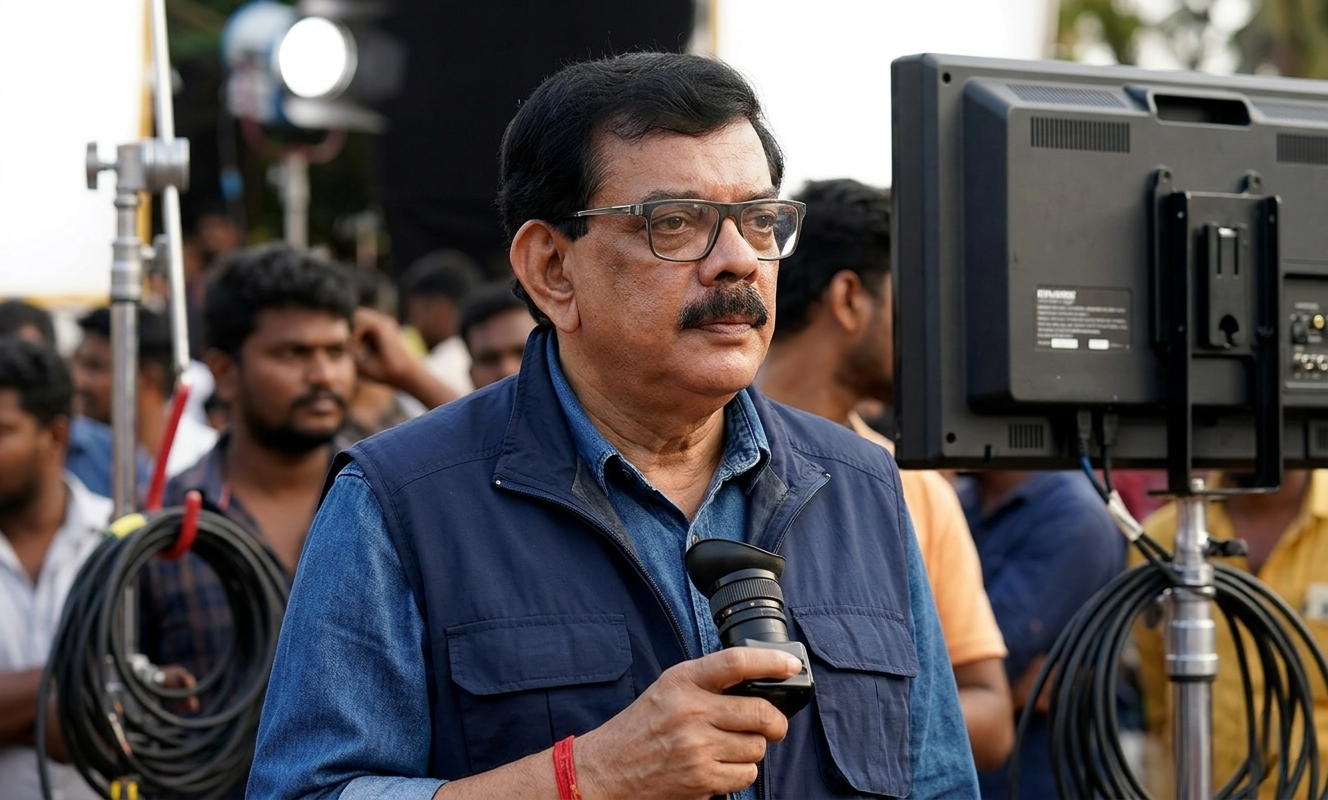
Priyadarshan
Born: 30 January 1957 (age 69)
Place: Thiruvananthapuram, Kerala, India
Title: Film Director, Screenwriter
Years active: 1982–present
When Order Collapses Perfectly
A door slams. Another opens. Someone hides under a table, someone else bursts into the room at precisely the wrong moment, and within seconds, the entire narrative spirals into orchestrated confusion. In Hera Pheri, the chaos is relentless, yet never random. Every misplaced object, every mistimed entry, every misunderstanding is engineered to collide at exactly the right second. Behind this choreography of disorder is Priyadarshan, a director who turned confusion into structure and farce into form. It is an outstanding paradox, films that appear spontaneous but are, in reality, meticulously constructed machines of timing and rhythm.
Early Life and Entry into Cinema: A Circle of Collaborators
Priyadarshan was born on January 30, 1957, in Thiruvananthapuram, Kerala, into a family connected to academia and the arts. His father, a librarian, and his early environment exposed him to literature and storytelling, even if cinema was not an immediate destination.
He studied at University College, Thiruvananthapuram, where he formed friendships that would shape his career. Among them were Mohanlal and Suresh Kumar, collaborators who would become central to his early work.
His entry into cinema in the late 1970s and early 1980s was gradual. He began as a scriptwriter and assistant, absorbing the mechanics of filmmaking before stepping into direction. His debut as a director came with Poochakkoru Mookkuthi (1984), a comedy that immediately established his flair for timing and ensemble staging.
Unlike directors who arrive with a singular vision, Priyadarshan emerged from collaboration. His cinema was shaped not in isolation but through a network of actors, writers, and technicians who shared a common rhythm.
The Malayalam Golden Run: Speed, Precision, and Popularity
The 1980s and early 1990s marked Priyadarshan’s most prolific phase in Malayalam cinema, coinciding with what is often described as its golden era.
Films like Boeing Boeing (1985), Chithram (1988), and Kilukkam (1991) combined humor with emotional undercurrents, creating narratives that were both entertaining and structurally tight. His collaborations with Mohanlal became particularly significant, producing films that balanced star power with ensemble dynamics.
What set Priyadarshan apart during this period was his ability to integrate multiple tonal registers. Comedy was rarely isolated. It coexisted with romance, drama, and occasionally melancholy.
His films were also technically polished for their time. Camera movement, editing rhythm, and spatial awareness within scenes reflected a director attentive to craft, not just content.
Yet, even in this phase, one could see the beginnings of a pattern, repetition of narrative devices, reliance on misunderstandings, and a preference for controlled chaos.
Reinventing Comedy: Structure Behind the Disorder
Priyadarshan’s approach to comedy is often misunderstood as improvisational or loosely constructed. In reality, it is highly engineered.
His films rely on:
- Situational humor rather than punchlines
- Ensemble casts where multiple narrative threads intersect
- Precise timing of entrances, exits, and reveals
This places him closer to traditions of farce and screwball comedy than to stand-up or dialogue-driven humor.
Influence and Adaptation
A significant aspect of his craft is his engagement with international cinema, particularly European and American comedies. Several of his films are adaptations or reinterpretations of foreign works.
This has been both a strength and a point of contention.
On one hand, Priyadarshan localized narratives effectively, embedding them within Indian cultural contexts. On the other, critics have questioned the extent of originality in his work.
Visual Grammar
His staging often uses confined spaces, rooms, corridors, and houses where characters move in and out rapidly. Editing is rhythmic, designed to sustain momentum rather than pause for reflection.
In essence, Priyadarshan treats comedy as choreography.
Bollywood Phase: Scaling Chaos to a National Audience
Priyadarshan’s transition to Hindi cinema in the late 1990s and early 2000s marked a significant expansion of his influence.
With Hera Pheri, he redefined mainstream Hindi comedy. The film’s success lay not just in its humor but in its structure, a tightly woven narrative of misunderstandings that escalates without losing coherence.
This was followed by films like Hungama (2003), Garam Masala (2005), and Bhool Bhulaiyaa.
Impact on Hindi Cinema
At a time when Bollywood comedy often relied on slapstick or star-driven humor, Priyadarshan introduced ensemble-driven narratives, situational complexity and faster pacing.
His films became box office successes, influencing a generation of filmmakers who attempted to replicate his style.
However, this phase also marked a shift toward formula. The repetition of narrative patterns became more visible, and critical reception began to diverge from commercial success.
Criticism and Controversies: The Question of Originality
Priyadarshan’s career has been accompanied by persistent debate around adaptation.
Many of his films are unofficial remakes or heavily inspired by foreign works. Critics argue that this reliance limits originality, reducing his role to that of an interpreter rather than a creator.
At the same time, his defenders point out that adaptation itself is a legitimate creative act and localization requires cultural translation, not mere replication.
Another criticism concerns formulaic repetition. Over time, his narrative structures began to feel predictable, reducing the freshness that marked his earlier work.
These critiques do not diminish his impact, but they complicate it.
Beyond Comedy: Attempts at Range
Priyadarshan’s filmography includes works that move beyond comedy, though they are less frequently discussed.
Kaalapani stands out as a significant departure. Set in the Cellular Jail during British rule, the film is ambitious in scale and serious in tone. It reflects a director capable of handling historical narrative and emotional weight.
In later years, films like Oppam (2016) show his engagement with thriller elements, though even here, traces of his comedic timing remain.
These works suggest that Priyadarshan’s range extends beyond farce, even if his reputation is largely defined by it.
Collaborations and Industry Impact: Building a Network
Priyadarshan’s career is deeply collaborative.
His long-standing association with Mohanlal produced some of Malayalam cinema’s most memorable films. In Hindi cinema, his collaborations with actors like Akshay Kumar and Paresh Rawal were central to his success.
He also worked closely with technicians, editors, cinematographers, and writers, creating a consistent production ecosystem.
Influence
His style influenced a wave of comedy films in both Malayalam and Hindi cinema. Many directors adopted his emphasis on ensemble casts and situational humor, though often without matching his precision.
He also played a role in bridging Malayalam and Hindi cinema, adapting narratives across linguistic and cultural contexts.
Personal Life and Public Persona: Discipline and Distance
Priyadarshan’s public persona is relatively restrained.
He is known for high productivity, structured working style and preference for efficiency over experimentation.
His personal life, including his marriage to actress Lissy and their subsequent separation, has occasionally entered public discourse, but he has largely maintained a professional focus.
He is not a director who cultivates mystique. His identity is tied more to output than to persona.
Continuing Relevance: The Machinery of Laughter
Priyadarshan’s place in Indian cinema is both secure and contested.
He is unquestionably one of the most prolific filmmakers, with a filmography spanning multiple languages and decades. His influence on comedy, particularly in the 2000s, is undeniable.
Today, his films are revisited with a mix of nostalgia and critical distance. They are recognized for their craftsmanship, even as their limitations are acknowledged.
What remains undeniable is his contribution to shaping a particular grammar of comedy in Indian cinema, one built on timing, structure, and controlled chaos.
In the end, Priyadarshan’s career is an outstanding study in contradiction, a filmmaker who mastered disorder by imposing order, and whose work continues to provoke both laughter and debate in equal measure.
Awards and honours
National Film Awards
2007: Best Feature Film – Kanchivaram (Golden Lotus)
2007: Best Feature Film (Producer) – Kanchivaram (Golden Lotus)
2019: Best Director – Marakkar: Lion of the Arabian Sea (Golden Lotus)
2019: Best Feature Film – Marakkar: Lion of the Arabian Sea (Golden Lotus)
1996: Best Art Direction – Kalapani (Sabu Cyril)
1996: Best Cinematography – Kalapani (Santosh Sivan)
Civilian Awards
2012: Padma Shri (India’s fourth-highest civilian award)
Kerala State Film Awards
1994: Best Film with Popular Appeal and Aesthetic Value – Thenmavin Kombathu
1995: Second Best Film – Kaalapani
Kerala Film Critics Association Awards
1991: Best Popular Film – Kilukkam
2016: Best Film – Oppam
2016: Best Director – Oppam
Filmfare Awards
1997: Best Film (Critics) – Virasat
2009: Best Director (Tamil) – Kanchivaram
Special Recognitions
2008 – Special Honour Jury Award – for Outstanding contributions to Indian Cinema
2008 – Special Jury Award at Chennai & Jaipur International Film Festival – ‘Sila Samayangalil’, an art movie on AIDS awareness.
2010 – Jaihind Rajat Mudra Award
2016 – Asiavision Award for Best Director – Oppam
2019 – Kishore Kumar Award by the Government of Madhya Pradesh
2022 – Honorary doctorate (D.Litt) – Hindustan Institute of Technology and Science.
Academic and Institutional Recognitions
2013: Excellence Award – Hindustan University, Chennai
2011-2014: Chairman – Kerala State Chalachithra Academy
2011-2014: Director – International Film Festival of Kerala
Government Appointments
2001: Chairman – Kerala State film Awards
2022: Chairman – National Film Awards – Best Film Friendly State
2019: Chairperson – Feature Films Jury, 50th International Film Festival of India (IFFI)
2016: Central Jury Chairperson – 64th National Awards (President’s Award for 2016)
Sports and Social Contributions
Columnist – Malayala Manorama Newspaper (for international cricket matches in Kerala)
Chairperson – Committee of Ceremonies, 35th National Games (2015)
Director – Rising Star Outreach of India (2014–2019)