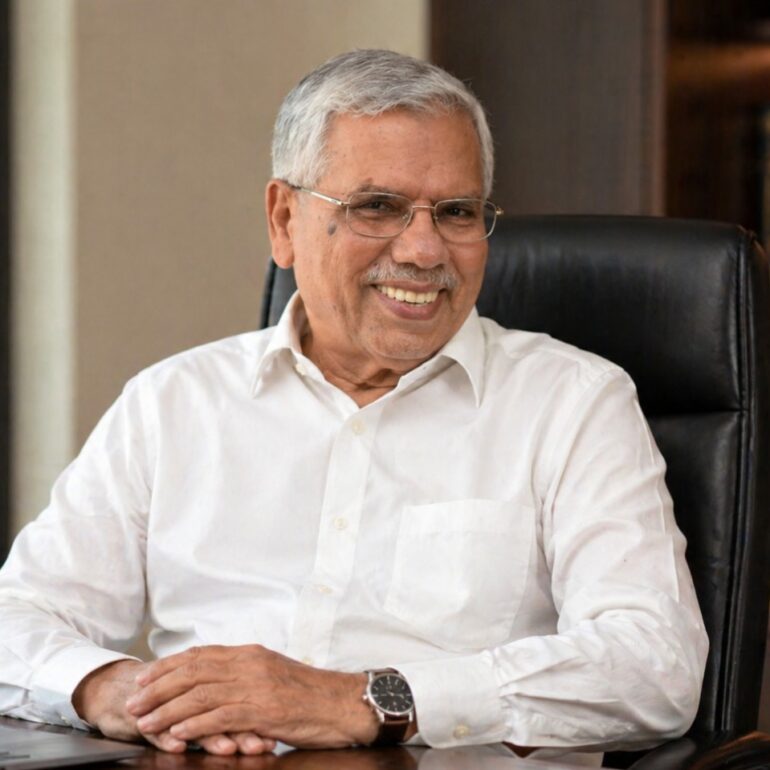

Sabu M. Jacob
Indian industrialist, business magnate, and chief coordinator of the Twenty20 political party
Sabu M. Jacob is an Indian businessman from Kerala. He is the managing director of Kitex Garments Limited. He is the chief coordinator and mentor of Twenty20 Kizhakkambalam, a non-profit organization developed as a Total Responsibility Program to effectively contribute to the social and economic development of Kizhakkambalam Panchayath where the company operates the aim is to make Kizhakkambalam the best developed village in India by 2020.
Key Facts
Full Name: Sabu M. Jacob
Born: 1962
Place: Kizhakkambalam, Ernakulam, Kerala
Title: Managing Director, Kitex Garments Limited
Occupation: Industrialist, Social Entrepreneur
Known For: Leadership of Kitex Garments, architect of the Twenty20 Kizhakkambalam governance model
On election day in Kizhakkambalam, the atmosphere carries a different kind of intensity. There are no towering political banners or traditional party symbols dominating the streets. Instead, the conversation revolves around prices of essential goods, housing schemes, and infrastructure projects, metrics that feel closer to corporate dashboards than political manifestos. At the centre of this shift is Sabu M. Jacob, whose work through Twenty20 Kizhakkambalam has transformed a local panchayat into what many describe as an outstanding case study in alternative governance. Whether this model represents innovation or overreach depends largely on where one stands.
Business Foundation: The Kitex Story
Before entering the political arena, Sabu M. Jacob built his reputation in industry. Kitex Garments Limited is among India’s leading manufacturers of infant garments, exporting to major global brands and retailers.
The company operates within a highly competitive segment of the textile industry, where margins are tight and compliance standards are stringent. Infant wear, in particular, demands high levels of quality control, safety standards, and certification.
Kitex’s growth reflects a model focused on scale and efficiency. Its integrated manufacturing facilities, supply chain management, and export orientation align with global production standards. Publicly available reports indicate that the company has established itself as a significant player in its niche, particularly in the U.S. and European markets.
The business also carries elements of family legacy, with roots in a broader textile and garment ecosystem. However, Sabu Jacob’s tenure is marked by consolidation and expansion, positioning Kitex as a global supplier rather than a regional manufacturer.
The Kizhakkambalam Experiment
The transition from industry to governance began with the formation of Twenty20 Kizhakkambalam, initially conceived as a corporate social responsibility initiative by the Kitex group.
The stated vision was to transform Kizhakkambalam into one of India’s most developed local economies. This ambition translated into a series of interventions that went beyond conventional CSR.
Programs introduced under the Twenty20 banner included subsidized food and essential goods, affordable housing schemes, healthcare support, and infrastructure improvements. Retail outlets offering products at lower-than-market prices became one of the most visible aspects of the initiative.
The approach was data-driven and execution-focused, resembling corporate operations more than traditional governance. Decisions were often framed in terms of efficiency, cost reduction, and measurable outcomes.
This model quickly gained traction among residents, particularly those who benefited directly from the schemes. It also set the stage for a deeper political engagement.
Politics Without a Party?
The next phase of the experiment came with Twenty20’s entry into local body elections. In a state dominated by strong political parties and ideological affiliations, this move represented a significant disruption.
The organization contested panchayat elections and secured a decisive victory in Kizhakkambalam, effectively taking control of local governance. This was not merely a political win; it was a structural shift.
Unlike traditional parties, Twenty20 positioned itself as a development-focused platform rather than an ideological one. Its campaign messaging emphasized delivery over rhetoric, infrastructure over ideology.
However, this approach also drew criticism. Established political parties questioned the implications of corporate-backed governance, raising concerns about accountability, transparency, and the potential concentration of power.
Impact vs Controversy
The outcomes of the Kizhakkambalam model are visible in multiple dimensions. Improvements in infrastructure, access to essential goods, and welfare delivery have been widely reported. For many residents, the changes are tangible and immediate.
At the same time, the model has generated significant debate. Critics argue that the blending of corporate resources with public governance creates an uneven playing field, where traditional democratic processes may be influenced by financial power.
There are also concerns about sustainability. Corporate-backed initiatives depend on continued financial support, raising questions about long-term viability once such backing changes.
Additionally, tensions between Twenty20 and mainstream political groups have led to conflicts, both at the local and state levels. These disputes highlight the friction between established political structures and emerging governance models.
Leadership Style and Philosophy
Sabu M. Jacob’s leadership style reflects his industrial background. It is direct, execution-oriented, and less concerned with political negotiation than with measurable outcomes.
This approach can be effective in operational contexts, where decisions can be implemented quickly and evaluated based on performance. In governance, however, the dynamics are more complex.
Public administration involves multiple stakeholders, competing interests, and institutional constraints. Applying a corporate model to this environment requires adaptation.
Jacob’s public image varies depending on perspective. Supporters view him as a reformer who has introduced efficiency into governance. Critics see him as a disruptor whose methods challenge established democratic norms.
The reality likely lies somewhere in between, shaped by both the successes and limitations of the model.
Broader Implications
The Kizhakkambalam experiment raises broader questions about governance in India. Can corporate efficiency be integrated into public systems without compromising democratic principles? Can such models be replicated in other regions?
Replication is not straightforward. Kizhakkambalam’s context, a relatively small geographic area with strong industrial backing, is unique. Scaling this model to larger or more diverse regions would introduce additional complexities.
However, the experiment does highlight gaps in traditional governance systems. Delays, inefficiencies, and resource constraints often limit the effectiveness of public programs. Models like Twenty20 attempt to address these gaps through alternative approaches.
The debate, therefore, is not just about one panchayat, but about the evolving relationship between state, market, and society.
Reflection
Sabu M. Jacob’s journey from industrialist to socio-political actor reflects a convergence of two domains that are typically kept separate. His work through Twenty20 Kizhakkambalam challenges conventional boundaries, raising both possibilities and concerns.
As Kerala continues to navigate its own governance and development challenges, the Kizhakkambalam model will likely remain a point of reference, studied, debated, and contested.
Whether it represents a viable alternative or a context-specific anomaly will depend on its long-term sustainability and adaptability. What is clear is that it has already altered the conversation around local governance.
In that sense, Sabu M. Jacob’s impact is not limited to the outcomes within a single panchayat. It extends to the questions his model raises about power, accountability, and the future of public systems in India, questions that remain as complex as they are outstanding in their implications.
Awards and recognitions
2017 – Featured among the finalists for EY Entrepreneur of the Year