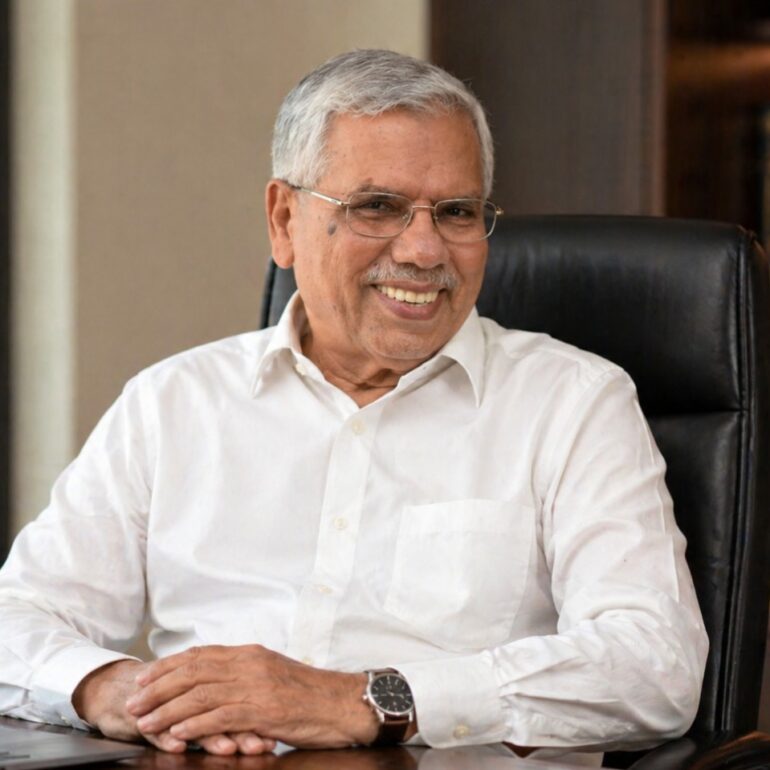

Dr. B. Govindan
Dr. B. Govindan is the Chairman of the renowned Bhima Group, a major South Indian jewelry retailer with over 100 years of legacy. Based in Kerala, he transformed the business from a single shop in Alleppey into a multi-outlet, multi-crore organization across India and the Middle East.
Key Facts
Full Name: Dr. B. Govindan
Born: June 1, 1944
Place: Kerala, India
Title: Chairman, Bhima Group
Occupation: Entrepreneur, Business Leader
Known For: Leading and expanding Bhima Group, a legacy jewellery retail chain with operations in India and the Gulf
Origins of Bhima Group
The story of Bhima Group begins in the early decades of the 20th century, when Kerala’s coastal towns were quietly shaping what would become one of India’s most culturally embedded retail sectors, gold jewellery. In regions like Alappuzha (Alleppey), jewellery was never merely ornamental. It functioned as savings, social security, and cultural expression.
Bhima’s first store, established in Alleppey, emerged in this environment. The business grew in a time when transactions were built on personal relationships rather than brand identity. Trust was local, reputation travelled by word of mouth, and consistency mattered more than scale.
This early foundation would later prove critical. Unlike newer entrants in the jewellery market, Bhima’s legacy was not constructed through marketing campaigns but through decades of transactional credibility. That heritage became both an asset and a constraint, something future leadership would have to preserve while also expanding beyond its traditional base.
Dr. B. Govindan’s Journey
Dr. B. Govindan’s entry into the business was not marked by a dramatic break from the past, but by a gradual immersion into its systems. As part of the family enterprise, he inherited not just a business, but a set of expectations tied to continuity, integrity, and customer trust.
What distinguishes his leadership is not a departure from these values, but the way he has operationalised them in a changing market. His approach reflects a clear understanding that legacy alone cannot sustain growth. The jewellery sector, particularly from the late 1990s onwards, began to shift toward organised retail, brand differentiation, and geographic expansion.
Govindan’s role, therefore, was less about founding a business and more about transforming one. This required navigating a delicate balance, retaining the emotional and cultural capital of a legacy brand while building systems capable of supporting scale.
Transformation and Expansion
The most visible aspect of Govindan’s leadership has been Bhima’s expansion beyond its original geography.
From a single store in Kerala, the company grew into a network of showrooms across South India, and eventually into the Gulf. This expansion was not incidental. It followed a broader economic pattern, the migration of Malayali communities to the Middle East, where demand for trusted Indian jewellery brands was strong.
Entering Gulf markets, however, is not simply a matter of replication. The regulatory environment, consumer expectations, and competitive landscape differ significantly from India. Jewellery retail in the UAE, for instance, is highly competitive, with established players and global standards of service.
Bhima’s ability to establish a presence in this ecosystem suggests a strategy built on leveraging diaspora trust while adapting to local retail norms. The brand’s familiarity among Malayali expatriates provided an entry point, but sustaining operations required consistency in quality, pricing transparency, and service delivery.
At the same time, expansion within India involved a shift from traditional store formats to more structured retail environments. Showrooms became larger, more standardised, and more aligned with contemporary consumer expectations, particularly among younger buyers who view jewellery as both investment and lifestyle product.
Leadership Style and Business Philosophy
Dr. B. Govindan’s leadership style appears to be grounded in operational continuity rather than disruptive change. In a sector where volatility can be driven by gold price fluctuations, regulatory shifts, and changing consumer preferences, stability itself becomes a strategic advantage.
His approach emphasises long-term relationships over short-term gains. This is particularly relevant in jewellery retail, where repeat customers and family networks often drive business more than one-time purchases.
At the same time, there is evidence of gradual adaptation. The evolution of showroom design, the incorporation of modern retail practices, and the expansion into international markets indicate a willingness to evolve without abandoning core principles.
Unlike aggressively branded competitors, Bhima’s positioning has remained relatively understated. This suggests a strategy that prioritises trust and familiarity over high-visibility marketing, a model that continues to resonate in certain segments of the market.
Challenges and Market Realities
The jewellery industry in India and the Gulf has undergone significant transformation over the past two decades.
In India, the introduction of hallmarking standards, GST regulations, and increasing formalisation have reshaped how businesses operate. For legacy players like Bhima, adapting to these changes involves not just compliance, but restructuring internal systems.
Competition has also intensified. Large national chains, international brands, and digitally enabled startups have entered the market, each bringing different value propositions. Some compete on design innovation, others on pricing or brand experience.
In the Gulf, the challenges are different but equally significant. Market saturation, fluctuating gold prices, and shifting consumer demographics require constant recalibration.
Navigating these dynamics requires a combination of operational discipline and strategic flexibility. Bhima’s continued presence in both India and the Middle East suggests an ability to manage these pressures, though detailed financial performance data is not publicly disclosed.
Milestones and Industry Standing
Over the years, Bhima Group has established itself as a recognisable name in South Indian jewellery retail. Its longevity alone places it among a select group of legacy brands that have successfully transitioned into the modern retail era.
While the company does not position itself aggressively in terms of public relations or corporate visibility, its sustained growth across multiple regions reflects a degree of institutional strength.
Dr. B. Govindan’s role in this journey has been less about public-facing leadership and more about internal consolidation and expansion. This aligns with a broader pattern among family-run businesses, where leadership is often exercised through operational control rather than external visibility.
Legacy and Industry Impact
The significance of Dr. B. Govindan’s leadership lies in how he has extended the life cycle of a traditional business model.
In Kerala, where the jewellery sector is both culturally and economically significant, Bhima represents a bridge between generations. It connects the informal, trust-based retail systems of the past with the structured, compliance-driven frameworks of the present.
His work also reflects the role of diaspora markets in shaping Indian businesses. The Gulf expansion is not just a geographic shift, but a strategic alignment with the economic realities of Kerala’s migrant population.
Looking ahead, the future of Bhima Group will likely depend on how effectively it can continue this balancing act. The next phase of growth will require deeper integration of technology, more refined branding strategies, and possibly a stronger engagement with younger consumers.
At the same time, the core challenge remains unchanged, maintaining trust in a market where the product itself, gold, is both emotionally and financially significant.
Reflection
Dr. B. Govindan’s journey is not defined by disruption, but by stewardship. In an industry where many legacy businesses have struggled to adapt, his leadership has ensured that Bhima Group remains relevant across generations and geographies.
It is a quieter form of entrepreneurship, one that prioritises continuity over spectacle, and systems over sudden scale. Yet, in a sector as competitive and culturally embedded as jewellery retail, that approach has proven to be outstanding, not for its visibility, but for its durability.