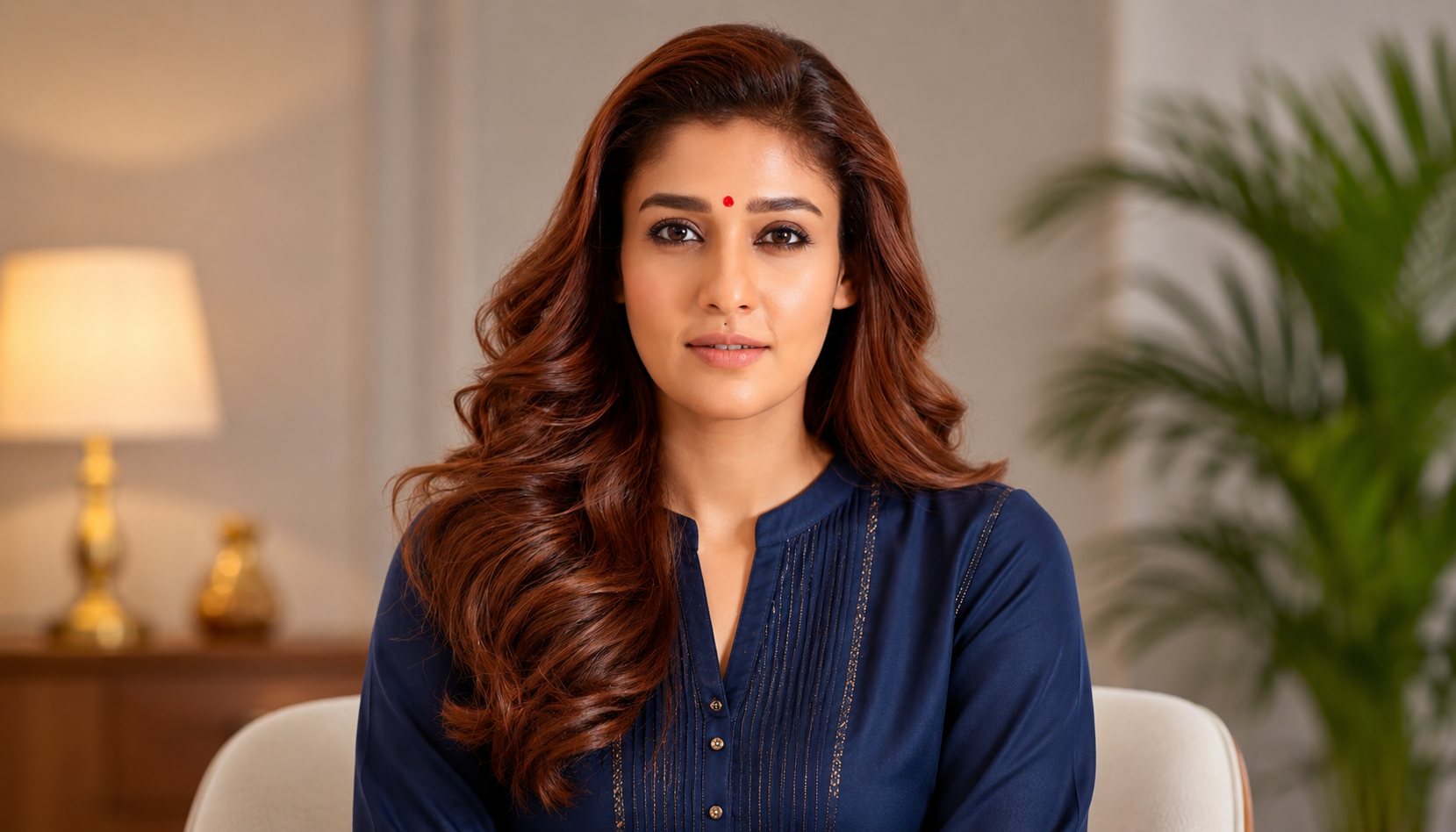
Nayanthara
Indian actress and film producer
Nayanthara is one of the most influential and highest-paid actresses in Indian cinema, widely known as the “Lady Superstar” of South Indian films. She has built a remarkable career with critically acclaimed and commercially successful performances across Tamil, Telugu, and Malayalam cinema. With a career spanning over two decades, she continues to set new benchmarks through powerful female-led roles and successful ventures as a producer.
Key Facts
• Full Name: Nayanthara (born Diana Mariam Kurian)
• Date of Birth: 18 November 1984
• Birthplace: Bengaluru, Karnataka, India
• Profession: Actress, Film Producer
• Film Debut: Manassinakkare (2003)
Few actresses in Indian cinema have enjoyed the kind of influence, longevity and popularity that Nayanthara commands today. Celebrated as the “Lady Superstar” of South Indian cinema, she has built a career that spans multiple industries, languages and generations of moviegoers. Yet her journey to the top was far from predictable.
Born as Diana Mariam Kurian on November 18, 1984, she grew up in a family that frequently moved because of her father’s service in the Indian Air Force. As a result, her childhood was spread across different parts of the country, exposing her to diverse cultures and experiences. Despite the constant relocations, she excelled in academics and was known for her quiet confidence.
Before entering films, she pursued a bachelor’s degree in English Literature and briefly worked as a model. Cinema was never part of a carefully planned career path. In fact, acting arrived unexpectedly, changing the course of her life in ways she could never have imagined.
The Early Rise of Nayanthara
Nayanthara’s entry into cinema was almost accidental. While pursuing her studies, she worked part-time as a model and had little interest in becoming an actress. Director Sathyan Anthikad noticed her through a modelling assignment and offered her a role in Manassinakkare (2003). Though she initially declined, she eventually agreed to do what she believed would be just one film. The movie became a major success and introduced audiences to a fresh talent with a natural screen presence. She followed it with Natturajavu and Vismayathumbathu, both opposite Mohanlal. Her performance in Vismayathumbathu, in particular, earned widespread praise and established her as one of the most promising newcomers in Malayalam cinema.
The growing attention soon opened doors beyond Kerala. In 2005, she made her Tamil debut with Ayya and quickly impressed audiences and critics alike. The same year, she appeared in Chandramukhi, one of the biggest blockbusters in Tamil cinema, a film that dramatically elevated her popularity. She also continued working in Malayalam through films such as Thaskara Veeran and Rappakal, while making memorable appearances in Ghajini and Sivakasi. Within a short period, she had become a familiar face across multiple South Indian film industries.
By 2006, Nayanthara’s career had gained remarkable momentum. She expanded into Telugu cinema with Lakshmi and Boss, I Love You, while simultaneously handling major Tamil releases such as Vallavan, Thalaimagan and E. Audiences appreciated her ability to adapt to different genres and characters, whether in romance, drama, thriller or commercial entertainers. What began as an unexpected opportunity had, within just a few years, transformed her into one of the most sought-after actresses in South Indian cinema.
A Breakthrough Across South Indian Cinema
By the late 2000s, Nayanthara had firmly established herself as one of the most sought-after actresses in South Indian cinema. A major turning point came with Billa (2007), where her stylish screen presence and confident performance attracted widespread attention. The film became a commercial success and marked a new phase in her career. The same year, she scored another hit with the Telugu action drama Tulasi, strengthening her popularity beyond Tamil cinema.
The momentum continued with films such as Yaaradi Nee Mohini, Kuselan, Satyam, Aegan, Villu and Aadhavan. Among them, Yaaradi Nee Mohini stood out for showcasing a different side of her acting ability. Audiences and critics appreciated her emotional performance, proving that she was capable of much more than glamorous roles. By this stage, Nayanthara had become a familiar face in both Tamil and Telugu cinema, with filmmakers increasingly trusting her with substantial characters.
Success Across Languages
The year 2010 was particularly significant. Nayanthara delivered a remarkable run of successful films across four South Indian languages, including Adhurs, Body Guard, Simha, Boss Engira Bhaskaran and Super. Each film strengthened her standing as a leading actress, while Body Guard earned her major recognition in Malayalam cinema. At the same time, she impressed critics with her performance in Shyamaprasad’s Elektra, a film that revealed a more intense and mature side of her acting abilities.
A Career-Defining Performance
In 2011, Nayanthara took on one of the most challenging roles of her career in Sri Rama Rajyam, portraying Sita. The performance received widespread acclaim and is still regarded as one of her finest. Her graceful and restrained portrayal earned her major awards and reinforced her reputation as a performer capable of balancing commercial success with critically acclaimed work. At the time, many believed the film would mark the end of her acting career as reports suggested she was stepping away from cinema.
The Comeback That Changed Everything
After a brief break, Nayanthara returned with Krishnam Vande Jagadgurum, where she played a journalist in a role that earned positive reviews. However, it was Raja Rani (2013) that truly signalled her triumphant comeback. Playing Regina, a woman struggling within an unhappy marriage, she delivered one of the most acclaimed performances of her career. The film was both a critical and commercial success and earned her major accolades. Later that year, Arrambam further strengthened her comeback story, proving that she had returned to the industry stronger than ever.
By the end of 2013, Nayanthara was no longer simply a leading actress. She had become one of the most influential stars in South Indian cinema, admired for her ability to combine box-office appeal with performances of genuine depth and substance.
The Rise of the Lady Superstar
The years after 2014 marked the most defining phase of Nayanthara’s career. While she continued to appear in mainstream commercial films, she increasingly chose stories that revolved around strong female characters. Films such as Anaamika and Maya signalled this shift. Among them, Maya emerged as a major success and proved that a woman-led film could draw audiences to theatres purely on the strength of its story and central performance. Her portrayal of a single mother caught in a mysterious situation earned widespread appreciation and marked the beginning of a new chapter in her career.
At the same time, Nayanthara maintained a strong presence in mainstream cinema through successful films such as Bhaskar the Rascal, Thani Oruvan and Naanum Rowdy Dhaan. The latter became particularly significant, with her portrayal of Kadambari winning praise from critics and audiences alike. She followed it with another memorable performance in Puthiya Niyamam opposite Mammootty, where she played a woman seeking justice after a traumatic experience. The role earned her major recognition and further strengthened her reputation as an actress willing to take on challenging characters.
Leading Films on Her Own Terms
By 2017, Nayanthara had become one of the few actresses capable of carrying a film entirely on her own. Dora and Aramm showcased her growing influence, with Aramm earning particular acclaim for her portrayal of a determined district collector. The success of the film reinforced her position as one of the most powerful female stars in South Indian cinema. She continued this momentum with Velaikkaran, followed by the highly successful Kolamaavu Kokila and Imaikkaa Nodigal in 2018. Both films highlighted her ability to balance commercial appeal with performance-driven roles.
The following years saw her expand her reach even further. She appeared in major productions such as Viswasam, Bigil, Sye Raa Narasimha Reddy and Love Action Drama, while continuing to choose female-centric projects like Airaa. Her popularity extended across Tamil, Telugu and Malayalam cinema, making her one of the most bankable stars in the region. Notably, Love Action Drama drew attention for placing her on equal footing with the male lead, reflecting the stature she had achieved within the industry.
A Star at the Peak of Her Powers
Even after reaching the top, Nayanthara showed little interest in repeating herself. Films such as Mookuthi Amman, Netrikann, Nizhal, Kaathuvaakula Rendu Kaadhal, O2, Gold, Godfather and Connect demonstrated her willingness to experiment with genres ranging from mythology and thriller to comedy, survival drama and horror. Her performance in Netrikann, where she played a visually impaired woman determined to uncover the truth, received particular praise and once again highlighted her versatility.
By the early 2020s, Nayanthara had achieved something rare in Indian cinema. She was not only one of the industry’s most successful actresses but also a star whose name alone could attract audiences to theatres. Through careful choices, consistent performances and an ability to reinvent herself, she transformed from a popular heroine into a phenomenon widely celebrated as the Lady Superstar of South Indian cinema.
A Successful Step into Hindi Cinema
After conquering the South Indian film industries, Nayanthara expanded her reach to Bollywood with Jawan, starring opposite Shah Rukh Khan. The action thriller became one of the biggest box-office successes in Indian cinema and introduced her to an even wider audience across the country. Playing a determined officer, she held her own alongside one of Bollywood’s biggest stars and received praise for her confident screen presence. The film marked an important milestone in a career that had already spanned two decades.
Continuing Her Success Across Industries
In the same period, Nayanthara continued to balance commercial entertainers with character-driven roles. She appeared in Iraivan and later reunited with Jai in Annapoorani: The Goddess of Food, where she played an aspiring chef pursuing her dreams despite social and personal challenges. While the film generated discussion and controversy after its release, her performance received appreciation from many viewers and critics. By this stage, she had firmly established herself as one of the highest-paid and most influential actresses in South Indian cinema.
Personal Life
Away from the spotlight, Nayanthara has generally preferred to keep her personal life private. A significant chapter in her life began during the making of Naanum Rowdy Dhaan, where she met filmmaker Vignesh Shivan. Their relationship gradually became one of the most admired partnerships in the South Indian film industry, and the couple married in 2022 in a private ceremony attended by close family members and friends.
Later that year, they welcomed twin sons, a moment that brought immense joy to their family and was warmly celebrated by fans. Today, while continuing to balance a demanding film career, Nayanthara remains deeply committed to her family life. Her ability to maintain that balance while staying at the top of a highly competitive industry has further strengthened the admiration she enjoys among audiences across India.
Nine: Nayanthara’s Entrepreneurial Journey
Beyond cinema, Nayanthara has successfully expanded her presence into the business world through Nine, a skincare and wellness brand she co-founded. The venture reflects her growing interest in entrepreneurship and her desire to build something beyond her identity as a film star.
Launched with a focus on beauty, self-care and wellness, Nine entered a highly competitive market but quickly attracted attention because of its emphasis on quality products and a strong brand identity. Rather than being a celebrity endorsement project, Nine has been positioned as a business in which Nayanthara plays an active role alongside her husband, filmmaker Vignesh Shivan.
The brand’s growth has highlighted another side of Nayanthara’s personality — that of a modern entrepreneur willing to explore opportunities beyond the entertainment industry. While she continues to be one of South India’s most sought-after actresses, Nine represents her efforts to create a lasting business legacy alongside her achievements in cinema.
Today, the success of Nine adds another dimension to Nayanthara’s public image. She is not only regarded as one of Indian cinema’s leading actresses but also as a businesswoman who has successfully translated her popularity and influence into a growing entrepreneurial venture.
Awards and Recognition
• Best New Face of the Year – Asianet Film Awards – Manassinakkare (2003)
• Best Actress – Asianet Film Awards – Body Guard (2010)
• Best Actress (Jury) – CineMAA Awards – Sri Rama Rajyam (2011)
• Best Actress – Edison Awards – Raja Rani (2013)
• Best Actress – Edison Awards – Naanum Rowdy Dhaan (2015)
• Best Actress – Edison Awards – Aramm (2017)
• Best Actress – Edison Awards – Imaikkaa Nodigal (2018)
• Filmfare Award for Best Actress (Telugu) – Sri Rama Rajyam (2011)
• Filmfare Award for Best Actress (Tamil) – Raja Rani (2013)
• Filmfare Award for Best Actress (Tamil) – Naanum Rowdy Dhaan (2015)
• Filmfare Award for Best Actress (Malayalam) – Puthiya Niyamam (2016)
• Filmfare Award for Best Actress (Tamil) – Aramm (2017)
• Best Actress – International Indian Film Academy Awards – Maya (2015)
• Best Actress – Kerala Film Critics Association Awards – Puthiya Niyamam (2016)
• Best Actress – Nandi Awards – Sri Rama Rajyam (2011)
• Best Actress – Santosham Film Awards – Sri Rama Rajyam (2011)
• Best Actress – SIIMA Awards – Sri Rama Rajyam (2012)
• Best Actress (Critics) – SIIMA Awards – Krishnam Vande Jagadgurum (2013)
• Best Actress – SIIMA Awards – Naanum Rowdy Dhaan (2016)
• Best Actress – SIIMA Awards – Bhaskar the Rascal (Malayalam) (2016)
• Best Actress – SIIMA Awards – Iru Mugan (2017)
• Best Actress – SIIMA Awards – Puthiya Niyamam (2017)
• Best Actress – SIIMA Awards – Aramm (2018)
• Best Actress – SIIMA Awards – Viswasam (2020)
• Best Actress – SIIMA Awards – Annapoorani: The Goddess of Food (2024)
• Best Actress – Tamil Nadu State Film Awards – Raja Rani (2013)
• Best Actress – Tamil Nadu State Film Awards – Aramm (2017)
• Best Film – Tamil Nadu State Film Awards – Koozhangal (Producer) (2020)
• Favourite Heroine – Vijay Awards – Billa (2007)
• Favourite Heroine – Vijay Awards – Yaaradi Nee Mohini (2008)
• Favourite Heroine – Vijay Awards – Raja Rani (2013)
• Best Actress – Vijay Awards – Raja Rani (2013)
• Favourite Heroine – Vijay Awards – Aramm (2017)
• Best Actress – Vijay Awards – Aramm (2017)
• Best Actress – Ananda Vikatan Cinema Awards – Naanum Rowdy Dhaan (2015)
• Best Actress – Ananda Vikatan Cinema Awards – Aramm (2017)
A Legacy Still Being Written
Nayanthara’s story is one of persistence, reinvention and self-belief. From a newcomer in Malayalam cinema to one of the most influential actresses in Indian cinema, she has consistently challenged expectations and expanded the possibilities available to women in mainstream films.
Today, she stands as a symbol of independence and success in an industry often dominated by male stars. Yet perhaps her greatest achievement lies in the fact that she has remained relevant across changing trends, evolving audiences and shifting cinematic landscapes.
For millions of fans, Nayanthara is more than a star. She represents a generation of women who have proven that talent, determination and confidence can redefine the rules of success.