Kalamandalam Gopi
Kathakali Artist
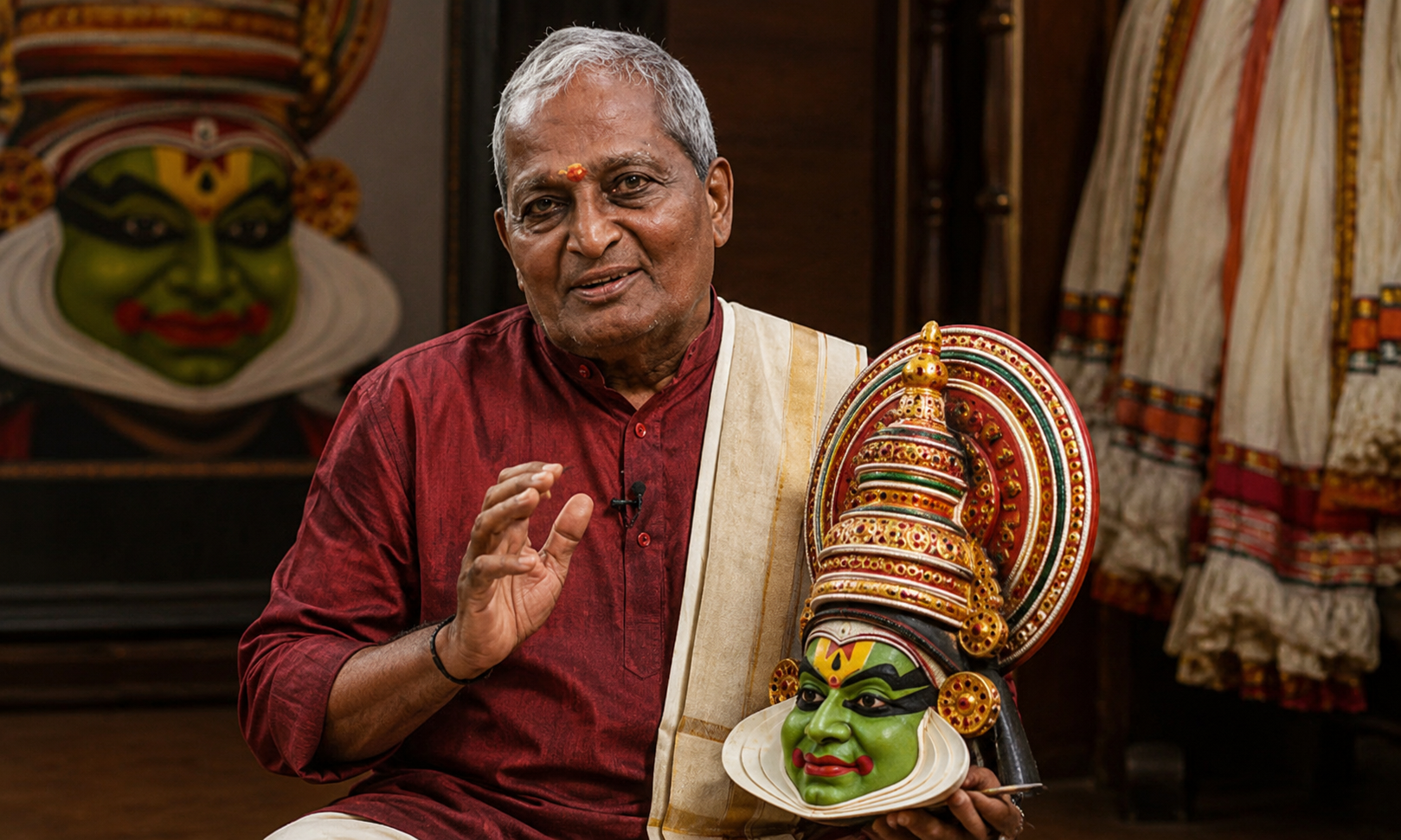
Vadakke Manalath Govindan Nair popularly known as Kalamandalam Gopi, is an Indian dancer who is an exponent of the classical dance-drama style known as Kathakali. He completed his formal lessons in the dance from the Kerala Kalamandalam in 1957. He began his career on the Kathakali stage in the 1960s and 1970s, but he had been appointed as a teacher at the Kerala Kalamandalam in 1957, by poet laureate Vallathol Narayana Menon, who had founded the school. In 1992, Gopi retired from the post as school principal and he is the only living performer of the art to have been appointed by Vallathol Narayana Menon himself. He is considered an icon of this dance performance.
Key Factors
Full Name: Vadakke Manalath Govindan Nair
Born: 1937
Birthplace: Kothachira, Kerala, India
Occupation: Kathakali Artist, Teacher, Principal
Known For: Mastery of pachcha roles and emotionally layered abhinaya in Kathakali
Major Roles: Nalan, Karnan, Rukmangadan, Bheeman, Arjuna, Dharmaputrar
National Recognition: Widely regarded as one of India’s greatest living Kathakali exponents
In the dim glow of traditional nilavilakku lamps, long before dawn breaks over Kerala’s temple courtyards, Kathakali begins as ritual before it becomes performance. The percussion rises slowly. Faces painted in layers of green, red, and white emerge from silence. Then, at the centre of the stage, a figure enters with measured dignity, his eyes carrying centuries of emotion before a single word is spoken. For generations of Malayalis, that presence often belonged to Kalamandalam Gopi. Whether as Nalan consumed by sorrow, Karnan torn between loyalty and destiny, or Bheeman radiating restrained fury, Gopi transformed Kathakali from stylized enactment into deeply human experience. Few artists have carried the emotional architecture of Kerala’s classical arts with such grace and discipline. Over decades, he evolved into not merely a performer, but an outstanding Malayali cultural institution whose face, gestures, and silences became inseparable from Kathakali itself.
Early Life and Childhood in Kerala
Kalamandalam Gopi was born as Vadakke Manalath Govindan Nair in Kothachira, a village landscape shaped by paddy fields, temples, rivers, and the rhythms of rural Kerala. The region belonged to an older Kerala where art forms were not separated from everyday life. Kathakali, Ottamthullal, temple festivals, percussion recitals, and oral storytelling existed not as elite cultural products, but as lived experiences.
His childhood unfolded within that atmosphere.
Yet his path into art was neither glamorous nor inevitable. Kerala’s classical performance traditions demanded extraordinary sacrifice. Training was physically punishing, economically uncertain, and emotionally consuming. Families often struggled to understand why young boys chose such difficult artistic lives.
Before Kathakali entered his life fully, Gopi briefly practiced Ottamthullal, the satirical solo dance tradition associated with the poet Kunchan Nambiar. That exposure introduced him to rhythm, dramatic expression, and performative storytelling. But Kathakali would eventually become his destiny.
The decisive turning point came through guru Thekkinkattil Ramunni Nair at Koodallur Mana near Kothachira. Under him, the young Govindan Nair entered the rigorous world of Kathakali training, a world governed by discipline, repetition, silence, and bodily control.
Journey into Kathakali
When Gopi joined Kerala Kalamandalam near Shoranur, the institution had already emerged as the spiritual and academic heart of Kerala’s classical performing arts. Founded by poet laureate Vallathol Narayana Menon, Kalamandalam represented a cultural renaissance project, an attempt to preserve and institutionalize art forms that were once confined to feudal patronage systems.
For students, life there was austere.
Kathakali training demanded complete surrender of the body. Artists woke before sunrise for physical exercises that stretched flexibility, strengthened muscles, and trained facial control. Eye movements alone required years of disciplined practice. The performer’s body had to become simultaneously athletic and expressive.
Gopi trained under some of the greatest gurus of the tradition, including Kalamandalam Ramankutty Nair, Kalamandalam Padmanabhan Nair, and Keezhpadam Kumaran Nair. Each teacher shaped different dimensions of his artistic personality.
What distinguished him early was emotional restraint.
Many Kathakali performers mastered technical brilliance, but Gopi gradually became known for internalizing emotion rather than merely displaying it. His performances carried psychological depth beneath stylized movement.
That quality would later define his greatest roles.
Remarkably, in 1957 itself, poet Vallathol appointed him as a teacher at Kerala Kalamandalam. It remains one of the defining symbolic moments in his career. Today, he is remembered as the only living Kathakali performer personally appointed by Vallathol Narayana Menon himself.
That connection placed him directly within the foundational history of Kerala’s modern classical arts movement.
Rise of a Kathakali Legend
By the 1960s and 1970s, Kalamandalam Gopi had emerged as one of Kathakali’s defining faces.
This was also a transformative period for Kathakali itself. The art form was moving beyond temple precincts and aristocratic patronage into cultural festivals, urban stages, international tours, and institutional spaces. Audiences were changing. Critics increasingly approached Kathakali not merely as ritual performance but as theatre, dance, literature, and psychological art.
Gopi adapted without diluting tradition.
He became especially celebrated for pachcha roles, the virtuous green-faced heroic characters central to Kathakali storytelling. These roles demanded not only technical precision but moral gravitas and emotional complexity.
His Nalan became legendary because it conveyed vulnerability without weakening heroism. Karnan, another iconic portrayal, revealed internal conflict and tragic dignity with unusual emotional realism. In Rukmangadan, he balanced regal authority with spiritual restraint.
Critics often observed that Gopi’s greatest strength lay in abhinaya, the subtle communicative power of facial expression and emotional interpretation.
In Kathakali, eyes speak before words do. A slight tremor of the eyelid, a controlled glance, or a gradual shift in facial tension can alter an entire scene’s emotional meaning. Gopi mastered this silent language with rare sensitivity.
At the same time, he excelled in physically demanding roles such as Bheeman in Kalyanasougandhikam and Bakavadham, Arjuna in Subhadraharanam, and Dharmaputrar in Kirmeeravadham.
Even within highly codified structures, he found humanity.
The Artistry of Kalamandalam Gopi
To understand Kalamandalam Gopi’s significance, one must understand that Kathakali is not realism in the conventional sense. It is stylized theatre governed by gesture systems, musical structures, costume architecture, and symbolic color codes.
Yet Gopi introduced emotional immediacy into that stylization.
His pachcha characters carried extraordinary psychological detail. Rather than presenting heroes as distant mythological icons, he revealed their doubts, grief, pride, tenderness, and moral conflicts.
As Karnan, he communicated the tragedy of loyalty and abandonment with haunting intensity. As Nalan, romantic anguish became almost painfully intimate. His facial control allowed transitions between emotional states to unfold gradually, almost cinematically.
Importantly, his performances never abandoned Kathakali grammar. Instead, he expanded its emotional possibilities from within tradition.
This balance between discipline and emotional accessibility made him deeply respected among scholars, critics, and audiences alike.
Partnership and Stage Legacy
Among Kathakali enthusiasts, the partnership between Kalamandalam Gopi and Kottakkal Sivaraman became almost historic.
Sivaraman was celebrated for female roles, while Gopi embodied heroic male protagonists. Together, they created performances remembered for emotional chemistry and theatrical elegance.
Their stage interactions transcended technical choreography. Audiences often described an almost musical synchronization between them, where gesture, rhythm, and emotional timing aligned seamlessly.
As later generations emerged, Gopi also collaborated with younger performers including Margi Vijayakumar, ensuring continuity across generations.
Teacher, Mentor, and Cultural Guardian
While audiences celebrated the performer, Kerala Kalamandalam witnessed another dimension of Gopi: the teacher.
He eventually became principal of the institution and retired from the post in 1992. His years as educator were crucial because Kathakali depends on oral transmission and embodied learning. Textbooks alone cannot preserve the art form.
Students learned not only technique from him, but artistic ethics.
Those who trained under him frequently recalled his insistence on humility, rigor, and emotional sincerity. He viewed Kathakali not as spectacle alone, but as spiritual discipline and cultural responsibility.
In many ways, Gopi belonged to the last generation directly linked to Kathakali’s older gurukula tradition while simultaneously navigating modern institutional culture.
That bridge made him invaluable to Kerala’s artistic continuity.
Beyond the Stage
Though inseparable from Kathakali, Gopi occasionally stepped into cinema as well.
His appearance in Vanaprastham introduced broader audiences to the emotional world of Kathakali performers. Directed by Shaji N. Karun and starring Mohanlal, the film explored the tension between artistic greatness and personal suffering within classical performance traditions.
Filmmaker Adoor Gopalakrishnan also documented him in the film Kalamandalam Gopi, screened at the International Film Festival of India in 2000 and other festivals globally. The documentary captured not merely a performer, but an artistic philosophy shaped by decades of devotion.
Later, journalist Meena Narayan directed the docu-fiction Making of a Maestro, tracing his journey from childhood onward.
Through such works, Gopi became one of the internationally recognizable faces of Kathakali.
Awards, Honours, and Recognition
The Government of India honoured Kalamandalam Gopi with the Padma Shri in 2009, recognizing his contribution to Indian classical arts.
Yet within Kerala, his recognition transcended formal awards.
Sangeet Natak Akademi Award (1987), the prestigious Kalidas Samman (2021), and the Kerala State Kathakali Puraskaram (2014).
For many Malayalis, he represents a living archive of Kathakali itself. His performances are discussed not merely as entertainment but as cultural memory. Institutions, critics, and scholars consistently identify him among the greatest exponents of the art form in the post-independence era.
Such honours matter because classical arts survive not through market popularity alone, but through sustained cultural respect.
Artists like Gopi preserved forms that require lifelong discipline in an age increasingly driven by speed and commercial visibility.
Kalamandalam Gopi and the Soul of Kerala
Perhaps the most remarkable thing about Kalamandalam Gopi is how fully he embodies Kerala’s artistic temperament.
Kathakali in his hands became more than mythology or visual grandeur. It became emotional philosophy. Through him, audiences encountered the inner lives of epic characters not as distant legends, but as reflections of human struggle.
His artistic journey also mirrors Kerala’s broader cultural history: the preservation of tradition alongside modernity, the dignity of rigorous learning, and the belief that art carries ethical as well as aesthetic responsibility.
Even his public persona reflects that sensibility. Despite national recognition, he remained deeply rooted in the humility and discipline associated with Kerala’s classical arts culture.
In an era increasingly dominated by instant visibility, Gopi’s life stands as testimony to slower forms of artistic greatness, those built through repetition, patience, silence, and devotion.
Reflection
Today, when Kalamandalam Gopi steps onto a Kathakali stage, audiences do not merely watch a performer. They witness an entire cultural lineage breathing through one individual. The oil lamps, the percussion, the painted face, the measured glance, the stillness before emotion erupts, all carry echoes of a Kerala that continues to survive through its artists.
Across decades, he preserved not just Kathakali’s technique, but its emotional soul. Through Nalan’s sorrow, Karnan’s dignity, and Bheeman’s force, he transformed epic characters into deeply human presences. Teacher, performer, cultural guardian, and artistic philosopher, Kalamandalam Gopi remains one of the truly outstanding Malayalis who carried Kerala’s classical heritage into the modern world without allowing it to lose its spiritual depth.
Awards
1995 – Kerala Sangeetha Nataka Akademi Award
2006 – Kerala Sangeetha Nataka Akademi Fellowship
2009 – Padma Shri
2011 – Sangeet Natak Akademi Fellowship