
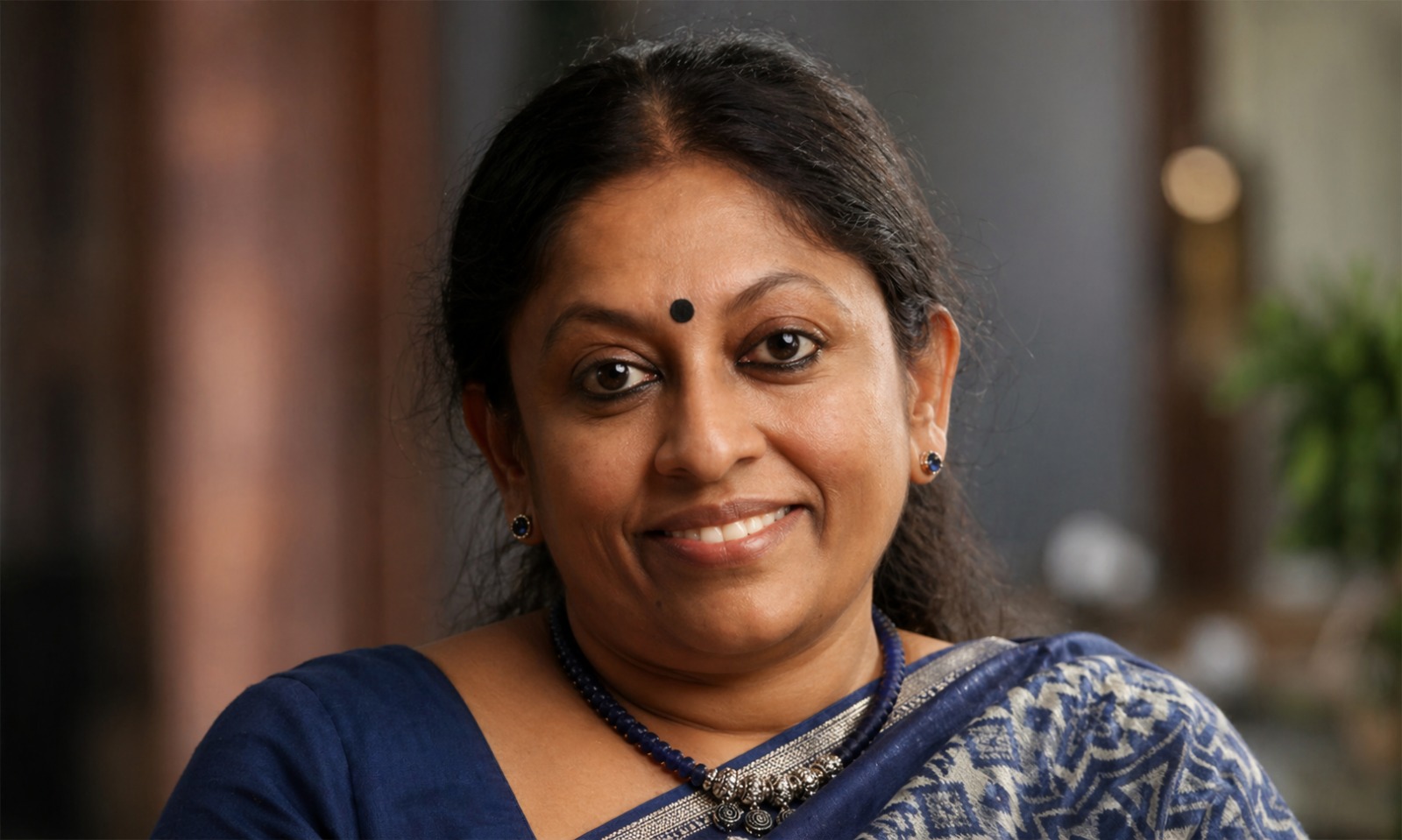
K. R. Meera
Novelist, Short story writer, Journalist
Born: 19 February 1970 (age 56)
Place: Sasthamkotta, Kollam district, Kerala, India
Title: Novelist, Short story writer, Journalist, Screenplay writer, Columnist
Genre: Novel, short story
The Weight of a Sentence
In Aarachar, the act of execution is not merely procedural, it becomes intimate, philosophical, almost unbearable. Chetna Grddha Mullick, the hangwoman at the center of the narrative, does not simply perform a duty; she inhabits a history of violence, inheritance, and gendered expectation. The rope tightens not just around the condemned, but around the idea of justice itself. This is the terrain of K. R. Meera, where power is never abstract and morality is never stable. Her fiction does not offer clarity; it confronts. There is an outstanding precision in her writing, a refusal to dilute complexity, that has made her one of the most formidable voices in contemporary Malayalam literature.
Journalism, Language, and the Making of a Voice
K. R. Meera was born in Kerala, a region whose literary and political cultures are deeply intertwined. Her upbringing unfolded within a society that prides itself on progressive values, literacy, and social awareness, yet continues to grapple with entrenched hierarchies of gender and power.
She pursued higher education in Malayalam literature, developing an early engagement with language not just as expression but as inquiry. This academic grounding would later inform the structural precision of her prose.
Before emerging as a major literary figure, Meera worked as a journalist with Malayala Manorama. Journalism played a crucial role in shaping her sensibility. It exposed her to the realities of society, its violence, contradictions, and silences.
This exposure sharpened her observational skills.
Her fiction would later carry the imprint of reportage, not in form, but in its attention to detail, its insistence on confronting uncomfortable truths.
Her transition from journalism to literature was not abrupt. It was a gradual shift from documenting reality to interrogating it.
From Observation to Confrontation
K. R. Meera’s early works signaled the arrival of a distinct voice.
Her short stories gained attention for their psychological depth and thematic boldness. They did not rely on dramatic plots but on the internal landscapes of characters, particularly women navigating systems of power.
Her transition to long-form fiction marked a deepening of these concerns.
Novels allowed her to explore complex structures, familial, social, political, with greater nuance. She moved from observing individual experiences to examining systemic forces.
Her writing began to occupy a space where literature intersected with ethics.
Readers and critics recognized that Meera was not merely telling stories; she was constructing moral and philosophical inquiries.
Violence, Power, and the Feminist Imagination
K. R. Meera’s major works form a coherent yet evolving body of literature.
Aarachar remains her most widely discussed novel. It is both a character study and a meditation on justice. Through Chetna, Meera examines how violence is institutionalized and how individuals internalize roles imposed by history.
The novel’s feminist dimension is complex.
Chetna is not presented as a victim or a hero. She is shaped by patriarchy yet exercises agency within its constraints. This ambiguity is central to Meera’s writing.
In Sooryane Aninja Oru Sthree, the focus shifts to the emotional and psychological experiences of women, exploring themes of love, betrayal, and selfhood.
Ghathakan continues her exploration of violence, but with a different narrative approach, examining guilt, morality, and the blurred lines between perpetrator and victim.
Across her works, certain themes recur.
Power is omnipresent. Not just in institutions, but in relationships, language, and memory. Violence is not always physical; it manifests in silence, control, and erasure.
Her feminism is not declarative. It emerges through narrative, through the lived experiences of her characters, revealing the structures that shape their lives.
Precision and Intensity
K. R. Meera’s prose is marked by clarity and intensity.
Her sentences are controlled, often measured, yet capable of carrying significant emotional weight. She avoids ornamental language, choosing instead a precision that enhances impact.
Interior monologue plays a crucial role. Her narratives often unfold through the consciousness of characters, allowing readers to inhabit their thoughts, contradictions, and conflicts.
Symbolism is present but restrained. Objects and actions acquire meaning through context rather than explicit interpretation. A rope, a gesture, a silence, becomes a site of meaning.
Structurally, her works resist linear simplicity. They move between time, memory, and perspective, creating narratives that require active engagement.
This distinguishes her from many contemporaries. While some rely on plot-driven storytelling, Meera prioritizes psychological and thematic depth.
Politics, Gender, and Society: Literature as Intervention
K. R. Meera’s work is deeply political.
Not in the sense of overt ideological messaging, but in its engagement with structures of power. Her fiction interrogates patriarchy, not as an abstract concept, but as a lived reality embedded in everyday life.
Her representation of women is significant. They are not confined to traditional roles or simplified narratives. Instead, they exist as complex individuals navigating systems that both constrain and define them.
Justice is a recurring concern. Her works question legal, moral, and social definitions of justice, exposing their inconsistencies and biases.
In the context of Kerala’s socio-political discourse, her writing serves as a counterpoint.
It challenges the state’s self-image, revealing the gaps between progressive ideals and lived realities.
Institutional Acknowledgment of a Difficult Voice
K. R. Meera’s work has received significant recognition, including the Kerala Sahitya Akademi Award and the Kendra Sahitya Akademi Award. These honors acknowledge her contribution to Malayalam literature.
However, awards do not fully capture her impact. Her writing often provokes discomfort. It resists easy categorization, making it both critically acclaimed and challenging for readers.
This tension between recognition and resistance is central to her position in contemporary literature.
Beyond the Page
K. R. Meera is not only a writer but also a public intellectual.
Her essays, interviews, and public statements extend the concerns of her fiction into broader discourse. She engages with issues of gender, justice, and culture, often articulating positions that challenge dominant narratives.
Her relationship with readers is complex. She does not seek to please or reassure. Instead, she invites engagement, sometimes confrontation.
Critics have responded with both admiration and scrutiny. Her work is taken seriously, not as popular literature, but as a significant contribution to contemporary thought.
Writing Against Simplification
K. R. Meera’s place in Malayalam literature is already firmly established.
She represents a shift toward narratives that prioritize complexity over comfort. Her work expands the possibilities of fiction, demonstrating that literature can engage deeply with ethical and political questions without losing narrative power.
For younger writers, she offers a model of rigor. A commitment to craft, to thought, and to the refusal of simplification. Her relevance extends beyond literature.
In a world increasingly shaped by polarized discourse and reductive narratives, her writing insists on nuance. It demands that readers confront ambiguity, question assumptions, and engage with uncomfortable truths.
This is her outstanding legacy. Not merely a body of work, but a way of thinking, a refusal to accept easy answers, and a persistent interrogation of the structures that shape human life.
Awards and honours
2004: Lalithambika Sahitya Award
2004: Gita Hiranyan Endowment Award by Kerala Sahitya Akademi – Ormayude Njarampu
2009: Kerala Sahitya Akademi Award for Story – Ave Maria
2013: Odakkuzhal Award – Aarachaar
2013: Kerala Sahitya Akademi Award for Novel – Aarachaar
2014: Vayalar Award – Aarachaar
2015: Kendra Sahitya Akademi Award – Aarachaar
2016: Shortlisted for the DSC Prize for South Asian Literature – Hangwoman (Translated by J. Devika)
2018: Muttathu Varkey Award – Aarachaar