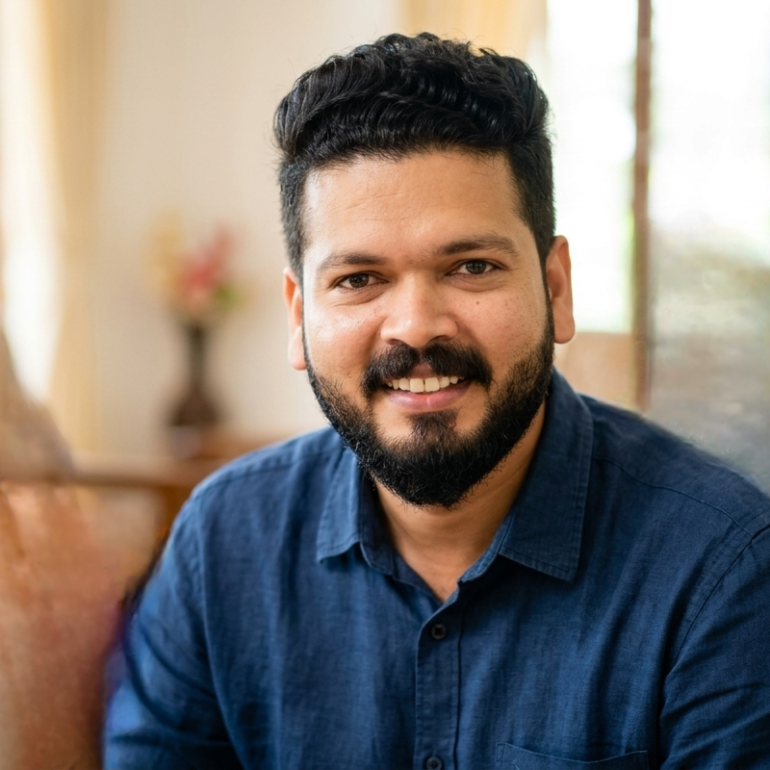
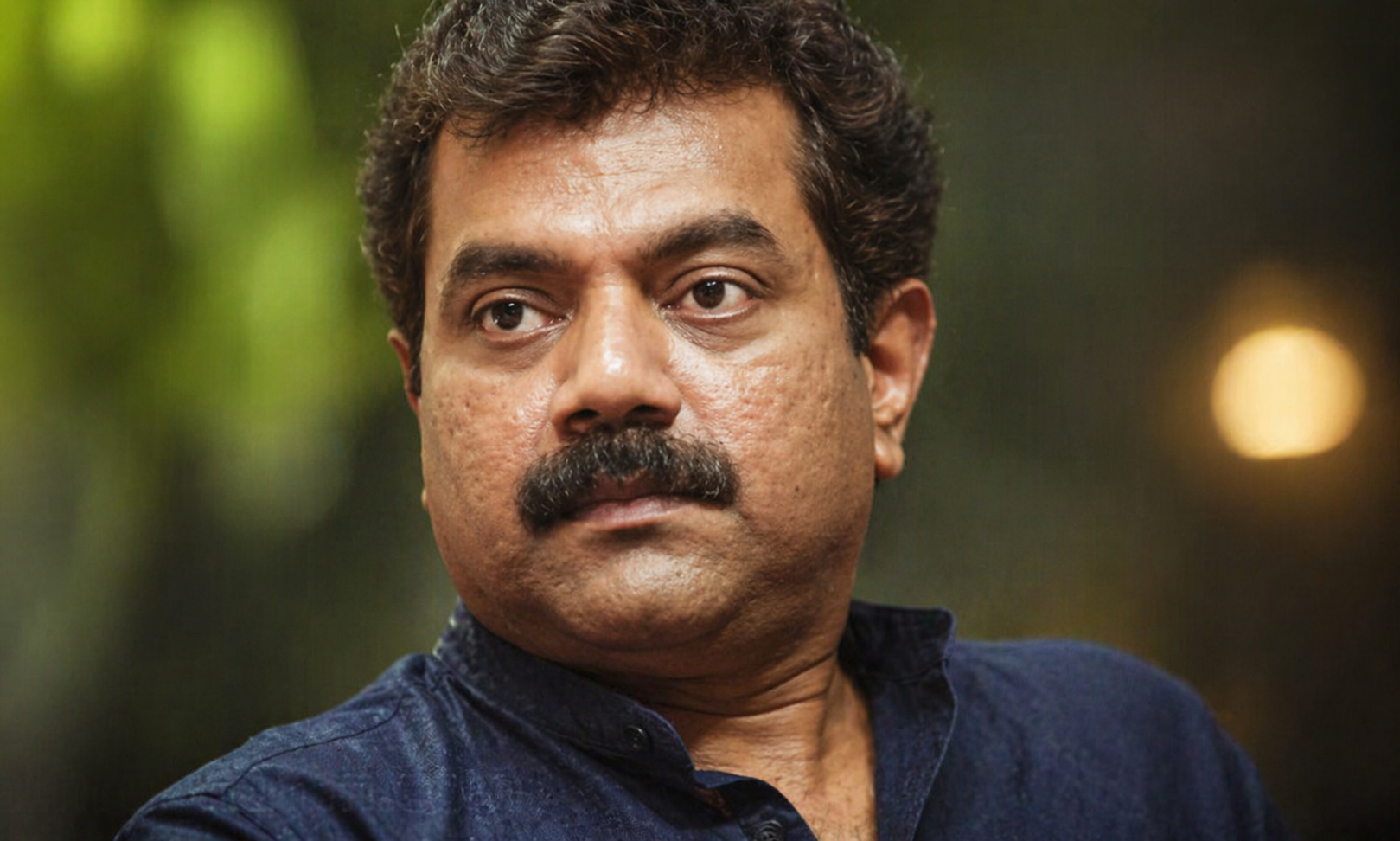
Subhash Chandran
Novelist
In Manushyanu Oru Aamukham, life does not unfold as a sequence of events but as a layered recollection, memory returning not in order, but in fragments. Jithendran’s existence is reconstructed through absences, silences, and the quiet erosion of time. Death is not an endpoint here; it is a lens through which life is reassembled. Manushyanu Oru Aamukham resists the conventional arc of storytelling, choosing instead to dwell in the unresolved. This is where Subhash Chandran distinguishes himself. His fiction does not narrate life as lived, but as remembered, distorted, and questioned. It is an outstanding literary space where narrative becomes inquiry, and the act of reading transforms into an act of reflection.
Born: 1972 (age 53–54)
Place: Kadungalloor, Ernakulam District, Kerala
Title: Writer
Genre: Fiction
A Mind Shaped by Kerala’s Cultural Density
Subhash Chandran was born in Kerala, a region where literature is not peripheral but central to cultural identity. The state’s intellectual tradition, shaped by political engagement, philosophical debate, and a deep reading culture, provided a fertile environment for his development.
His early life unfolded within this context, where books, newspapers, and public discourse intersected. Unlike writers who emerge from isolated literary pursuits, Chandran’s sensibility appears to have been shaped by the collective intellectual climate of Kerala.
He pursued higher education and developed an interest in literature that extended beyond storytelling into philosophical inquiry. His engagement with Malayalam literary traditions, as well as broader Indian and global influences, contributed to a voice that is both rooted and expansive.
His entry into writing was gradual.
Short stories became his initial medium, allowing him to explore narrative structures and thematic concerns without the scale of a novel. These early works revealed a writer interested not in external drama, but in internal states, memory, perception, and the passage of time.
The Emergence of a Distinct Literary Voice
Subhash Chandran’s breakthrough came with Manushyanu Oru Aamukham, a novel that redefined narrative expectations within contemporary Malayalam literature.
The novel does not follow a linear progression. Instead, it constructs a life through recollection, examining how memory shapes identity. Jithendran, the central figure, is less a character in the conventional sense and more a presence assembled through fragments.
This structural choice is significant.
It reflects Chandran’s broader literary concern, that life cannot be fully understood in the moment of its occurrence. Meaning emerges retrospectively, through memory, reinterpretation, and loss.
His short stories further develop these ideas.
They often focus on seemingly ordinary situations, a relationship, a moment of reflection, a quiet interaction, but expand them into philosophical inquiries. The external world remains minimal, while the internal landscape becomes expansive.
His writing resists resolution.
Stories do not conclude so much as they dissolve, leaving readers with questions rather than answers.
Time as a Central Character
At the heart of Subhash Chandran’s work lies an engagement with time.
Time, not as chronology, but as experience.
His narratives explore how time alters perception, how memory reshapes reality, and how identity is constructed through what is remembered and what is forgotten.
Death is a recurring motif, not as an event, but as a perspective.
By situating narratives in relation to mortality, Chandran forces a reconsideration of life’s significance. His characters often exist in a state of reflection, aware, consciously or subconsciously, of the transient nature of existence.
His style blends realism with metaphysical inquiry.
Settings are grounded, familiar, recognizable Kerala landscapes, domestic spaces, social interactions. Yet, within these settings, the narrative moves toward abstraction, questioning the nature of self and existence.
Language is measured and precise.
There is a deliberate pacing in his prose, allowing thoughts to unfold gradually. Sentences often carry a reflective quality, inviting the reader to pause rather than proceed.
Place in Malayalam Literature: Continuity and Departure
Subhash Chandran’s work exists within a rich lineage of Malayalam literature, yet it marks a distinct departure.
Writers like M. T. Vasudevan Nair explored human relationships with psychological depth, while O. V. Vijayan introduced existential and philosophical dimensions into narrative.
Chandran engages with both traditions but extends them.
His focus on memory and temporality introduces a different narrative logic, one that prioritizes reflection over progression. Unlike socially driven narratives that foreground external conflict, his work turns inward, examining the architecture of consciousness.
Among contemporaries, his writing stands out for its intellectual density.
It does not seek mass appeal, but neither is it inaccessible. It occupies a space where literary rigor meets emotional resonance.
Critical Interpretation: Why Subhash Chandran Matters
Subhash Chandran’s importance lies in his ability to reframe fundamental questions.
What is a life?
Is it the sequence of events we experience, or the memories we construct afterward? How does death alter the meaning of existence? Can identity be stable in the face of time’s constant transformation?
His work does not answer these questions. It sustains them.
In a literary culture that often oscillates between social realism and narrative experimentation, Chandran occupies a space that integrates both, grounding philosophical inquiry in lived experience.
His writing resonates in a contemporary context where questions of identity, memory, and meaning have become increasingly complex.
Literature as Reflection
Subhash Chandran’s legacy is not defined by volume, but by depth.
His work continues to influence readers and writers who seek to explore narrative beyond surface-level storytelling. Younger writers, particularly those interested in psychological and philosophical themes, find in his work a model of restraint and rigor.
His place within Malayalam literature is secure, not as a dominant figure in terms of output, but as a writer who has expanded the possibilities of the form.
As literature evolves, his work remains relevant precisely because it does not anchor itself to a specific moment.
It engages with enduring questions.
In the end, Subhash Chandran’s writing asks us to reconsider not just stories, but the way we understand our own lives. It suggests that meaning is not immediate, that it emerges slowly, through reflection, through memory, through the quiet passage of time.
That is his outstanding contribution, to transform literature into a space where life is not merely narrated, but examined, questioned, and, perhaps, briefly understood.
Awards
2001: Kerala Sahitya Akademi Award for Story – Ghatikarangal Nilaykunna Samayam
2009: Abu Dhabi Sakthi Award (Story) – Parudeesa Nashtam
2011: Kerala Sahitya Akademi Award for Novel – Manushyanu Oru Amukham
2011: Odakkuzhal Award – Manushyanu Oru Amukham
2014: Kendra Sahitya Akademi Award – Manushyanu Oru Amukham
2015: Vayalar Award – Manushyanu Oru Amukham
2017: Abu Dhabi Sakthi Award (Drama) – Onnaramanikoor
2019: Padmarajan Award – Samudrashila
2023: Padmaprabha Literary Award