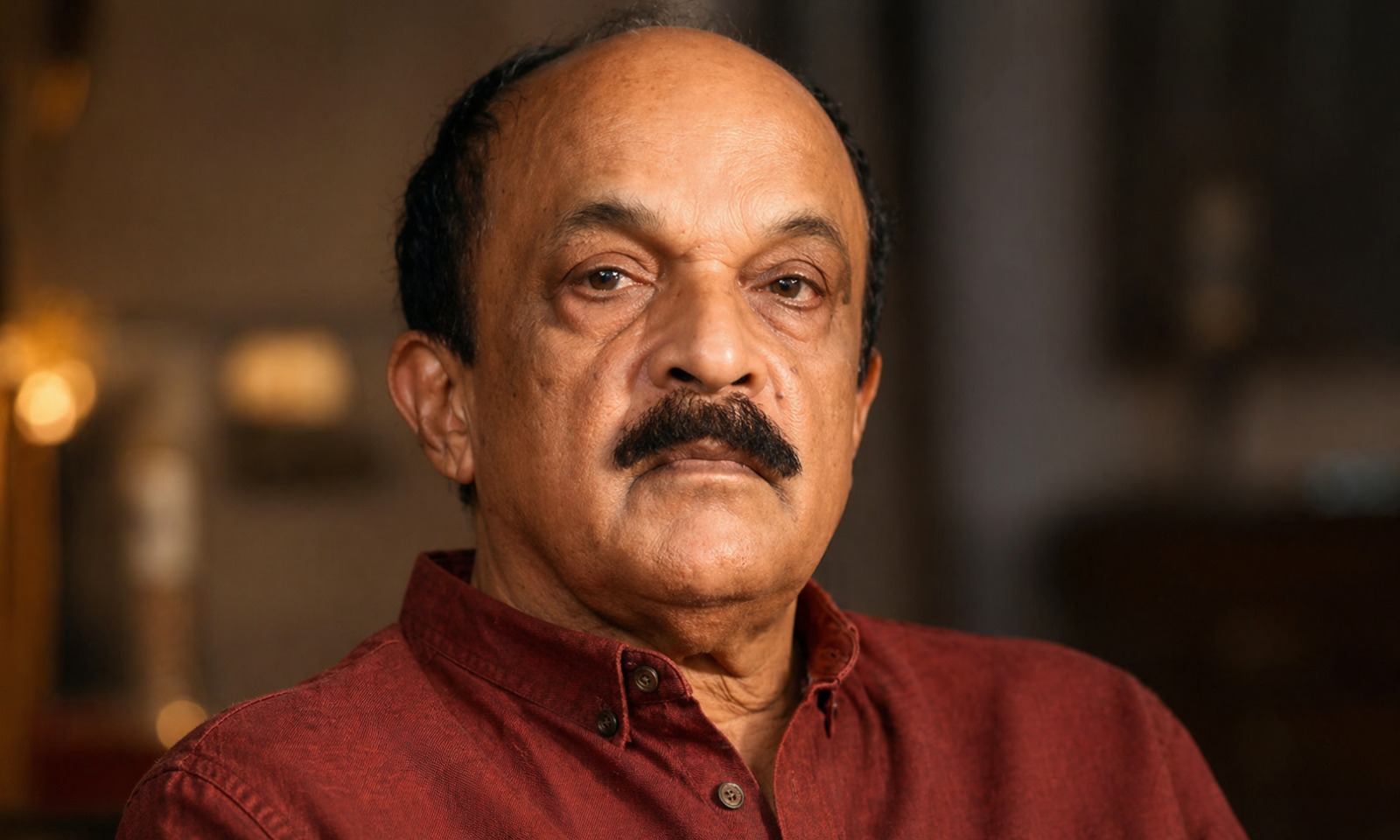
Paul Zacharia
Real name: M. P. Scaria
Born: 5 June 1945 (age 80)
Place: Urulikunnam, Travancore, (present day, Kottayam district, Kerala)
Title: Short story Writer, Novelist, Essayist
Growing Within a Culture of Debate
Paul Zacharia was born in 1945 in Kerala, in a period when the region was undergoing profound socio-political transformation. The decades following independence saw the emergence of strong leftist movements, social reform initiatives, and an expanding literary culture that encouraged critical engagement.
His upbringing unfolded within this environment of debate and dissent.
Kerala’s intellectual climate, shaped by political activism, religious diversity, and a deep engagement with literature, provided fertile ground for a questioning mind. Zacharia’s early exposure to reading was not confined to Malayalam texts alone; he engaged with global literature, philosophy, and political thought.
Education played a significant role in shaping his intellectual trajectory. He pursued studies in English literature, which opened pathways to modernist and postmodernist traditions. Writers who challenged narrative authority, explored absurdity, and questioned the nature of reality influenced his thinking.
From the beginning, Zacharia’s orientation was not toward affirmation but toward interrogation.
A Voice That Refused Conformity
Zacharia entered Malayalam literature through short fiction, a form that allowed for experimentation and compression. His early stories stood apart.
At a time when much of Malayalam writing was engaged with social realism or romantic narratives, Zacharia introduced a different tone, ironic, minimalist, and philosophically inclined. His narratives often resisted clear moral positions, instead presenting situations that invited interpretation.
Recognition came gradually. Critics noted his distinct voice, while readers encountered a style that required active engagement. His work did not offer immediate emotional satisfaction; it demanded reflection.
This refusal to conform became central to his identity as a writer.
The Precision of Irony
Paul Zacharia’s writing is defined by its restraint.
He employs minimalism not as an aesthetic choice alone but as a philosophical stance. His sentences are often concise, stripped of excess, allowing meaning to emerge through implication.
Irony is central. Yet, it is not overt satire that seeks laughter. His irony is quieter, more unsettling. It reveals contradictions without resolving them.
Absurdity plays a significant role. Influenced by global literary traditions, particularly existentialist and absurdist writing, Zacharia constructs narratives where logic is subtly destabilized. Characters encounter situations that expose the fragility of meaning.
Narrative structure is often unconventional. Stories may begin without clear context, shift perspectives, or end abruptly. This fragmentation mirrors the uncertainty he seeks to explore.
The Human Condition Under Examination
Zacharia’s body of work includes short stories, novels, and essays that collectively examine the human condition through a critical lens.
His themes are consistent yet varied in expression. Existentialism is central.
His characters often confront meaninglessness, not as despair, but as a condition to be acknowledged. Life is presented without inherent structure, leaving individuals to navigate ambiguity.
Religion appears frequently. However, it is treated with skepticism. Zacharia examines how belief systems function, often revealing their contradictions and the ways in which they intersect with power.
Politics is another recurring concern. Rather than direct commentary, his work engages with political structures through allegory and satire. Power is depicted as both pervasive and absurd.
Human relationships, too, are explored with a critical eye. They are not romanticized but presented as complex, often shaped by misunderstanding, expectation, and limitation.
Writing Beyond Fiction
Beyond fiction, Paul Zacharia has established himself as a significant public intellectual.
His essays and columns engage directly with socio-political issues, offering perspectives that are often provocative. He addresses topics such as religion, governance, cultural identity, and freedom of expression.
His stance is marked by independence. He does not align himself easily with ideological positions. Instead, he critiques across boundaries, questioning both institutional authority and popular sentiment.
This role has led to debates. His writings sometimes provoke strong reactions, reflecting the discomfort inherent in his approach. Yet, this engagement with public discourse reinforces his position as a writer who refuses neutrality.
Between Modernism and Postmodernity
Paul Zacharia occupies a unique position within Malayalam literature.
He emerges from the modernist tradition but extends it toward postmodern concerns. Writers like O. V. Vijayan explored existential and philosophical themes, while others engaged with social realism.
Zacharia intersects with these traditions but diverges in tone and method.
His use of irony, minimalism, and narrative fragmentation aligns him with postmodern sensibilities. Yet, his engagement with fundamental philosophical questions retains a modernist depth.
His influence is evident. Younger writers who experiment with form and challenge narrative authority often draw, directly or indirectly, from the space he helped create.
A Writer Who Divides
Paul Zacharia’s work has received critical acclaim, including recognition from major literary institutions such as the Kerala Sahitya Akademi.
However, his reception is not uniform.
Some readers find his writing intellectually stimulating, appreciating its depth and subtlety. Others perceive it as distant or inaccessible, particularly due to its minimalism and lack of conventional narrative structure.
This division is integral to his identity as a writer. He does not seek universal appeal. His work demands engagement, patience, and a willingness to inhabit uncertainty.
Critics often debate his approach. Is his irony a form of clarity or evasion? Does his minimalism enhance meaning or obscure it? These questions continue to shape discussions around his work.
The Discipline of Doubt
Paul Zacharia’s legacy lies in his commitment to questioning.
In a cultural context where narratives often seek resolution, he insists on ambiguity. His writing resists closure, leaving readers with questions rather than answers.
This approach remains relevant. In contemporary socio-political discourse, where certainty is often asserted without examination, Zacharia’s work offers a counterpoint. It encourages skepticism, reflection, and the recognition of complexity.
His influence extends beyond literature. It shapes a mode of thinking, one that values doubt as a necessary condition of understanding.
As Malayalam literature continues to evolve, his work stands as a reminder that writing can be both an artistic and intellectual act, a space where meaning is not given but interrogated.
That is his outstanding contribution, to make doubt not a weakness, but a discipline, and in doing so, to redefine what it means to write in a world that resists easy answers.
Awards
Kendra Sahitya Akademi Award (Indian Academy of Literature)
Ezhuthachan Puraskaram 2020
Vallathol Award 2019
Mathrubhumi Literary Award 2023
Kerala Sahitya Akademi Award for Story (Kerala Academy of Literature)
Distinguished Fellowship of the Kerala Sahitya Akademi