
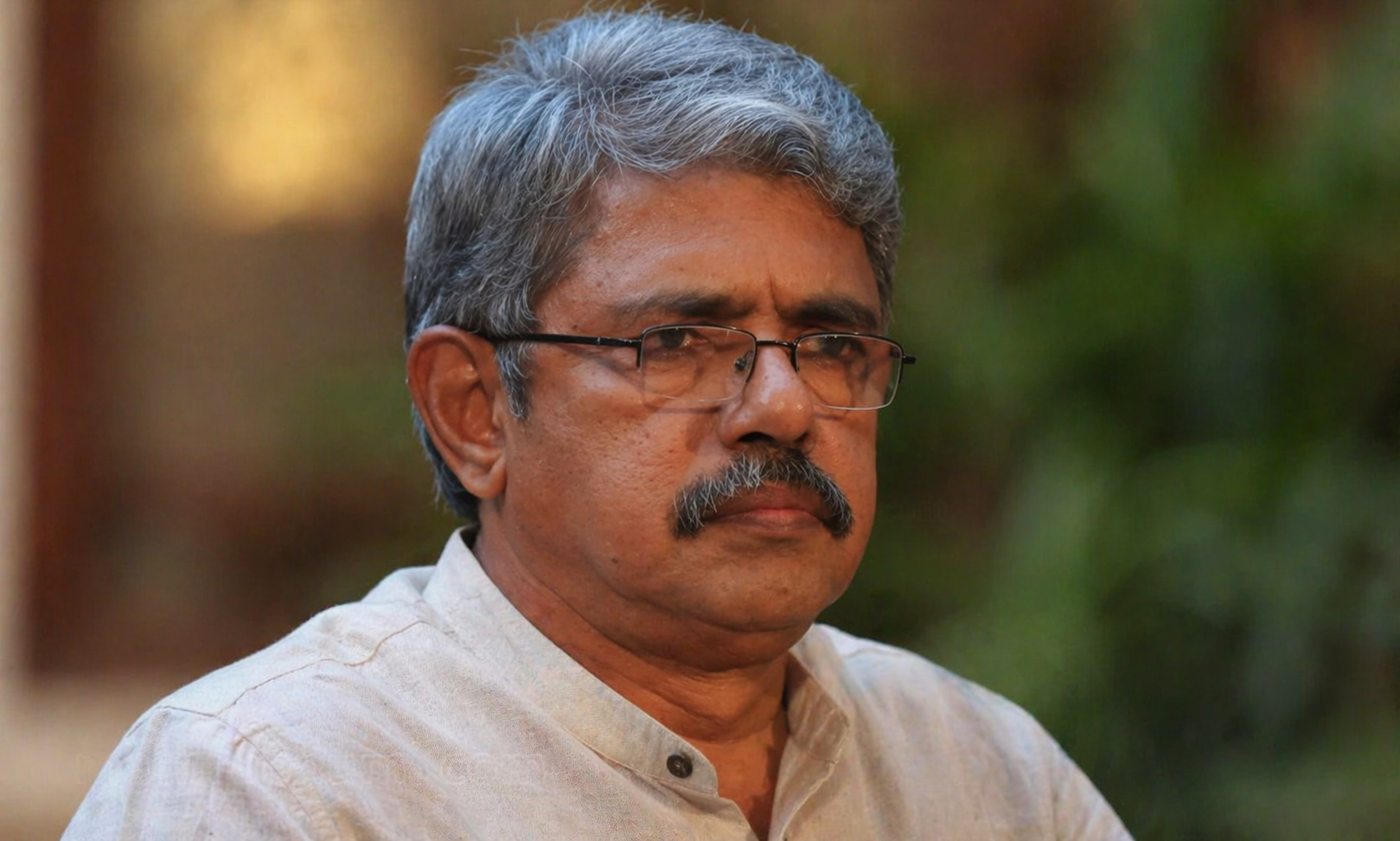
Balachandran Chullikkad
Born: 30 July 1957 (age 68)
Place: Paravoor, Kerala, India
Title: Poet, Actor, Lyricist, Screenwriter
A Mind Restless from the Beginning
Balachandran Chullikkad was born in Kerala in 1957, in a milieu that was culturally vibrant yet politically charged. His formative years unfolded during a period when Kerala’s intellectual life was deeply shaped by leftist thought, social reform movements, and an expanding literary culture.
His early exposure to literature came not as a structured pursuit but as a lived environment. Poetry, cinema, political discourse, and philosophical questioning coexisted. This plurality shaped his sensibility.
He was drawn as much to rebellion as to reflection.
The young Chullikkad was influenced by global literary currents, existentialist philosophy, and Malayalam’s own modernist traditions. Writers who questioned meaning, identity, and the structures of society resonated with him. At the same time, the immediacy of Kerala’s socio-political realities grounded his imagination.
His entry into poetry was not tentative. It was urgent.
He began writing at a young age, driven less by literary ambition and more by an internal necessity to articulate experience, particularly experiences of alienation, longing, and defiance.
Emergence as a Poet: A Voice That Refused to Fit
When Balachandran Chullikkad emerged in the Malayalam literary scene, he did not arrive as part of a movement.
He arrived as a disturbance.
The late twentieth century saw Malayalam poetry navigating between romanticism, social realism, and modernist experimentation. Chullikkad’s work intersected with these currents but did not fully belong to any.
His early poems carried an intensity that set him apart.
They were not concerned with narrative clarity or ideological messaging. Instead, they focused on emotional states, often raw, sometimes unsettling. Love, in his poetry, was rarely gentle. It was fractured, obsessive, and intertwined with pain.
Readers encountered a voice that was deeply personal yet resonant.
Critics began to recognize that this was not merely another poet entering the field, but a writer redefining the emotional and philosophical possibilities of Malayalam poetry.
Desire, Despair, and the Search for Meaning
Balachandran Chullikkad’s poetry operates within a landscape shaped by contradiction.
Alienation is central.
His poems often depict individuals who are estranged, from society, from relationships, even from themselves. This alienation is not merely social but existential, reflecting a deeper disconnection from meaning.
Desire appears as both a force and a wound.
Love, in his work, is intense but rarely fulfilling. It exists alongside betrayal, loss, and longing. The emotional register is heightened, yet controlled through precise language.
There is also a persistent engagement with spirituality.
Not in the conventional sense of faith, but as a questioning of existence. His poems move between skepticism and yearning, between disbelief and the search for transcendence.
His imagery is stark.
He avoids ornamentation, choosing instead to present images that carry emotional weight. A simple object, a room, a memory, becomes charged with significance.
Language is direct, yet layered.
The apparent simplicity of his lines often conceals deeper philosophical currents. His poems demand rereading, each encounter revealing new nuances.
Expanding the Emotional Register
Chullikkad’s body of work includes several poetry collections that have become central to contemporary Malayalam literature. His poems are often anthologized, discussed, and revisited, indicating their enduring relevance.
Beyond poetry, he has contributed essays and memoirs that reveal another dimension of his writing.
His prose, particularly autobiographical reflections, offers insight into the life behind the poetry. These writings blur the line between personal narrative and literary construction, creating a persona that is both real and mythic.
His style has evolved over time.
While early works are marked by intense emotional expression, later writings show a certain restraint, a reflective distance. Yet, the core concerns remain unchanged, the exploration of human vulnerability and the search for meaning.
The Rebel as Figure
Balachandran Chullikkad’s public persona is inseparable from his writing.
He is often seen as a rebellious intellectual, a figure who challenges norms not only through his poetry but also through his public statements and presence.
His speeches and interviews carry the same intensity as his poems.
He does not soften his positions for acceptance. This has contributed to both his appeal and his controversies.
The media has played a role in shaping his image.
At times, the persona risks overshadowing the poetry. Yet, for many readers, the two are intertwined, the life informing the work, and the work reinforcing the life.
The Visual Imagination
Chullikkad’s engagement with cinema adds another layer to his artistic identity.
He has appeared in Malayalam films, bringing to the screen a presence that mirrors his literary persona, intense, introspective, and slightly detached.
Cinema, in turn, influences his writing.
There is a visual quality to his poetry, an attention to image and framing that suggests a cinematic sensibility. Scenes unfold not just through words but through carefully constructed visual impressions.
This cross-medium engagement expands his reach, positioning him not only as a poet but as a cultural figure.
A Divisive Yet Enduring Voice
Balachandran Chullikkad’s work has been widely discussed, both within academic circles and among general readers.
Critics often highlight his ability to capture emotional intensity without losing philosophical depth. At the same time, some have questioned the self-referential nature of his work, arguing that it risks becoming insular.
This tension is part of his significance.
He is not a universally accepted poet. His work invites strong responses, admiration, critique, and sometimes discomfort.
For younger poets, he represents a possibility. A way of writing that prioritizes authenticity over conformity, emotional truth over narrative clarity.
Contradictions and Complexities: The Poet and the Persona
There is an inevitable tension in Balachandran Chullikkad’s life and work.
The poet who writes about alienation becomes a public figure. The individual who questions meaning becomes a voice within cultural discourse.
His persona, shaped through media, memory, and self-representation, sometimes risks becoming a narrative in itself.
This raises questions.
Where does the poet end and the persona begin? How much of the work is autobiographical, and how much is constructed?
These ambiguities do not weaken his writing. They deepen it.
A Voice That Refuses Resolution
Balachandran Chullikkad remains a vital presence in Malayalam literature because his work does not resolve itself.
It continues to ask.
In a cultural landscape that often seeks clarity and closure, his poetry insists on ambiguity. It refuses easy answers, choosing instead to dwell in questions.
His influence extends beyond specific works.
It lies in the sensibility he represents, a commitment to confronting the complexities of existence without simplification.
Future generations may read him differently.
They may focus less on the persona and more on the text, less on the myth and more on the language. Yet, the core of his work will remain, its intensity, its questioning, its refusal to console.
That is his outstanding legacy, a body of work that does not comfort, but compels us to confront the uneasy truths of being human.
Awards
In 1990, he refused the Sanskriti Award for the best young writer in India and declared that he would not accept any award for his literary works.
In 2001, his work Balachandran Chullikkadinte Kavithakal was selected for the Kerala Sahitya Akademi Award for Poetry, but Chullikkad did not accept the award.
In 2003, he received the National Film Award for Best Non-Feature Film Narration / Voice Over (Non Feature Film Category) for The 18 Elephants – 3 Monologues.