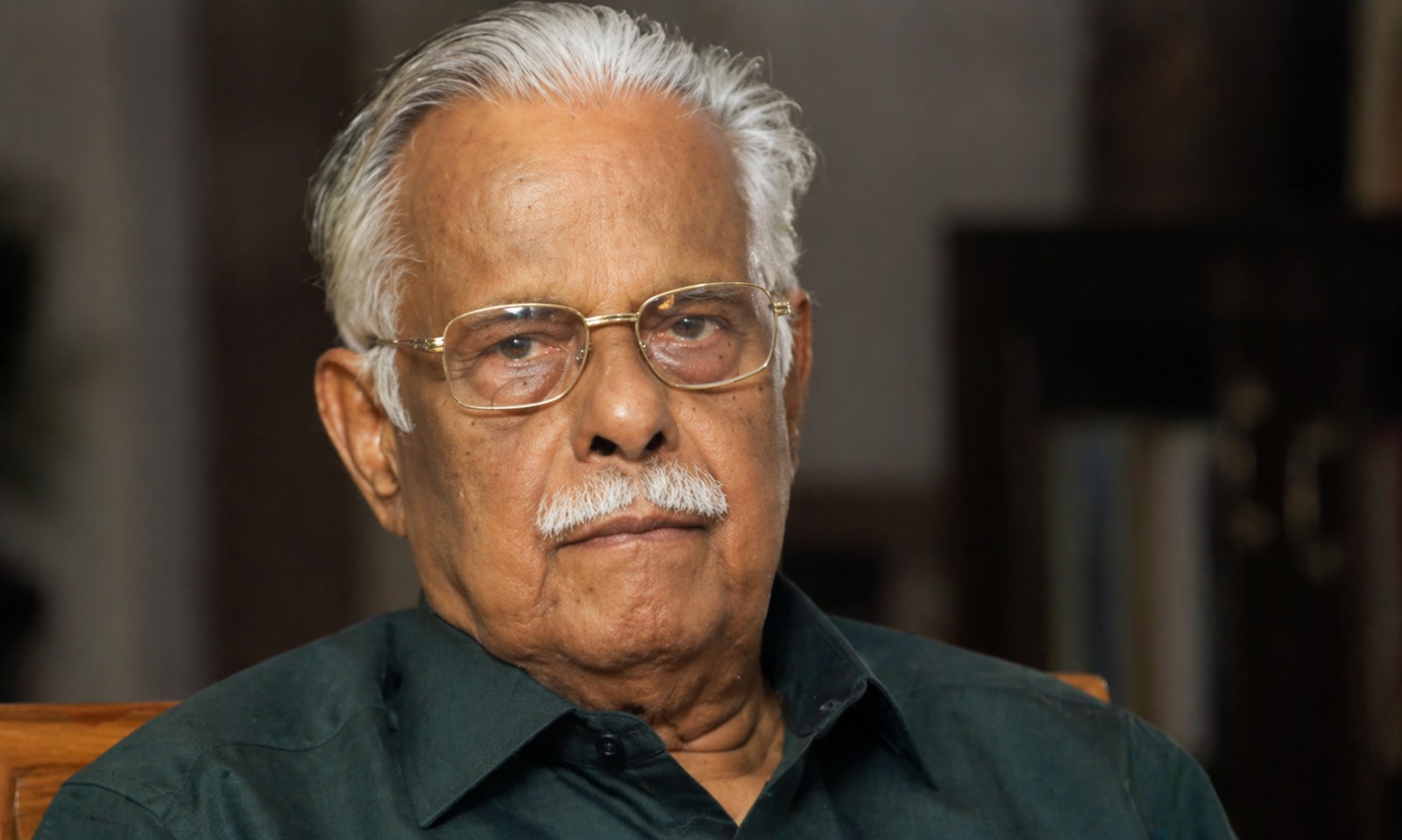
T. Padmanabhan
Born: 5 February 1931 (age 95)
Place: Pallikunnu, Kannur, Kerala
Title: Short story writer
Years active: 1950–present
Growing Into Stillness
T. Padmanabhan was born in 1931 in Kannur, Kerala, a region with a strong literary tradition and a vibrant intellectual culture. His early years unfolded in a society undergoing significant transformation, shaped by colonial history, nationalist movements, and the emergence of modern Malayalam literature.
Unlike writers who foreground social upheaval, Padmanabhan’s sensibility developed inward.
His formative influences were not only literary but philosophical. He was drawn to questions of existence, memory, and perception. The act of observing, rather than intervening, became central to his approach.
His education exposed him to both Malayalam and global literary traditions. Writers associated with modernism, particularly those who explored interiority and psychological nuance, resonated with him.
From the beginning, Padmanabhan’s orientation was toward precision. He was less interested in storytelling as narration and more in storytelling as distillation.
A Quiet Departure
Padmanabhan entered Malayalam literature during a period when the short story was evolving rapidly.
Writers were exploring social realism, addressing issues of class, caste, and political change. Narrative clarity and thematic directness were often emphasized.
Padmanabhan took a different path. His early stories did not foreground external conflict. Instead, they focused on internal states, moments of realization, fragments of experience that resisted easy interpretation.
Recognition came not through popularity but through critical attention. Readers encountered a style that required patience. The absence of overt drama was not a lack, but a deliberate choice.
His work marked a shift. It suggested that the short story could function not as a vehicle for narrative progression, but as a space for reflection.
The Art of Minimalism
T. Padmanabhan’s writing is often described as minimalist, but the term requires careful understanding.
His minimalism is not reduction for its own sake. It is a discipline.
Every sentence is measured. Every word carries weight. What is omitted becomes as significant as what is written.
Silence plays a crucial role. His stories often end before reaching conventional closure, leaving readers in a space of contemplation. This use of silence transforms reading into an active process.
Subtext is central. Emotions are rarely stated directly. They emerge through gesture, memory, and atmosphere. A pause, a glance, a fragment of thought, becomes the site of meaning.
Time, in his work, is fluid. Past and present coexist, often blending into each other. Memory is not a stable record but a shifting presence.
This approach aligns him with global minimalist traditions, yet his work remains distinctly rooted in Malayalam sensibility.
The Inner Landscape
Padmanabhan’s stories are not easily categorized by plot. They revolve around states of being.
Loneliness is a recurring theme. His characters often exist in isolation, not necessarily physical, but emotional and existential. They are aware of their distance from others, from themselves, from meaning.
Memory functions as both refuge and burden. The past is not recalled for nostalgia alone. It intrudes, reshapes, and sometimes distorts the present.
Time is treated as a continuous flow. Moments are not isolated but interconnected, each carrying traces of what came before.
Longing permeates his work. It is rarely fulfilled. Instead, it remains suspended, creating a sense of incompleteness that defines his narratives.
His stories differ fundamentally from plot-driven fiction. There is no clear beginning, middle, or end. Instead, there is a moment, precisely observed, that opens into a larger emotional and philosophical space.
A Singular Position
Within Malayalam literature, T. Padmanabhan occupies a unique position.
Writers such as M. T. Vasudevan Nair explored psychological depth within structured narratives, while others engaged with social realism or political themes.
Padmanabhan diverged. His focus on interiority and minimalism set him apart from dominant trends. He neither rejected realism nor fully embraced modernist abstraction. Instead, he created a space where both could coexist.
His influence is subtle. Rather than initiating a movement, he expanded the possibilities of the short story form. Writers who prioritize mood, silence, and introspection often trace their lineage, implicitly or explicitly, to his work.
The Writer’s Persona: Discipline and Withdrawal
T. Padmanabhan’s public persona mirrors his writing.
He is known for his reclusive nature and limited output. Unlike prolific writers, he has produced a relatively small body of work.
This is not due to constraint, but to choice. He approaches writing with a sense of discipline that resists excess. Each story undergoes careful refinement, resulting in a style that feels inevitable rather than constructed.
He has often expressed a belief in the importance of precision. Writing, for him, is not accumulation but selection.
This approach contributes to his reputation. He is seen not as a writer who participates in literary culture, but as one who observes it from a distance.
The Weight of Restraint
T. Padmanabhan’s work has received significant recognition, including major literary awards such as the Kerala Sahitya Akademi Award and the Kendra Sahitya Akademi Award.
Critics consistently highlight his mastery of form. His ability to convey profound emotional and philosophical insights through minimal means is often cited as his defining strength.
Readers, however, encounter his work differently. For some, the absence of conventional narrative can be challenging. For others, it is precisely this openness that makes his stories enduring.
His influence is evident in contemporary Malayalam literature. Writers who explore interiority, silence, and minimalism operate within a space that Padmanabhan helped define.
The Enduring Power of Quiet
In an age dominated by speed, excess, and constant articulation, T. Padmanabhan’s writing offers an alternative. It insists on stillness.
His stories remind us that meaning does not always emerge through explanation. It can reside in pause, in absence, in what is left unsaid.
For contemporary readers, his work demands a different mode of engagement.
It asks for patience, attention, and a willingness to inhabit uncertainty.
New generations may approach his writing with different expectations.
Yet, the core of his work remains unchanged, its clarity, its restraint, its refusal to simplify.
That is his outstanding significance. He demonstrates that literature need not be loud to be powerful, that a single, carefully crafted moment can hold the weight of an entire life.
Awards and honours
1973 – Kerala Sahitya Akademi Award for Story, Saakshi,he declined it
1995 – Odakkuzhal Award for his story, Kadal was also rejected
1966 – Kendra Sahitya Akademi Award of for Gowry
1998 – Lalithambika Andharjanam Award
2001 – Vayalar Award of for Puzha Kadannu Marangalude Edayileku
2001 – the Vallathol Award
2003 – Ezhuthachan Award
2007 – Muttathu Varkey Award
2012 – Kerala Sahitya Akademi inducted him as their distinguished fellow
2014 – C. V. Kunhuraman Literary Prize
2014 – Bharatiya Bhasha Parishad Award
2015 – Mathrubhumi Sahitya Puraskaram
2019 – Abu Dhabi Sakthi-T. K. Ramakrishnan Award
2018 – Honorary doctorate by Mahatma Gandhi University