

Unni R
Indian short-story writer and screenwriter
Unni R is a celebrated voice in Malayalam literature and cinema, known for his sharp, emotionally layered short stories and screenplays. His writing often captures ordinary human lives with quiet intensity, making him one of the most distinctive storytellers of contemporary Malayalam writing.
Real Name: P. Jayachandran
Born: 12 April 1971 (age 55)
Place: Kudamaloor, Kottayam, Kerala, India
Title: Short story writer, Screenwriter
Education: CMS College Kottayam and Baselius College
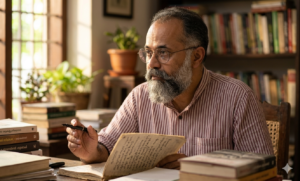
A Man, an Elephant, and a Silence That Lingers
There is a moment in Leela when desire ceases to be erotic and becomes something else, unsettling, abstract, almost philosophical. A man, wealthy and detached, pursues an obsession that resists easy explanation, culminating in an act that is less about fulfillment and more about emptiness. The scene does not resolve. It lingers. This is the territory Unni R. inhabits, where desire is stripped of romance and morality becomes porous. His writing does not guide the reader toward judgment. It suspends them in discomfort. That is his outstanding power, to construct narratives that feel deceptively simple on the surface but open into psychological spaces where certainty collapses.
A Landscape of Quiet Observations
Unni R. was born in Kerala, a state whose literary tradition is unusually dense, layered with political thought, social realism, and philosophical inquiry. Growing up in such a cultural environment means encountering literature not as an elite pursuit but as part of everyday discourse.
His formative years were shaped by this atmosphere. Kerala’s public culture, newspapers, libraries, political debates, and serialized fiction, created a fertile ground for storytelling. Yet, unlike many writers who align themselves clearly with ideological or literary movements, Unni’s early sensibility seems to have leaned toward observation rather than assertion.
He studied at the University of Kerala, where exposure to Malayalam literature deepened his engagement with narrative forms. The influence of earlier writers, from the psychological realism of M. T. Vasudevan Nair to the existential tensions in the works of O. V. Vijayan, is visible, though never imitative.
What distinguishes Unni’s early formation is restraint. His writing would later emerge not from overt ideological positioning, but from a quieter, more unsettling interrogation of human behavior.
The Emergence of a Distinct Voice
Unni R.’s entry into Malayalam literature came through short stories published in prominent magazines, the traditional gateway for literary recognition in Kerala. These early works did not immediately position him as a mainstream voice. Instead, they circulated within attentive literary circles, where his distinct tonal quality began to attract notice.
His stories were marked by a refusal to conform.
They did not rely on dramatic plot twists or overt social commentary. Instead, they unfolded slowly, often focusing on internal states rather than external action. Characters appeared ordinary, almost indistinct at first glance, but gradually revealed layers of contradiction, desire, and moral ambiguity.
This approach created a particular kind of reader response. Not immediate admiration, but a lingering unease. Over time, that unease became recognition.
Writing the Uncomfortable
Unni R.’s work is preoccupied with the inner life, particularly the aspects that resist articulation.
Desire, in his stories, is rarely straightforward. It is tangled with power, guilt, and self-awareness. Masculinity appears not as strength but as fragility, often expressed through control, detachment, or obsession.
His narratives frequently blur the line between realism and psychological intensity.
Events are grounded in recognizable settings, villages, towns, domestic interiors, but the emotional landscape often feels dislocated. Characters act in ways that are not easily explained, yet feel disturbingly plausible.
Language plays a crucial role.
His prose is sparse, controlled, and deliberate. There is little excess. Sentences carry weight through what they omit as much as what they state. This economy creates space for ambiguity, allowing readers to inhabit the text rather than simply consume it.
He does not moralize. This is perhaps the most defining feature of his writing. He presents situations without offering resolution or judgment, leaving interpretation open, and often uncomfortable.
Major Works and Critical Reception: The Shock of Leela and Beyond
Among Unni R.’s works, Leela stands as the most widely discussed and contested.
Originally a short story, it gained broader visibility through its cinematic adaptation. The narrative, centered on a man’s disturbing desire involving an elephant, provoked strong reactions. Critics debated its intent, whether it was a critique of power, a psychological study, or an exercise in provocation.
The responses were polarized. Some saw it as a bold exploration of taboo, pushing Malayalam literature beyond its comfort zones. Others viewed it as excessive, questioning its ethical implications.
This tension is central to Unni’s reception. His work does not seek consensus. It invites division.
Beyond Leela, his body of short stories continues to engage with similar themes, isolation, moral ambiguity, and the unsettling aspects of everyday life. His collections have earned critical recognition, though they remain less widely read than more accessible literary works.
Awards and honors have followed, but they have not defined his reputation. What defines it is the persistence of debate.
From Page to Screen
Unni R.’s transition into screenwriting marked a significant expansion of his narrative reach.
Malayalam cinema, particularly in the post-2000 era, has increasingly drawn from literary sensibilities. Writers like Unni have contributed to this shift, bringing psychological depth and narrative complexity into mainstream storytelling.
Adapting his style to cinema required recalibration. Literary ambiguity does not always translate directly to visual media. Yet, his screenplays retain a sense of restraint, avoiding overt exposition and allowing scenes to carry emotional weight.
His collaborations with filmmakers have produced works that resist formula, often prioritizing character over plot. However, the move to cinema also exposes limitations.
Film demands audience engagement on a different scale. The ambiguity that works in literature can sometimes alienate viewers. This creates a tension between artistic intent and reception.
Unni’s work navigates this space, not always smoothly, but consistently on its own terms.
Unni R. and the Question of Morality
Perhaps the most contentious aspect of Unni R.’s work is its engagement with morality.
His narratives often center on acts that challenge social norms, desire that transgresses boundaries, behavior that resists ethical categorization.
This has invited critical scrutiny, particularly from feminist perspectives.
Questions arise.
Does his work critique patriarchal desire, or does it risk reproducing it? Are his female characters subjects of agency, or are they framed within male psychological landscapes?
There are no easy answers.
What can be said is that his writing refuses simplification. It does not present models of virtue or vice. Instead, it exposes the instability of these categories.
This is both its strength and its discomfort.
Place in Contemporary Malayalam Literature
Within contemporary Malayalam literature, Unni R. occupies a distinct position.
He is neither a mass-market writer nor an entirely academic figure. His work sits at the intersection of literary seriousness and cultural relevance, engaging with themes that resonate beyond the page.
Compared to peers, his writing is less overtly political but deeply psychological. Where some writers address social issues directly, Unni approaches them obliquely, through individual experience and internal conflict.
His influence is visible among younger writers who explore similar terrains, ambiguity, interiority, and the limits of moral frameworks.
He contributes to a broader shift in Malayalam storytelling, one that moves away from clear resolutions toward open-ended narratives.
Public Persona and Creative Philosophy
Unni R. maintains a relatively restrained public presence.
In interviews, he often emphasizes process over message. Writing, for him, is less about conveying a predetermined idea and more about exploring a situation to its limits.
This approach aligns with his work. He does not claim authority over interpretation. Instead, he positions himself as an observer, constructing scenarios and allowing them to unfold.
There is a deliberate refusal to explain. This can frustrate readers seeking clarity, but it reinforces the autonomy of the text.
Continuing Relevance
Unni R.’s significance lies not in popularity but in persistence.
His work continues to challenge readers and viewers, refusing comfort, resisting closure. In a cultural environment that often seeks clarity, his narratives insist on ambiguity.
This makes them difficult, but also necessary.
As Malayalam literature and cinema evolve, incorporating new voices and forms, Unni’s work remains a reference point, not as a model to imitate, but as a reminder of what storytelling can do when it refuses to resolve itself.
His future trajectory is uncertain, but that uncertainty is consistent with his aesthetic.
What remains is the impact of a body of work that does not settle, that continues to provoke, unsettle, and linger.
It is an outstanding contribution, not because it offers answers, but because it compels us to confront the questions we would rather avoid.
Awards and honours
2020 – Kerala Sahitya Akademi Award for Story – Vaanku
2015 – Best Screenplay for Charlie
2006 – Geetha Hiranyan Endowment– Ozhivu Divasathe Kali
Thomas Mundasseri Award – Ozhivudivasathe Kali
Ankanam E.P. Sushama Endowment– Ozhivu Divasathe Kali
Abu Dhabi Sakthi Award – Kottayam 17
Ayanam C. V. Sreeraman Award – Kottayam 17
K. A. Kodungalloor Story Award
T. P. Kishore Award
V. P. Sivakumar Memorial Keli Award[citation needed]
Mohan Raghavan Award for Best Script – Charlie[citation needed]
IIFA Award for Best story – Charlie