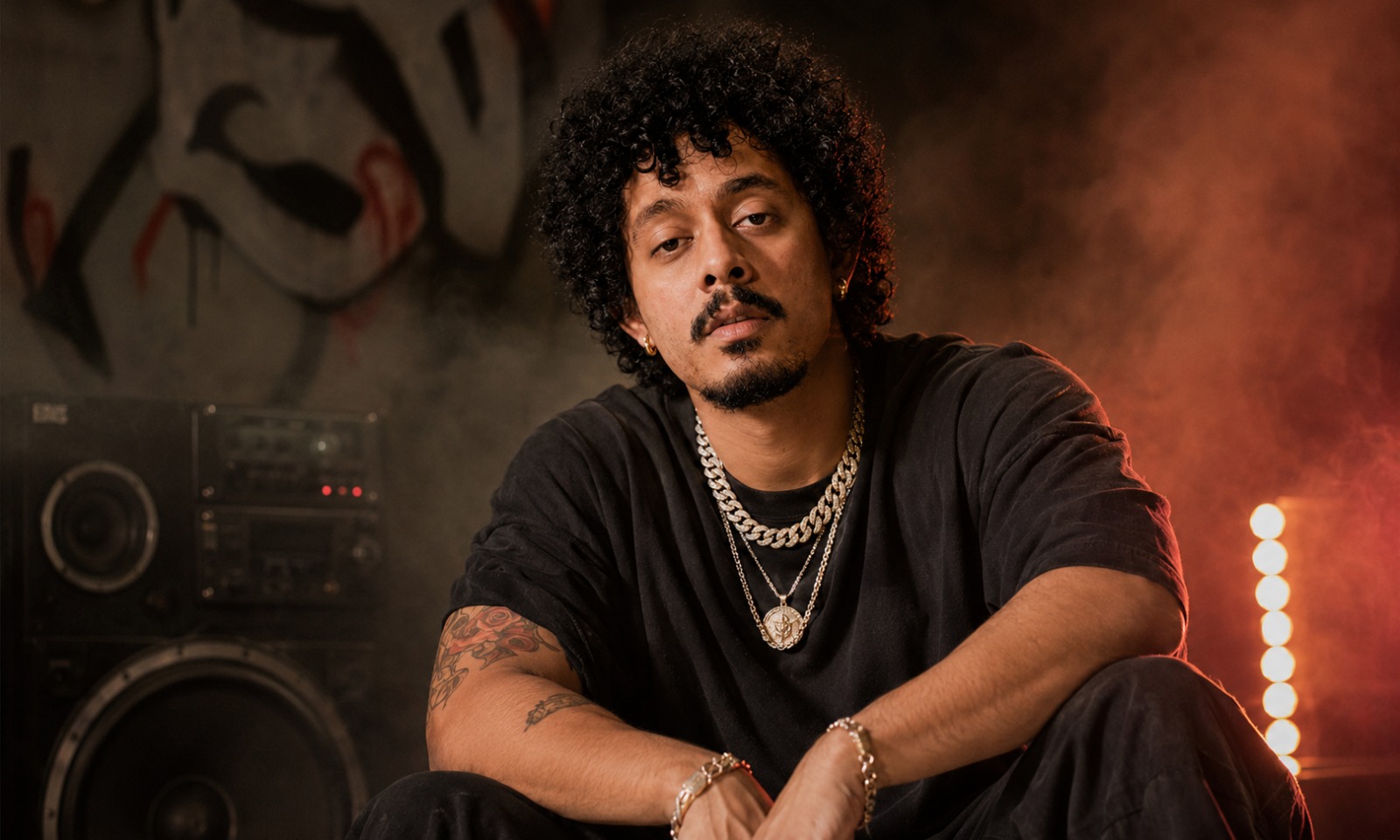
HanumanKind (Sooraj Cherukat)
Indian Rapper
Sooraj Cherukat known professionally as Hanumankind, is a rapper, singer, songwriter, and actor from Kerala, India. He received mainstream popularity in India and internationally with his track “Big Dawgs”, which features the Hyderabad-based artist and producer Kalmi and American rapper ASAP Rocky on its remix. Sooraj Cherukat was born in 1992, in Malappuram, Kondotty, Kerala, India. His father works for a leading oil company, as a result he moved around a lot. As a child, Cherukat lived in Nigeria, Saudi Arabia, Dubai, Egypt, Qatar, and Italy before settling down in Houston, Texas when he was in second grade. He attended Houston Community College in 2011. In 2012, he returned to India enrolling at PSG College in Coimbatore, Tamil Nadu to pursue a degree in business administration. He worked at Goldman Sachs in 2014, and also as a personal trainer.
Key Factors
Full Name: Sooraj Cherukat
Stage Name: Hanumankind
Born: 17 October 1992
Birthplace: Malappuram district
Occupation: Rapper, Singer, Songwriter, Performer, Actor
Genres: Hip hop, rap, alternative hip hop
The motorcycles roar inside the “well of death” arena in Ponnani. Dust rises into the humid Kerala night as riders circle vertically against gravity, their engines screaming in rhythmic loops. At the centre stands a rapper with a fierce stare, braided energy, and a voice that sounds equally shaped by Houston streets and Malappuram memory. The camera moves like adrenaline itself. Then the beat drops. “Big Dawgs” arrives not as a song alone, but as a declaration.
In a matter of months, Hanumankind transformed from one of India’s most respected underground rappers into a global cultural conversation. International listeners who had rarely encountered Indian hip hop beyond stereotypes suddenly found themselves pulled into a sonic world where Southern American rap collided with Kerala percussion, where local landscapes felt cinematic instead of exotic, and where an artist from Malappuram carried himself with unmistakable global confidence. Born as Sooraj Cherukat, Hanumankind emerged during a moment when Indian music was searching for new identities beyond imitation. What made him stand apart was not simply technical skill or charisma, but authenticity. He sounded like nobody else. More importantly, he represented a generation of Indians shaped by migration, internet culture, and fractured identities, yet still deeply connected to where they came from. That is what makes him such an outstanding Malayali artist in contemporary global music culture.
From Kerala to the World
To understand Hanumankind’s music, it helps to understand movement.
His life began in Kerala, but stability never stayed long. Because of his father’s work in the oil industry, Sooraj Cherukat spent his childhood moving constantly across countries and cultures. Nigeria, Saudi Arabia, Dubai, Egypt, Qatar, Italy, and eventually the United States became chapters in his formative years.
For many children, such constant displacement can create confusion or emotional distance. For artists, however, it often becomes fuel.
Every relocation demanded adaptation. Every classroom meant learning new accents, social codes, and cultural rhythms. By the time he settled in Houston during elementary school, Sooraj had already developed the psychological flexibility of someone who understood what it meant to belong everywhere and nowhere at once.
That experience quietly shaped the confidence listeners now associate with Hanumankind.
His music rarely sounds defensive about identity. Instead, it embraces multiplicity. He can reference American rap traditions while standing unapologetically inside Indian visual culture. He can perform alongside global rap stars without diluting where he comes from.
Kerala remained emotionally important even while he travelled widely. Malappuram’s atmosphere, language textures, and social energy would later reappear in his visual storytelling and sonic choices. Unlike many artists who erase local roots while pursuing global appeal, Hanumankind increasingly leaned into them.
Discovering Hip Hop in Houston
Houston was where rap stopped being entertainment and became language.
The city’s hip hop culture during the 2000s carried a distinct identity, slower flows, heavy bass, chopped-and-screwed experimentation, and an atmosphere deeply tied to Southern street realities. Young Sooraj absorbed that ecosystem intensely.
Artists like Chamillionaire, Three 6 Mafia, UGK, DJ Screw and Project Pat shaped his understanding of rhythm, aggression, atmosphere, and swagger. Later influences such as Kendrick Lamar, J. Cole and Logic added narrative complexity and lyrical introspection.
Houston hip hop also taught him something crucial about authenticity.
Southern rap historically faced dismissal from America’s coastal hip hop establishments before eventually reshaping mainstream rap culture itself. That tension between local identity and global recognition would later mirror Hanumankind’s own position within Indian music.
He did not grow up consuming hip hop from a distance. He grew up inside one of its most culturally influential regional ecosystems.
That difference shows.
His cadence, breath control, confidence, and instinctive understanding of rhythm feel lived-in rather than studied.
The Birth of Hanumankind
Before the headlines and international recognition, there was simply experimentation.
The stage name itself revealed ambition and symbolism. “Hanumankind” combined the mythological power of Hanuman with the broader idea of humanity. The name suggested both rootedness and universality, a recurring tension within his artistry.
Early tracks circulated online through independent platforms and underground communities. His “959 Mixtape” on SoundCloud captured raw hunger more than polished perfection. Songs like “Super Mario” revealed an artist still discovering form but already possessing unusual energy and personality.
The Indian independent hip hop scene during the late 2010s remained fragmented and regionally scattered. Major labels had not fully invested in rap yet, and artists often built audiences through live circuits, online communities, and word-of-mouth recognition.
Hanumankind emerged during this transitional period.
Unlike many rappers chasing formulaic commercial success, he seemed interested in building identity first. His performances carried physical intensity, theatrical movement, and an almost confrontational stage presence that immediately separated him from softer mainstream pop-rap trends.
There was also a visible refusal to imitate Western artists superficially. Even while influenced by American rap culture, he did not sound like a copy.
Building an Identity in Indian Hip Hop
When Sooraj returned to India for higher education at PSG College, he entered a country whose hip hop culture was still evolving.
Like many middle-class Indian young adults, he initially followed conventional professional pathways. He worked at Goldman Sachs and later as a personal trainer while continuing to pursue music independently.
That period mattered because it grounded him outside the mythology of overnight success.
He understood routine, economic pressure, and the uncertainty of choosing creativity over stability. Those experiences later added texture to his writing and public persona.
Performances at events like NH7 Weekender helped establish his reputation within India’s live music circuit. The release of Kalari in 2019 signalled a more fully formed artistic vision. Even the title carried symbolic resonance, invoking Kerala’s martial traditions while framing rap itself as disciplined combat.
His second EP, Surface Level, expanded his sonic experimentation further. Tracks like “DAMNSON,” “Go To Sleep,” and “Genghis” revealed an artist increasingly comfortable moving between aggression, introspection, and theatrical performance energy.
At a time when much of Indian rap was either heavily localised or overly westernised, Hanumankind occupied a rare middle space.
He sounded international without sounding culturally detached.
“Big Dawgs” and the Global Explosion
Then came “Big Dawgs.”
Few Indian hip hop tracks in recent memory have travelled internationally with such speed and force. Released in 2024 alongside producer Kalmi, the song felt simultaneously cinematic, raw, and aggressively confident.
But the music video transformed it into a phenomenon.
Directed by Bijoy Shetty, the video placed Hanumankind inside Kerala’s “well of death” carnival spectacle, where motorcycle riders perform gravity-defying stunts inside cylindrical wooden structures.
The imagery was stunning because it never begged for foreign approval.
There were no forced attempts to “explain” India. No exotic tourism aesthetic. No sanitised global branding.
Instead, the video trusted local texture.
Sweat, dust, rusted metal, danger, movement, and controlled chaos became part of the visual language. Kerala appeared not as postcard beauty but as lived atmosphere.
That authenticity resonated globally.
International listeners unfamiliar with Indian culture still understood the adrenaline, confidence, and cinematic energy immediately. The remix featuring ASAP Rocky pushed the track further into global conversation, validating Hanumankind’s credibility beyond regional novelty.
More importantly, “Big Dawgs” proved something many Indian independent artists had long believed, global audiences are willing to engage with Indian music when it feels original rather than imitative.
Carrying Kerala into Global Hip Hop
One of the most fascinating aspects of Hanumankind’s rise is how naturally Kerala exists within his aesthetic world.
Not performatively. Not symbolically. Naturally.
The percussion-heavy textures in “Run It Up,” especially the incorporation of chenda-inspired rhythmic energy, reflected a growing confidence in integrating regional sonic identity into modern rap production.
Kerala appears in his work through movement, language rhythms, visual mood, and social texture. Even when English dominates lyrically, there is something unmistakably Malayali in the emotional cadence and groundedness.
This matters culturally.
For years, Indian artists seeking international recognition often flattened local identity to appear globally acceptable. Hanumankind instead demonstrates that specificity creates universality.
The more rooted he becomes, the more globally distinctive he sounds.
That may ultimately become his greatest artistic contribution.
Beyond Music: Acting and Cultural Influence
As his visibility expanded, Hanumankind gradually evolved beyond music alone.
His track “The Last Dance” appearing in Aavesham connected him further with Malayalam popular culture, while his acting appearance in Rifle Club under director Aashiq Abu signalled broader artistic ambitions.
He also became increasingly visible within fashion and youth culture spaces. Festival performances, including appearances at Rolling Loud India and Netflix Tudum events, positioned him not merely as a rapper but as part of a larger shift in how Indian artists are perceived globally.
There is a cinematic quality to his persona that extends beyond music videos.
He understands visual mythology.
Monsoon Season and Artistic Evolution
His debut mixtape Monsoon Season, released in 2025, represented a significant artistic leap.
Collaborations with artists such as Denzel Curry, ASAP Rocky, and Maxo Kream expanded the project’s international weight, but the real strength of the mixtape lay in its cohesion.
The production, shaped heavily through longtime collaborators like Kalmi and Parimal Shais, balanced aggression with atmosphere. Sonically, the project moved beyond viral-hit energy into something more textured and emotionally layered.
Critically, Monsoon Season suggested Hanumankind was thinking carefully about longevity.
Many viral artists struggle to deepen identity after sudden fame. This project instead indicated artistic maturity and increasing conceptual ambition.
Why Hanumankind Matters
Indian hip hop is no longer a fringe movement.
It is becoming one of the country’s most important youth-driven cultural forms. Yet within that landscape, authenticity remains rare and difficult.
Hanumankind matters because he resists easy categorisation.
He is neither entirely underground nor fully commercial. Neither purely Indian nor culturally detached from India. Neither nostalgic nor blindly globalised.
His success also disrupts longstanding assumptions about how Indian artists should sound internationally. For decades, global visibility for Indian musicians often depended on fusion stereotypes or exotic framing.
Hanumankind arrives differently.
He belongs inside global rap conversations because of artistic credibility, not novelty.
That distinction is enormous.
Legacy in Progress
The story of Hanumankind still feels unfinished, which is precisely what makes it exciting. His career currently exists in that rare space where ambition, identity, timing, and talent are colliding at once. He carries the emotional memory of Kerala, the survival instincts of migration, and the sonic confidence of Houston hip hop into a rapidly changing global music culture.
Somewhere between the roaring motorcycles of Ponnani, the bass-heavy influence of Southern rap, and the thunder of chenda rhythms lies the artistic world he has built for himself. It is loud, restless, intelligent, and impossible to ignore. And as Indian music continues searching for voices capable of crossing borders without losing authenticity, Hanumankind increasingly stands as an outstanding Malayali artist whose journey reflects something larger than fame itself, the arrival of a new global Indian cultural identity that no longer asks permission to be seen.