
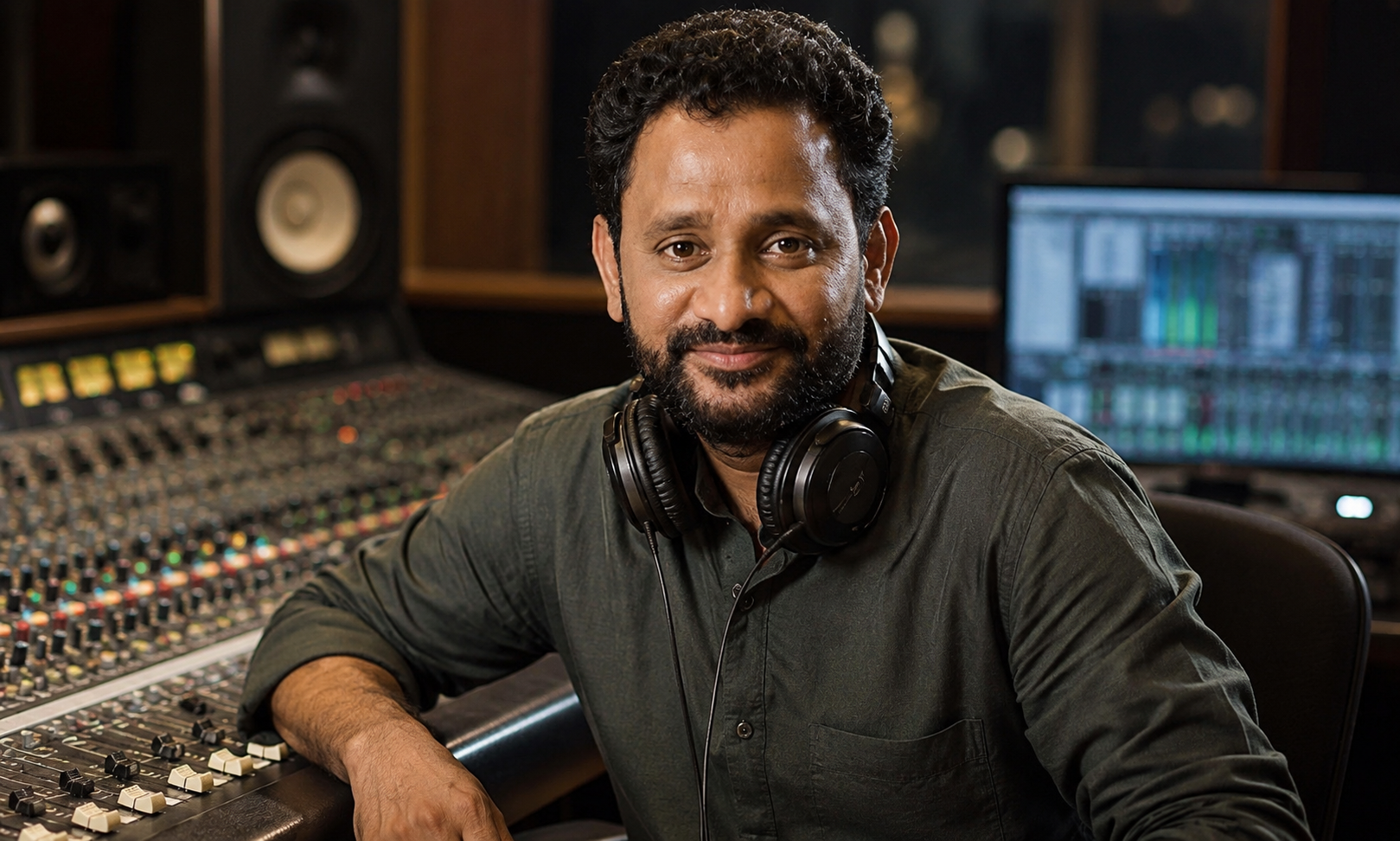
Resul Pookutty
Indian sound designer
Resul Pookutty is an Indian film sound designer, sound editor and audio mixer. He won the Academy Award for Best Sound Mixing, along with Richard Pryke and Ian Tapp, for Slumdog Millionaire. Born into a family in Vilakkupara, near Anchal, Kollam, Kerala, India. He did his bachelor’s degree in physics from Milad-E-Sherief Memorial College, Kayamkulam during 1987–1990. He joined Government Law College, Thiruvananthapuram for studying Bachelor of Laws (LLB) degree, however, he was unable to complete it. In 1995, he graduated from Film and Television Institute of India in Pune. He wrote the remaining LLB exam papers and enrolled as an advocate in 2012.
Key Factors
Full Name: Resul Pookutty
Date of Birth: 30 May 1971
Place of Birth: Vilakkupara near Anchal, Kollam district, Kerala, India
Occupation: Sound Designer, Sound Editor, Audio Mixer
Known For: Academy Award-winning sound design for Slumdog Millionaire
Major Awards: Academy Award, Padma Shri, National and international honours
International Recognition: Member of AMPAS Executive Committee, Motion Picture Sound Editors Guild (MPSE), Cinema Audio Society (CAS)
Educational Institutions: MSM College Kayamkulam, Film and Television Institute of India (FTII Pune)
On the night of the 81st Academy Awards in Los Angeles, when the words “And the Oscar goes to…” echoed through the auditorium, millions of Indians watched history unfold through the quiet composure of a man from a small village in Kerala. Resul Pookutty walked toward the stage carrying not just an Academy Award-winning achievement, but the story of an outstanding Malayali journey shaped by poverty, persistence, and an almost obsessive devotion to sound. Long before Hollywood applause and international recognition, there had been kerosene lamps, six-kilometre walks to school, and nights spent listening closely to the world around him in a village without electricity. That sensitivity to sound, to silence, to atmosphere, would eventually transform him into one of the most respected sound designers in global cinema. More than an Oscar winner, Resul Pookutty became proof that Indian cinema technicians could stand at the centre of world cinema with brilliance, originality, and technical mastery.
A Childhood Lit by Kerosene Lamps
The village landscapes of Kerala often appear romantic in cinema, filled with green paddy fields, monsoon rain, and coconut trees moving gently in the wind. But for many families in the 1970s and 1980s, rural life also meant hardship, limited infrastructure, and uncertainty.
Resul Pookutty was born into such a world in Vilakkupara near Anchal in Kollam district. He was the youngest of eight children in a financially struggling household. His father worked as a private bus ticket checker, earning just enough to keep the family afloat.
There was no electricity in the village during his childhood.
At night, he studied under the dim glow of kerosene lamps. To attend school, he walked nearly six kilometres through rough terrain. Those journeys were not merely physical. They shaped his awareness of environment and sound. The rustling of trees, the rhythm of footsteps, distant voices, rainfall hitting tin roofs, bus engines echoing through village roads, these became part of his subconscious memory bank long before he understood sound professionally.
Years later, Pookutty would often speak about listening as a deeply human act rather than merely technical practice.
That philosophy began in rural Kerala.
From Kerala to FTII: Discovering the Language of Sound
Like many middle-class students from Kerala, Resul initially pursued conventional education pathways. He completed his bachelor’s degree in Physics from MSM College in Kayamkulam between 1987 and 1990.
Physics mattered because sound itself is science before it becomes emotion.
He later joined Government Law College in Thiruvananthapuram to pursue an LLB degree, partly fulfilling his father’s dream of seeing him become an advocate. Yet law never fully captured his imagination.
Cinema did.
In 1995, he graduated from the Film and Television Institute of India (FTII Pune), one of India’s most influential film schools. FTII was not simply a training institution. It was an intellectual laboratory where cinema was discussed with seriousness and artistic ambition.
For Pookutty, sound became revelation.
Indian cinema had historically prioritised visuals and music, while sound design remained technically functional rather than emotionally immersive. At FTII, he encountered world cinema traditions where ambient sound, silence, texture, and acoustic space shaped storytelling as profoundly as camera movement or dialogue.
He understood that sound could carry memory, tension, fear, intimacy, and social atmosphere.
That understanding would define his career.
Mumbai Dreams and the Struggles of Survival
After graduating, Resul moved to Mumbai, joining thousands of dreamers attempting to survive inside India’s chaotic film capital.
The transition was difficult.
Mumbai’s film industry operated through networks, hierarchy, and relentless competition. Technicians often remained invisible despite carrying enormous creative responsibility. Sound departments, especially in the 1990s, rarely received mainstream recognition.
Pookutty later described his move to Mumbai as “natural immigration” for an FTII graduate because much of the industry’s technical backbone came from the institute.
His early years involved persistence more than glamour.
He worked quietly, learning production realities and adapting to the pace of commercial filmmaking. His debut as a sound designer came with Private Detective: Two Plus Two Plus One directed by Rajat Kapoor.
The breakthrough arrived slowly rather than suddenly.
The Sound Behind Indian Cinema
By the early 2000s, Indian cinema itself was changing. Multiplex culture, digital post-production, and global audience exposure began reshaping filmmaking aesthetics.
Resul Pookutty emerged at exactly the right moment.
His work on Black directed by Sanjay Leela Bhansali drew widespread industry attention. The film demanded intricate emotional soundscapes rather than conventional dramatic amplification.
Pookutty approached sound psychologically.
In films like Musafir, Zinda, Traffic Signal, and Saawariya, he demonstrated how urban atmosphere, silence, echoes, and environmental texture could deepen storytelling.
He later worked on major productions across languages including Kerala Varma Pazhassi Raja and Enthiran.
His contribution went beyond technical polish.
He changed how Indian filmmakers thought about cinematic listening.
The Oscar Night That Changed Everything
When Danny Boyle assembled the international crew for Slumdog Millionaire, the project itself was unconventional, a British production deeply rooted in Indian urban life.
Sound became central to the film’s energy.
Mumbai in Slumdog Millionaire is noisy, frantic, emotional, crowded, violent, musical, and unpredictable. Pookutty’s work captured that sensory chaos without losing emotional clarity.
At the 81st Academy Awards in 2009, he shared the Oscar for Best Sound Mixing with Richard Pryke and Ian Tapp.
For Indian technicians, the moment felt historic.
Actors and composers from India had received international attention before, but technicians rarely occupied centre stage globally. Pookutty’s victory changed perception inside the industry itself. Young sound engineers, editors, cinematographers, and designers suddenly saw global recognition as possible.
Back in Kerala, celebrations erupted across media and public spaces.
The image of a Malayali technician holding an Oscar carried enormous emotional significance.
Not merely because he won, but because of where he began.
More Than an Oscar Winner
After global recognition, Resul Pookutty could easily have become a ceremonial celebrity figure.
Instead, he continued engaging deeply with cinema education, technical mentorship, and conversations about artistic discipline.
He repeatedly emphasized that sound is not decoration. It is narrative.
In interviews, he often criticised the lack of serious technical training and infrastructure in Indian cinema while simultaneously advocating for better film education and respect for technicians.
His international memberships in organisations like the Academy of Motion Picture Arts and Sciences, the Motion Picture Sound Editors Guild, and the Cinema Audio Society positioned him as one of the few Indian technicians integrated into global professional circles at the highest level.
He also emerged as a public speaker capable of translating complex technical ideas into accessible artistic conversations.
A Proud Malayali on the Global Stage
Despite decades in Mumbai and international recognition, Pookutty has consistently retained visible emotional ties to Kerala.
That connection matters.
Kerala has historically produced writers, filmmakers, scientists, and intellectuals whose work travelled globally while remaining culturally rooted. Resul Pookutty fits within that tradition.
His story resonates deeply with young Malayalis because it dismantles assumptions about geography and opportunity. He came not from privilege or metropolitan advantage, but from a village without electricity.
Even after becoming globally recognised, he frequently speaks about dignity, education, discipline, and humility rather than celebrity.
That groundedness has become central to his public image.
Awards, Recognition, and Global Respect
The Academy Award remains the defining milestone of his career, but Pookutty’s recognitions extend far beyond a single Oscar night.
In 2010, the Government of India honoured him with the Padma Shri for his contribution to cinema.
The same year, Sree Sankaracharya University of Sanskrit conferred an honorary doctorate upon him, recognising not only technical excellence but cultural contribution.
More recently, Rocheston in New York awarded him the title “Distinguished Engineer,” acknowledging his international influence and technical innovation.
These honours collectively reflect something larger than individual success.
They signify the growing recognition of cinema technicians as artists.
Continuing Influence
In cinema, audiences often remember faces, dialogues, and songs. Sound exists more invisibly. It shapes emotion without announcing itself. Resul Pookutty built his career inside that invisible architecture of storytelling. As an Academy Award-winning sound designer, sound editor, and audio mixer, he helped redefine how Indian films approached sound as an artistic language rather than merely technical support. From Malayalam villages to Mumbai studios, from the classrooms of the Film and Television Institute of India to the Dolby-equipped sound stages of international cinema, his journey has been marked by discipline, experimentation, and resilience. His Oscar-winning work on Slumdog Millionaire brought unprecedented global attention to Indian sound design and opened doors for technicians who had long remained outside the spotlight. Yet despite global acclaim, Pookutty continues to speak with deep emotional connection to Kerala, to ordinary people, and to the struggles that shaped him.
Resul Pookutty changed Indian cinema in ways many audiences may never consciously notice.
That is the paradox of great sound design. When done perfectly, it disappears into emotional experience itself.
Yet his influence is unmistakable.
After his Oscar win, conversations around sound quality, immersive mixing, ambient realism, and acoustic storytelling became far more serious within Indian cinema. Young technicians began entering the field with greater ambition. Film schools increasingly treated sound as creative authorship rather than mechanical labour.
His life story also became symbolic beyond cinema.
It represented the possibility of intellectual and artistic excellence emerging from ordinary Indian realities, from villages, from financial struggle, from persistence without privilege.
Today, when aspiring filmmakers and technicians from Kerala dream about international cinema careers, Resul Pookutty’s journey exists as proof rather than fantasy.
And that may ultimately be his greatest contribution.
Not merely winning an Oscar, but expanding the imagination of what an outstanding Malayali artist from a small village could achieve on the world stage through patience, craft, and the power of listening closely to life itself.
Awards
2024: Kerala State film Award for best Sound design for Aadujeevitham – The Goat Life
2019 : National Film Award for Best Audiography for his work in Oththa Seruppu Size 7
2019 : Golden Jury Film Award the best sound designing for Sax by Julius
2016 : Golden Reel award the best sound for documentary India’s Daughter
2012 : Zee Cine Award for Best Sound Design for his work in Ra.One.
2010 : National Film Award for Best Audiography for his work in Pazhassi Raja
2010 : Honorary Doctorate (D.Litt.) by Sree Sankaracharya University of Sanskrit
2010 : Padma Shri by Government of India
2009 : Asianet Film Awards – Special Honour Jury Award
2009 : Chakkulathamma Swaravarsha Award
2009 : Bahadoor Award
2009 : Academy Award for Best Sound Mixing along with Ian Tapp and Richard Pryke for his work in Slumdog Millionaire.
2009 : BAFTA Award for Best Sound along with Glenn Freemantle, Richard Pryke, Tom Sayers and Ian Tapp for his work in Slumdog Millionaire.
2005 : Zee Cine Award for Best Audiography for his work in Musafir.