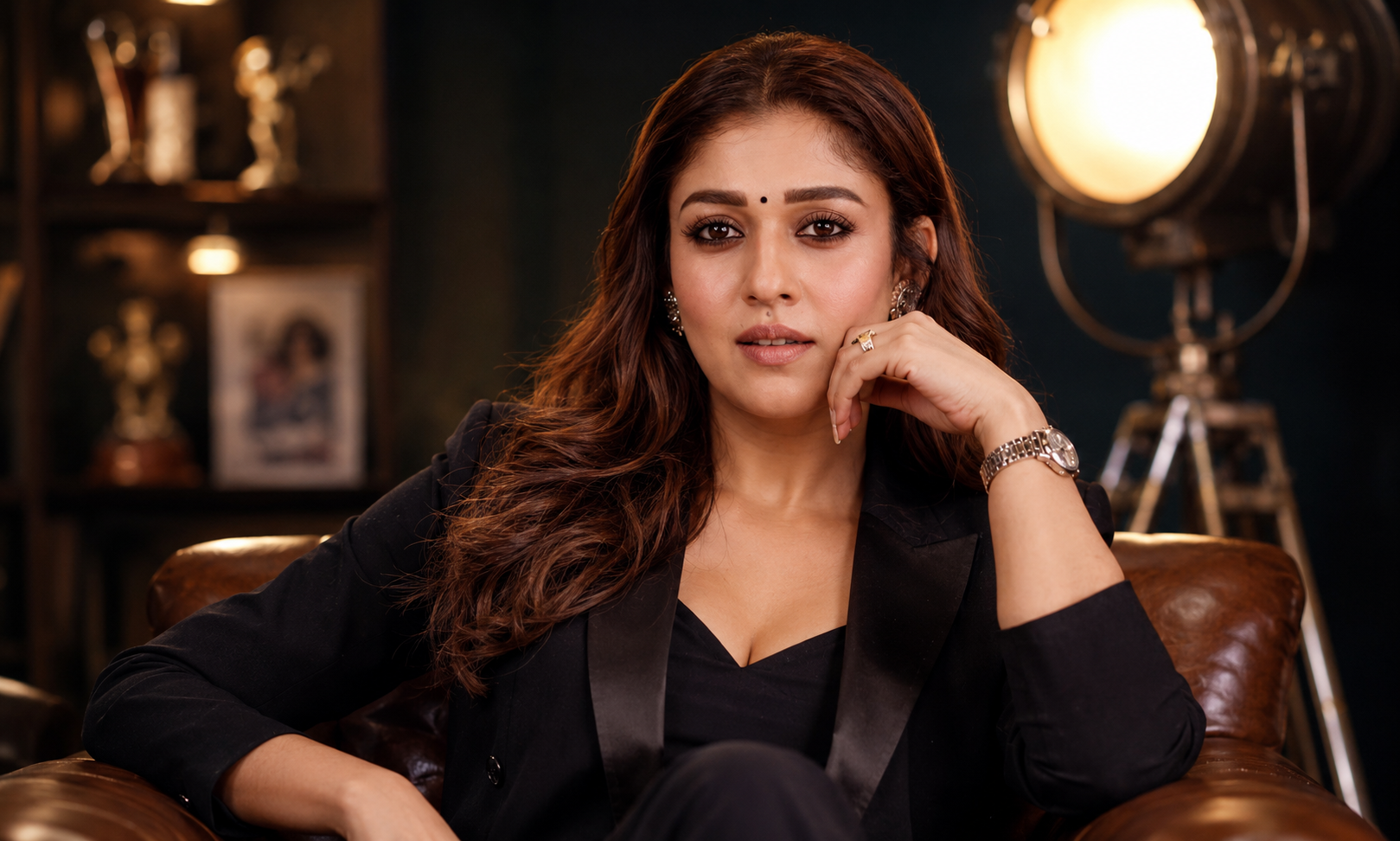
Nayanthara
Indian Actress, Film Producer & Entrepreneur
Nayanthara is an Indian actress and producer known for her work in Tamil, Telugu and Malayalam films. One of the highest-paid actresses in India, she was the only South Indian actress to be featured in Forbes India “Celebrity 100” list in 2018. Nayanthara was born as Diana Mariam Kurian on 18 November 1984 in Bangalore, Karnataka. Nayanthara belongs to a Malayali Syrian Christian family hails from Thiruvalla, Kerala, and was born to Kurian Kodiyattu and Omana Kurian.
Key Factors
Full Name: Nayanthara
Real Name: Diana Mariam Kurian
Date of Birth: 18 November 1984
Place of Birth: Bangalore, Karnataka, India
Native Place: Thiruvalla, Kerala
Occupation: Actress, Film Producer, Entrepreneur
Titles / Popular Names: Lady Superstar
Industries Worked In: Malayalam, Tamil, Telugu, Kannada, Hindi
Years Active: 2003–present
Production House: Rowdy Pictures
In Indian cinema, stardom is often loud. It thrives on relentless visibility, spectacle, and mythology. Yet Nayanthara built hers differently. Reserved in public, intensely selective with interviews, and fiercely protective of her personal space, she cultivated an aura that only deepened her popularity. Over the years, she evolved from a promising Malayalam newcomer into one of the most influential women in contemporary Indian entertainment. Her journey spans more than 75 films across multiple languages, from early commercial entertainers to emotionally layered women-centric dramas that challenged the male-dominated structures of South Indian cinema. Whether portraying vulnerable lovers, mythological figures, grieving mothers, fearless administrators, or psychologically complex protagonists, Nayanthara consistently brought emotional restraint and authority to her performances. Her rise also mirrors the changing aspirations of South Indian audiences, especially women who saw in her characters a rare combination of strength and vulnerability. More than a star, she became a cultural force, someone who proved that a female actor could command both artistic respect and commercial power without surrendering her individuality.
There was a time in South Indian cinema when heroines were expected to orbit around male stars, appearing briefly between songs, romance, and spectacle before fading into the background of the narrative. Then came Nayanthara, a quiet yet fiercely self-possessed performer from Kerala who would gradually alter that equation. She did not storm the industry overnight with dramatic declarations or carefully manufactured rebellion. Instead, she transformed herself film by film, setback by setback, reinvention by reinvention. Born as Diana Mariam Kurian in a Malayali Syrian Christian family, she entered cinema almost accidentally, unsure if acting would ever become a career. Two decades later, she emerged as the “Lady Superstar” of South Indian cinema, a rare female actor capable of commanding opening weekends, carrying female-led blockbusters, and reshaping how women were written in mainstream commercial films. Across Tamil, Telugu, Malayalam, Kannada, and eventually Hindi cinema, Nayanthara built an outstanding career defined not merely by glamour or popularity, but by resilience, emotional intelligence, discipline, and an extraordinary understanding of screen presence.
Early Life and Malayali Roots
Long before the cameras, designer costumes, and superstar status, she was Diana Mariam Kurian, the daughter of an Indian Air Force officer and a Malayali Syrian Christian family deeply connected to Kerala’s cultural traditions.
Because of her father’s military career, her childhood unfolded across multiple Indian cities including Jamnagar and Delhi. Yet despite the constant movement, Kerala remained emotionally central to her identity. Her family traced its roots to Thiruvalla, and much of her education took place in Kerala, where she studied in schools around Tiruvalla before attending Mar Thoma College for a degree in English Literature.
Friends and acquaintances from her early years often described her as reserved, disciplined, and academically inclined rather than aggressively ambitious about cinema.
Acting was not part of a carefully designed childhood dream.
In fact, she initially resisted it.
During college, she took up modelling assignments part-time, largely as a casual opportunity rather than a career plan. Those photographs eventually reached filmmaker Sathyan Anthikad, who noticed something quietly compelling about her screen presence.
That single moment would alter the trajectory of her life.
The Unexpected Film Debut
When Sathyan Anthikad approached her for Manassinakkare, Nayanthara reportedly declined at first. She was uncertain about cinema and did not imagine herself becoming an actress.
Eventually, she agreed to act in “just one film.”
Malayalam cinema, however, noticed her immediately.
Manassinakkare became a commercial success, and audiences responded warmly to her natural screen presence. Unlike many debutantes of the era, she did not appear overly rehearsed or theatrically dramatic. There was a quietness to her performance that felt authentic.
Soon followed films like Vismayathumbathu alongside Mohanlal, where critics particularly praised her emotionally expressive performance.
At that stage, few could have predicted the scale of the career ahead.
She was still viewed primarily as a promising Malayalam actress.
But South Indian cinema was already beginning to notice her.
Rise Across South Indian Cinema
The mid-2000s transformed Nayanthara from a regional newcomer into a rapidly expanding South Indian star.
Her Tamil debut in Ayya introduced her to a larger commercial audience, but it was Chandramukhi, opposite Rajinikanth, that changed everything.
The film became a cultural phenomenon.
Its massive theatrical run elevated everyone associated with it, but for Nayanthara, it established her as one of Tamil cinema’s most sought-after actresses.
Soon came Ghajini, Telugu hits like Lakshmi, and major commercial projects across industries.
At a time when South Indian heroines were often reduced to ornamental roles, Nayanthara managed to hold audience attention even within heavily male-driven narratives.
Part of this came from glamour. She undoubtedly became one of the era’s most photographed and commercially bankable actresses.
But glamour alone does not sustain a two-decade career.
What distinguished her was adaptability.
She learned how different industries functioned, adjusted her performances accordingly, and steadily built credibility beyond appearance.
Her transformation in Billa marked a turning point in public perception. Styled with a sharper, more cosmopolitan image, she suddenly embodied a new kind of South Indian female stardom, glamorous yet commanding.
The industry noticed.
So did audiences.
Reinvention and the Birth of “Lady Superstar”
Many stars achieve popularity. Few successfully reinvent themselves multiple times.
Nayanthara’s greatest achievement may be her evolution from conventional commercial heroine to the driving force behind female-led mainstream cinema.
After a period marked by personal controversies and temporary career uncertainty, she returned with remarkable clarity.
Raja Rani became one of the defining performances of her career. Her portrayal of Regina, a woman navigating grief and emotional isolation within marriage, revealed a performer capable of emotional restraint rather than melodrama.
Critics and audiences responded intensely.
Then came the real transformation.
Films like Maya, Aramm, Kolamaavu Kokila, Netrikann, and Mookuthi Amman fundamentally altered the economics of female stardom in Tamil cinema.
These were not merely “women-centric films” marketed symbolically.
They succeeded commercially. That distinction matters.
In Aramm, she played a district collector confronting systemic negligence and political failure. The performance carried unusual authority and emotional intelligence. In Kolamaavu Kokila, she balanced deadpan humour with criminal desperation. In Maya, she embraced psychological horror with restraint rather than exaggeration.
Her acting style became increasingly minimalist. She rarely overperformed emotions.
Instead, she relied on silence, gaze, timing, and emotional containment.
That subtlety became central to her charisma.
Audiences began referring to her not simply as an actress, but as “Lady Superstar,” a title reflecting commercial power traditionally reserved for male actors.
Career Challenges and Public Scrutiny
Nayanthara’s journey was never free from intense public scrutiny.
Her relationships, personal life, career breaks, and public appearances frequently became tabloid material, especially during the late 2000s and early 2010s.
At various points, sections of the media portrayed her less as an artist and more as a celebrity spectacle.
Yet one of the most striking aspects of her career has been her refusal to publicly overexplain herself.
Rather than constantly responding to controversy, she focused on rebuilding her filmography.
This strategic silence eventually became part of her mystique.
Her comebacks often felt stronger precisely because she allowed her work to speak louder than public noise.
Expansion Beyond Acting
Over time, Nayanthara expanded beyond cinema into entrepreneurship and production.
Together with Vignesh Shivan, she launched Rowdy Pictures, producing films including Koozhangal, which received international acclaim.
She also entered the beauty and wellness business through ventures like 9Skin and Femi9 while endorsing major brands across South India.
Unlike many celebrity businesses built purely on branding, her ventures reflected the larger transformation of South Indian actresses into independent commercial figures with creative and financial agency.
She has also participated in charitable initiatives, including donations during natural disasters and support for film workers during the COVID-19 pandemic.
Bollywood Entry and Pan-Indian Recognition
Although already enormously famous in South India, her Hindi debut with Jawan opposite Shah Rukh Khan introduced her to a much larger pan-Indian audience.
The film became one of India’s highest-grossing productions, further expanding her national visibility.
Soon after, Netflix released Nayanthara: Beyond the Fairytale, offering audiences a more intimate glimpse into her career and personal life.
In the streaming era, where regional boundaries in Indian cinema are rapidly dissolving, Nayanthara emerged as one of the few South Indian actresses with genuinely pan-Indian cultural recognition.
Personal Life and Partnership with Vignesh Shivan
Her relationship with filmmaker Vignesh Shivan gradually evolved into one of South Indian cinema’s most closely followed celebrity partnerships.
Unlike the secrecy surrounding earlier phases of her personal life, this relationship unfolded more openly and comfortably in public view.
The couple married in 2022 in Mahabalipuram in a ceremony attended by film industry figures and close family members.
Later that year, they announced the birth of their twin sons through surrogacy.
Motherhood added another dimension to Nayanthara’s public image, not by diminishing her stardom, but by humanizing it.
Nayanthara and the Evolution of Women in South Indian Cinema
Perhaps Nayanthara’s most important contribution lies in how she altered expectations around female actors in commercial South Indian cinema.
For decades, actresses often disappeared after marriage, struggled to command equal pay, or found themselves confined to supporting roles once younger heroines entered the industry.
Nayanthara challenged each of those assumptions.
She continued leading major films after marriage.
She negotiated substantial remuneration.
She built commercially successful female-led projects.
And crucially, she proved that audiences would support stories centered entirely around women if the writing and performance were compelling enough.
Her influence is now visible across Tamil and South Indian cinema, where more actresses are pursuing author-backed roles and female-led narratives.
That shift did not happen in isolation.
Nayanthara helped normalize it.
Legacy
From Diana Mariam Kurian of Thiruvalla to the “Lady Superstar” of Indian cinema, Nayanthara’s journey reflects far more than celebrity success.
It is the story of reinvention, survival, emotional intelligence, and extraordinary self-belief.
She entered cinema accidentally, endured scrutiny relentlessly, and ultimately transformed herself into one of the rare female stars capable of reshaping the industry itself.
For audiences across Kerala and South India, she represents a form of modern stardom that combines elegance with authority, vulnerability with resilience, and commercial success with artistic evolution.
And that is why Nayanthara remains not merely a film star, but an outstanding Malayali woman who permanently changed the language of female stardom in Indian cinema.