Tiffany Brar
Indian community service worker
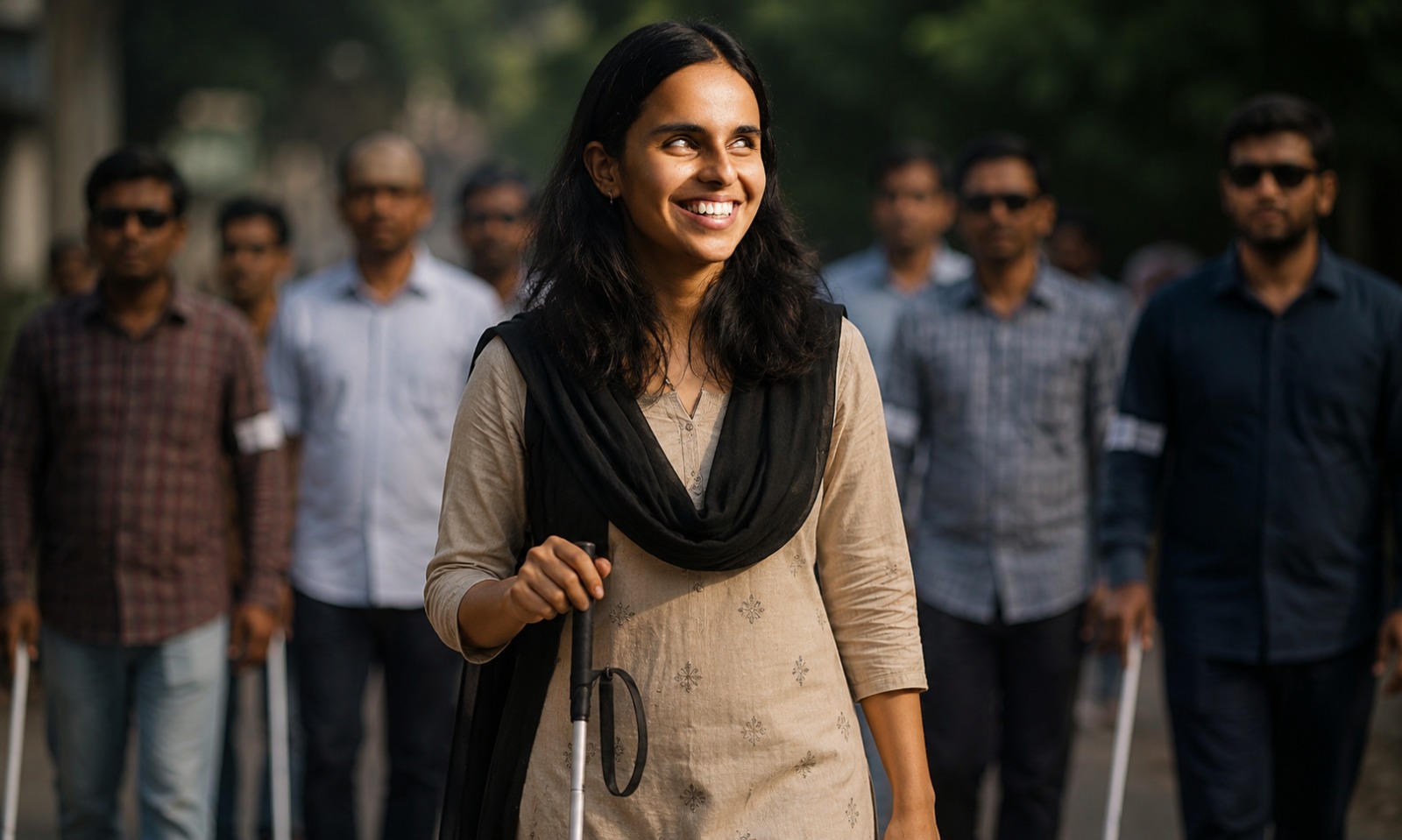
Tiffany Brar is an Indian community service worker who became blind as an infant due to oxygen toxicity. Brar is the founder of the Jyothirgamaya Foundation, a non-profit organization that teaches life skills to blind people of all ages. She is a trainer, a campaigner for disability awareness and an advocate for an inclusive society.
Key Factors
Full Name: Tiffany Brar
Occupation: Social Worker, Disability Rights Advocate, Educator, Motivational Speaker
Founder of: Jyothirgamaya Foundation
Known For: Blind empowerment, inclusive education, independent living training, disability rights advocacy
Identity: Social reformer and advocate for independent living among visually impaired communities
A Childhood Defined by Darkness, But Never Defeat
Tiffany Brar’s story begins in a military household shaped by movement, discipline, and adaptation. Born in Chennai while her father, General T. P. S. Brar, was posted there, she spent her childhood across different parts of India, particularly Punjab and Kerala.
At six months old, she lost her eyesight due to oxygen toxicity linked to Terry Syndrome. For many families, such a diagnosis in the 1980s would have immediately narrowed expectations for the future. But while blindness changed the structure of Tiffany’s life, it never diminished her determination to participate fully in the world around her.
Her father’s military career meant constant relocation, and those movements exposed her to multiple languages, cultures, and social environments. Because visual cues were unavailable to her, communication became her primary way of understanding people and surroundings. Over time, she became fluent in several Indian languages, an ability that later became central to her activism and public engagement.
Yet childhood was also marked by exclusion.
In interviews, Tiffany has spoken candidly about the isolation she experienced within educational institutions. Teachers sometimes made her sit at the back of classrooms. Braille materials arrived late or not at all. In integrated schools, she often felt invisible, caught between systems that claimed inclusion but rarely practiced it meaningfully.
What wounded her most was not blindness itself, but society’s assumptions about blind people.
Children excluded her from activities. Schools underestimated her intelligence. Accessibility was treated as an afterthought rather than a right.
Still, she persisted academically.
Despite the barriers, Tiffany secured first rank in the CBSE board examination in Class 12 while studying alongside sighted students, a remarkable achievement considering the limited accessibility infrastructure available at the time.
The Girl Who Refused to Be Limited
The defining quality of Tiffany Brar’s life is not resilience in the conventional inspirational sense. It is refusal, refusal to accept narrow definitions of capability.
She studied across a combination of blind schools, military schools, and integrated educational institutions. Each environment exposed different shortcomings in India’s disability support systems.
In some schools, blindness meant segregation. In others, it meant token inclusion without practical support.
These experiences sharpened her awareness of structural inequality early in life.
After completing school, she moved to Kerala for higher education and joined the Government College for Women in Thiruvananthapuram to pursue English literature under the University of Kerala.
Literature gave her language for emotions and systems she had long observed intuitively. But outside classrooms, she was also beginning to understand something larger: the overwhelming invisibility of blind individuals from economically marginalized backgrounds.
After graduation in 2009, she worked with Braille Without Borders as a telephone operator and trainer. That role changed her understanding of disability in India more profoundly than any classroom education could.
She travelled to organizations and communities where visually impaired individuals remained confined indoors for years, not because of blindness itself, but because families and communities assumed they could never function independently.
Some had never learned Braille. Others had never used a mobility cane. Many lacked access to basic education, technology, or employment training.
Tiffany realised the problem was not simply disability.
It was social conditioning.
Discovering a Mission Beyond Herself
There is often a single moment in the lives of social reformers when personal frustration transforms into collective mission. For Tiffany Brar, that shift happened gradually through encounters with blind individuals denied autonomy.
She saw children growing into adulthood without mobility training. She met families who believed blind daughters should remain hidden inside homes. In parts of India, roads were inaccessible, schools unprepared, and opportunities virtually nonexistent.
Instead of treating these conditions as unfortunate realities, Tiffany began questioning the systems that produced them.
Her response was radical in its simplicity.
If blind people could not reach schools, training centers, or opportunities, those resources would have to reach them instead.
The Birth of Jyothirgamaya Foundation
In July 2012, Tiffany Brar founded the Jyothirgamaya Foundation in Kerala.
The name “Jyothirgamaya,” derived from Sanskrit, roughly translates to “leading toward light.” It was not intended as a metaphor for curing blindness. Tiffany repeatedly emphasized that blindness itself was not darkness. Ignorance and exclusion were.
One of the foundation’s most innovative initiatives was its mobile school for the blind.
“If the blind cannot go to school, then the school shall go to them,” she famously said while describing the concept.
The model addressed a major issue in rural India: accessibility. Instead of waiting for marginalized individuals to navigate inaccessible systems, the foundation directly reached communities through training camps and outreach programs.
The work extended far beyond Braille literacy.
Students were taught mobility skills, independent travel, computer literacy, daily living techniques, confidence building, and communication. The emphasis was always on autonomy rather than dependency.
Tiffany also challenged educational policies in Kerala that prioritized text-recognition software without ensuring strong Braille or English education for visually impaired children. She argued that genuine inclusion required skill development, not technological shortcuts alone.
The foundation gradually evolved into one of Kerala’s most recognized disability-rights initiatives.
Changing the Meaning of Blindness in India
Indian society has historically approached disability through charity, pity, or protection. Tiffany Brar’s activism fundamentally challenged those attitudes.
She argued consistently that overprotection could become another form of oppression.
Blind individuals, she insisted, should not merely survive. They should travel independently, pursue careers, form relationships, and participate fully in public life.
This philosophy shaped initiatives like “Road to Independence,” a training program focused on self-reliance and mobility.
Her advocacy also extended into public speaking, awareness campaigns, and educational reform conversations. Rather than presenting herself as inspirational in a conventional sense, Tiffany spoke directly about inaccessible infrastructure, exclusionary systems, and social prejudice.
That honesty gave her activism unusual credibility.
She became part educator, part campaigner, and part cultural critic.
Leadership, Innovation, and Recognition
As her work expanded, national and international recognition followed.
In 2016, World Wide Fund for Nature selected her as an ambassador for Earth Hour India, recognizing her role as a public advocate and social leader.
In 2020, she became the first Indian recipient of the Holman Prize from the US-based organization LightHouse for the Blind and Visually Impaired, an award honoring blind individuals undertaking ambitious projects.
But Tiffany’s influence has always been grounded less in awards than in practical innovation.
One striking example is the “Tiffy Template,” developed with inventor Paul D’Souza. The simple tactile device helps visually impaired individuals identify Indian currency notes independently, reducing the risk of financial exploitation.
In 2019, she established a preparatory school and kindergarten for visually impaired children in Thiruvananthapuram, inaugurated by former Kerala Health Minister K. K. Shailaja.
Even during the devastating Kerala floods in 2018, Tiffany participated actively in relief efforts, collecting and organizing supplies for affected communities in Wayanad. The Government of India later recognized her efforts.
An Outstanding Malayali With a Global Message
Although Tiffany Brar was born outside Kerala, much of her social identity and activism became deeply connected to the state.
Kerala’s relatively high literacy rates and social awareness created space for conversations around inclusion, but Tiffany also exposed the contradictions within that progressive image. She repeatedly pointed out that educational success means little if accessibility remains weak.
In many ways, she represents a distinctly Malayali form of public leadership: intellectually engaged, socially conscious, and deeply rooted in education.
At the same time, her work speaks far beyond Kerala.
She now travels independently across India and internationally, conducting workshops, speaking engagements, and advocacy programs. For many visually impaired individuals, particularly young women, she represents a model of autonomy rarely visible in mainstream public life.
Her activism is not built around heroism.
It is built around normalization, the radical idea that blind individuals deserve ordinary freedoms most people take for granted.
Continuing Impact
Tiffany Brar’s greatest contribution may ultimately lie in changing perception.
Through the Jyothirgamaya Foundation, she helped shift blindness in public imagination from helplessness to capability. She transformed training into empowerment and advocacy into structural critique.
Her work continues to influence conversations around inclusive education, disability rights, accessibility, and independent living in India. More importantly, it has changed lives at the individual level, children learning Braille confidently, adults travelling independently for the first time, families beginning to see blindness differently.
In a country where disability is still frequently misunderstood, Tiffany Brar’s voice remains both urgent and necessary.
Her journey from a child excluded inside classrooms to a nationally recognized advocate for independence reflects something larger than personal achievement. It reflects the possibility of rebuilding society itself around dignity instead of limitation.
For Kerala, and increasingly for India as a whole, Tiffany Brar stands as an outstanding Malayali humanitarian whose life continues to redefine what inclusion truly means.
Awards
2023 – International Woman’s day Award from the Delhi Commission for women
2022 – Nari Shakti Puraskar for empowering visually impaired rural women
2021 – Inspiring Woman Award from eiT NASSCOM
2020 – Holman Prize from the Lighthouse for the Blind, United States
2020 – Spirit Awards from World Pulse, United States
2019 – The Spindle Award for Project Jyothirgamaya From Voice, Netherlands
2019 – World of Difference International Award from The International Alliance for Women, Australia
2019 – Iconic women for making the world a better place Award from Women Economic Forum
2019 – Award for Excellence in social service from the Kochouseph Chittilappilly Foundation
2019 – Wonder Woman Award for her Community service from Ladies Circle India
2019 – Neelam Khurshid Kanga Award from the National Association for the Blind, awarded by John Abraham
2018 – Helen Keller award from the National Centre for Promotion of Employment for Disabled People (NCPEDP)
2018 – Karma Rathna Award for Outstanding social worker from Palm International
2018 – Real Hero Award by ZEE TV from Vivek Oberoi, Omung Kumar and Huma Qureshi
2018 – Vocational Excellence Award from Rotary International
2018 – Phoenix Award from Padma Shri Mammooty
2018 – Women of Vision Kerala vanitha Rathna Award
2018 – Make A Difference Award from Rotary International
2018 – Women of the Year Award from Job Day Foundation
2017 – National Award for being a ‘Best role model’ from the President of India
2017 – Age of Unknown Award by TEDx vazthacaud
2017 – Sarojini Trilok Nath-National Best Role Model Award from National Association for the Blind
2017 – Bold and Beautiful Award from Doordarshan
2016 – Prestigious Saarthak Naari Women Achievers Award
2016 – For the Sake of Honour Award, Rotary International’s highest award
2015 – Women of the Year Award from Hope Trust
2012 – Kerala State Award for Social Worker
Recognition
Ram Nath Kovind, President of India calls her while addressing the Nation during his speech on United Nations’ International Day of Persons with Disabilities when she received the National Award, in 2017, for the Best Role Model. He recognized her achievements in the field of social service and adventurous activities.
A.P.J.Abdul Kalam former president of India, appreciated Tiffany Brar for her efforts to empower her fellow visually impaired people around the world.
Tiffany Brar was felicitated for her achievements by the Malayalam actor Padma Shri Mohanlal, in his talk show Lal Salam. He called Brar “A miraculous woman”.