Kerala History – Timeline
Ancient Times
Spice trade with Rome, Greece & Arabia begins.
300 BCE – 300 CE
Chera dynasty rules; strong maritime trade grows.
1000–1500 CE
Arab traders arrive; Islam spreads along the coast.
1498
Vasco da Gama lands in Kozhikode → European era begins.
1500–1947
Portuguese, Dutch & British control spice trade; colonial rule.
1947 onwards
India becomes independent; Kerala state formed in 1956.
Modern Kerala
High literacy, strong education, health & global diaspora.
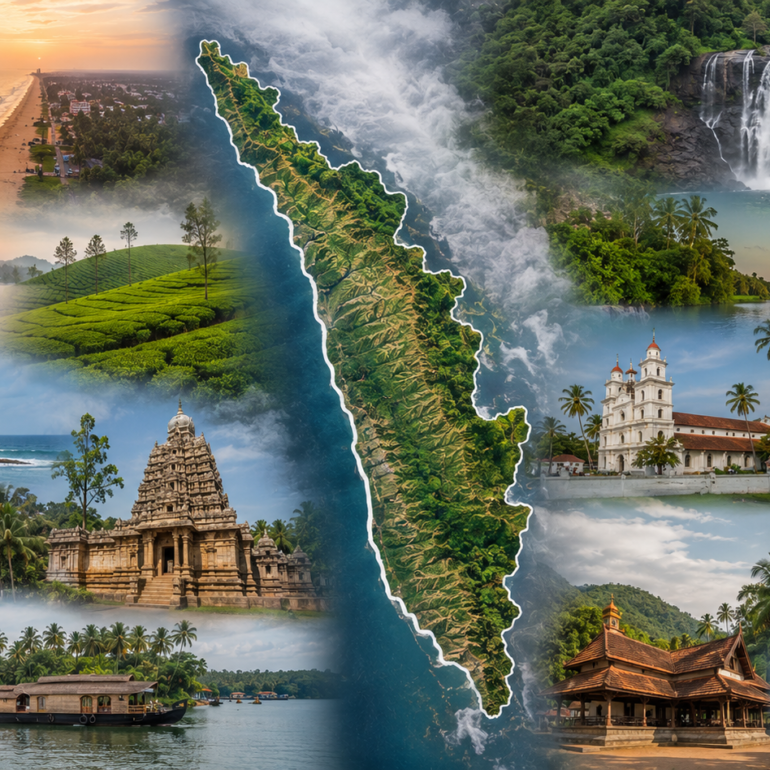
Along the lush southwestern edge of India lies Kerala, a land shaped by monsoon rains, coconut groves, mountain passes, and the endless rhythm of the Arabian Sea. For thousands of years, this narrow strip along the Malabar Coast stood at the center of global trade networks, attracting merchants, travelers, philosophers, and empires from across the world. Long before globalization became a modern idea, Kerala was already an outstanding crossroads of civilizations.
Roman ships once sailed toward its spice ports in search of black pepper, often called “black gold.” Arab traders brought Islam to its shores peacefully through commerce. Jewish communities found refuge here centuries ago. Christian traditions took root remarkably early in Indian history. Chinese merchants visited its harbors, and later European powers fought fiercely to control its trade routes.
Yet Kerala’s history is not only about commerce or conquest. It is also a story of intellectual brilliance, social reform, artistic evolution, and cultural openness. From the ancient Chera dynasty to the formation of the modern state in 1956, Kerala evolved through continuous interaction with the wider world while preserving a deeply rooted regional identity. Today, the outstanding cultural richness of Kerala remains one of the most distinctive in India.
Ancient Kerala and the Chera Kingdom
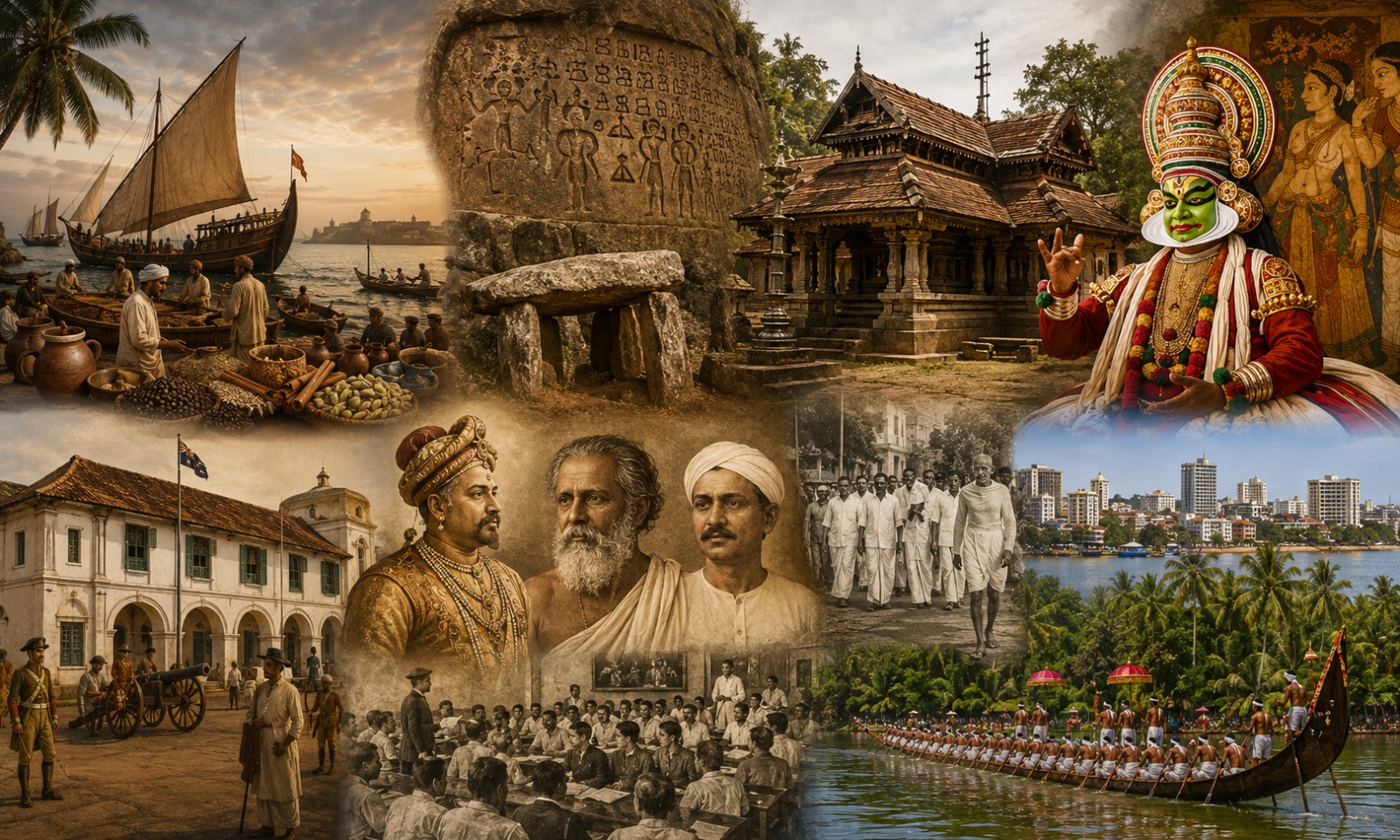
The earliest historical references to Kerala appear in ancient Indian and Mediterranean records. In the 3rd century BCE, Mauryan emperor Ashoka mentioned “Keralaputra” in his rock inscriptions, identifying the region as one of the independent kingdoms of southern India. This early reference confirms that Kerala already possessed political and cultural significance over two thousand years ago.
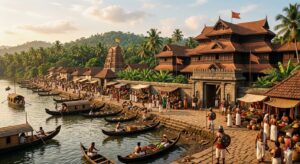
The dominant power of ancient Kerala was the Chera dynasty, whose rulers controlled important parts of the Malabar Coast. Geography played a major role in Kerala history. Protected by the Western Ghats mountains and connected to the Arabian Sea, Kerala became one of the world’s most valuable spice-producing regions.
Black pepper transformed Kerala into an outstanding center of maritime trade. Roman, Greek, Arab, and later Persian merchants sailed across the Indian Ocean to reach Kerala’s ports. Ancient Roman coins discovered in Kerala reveal the scale of these commercial relationships. Ports such as Muziris became internationally famous, linking Kerala to the Mediterranean world, East Africa, and the Middle East.
Trade did more than bring wealth. It also introduced new cultures, religions, languages, and ideas, shaping Kerala into a remarkably cosmopolitan society for its time.
Religion, Philosophy, and Cultural Growth
The religious and cultural history of Kerala reflects centuries of exchange and coexistence. Hindu traditions gradually became dominant, with temples emerging as important social and artistic centers. At the same time, Buddhism and Jainism also influenced ancient Kerala, leaving traces in architecture, rituals, and literature.
One of Kerala’s greatest intellectual figures, Adi Shankaracharya, was born in Kalady during the 8th century. He became one of India’s most influential philosophers and developed the doctrine of Advaita Vedanta, which teaches the unity of the individual soul with ultimate reality. His philosophical work shaped Indian spiritual thought for centuries.
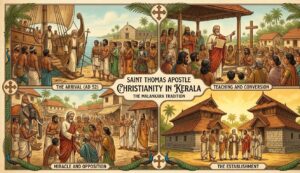
Kerala’s coastal openness also encouraged the peaceful arrival of other faiths. Arab traders introduced Islam to the region, creating some of the earliest Muslim communities in India. Christianity in Kerala traces its roots to ancient traditions associated with Saint Thomas the Apostle. Jewish communities also settled along the coast, particularly around Kochi, where they contributed to Kerala’s multicultural identity.
This extraordinary coexistence of religions made Kerala culturally unique long before the modern idea of pluralism emerged.
Medieval Kerala and the Rise of Regional Kingdoms
After the decline of the Chera dynasty, Kerala witnessed the rise of several regional kingdoms. Among them, the Kingdom of Kozhikode emerged as one of the most powerful under the rule of the Zamorins. Kozhikode, known internationally as Calicut, became an outstanding port city that connected India to the global spice trade.
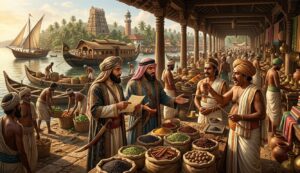
Arab merchants maintained strong commercial ties with Kerala during this period, while Chinese fleets also visited the Malabar Coast. Kerala’s ports bustled with sailors, traders, and travelers carrying spices, silk, ceramics, and precious goods across the Indian Ocean.
Meanwhile, kingdoms such as Kochi and Travancore developed their own political and cultural identities. Literature, temple arts, dance traditions, and architecture flourished during medieval Kerala, contributing to the region’s enduring cultural legacy.
Kerala School of Mathematics and Astronomy
One of the most remarkable chapters in Kerala culture and history emerged during the 14th century with the Kerala School of Mathematics and Astronomy. Founded by Madhava of Sangamagrama, this intellectual tradition made pioneering contributions to mathematics centuries before similar developments in Europe.
Scholars in Kerala explored advanced concepts involving infinite series and trigonometric calculations. Their work anticipated ideas later associated with calculus and modern mathematical analysis. Though these discoveries remained relatively unknown outside India for centuries, historians today recognize the Kerala School as an outstanding achievement in global scientific history.
Arrival of Europeans
Kerala colonial history began dramatically in 1498 when Portuguese explorer Vasco da Gama arrived at Kozhikode after sailing around the Cape of Good Hope. His arrival changed world history by opening a direct sea route between Europe and India.
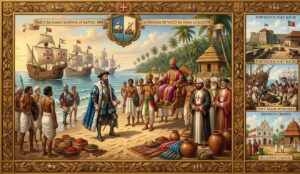
The Portuguese quickly attempted to dominate Kerala’s spice trade through forts, naval power, and political alliances. Soon the Dutch, French, and British also entered the competition, turning Kerala into a battleground for European commercial ambitions.
Control of pepper and other spices brought enormous wealth, making the Malabar Coast strategically vital to European empires. Colonial powers reshaped Kerala’s economy, politics, and military systems, though local rulers often resisted foreign domination.
Travancore and Resistance to Colonial Powers
Among Kerala’s most outstanding rulers was Marthanda Varma of Travancore. In 1741, his forces defeated the Dutch at the famous Battle of Colachel, one of the earliest major Asian victories against a European colonial power.
Following this victory, Travancore modernized its military using European techniques and weapons. Marthanda Varma also strengthened administration, expanded territory, and consolidated political authority. Under his leadership, Travancore emerged as a powerful and stable kingdom capable of resisting external threats.
This period demonstrated that Kerala’s rulers were not passive observers of colonial expansion but active participants shaping their own destiny.
British Rule and Social Transformation
By the late 18th and early 19th centuries, British influence became dominant in Kerala. Northern Kerala formed part of the Malabar District under direct British administration, while Travancore and Cochin continued as princely states allied with the British Crown.
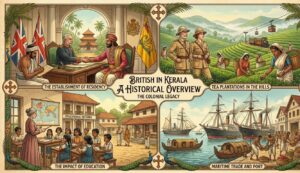
British rule brought major social and educational changes. Christian missionaries established schools and printing presses, helping expand literacy and modern education. At the same time, Kerala society faced deep caste inequalities and social restrictions.
Reformers such as Sree Narayana Guru challenged caste discrimination and advocated social equality. Other renaissance movements promoted education, women’s rights, and democratic participation. These reform efforts transformed Kerala into one of the most socially progressive regions in India.
Formation of Modern Kerala
After Indian independence in 1947, the princely states of Travancore and Cochin joined the Indian Union. In 1956, the modern state of Kerala was officially created by combining Travancore-Cochin with the Malabar District and Kasaragod region based on Malayalam linguistic identity.
The formation of Kerala marked the beginning of a new political chapter. Shared language, literary traditions, and cultural memory helped unite diverse regions into a single state.
Everyday life in Kerala
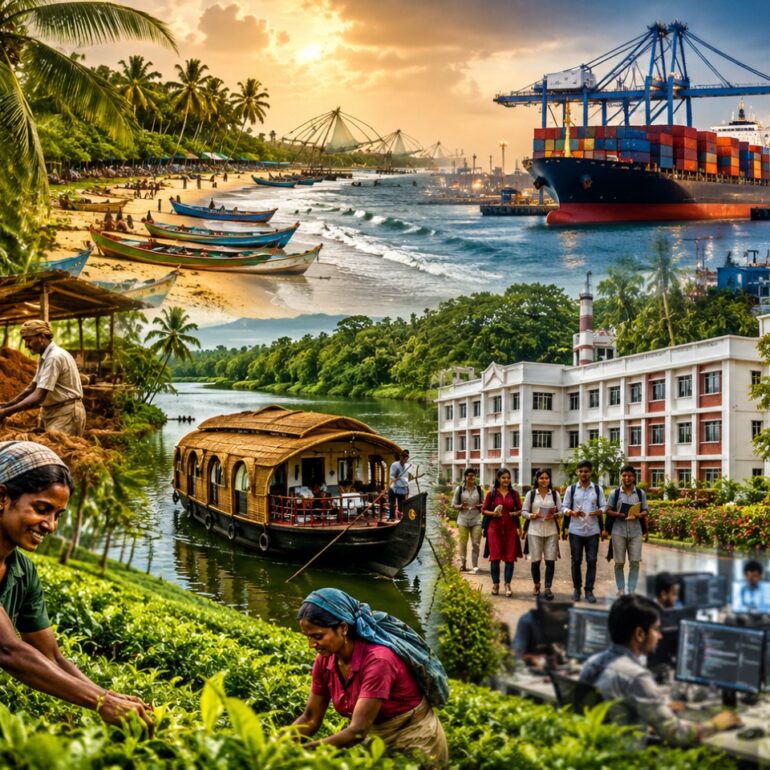
Everyday life in Kerala is built around small, familiar moments that feel deeply connected to the land and the sea. Food is central to daily living, shaped by rice, coconut, spices, and fresh seafood, with meals often bringing families together in a simple but meaningful way.
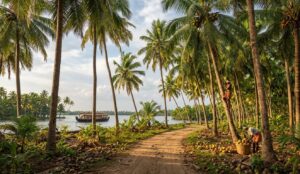
Along village roads and town corners, tea shops are more than just places to drink tea — they are social spaces where conversations flow easily, from local news to politics and cinema. In coastal areas, fishing villages continue a long tradition of life tied to the Arabian Sea, where the day begins early and ends with the rhythm of the tides.
Across the state, coconut trees are not just part of the landscape but part of everyday survival and economy, influencing food, trade, and traditional practices. Together, these everyday elements create a lifestyle that is simple, connected, and deeply rooted in Kerala’s natural environment.
Kerala Today
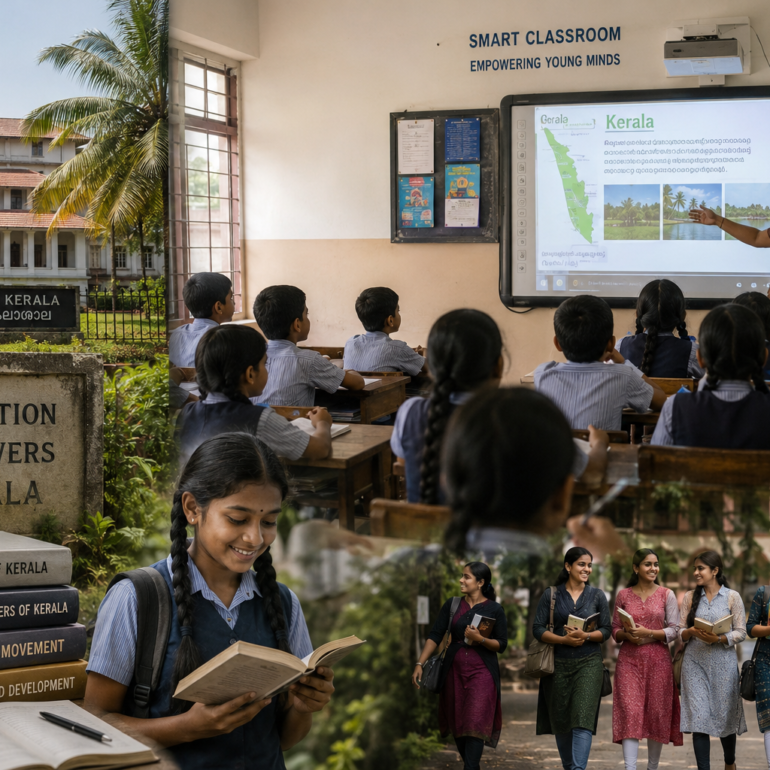
Modern Kerala carries the legacy of its long and outstanding historical journey. The state is internationally recognized for high literacy, healthcare, and social development. Its religious diversity and relative communal harmony continue to reflect centuries of coexistence shaped by trade and migration.
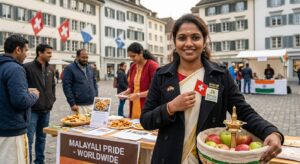
Malayalis today live across the globe, especially in the Middle East, Europe, and North America, creating a vibrant global diaspora connected deeply to Kerala’s culture. Traditional arts like Kathakali and Mohiniyattam, historic backwaters, spice cuisine, literature, and intellectual life continue to attract visitors from around the world.
The history of Kerala is ultimately the story of a society that remained open to the sea, to ideas, and to people. From ancient spice ports to modern achievements, Kerala’s past continues to shape its identity as one of India’s most culturally rich and globally connected regions.