Education is one of Kerala’s greatest achievements and a source of pride for its people. The roots of learning in Kerala go back many centuries. In those days, education was mainly connected to temples, mosques, churches, and royal courts, where people gained knowledge through traditional systems of learning.
Timeline of Kerala’s Educational Evolution
1817 – Maharani Gouri Parvathi Bayi of Travancore promotes education through state support for schools.
Mid-1800s – Christian missionaries establish modern schools and expand formal education.
Late 1800s – Social reformers like Sree Narayana Guru, Ayyankali, and Chattampi Swamikal advocate equal access to education.
1956 – Formation of Kerala strengthens focus on education and social development.
1960s–1980s – Government schools, colleges, and literacy programs expand across the state.
1989–1991 – Large-scale literacy campaigns are launched throughout Kerala.
1991 – Kerala becomes India’s first fully literate state.
2000s–Present – Smart classrooms, digital learning, and technology-driven education transform the sector.
A major turning point came in the nineteenth century. In 1817, Maharani Gouri Parvathi Bayi of Travancore issued an important announcement of supporting education. This marked the beginning of a new chapter in Kerala’s educational history. Through the efforts of social reformers, missionaries, and rulers, education gradually reached all sections of society. By the end of the twentieth century, Kerala had become the most literate state in India. Today, with a literacy rate of more than 96 percent, Kerala continues to be a model for the rest of the country.
Education in the Past
In earlier times, education was not accessible to everyone. Many people were denied educational opportunities because of their caste, gender, or economic background. Traditional learning centres taught subjects such as language, philosophy, mathematics, and religious studies. However, a large section of society had little or no access to formal education.
The nineteenth century brought major changes. Missionary schools introduced science, English, and other modern subjects. At the same time, the rulers of Travancore and Cochin recognized the importance of education for social development. Social reformers challenged discrimination and fought to ensure that people from all communities could receive an education. Their efforts helped transform education from a privilege enjoyed by a few into a right available to everyone.
Education in Kerala Today
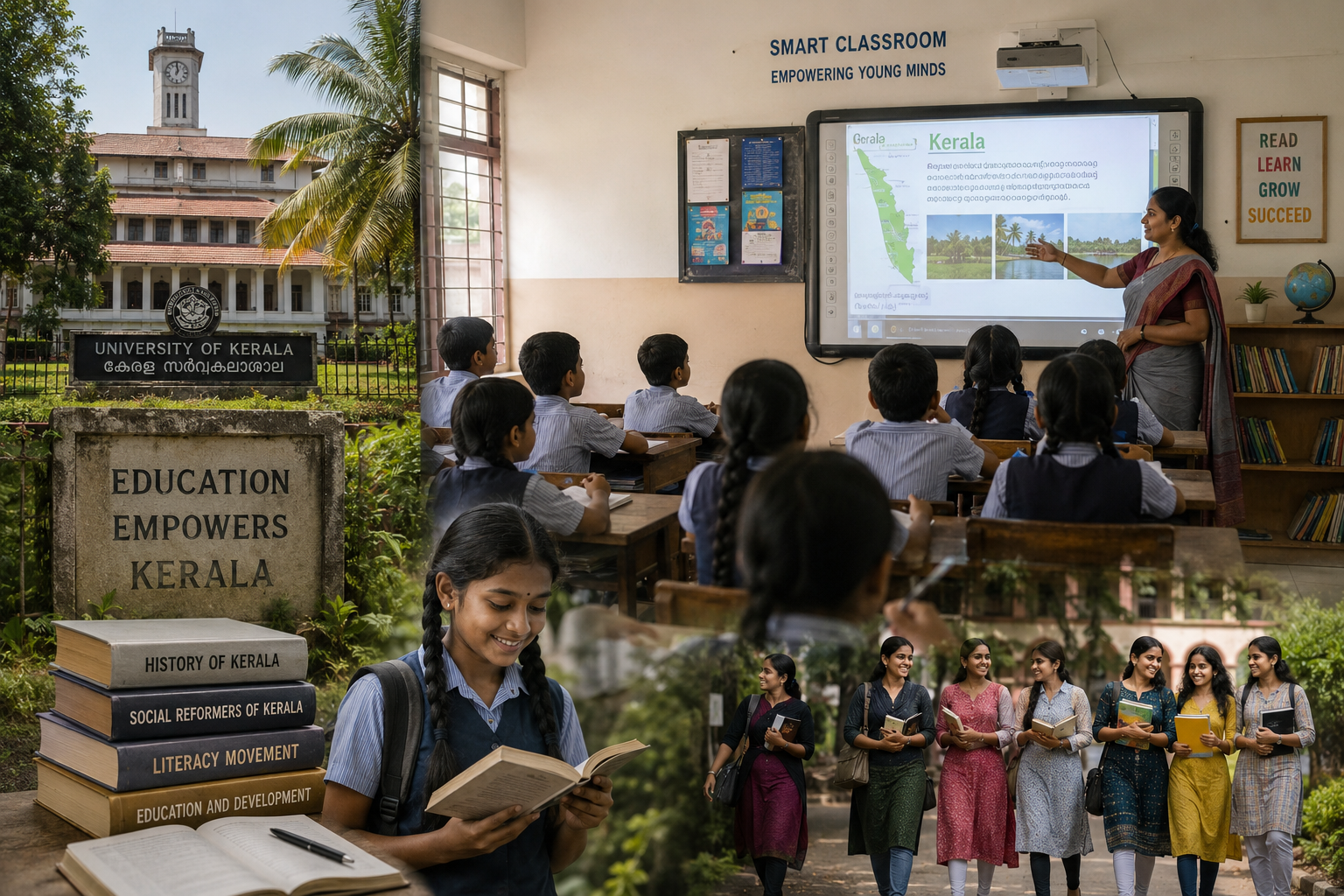
Today, Kerala has one of the strongest educational systems in India. Government schools, aided schools, private institutions, colleges, universities, and research centres provide education to millions of students across the state.
Technology has brought significant changes to the education sector. Smart classrooms, digital learning materials, online platforms, and technology-based teaching methods have made learning more effective and accessible.
Kerala has also set an example in women’s education. High female literacy and the active participation of women in education have played an important role in the state’s social progress. Educational institutions in Kerala have produced doctors, engineers, scientists, writers, entrepreneurs, teachers, and many other professionals who have made valuable contributions around the world.
A Legacy of Learning
The history of education in Kerala is a story of vision, social reform, and collective effort. From traditional centres of learning to modern digital classrooms, this journey has been one of the driving forces behind Kerala’s social development. Education has given Kerala not only high literacy but also progressive thinking, social awareness, and confidence. As Kerala continues to move forward, education remains one of the strongest foundations of its success and an inspiration for future generations.