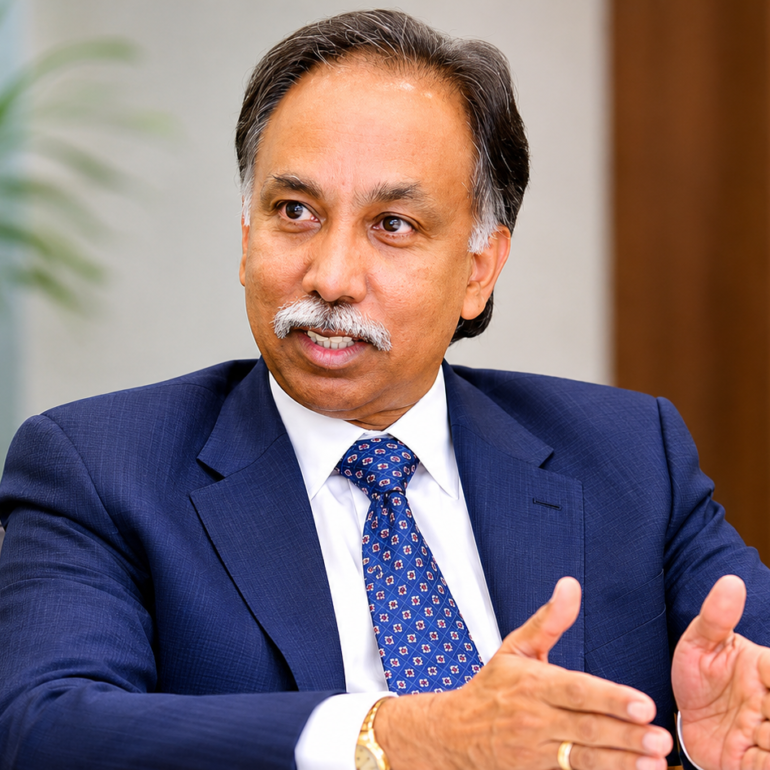

Anoop P. Ambika
serial entrepreneur, organiser and a technology enthusiast
Anoop Ambika, a serial entrepreneur and technology enthusiast, started out as a design engineer in General Electric. With over 26 years of industry experience, he has held several key roles including the CEO of KSUM, and previously, as the CEO of GenproResearch. He represents Kerala Knowledge Economy Mission (KKEM) in Kerala State Planning Board and has co-founded several technology startups. He has also served as the Patron of Natana, the arts and cultural forum of IT companies in Kerala.
Key Facts
Full Name: Anoop Ambika
Place: Kerala, India
Current Role: CEO, Kerala Startup Mission
Occupation: Entrepreneur, Technology Leader, Ecosystem Builder
Known For: Leadership in Kerala’s startup ecosystem, role in Kerala Knowledge Economy Mission, startup mentorship
On a typical day at a startup hub in Kerala, the scene is less about spectacle and more about structure. Founders move between mentoring sessions, prototype labs, and investor meetings, navigating a system that did not exist in this form a decade ago. Unlike Bengaluru or Hyderabad, where private capital built the ecosystem first, Kerala’s model has been more institutional, anchored by the state. At the centre of this architecture is Kerala Startup Mission, and within it, Anoop Ambika, a figure who operates less as a figurehead and more as a system designer. His role is not to create startups directly, but to build the conditions under which they can emerge and scale.
Early Career and Foundations
Anoop Ambika’s professional trajectory begins in engineering, with early experience at General Electric as a design engineer. This phase is significant not just for technical grounding, but for exposure to structured problem-solving and global industrial practices.
For many engineers in India, careers in multinational corporations represent stability. Ambika’s shift away from this path toward entrepreneurship reflects a different orientation, one that prioritizes experimentation over predictability.
The transition from engineering to entrepreneurship is not uncommon, but it is rarely straightforward. It involves moving from defined roles to uncertain environments, from execution to decision-making. This shift would later inform his approach to ecosystem building, where understanding the founder’s journey becomes critical.
Entrepreneurial Journey
Before entering the public innovation space, Ambika built his credentials as a serial entrepreneur. He is associated with ventures such as GenproResearch, a technology company operating in the healthcare and data analytics domain.
This phase of his career is important in understanding his leadership style. Entrepreneurs operate under constraints, limited capital, evolving markets, and constant risk. Decisions are often iterative rather than definitive.
Running a startup also exposes founders to systemic gaps, access to funding, mentorship, infrastructure, and talent. These gaps often become the focus areas for those who later move into ecosystem roles.
While detailed financial and operational data on his ventures is not extensively documented in public sources, his experience as a founder provides a practical lens through which he approaches policy and institutional design.
Leadership at KSUM
As CEO of Kerala Startup Mission, Anoop Ambika operates at the intersection of government policy and entrepreneurial activity. KSUM itself is a unique entity, a state-supported organization tasked with building and nurturing Kerala’s startup ecosystem.
Under his leadership, the focus has been on strengthening infrastructure, expanding incubation networks, and increasing access to funding and mentorship. Kerala’s approach differs from other states in that it relies more heavily on public institutions to catalyze private innovation.
Key initiatives associated with KSUM include the development of startup hubs, support programs for early-stage ventures, and efforts to integrate innovation into educational institutions. The emphasis is not just on creating startups, but on building a pipeline of talent and ideas.
One of the distinguishing aspects of Ambika’s tenure is the attempt to decentralize innovation. Rather than concentrating activity in a single city, KSUM has worked to create nodes across the state, reflecting Kerala’s dispersed urban structure.
Policy and Ecosystem Influence
Beyond KSUM, Anoop Ambika’s role extends into broader policy frameworks. He is associated with the Kerala Knowledge Economy Mission, an initiative aimed at creating employment opportunities through knowledge-driven sectors.
His involvement with the Kerala State Planning Board, as referenced in public profiles, places him within the state’s strategic decision-making ecosystem. This connection between operational leadership and policy formulation is critical.
In many regions, startup ecosystems evolve independently of government policy. In Kerala, the two are closely linked. This creates both opportunities and constraints. On one hand, policy support can accelerate infrastructure development. On the other, bureaucratic processes can slow down decision-making.
Ambika’s role, therefore, involves navigating these dynamics, aligning entrepreneurial needs with policy frameworks, and ensuring that institutional mechanisms remain responsive.
Cultural and Community Contributions
An often-overlooked dimension of Anoop Ambika’s profile is his engagement with cultural initiatives. As a patron of Natana, an organization associated with arts and cultural expression, he reflects a broader perspective on innovation.
This intersection between technology and culture is particularly relevant in Kerala, where artistic traditions coexist with high levels of education and technological adoption. Innovation, in this context, is not limited to startups but extends to creative industries and community engagement.
Such involvement suggests a leadership approach that views ecosystems holistically, recognizing that entrepreneurship is influenced not just by capital and infrastructure, but also by cultural context.
Leadership Style and Philosophy
Anoop Ambika’s leadership style differs from both traditional bureaucratic models and high-visibility startup founders. It is operational, systems-oriented, and relatively low-profile.
Decision-making in his role involves balancing multiple stakeholders, government departments, startups, investors, and educational institutions. This requires a level of coordination that is closer to system management than individual leadership.
His background as an entrepreneur likely informs a preference for practical solutions over theoretical frameworks. Policies and programs are evaluated not just for intent, but for execution.
There is also an emphasis on inclusivity. Kerala’s startup ecosystem aims to be accessible across geographies and demographics, reflecting the state’s broader social development indicators.
Impact and Legacy
Assessing the impact of Anoop Ambika’s work involves looking at the broader trajectory of Kerala’s startup ecosystem. Over the past decade, the state has seen a steady increase in the number of startups, incubators, and innovation programs.
While Kerala does not yet match the scale of ecosystems like Bengaluru, it has carved out a distinct identity. Its model emphasizes public infrastructure, talent development, and distributed growth.
Challenges remain. Access to large-scale funding, retention of talent, and integration with national and global markets continue to be areas of concern. The success of the ecosystem will depend on how these challenges are addressed over time.
Ambika’s contribution lies in shaping the framework within which these issues are being tackled. His role is less about individual success stories and more about building a system that can sustain them.
Looking ahead, the question is not just how many startups Kerala can produce, but how many can scale, survive, and create long-term value. This requires continuous adaptation, both in policy and practice.
In that sense, Anoop Ambika’s journey reflects a broader shift in how entrepreneurship is supported in India. It moves from isolated success stories to structured ecosystems, from individual ambition to collective infrastructure. That transition, still in progress, carries its own complexities. But it also defines a new model of leadership, one that is quietly outstanding in its systemic impact.