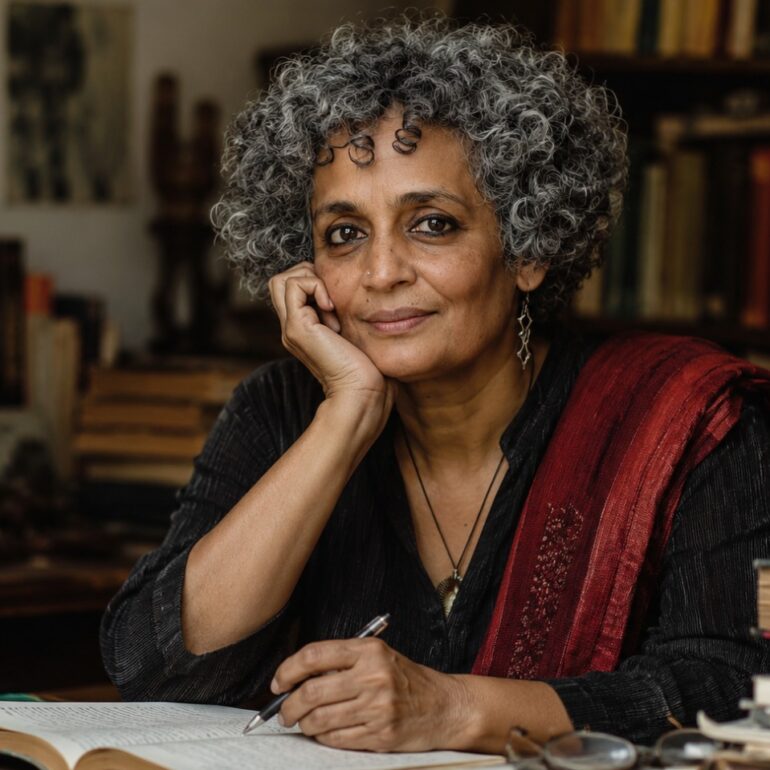
Daya Bai
Real Name: Mercy Mathew
Education: University of Mumbai (Master of Social Work)
Title: Social worker, Activist
Known for: Tribal upliftment
A Meeting Under the Neem Tree
The meeting does not begin with a speech. It begins with listening.
Under a neem tree in a small tribal hamlet in Madhya Pradesh, Daya Bai sits on the ground, surrounded by women who speak in turns, sometimes hesitantly, sometimes with urgency. The concerns are immediate, land disputes, a delayed ration, a child’s illness. There are no microphones, no banners, no visible markers of activism as it is often imagined. What unfolds instead is slower, quieter, and far more demanding. It is an outstanding kind of work, built not on visibility but on presence, on the decision to stay where the state is distant and the market indifferent. In these conversations, activism is not performed. It is lived.
Early Life and Influences: Choosing Departure
Daya Bai was born in Kerala into a Syrian Christian family, in a social environment far removed from the realities she would later inhabit. Her early life was marked by access to education and a relatively stable socio-economic setting, a contrast that would become central to her later choices.
Her worldview was shaped by exposure to Gandhian thought, particularly the emphasis on simplicity, self-reliance, and service. Unlike many who encounter such ideas abstractly, Daya Bai interpreted them as directives rather than ideals.
The turning point in her life was not a single dramatic event but a gradual realization, that structural inequality in India was not incidental but deeply embedded, and that meaningful engagement required proximity, not distance.
She chose to leave behind the possibility of a conventional life and moved north, eventually settling in tribal regions of Madhya Pradesh. This decision was less about sacrifice in a moral sense and more about alignment, a deliberate repositioning of her life within the margins of Indian society.
Journey into Activism: Entering Without Authority
When Daya Bai arrived in the tribal belt of central India, particularly in districts like Barwani, she did not arrive as a leader or organizer. She arrived as an outsider, unfamiliar with local dialects, customs, and social structures.
Integration was neither immediate nor easy.
Trust in such communities is not granted through credentials but earned through consistency. For months, and then years, her work was defined by observation and participation, living in conditions similar to those of the communities she sought to work with, sharing daily routines, and learning through proximity.
Her early initiatives were modest. She focused on understanding the specific challenges faced by tribal families, issues of land alienation, lack of access to healthcare, absence of schooling, and exploitation by local power structures.
What distinguished her approach was its refusal to impose external frameworks. Instead of introducing pre-designed programs, she allowed the direction of her work to emerge from the needs articulated by the community itself.
Work with Tribal Communities: Building from the Ground Up
Over time, Daya Bai’s work expanded into multiple areas, each interconnected.
Land rights became a central concern. Many tribal families lacked formal documentation of their land, making them vulnerable to displacement and exploitation. She worked with communities to navigate bureaucratic processes, assert claims, and resist unlawful dispossession.
Education was another critical focus. In regions where formal schooling was either absent or inaccessible, she helped initiate informal learning spaces, often held in open areas, designed to accommodate the rhythms of rural life rather than impose rigid structures.
Healthcare interventions were similarly grounded. Instead of relying solely on external medical systems, she emphasized awareness, preventive care, and basic accessibility.
Women’s empowerment emerged not as a separate agenda but as an integral part of her work. Through collective discussions and informal groups, women began to articulate their concerns more openly, gradually shifting local dynamics.
The impact of these efforts is not easily quantifiable. It does not translate into large-scale statistics or immediate transformation. Instead, it appears in smaller shifts, increased confidence, greater awareness of rights, and a gradual reduction in vulnerability.
Gandhian Ideology in Practice: Living the Method
Daya Bai’s work is often described as Gandhian, but the term is frequently used without precision.
In her case, it manifests in specific ways.
She lives simply, often in conditions similar to those of the communities she works with. This is not symbolic austerity but a functional choice, reducing distance between activist and community.
Her methods are non-violent, but not passive. She engages in protest, negotiation, and advocacy, but always within a framework that avoids confrontation for its own sake.
Perhaps most importantly, her work reflects the Gandhian idea of being with rather than working for. She does not position herself as a provider of solutions but as a participant in collective problem-solving.
In a contemporary context where activism is often mediated through institutions, funding structures, and visibility, this approach is both rare and difficult to sustain.
Challenges and Resistance: Working Against Structure
Daya Bai’s work operates within a landscape shaped by structural constraints.
Government schemes aimed at tribal welfare often suffer from poor implementation, bureaucratic delays, and lack of accountability. Navigating these systems requires persistence and negotiation, often without institutional backing.
There has also been resistance from local power structures, individuals or groups that benefit from existing inequalities. Efforts to assert land rights or challenge exploitation can provoke tension, placing activists and communities at risk.
Her approach, grounded in non-violence, does not eliminate conflict. It reframes it, turning confrontation into dialogue, even when outcomes remain uncertain.
The personal cost of such work is significant. Living in remote areas, with limited resources and constant engagement with hardship, requires sustained commitment.
Visibility Without Transformation
Daya Bai has received recognition for her work, including national-level awards acknowledging her contribution to social service.
Yet, recognition sits uneasily within her life.
Awards bring visibility, but they do not necessarily alter the conditions she works within. The communities she engages with continue to face the same structural challenges, regardless of external acknowledgment.
Her lifestyle remains largely unchanged by such honors. She continues to live simply, maintaining distance from institutional power and public spotlight.
This contrast highlights a broader issue in India’s recognition systems, the gap between symbolic acknowledgment and substantive change.
Leadership Without Hierarchy
Daya Bai’s leadership style resists conventional categorization.
She does not operate as a central authority figure. Instead, her role is facilitative, creating space for dialogue and collective decision-making.
Within the communities she works with, she is seen less as an external agent and more as a participant. This perception is built over time, through sustained engagement rather than formal designation.
In media narratives, she is sometimes framed as a figure of selfless service. While not inaccurate, this framing risks oversimplification, reducing complex, sustained work into moral shorthand.
Her actual practice is more intricate, balancing empathy with strategy, patience with persistence.
A Model That Resists Scale
Daya Bai’s work raises a critical question about the nature of social change.
Her model is deeply localized, built on relationships, trust, and long-term presence. It does not scale easily. It cannot be replicated through policy alone or expanded through rapid institutionalization.
In contemporary India, where development is often measured in terms of scale and speed, such work can appear limited. Yet, it addresses dimensions of inequality that large systems often overlook, lived experience, cultural context, and community agency.
Her legacy lies not in the size of her interventions but in their depth.
For future generations of activists, her work offers both inspiration and challenge. It demonstrates that meaningful change requires time, proximity, and a willingness to operate without immediate visibility.
Staying Where It Matters
In the end, Daya Bai’s work cannot be easily summarized or concluded.
It continues, in villages where progress is incremental, where conversations under trees matter as much as policy decisions in distant capitals. Her life resists the narrative arcs often imposed on activism, there is no clear beginning, no decisive climax, no final resolution.
What remains is presence.
It is an outstanding form of commitment, not defined by scale or recognition, but by continuity, by the choice to remain where the work is hardest and the outcomes least certain. In that choice lies both the strength and the quiet significance of her legacy.
Awards and Recognition
2007 – Vanitha Woman of the Year Award
2012 – Good Samaritan National Award (instituted by the Kottayam Social Service Society and Agape Movement, Chicago)