Sreeshankar Murali
Indian track and field athlete
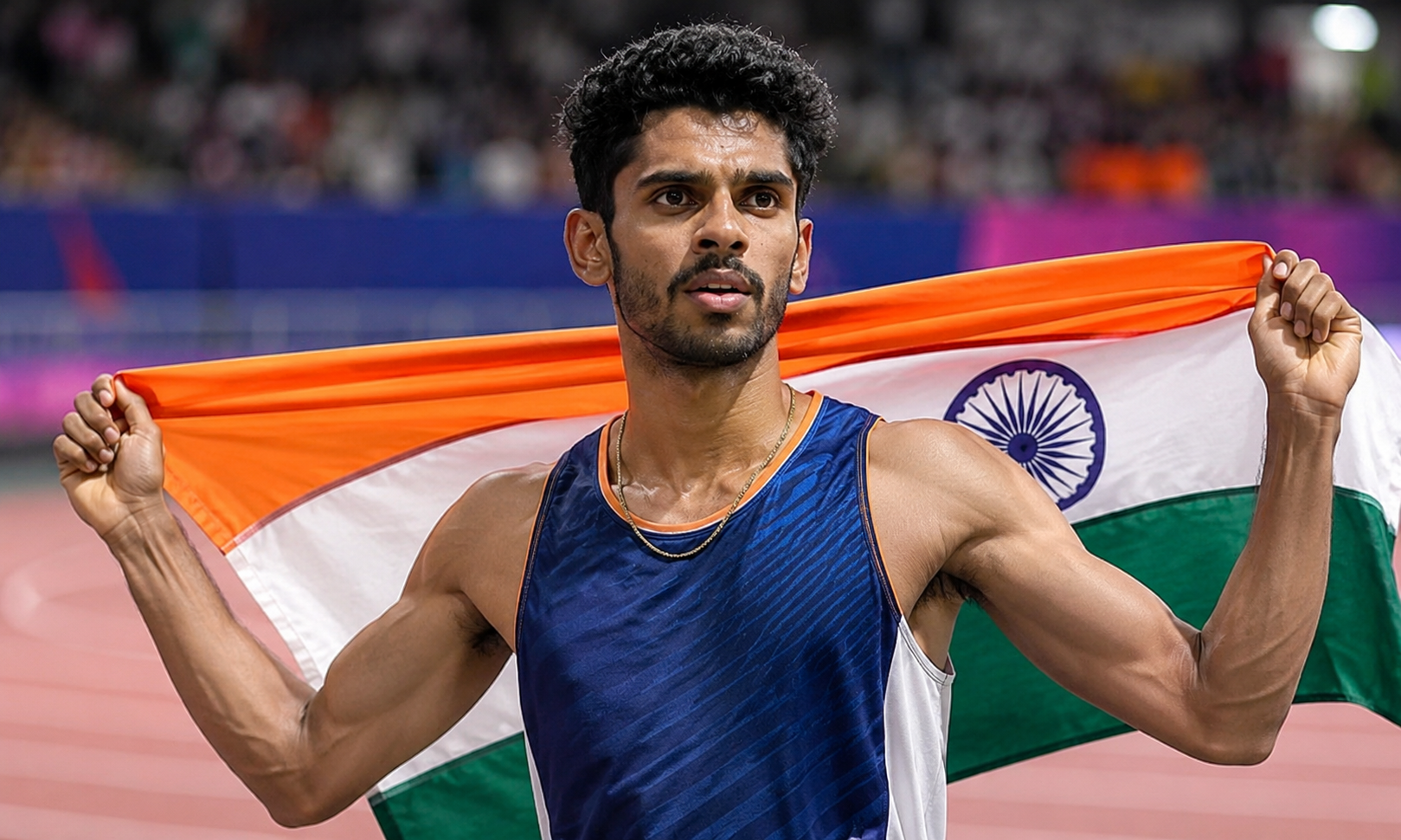
Sreeshankar Murali is an Indian track and field athlete who competes in the long jump event. Sreeshankar’s father S. Murali is a former triple jump athlete and silver medalist at the South Asian Games. His mother K. S. Bijimol has won a silver medal in 800 metres at the 1992 Asian Junior Athletics Championships. His sister Sreeparvathy is a heptathlete. As of August 2019, Sreeshankar is pursuing a BSc in mathematics at the Government Victoria College, Palakkad.
Key Factors
Full Name: Murali Sreeshankar
Date of Birth: 27 March 1999
Birthplace: Palakkad, Kerala, India
Sport: Athletics
Major Achievements: Commonwealth Games 2022 silver medal, Diamond League finalist, national record holder
Awards: Arjuna Award nominee discussions, multiple national athletics honours
Sreeshankar Murali is one of the defining faces of modern Indian athletics, a long jumper whose career has embodied both the exhilarating rise of Indian track and field and the emotional fragility of elite sport. Known for his explosive speed, technical precision, and remarkable consistency on the runway, Sreeshankar emerged from Kerala’s deeply rooted athletics culture to become one of India’s finest horizontal jump athletes.
At a time when Indian athletics was traditionally dominated by runners and throwers, he transformed long jump into a serious medal event for the country on the global stage. His Commonwealth Games silver medal, Diamond League performances, and repeated jumps beyond eight metres placed him among the world’s elite competitors. Yet behind the distances and records lies a deeply human story, one shaped by injuries, sacrifice, psychological pressure, and the loneliness that often accompanies Olympic dreams.
The Distance Between Flight and Fall
Murali Sreeshankar and the relentless pursuit of India’s Olympic long-jump dream
The runway always looks longer when an athlete is carrying expectation.
Inside a packed stadium, the crowd sees only a few seconds, the accelerating sprint, the violent take-off, the suspended body floating briefly against gravity. But for a long jumper, those few seconds contain years of repetition, injury rehabilitation, technical obsession, and mental negotiation.
When Murali Sreeshankar begins his run-up, there is a peculiar stillness in his movement. The early strides feel controlled, almost measured, before the acceleration arrives in waves. Then comes the board, the split-second timing decision that separates medals from failure, and finally the jump itself, a collision between speed and geometry.
For years, Indian athletics searched for a long jumper capable of belonging consistently among the world’s elite. Sreeshankar became that athlete.
But elite sport rarely follows a smooth arc. Just when he appeared ready for the defining Olympic chapter of his career, injury intervened with devastating cruelty.
And suddenly, one of India’s brightest athletics hopes found himself confronting the most difficult opponent in sport, absence.
A Childhood Built Around Athletics
In Kerala, athletics is not merely a sport. In many households, especially those shaped by state-level competition and school meets, it becomes culture, discipline, and identity.
Sreeshankar grew up inside such a household.
Born in Palakkad, he was raised in a family where athletics was woven naturally into daily life. His father, S. Murali, had been a triple jumper at the national level. His mother, K. S. Bijimol, also came from an athletics background. Even his sister participated in competitive sport.
For many Indian athletes, discovering athletics feels accidental. For Sreeshankar, it felt inevitable.
Yet the family environment was not built around romantic sporting fantasies. It revolved around discipline. Conversations about technique, recovery, training rhythm, and body control were ordinary parts of life.
As a child, he initially displayed strong sprinting ability. Coaches and observers noticed his speed long before long jump became his primary event. But somewhere around the age of thirteen, the transition began.
His father recognised something important.
The combination of acceleration, body coordination, and explosive take-off suggested that Sreeshankar possessed the raw ingredients necessary for long jump.
That decision would alter the trajectory of Indian athletics.
Learning One of Athletics’ Cruellest Events
Long jump often appears deceptively simple to casual audiences.
Run fast. Jump far.
In reality, it is one of the most technically unforgiving events in track and field.
The athlete must generate maximum controllable speed across the runway while maintaining rhythm precision down to centimetres. A take-off too early sacrifices distance. A take-off too late becomes a foul. The body must remain balanced at extreme velocity before converting horizontal momentum into vertical lift in less than a fraction of a second.
Every successful jump is essentially controlled violence.
Sreeshankar developed a reputation early for his technical sophistication. Unlike many young jumpers who relied primarily on raw athleticism, he showed unusual awareness of rhythm and runway management.
Training became increasingly scientific.
Explosive drills, sprint mechanics, plyometrics, strength conditioning, and take-off repetition dominated his life. Long jumpers spend years training the nervous system as much as the body itself. Precision matters as much as power.
Sreeshankar embraced that process obsessively.
The Emergence of a National Hope
Indian athletics has historically struggled in horizontal jumps.
While legends like Anju Bobby George transformed women’s long jump, Indian men rarely sustained world-class standards consistently. Crossing eight metres remained psychologically enormous within the national athletics imagination.
Sreeshankar changed that perception.
His breakthrough came dramatically during the 2018 Federation Cup, where he produced a jump of 8.20m, breaking the long-standing national record. The leap immediately established him as one of India’s most serious athletics prospects.
The significance extended beyond statistics.
Breaking a national record in Indian athletics often represents a psychological shift. It signals that international standards are becoming reachable rather than symbolic.
Then came 2021.
At the Indian Grand Prix in Patiala, Sreeshankar leapt 8.26m, surpassing the Olympic qualification standard. In a country increasingly awakening to athletics beyond cricket, the performance generated enormous excitement.
India finally possessed a male long jumper capable of challenging elite global fields.
The Pain Behind the Progress
Elite sport rarely reveals its physical cruelty publicly.
Before the 2018 Commonwealth Games, Sreeshankar suffered appendicitis severe enough to require emergency surgery. The timing was disastrous. Recovery caused significant weight loss and physical weakness, compromising months of preparation.
For an explosive event like long jump, even minor muscular imbalance can destroy performance consistency.
But athletes at elite level often compete through compromised conditions because opportunities are limited and momentum fragile.
Sreeshankar returned faster than many expected, but the episode exposed how physically vulnerable elite athletics careers truly are.
The Tokyo Olympics later brought another emotional challenge.
Despite entering with strong expectations, Sreeshankar struggled to reproduce his best performances on the Olympic stage. The disappointment weighed heavily because athletics differs fundamentally from many team sports. Failure becomes intensely personal. There are no teammates to absorb pressure.
Long jump is particularly brutal psychologically because every attempt feels final.
One mistimed step can erase years of preparation.
India’s Rise on the Global Stage
Despite setbacks, Sreeshankar steadily evolved into one of the world’s most consistent jumpers.
His performances across Diamond League competitions and international circuits gradually changed how Indian athletics was perceived globally. Historically, Indian athletes were often treated as occasional participants rather than sustained contenders in technical field events.
Sreeshankar challenged that stereotype.
Then came Birmingham 2022.
At the Commonwealth Games, he produced the defining championship performance of his career, winning silver with a leap of 8.08m. It was historic, the first Commonwealth Games medal won by an Indian male long jumper.
The achievement mattered deeply because it validated years of technical development.
India was no longer merely producing athletes capable of participation. It was producing field-event athletes capable of sustained international competitiveness.
Sreeshankar’s consistency beyond eight metres placed him among the elite group of global long jumpers regularly capable of finals appearances at major championships.
The Paris Olympics Dream
By 2023, Sreeshankar looked increasingly mature as an athlete.
His jump of 8.37m secured qualification for the Paris Olympics and reinforced the sense that Indian athletics might finally witness a historic Olympic long-jump campaign.
There was reason for optimism.
He had improved technically. His run-up rhythm appeared more controlled. International exposure had strengthened competitive maturity. Sports science support from programs like TOPS and organisations such as JSW Sports significantly improved preparation structures for elite Indian athletes.
Then came the injury.
A knee problem in 2024 abruptly altered everything.
For explosive athletes, knee injuries strike at identity itself. The event depends entirely on trust in take-off power. Without confidence in the body, even approaching maximum speed becomes psychologically terrifying.
Surgery in Doha followed.
And with it came devastating confirmation, Sreeshankar would miss the Paris Olympics despite qualifying.
For athletes, missing the Olympics through injury creates a unique form of grief. Qualification proves capability. Absence denies fulfilment.
The emotional silence surrounding rehabilitation can feel unbearable.
No stadiums. No applause. Only repetition, uncertainty, and waiting.
Rebuilding the Athlete
Comebacks in athletics are rarely cinematic.
They are slow, repetitive, and emotionally exhausting.
Sreeshankar’s rehabilitation demanded not only physical rebuilding but psychological reconstruction. Long jumpers recovering from knee injuries must relearn trust in movement. Every sprint approach carries subconscious fear.
Would the knee respond?
Would explosiveness return?
Would the body still obey instinctively?
His eventual return in 2025, marked by victory at a World Athletics Continental Tour Bronze-level meet, represented more than a competitive result.
It represented survival.
Athletes often speak about rediscovering hunger after injury. Sreeshankar’s comeback carried precisely that feeling, not triumphalism, but renewed purpose.
The Science Behind His Success
Technically, Sreeshankar remains one of India’s most sophisticated jumpers.
His greatest strength lies in runway acceleration control. Many long jumpers lose technical balance while attempting maximum velocity. Sreeshankar generally maintains cleaner body positioning through approach phases.
His explosiveness at take-off also stands out significantly by Indian standards.
However, like many elite jumpers, consistency remains an ongoing challenge. Long jump margins are microscopic. Slight changes in rhythm, wind conditions, fatigue, or psychological timing can dramatically affect outcomes.
At global level, maintaining stable elite performance demands extraordinary technical precision.
Sreeshankar’s evolution reflects increasing scientific professionalism within Indian athletics itself.
A Symbol of Indian Athletics’ Transformation
Sreeshankar’s career mirrors broader changes within Indian sport.
For decades, Indian athletes often trained within limited systems lacking advanced sports science, rehabilitation infrastructure, and international exposure. Modern programs have improved those realities significantly, though challenges remain.
Support systems like TOPS, private sponsorship structures, biomechanics analysis, and professional rehabilitation now increasingly shape elite preparation.
Yet Sreeshankar’s journey also highlights how fragile athletic careers remain despite these improvements.
One injury can still disrupt Olympic dreams entirely.
That reality makes resilience central to elite sport.
Conclusion
Murali Sreeshankar represents something larger than medals, records, or distances measured in metres.
He represents a generation of Indian athletes attempting to push beyond historical limits, athletes raised inside increasingly professional systems yet still confronting the emotional uncertainty that defines elite sport everywhere in the world.
From Kerala’s athletics culture to Diamond League runways, from national records to Olympic heartbreak, his career has unfolded through equal parts brilliance and vulnerability. The image most people remember may eventually be one of flight, a perfectly timed leap suspended briefly against gravity. But perhaps the more meaningful image is the quieter one: an injured athlete rebuilding himself patiently after loss, refusing to let disappointment become identity.
Because in modern Indian athletics, Murali Sreeshankar’s story is not only about how far a man can jump. It is about how far resilience can carry ambition when dreams appear temporarily out of reach.