
Kayees Rahmathulla Cafe
The Soul of Mattancherry
Kayees Rahmathulla Cafe in Mattancherry is one of Kochi’s most iconic destinations for traditional Malabar cuisine. Best known for its biryani and long-standing culinary legacy, the restaurant has remained closely connected to the food culture of old Kochi. Making it a must-visit for lovers of authentic Malabar flavours.
Contact: 09846041234
Location: https://maps.app.goo.gl/SRHwAPzUQczHyyVr8
website: https://share.google/4jr4A0NHFBlljYwth
By lunchtime, the streets around Kayees Rahmathulla Hotel begin to change rhythm. Spice traders step out from crowded godowns. Port workers arrive in faded shirts dampened by Kochi humidity. Families squeeze through narrow lanes lined with ageing colonial buildings and old wholesale shops carrying the scent of pepper, cardamom, dust, diesel, and sea air. Inside the restaurant, steel plates strike tabletops in quick succession while servers move rapidly through tightly packed rows of customers. Conversations rise above the noise of ceiling fans and kitchen commands. Somewhere in the middle of that controlled chaos, biryani arrives at tables with remarkable consistency, fragrant, restrained, and unmistakably Kayees.
Few restaurants in Kerala inspire this kind of enduring emotional loyalty. Kayees Rahmathulla Hotel is not defined by polished interiors or curated nostalgia. Its importance comes from continuity. For decades, the restaurant has remained woven into the everyday life of Mattancherry, feeding generations of traders, labourers, politicians, artists, journalists, sailors, and travellers passing through Kochi’s old commercial heart. In a rapidly changing city, Kayees survives as something increasingly rare, an outstanding culinary institution where food, memory, migration, and history still exist together in living form.
Inside Kayees Rahmathulla Hotel
Mattancherry has always been a place shaped by arrival.
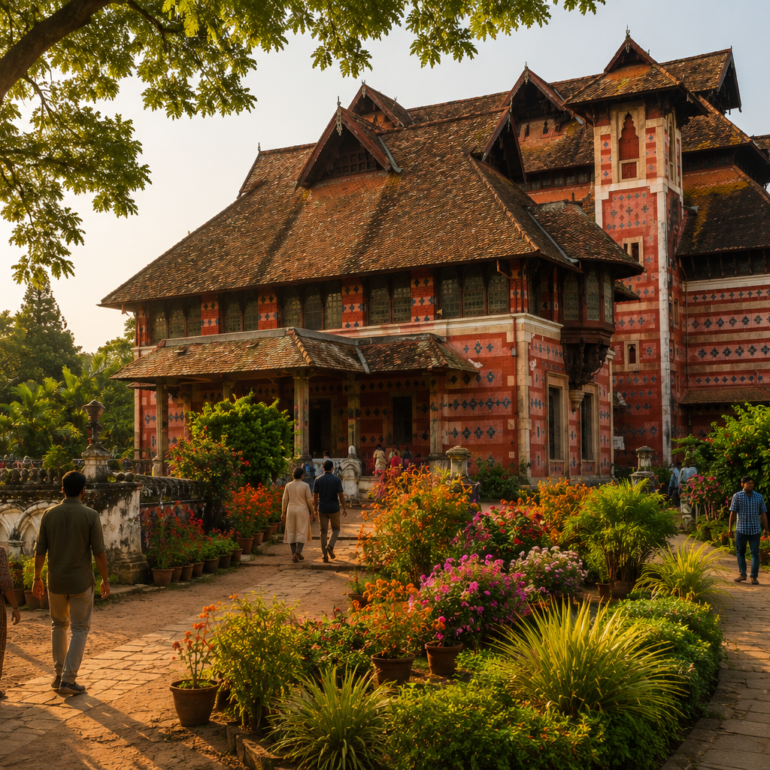
Long before Kochi became a tourism brand or an urban culinary destination, this part of the city functioned as one of the Indian Ocean’s most active trading zones. Arab merchants, Gujarati traders, Jewish communities, Konkan settlers, Tamil labourers, and Malayali Muslim business families moved through these streets carrying spices, textiles, stories, languages, and food traditions. Even today, the neighbourhood feels layered with movement. Handcarts still pass through narrow roads beside centuries-old warehouses. The smell of spice storage hangs permanently in the air. Old signboards fade slowly above crowded wholesale markets.
Kayees belongs completely to this landscape.
Unlike restaurants designed to recreate “heritage atmosphere,” Kayees never needed to manufacture authenticity because it emerged naturally from Mattancherry’s working commercial culture. The restaurant feels inseparable from the neighbourhood around it. One can imagine traders eating here decades ago after unloading cargo near the port, discussing business over beef curry and rice while ships waited beyond the harbour.
That continuity still defines the experience today.
The building itself remains modest. Tables sit close together. Service is efficient rather than ceremonial. There is little interest in decorative reinvention. Kayees operates with the confidence of a place that understands its identity deeply enough not to modernize unnecessarily.
And yet the emotional pull of the restaurant is extraordinary.
People who moved away from Kochi often speak about Kayees with the intimacy usually reserved for family rituals or childhood memories. Returning visitors measure time through meals eaten there. Office workers from Ernakulam still cross the city for lunch. Tourists arrive because of reputation, but locals return because the restaurant feels emotionally familiar in ways difficult to explain through food criticism alone.
The Soul of Mattancherry
To understand Kayees properly, one must understand Mattancherry itself.
This is not the polished Kochi of luxury waterfront hotels and contemporary cafés. Mattancherry remains rough-edged, crowded, commercially alive. The area still carries visible traces of the port city that shaped Kerala’s modern history through maritime trade. Spice warehouses stand beside old mosques and colonial structures weathered by monsoon rain and sea salt. Malayalam mixes naturally with Tamil, Hindi, Gujarati, and Arabic influences in daily conversation.
Food here evolved through commerce and migration.
Malabar-Muslim cuisine itself emerged partly from centuries of exchange across the Arabian Sea. Traders brought ingredients, techniques, and culinary sensibilities that merged with Kerala’s coastal ecology. Rice, meat, coconut, dried fruits, black pepper, ghee, and aromatic spices developed into a cuisine defined not by extravagance, but by layered balance.
Kayees reflects this historical blending beautifully.
The restaurant does not present Muslim cuisine as spectacle or luxury product. Instead, it serves food with the directness of places originally built to feed working communities consistently and well. That practicality gives the restaurant its integrity.
Lunch at Kayees feels less like dining out and more like entering a living social ecosystem.
The crowd itself tells the story of Kochi. Elderly regulars sit beside young professionals photographing biryani for social media. Port workers eat quickly before returning to labour. Visitors from Gulf countries arrive searching for remembered flavours. Politicians and artists occasionally appear without disrupting the atmosphere because Kayees treats everyone with the same hurried efficiency.
No one lingers too long. Tables must keep moving.
And somehow, that urgency becomes part of the restaurant’s emotional character.
A Restaurant Built on Memory
Many famous restaurants survive because of marketing or reinvention.
Kayees survived because people carried it with them emotionally across generations.
In Kochi, nearly everyone seems to possess a Kayees memory. Some remember fathers bringing home parcels wrapped carefully after work. Others speak about student lunches shared there during college years. Traders recall decades of eating at the same tables after long mornings inside spice markets. Families returning from Gulf countries often make Kayees one of their first stops from the airport.
These rituals matter because they transform restaurants into cultural landmarks.
Kayees functions almost like an archive of everyday urban life in Kochi. Political conversations, business negotiations, family gatherings, journalistic debates, shipping discussions, and ordinary working lunches have unfolded there continuously for decades.
Unlike fashionable restaurants driven by trends, Kayees developed loyalty slowly through repetition and reliability.
Its food remains recognisable across generations.
That consistency is surprisingly difficult to maintain, especially for restaurants operating at large daily volume. Yet Kayees preserves flavour memory with remarkable discipline. Customers return expecting the same aromatic rice, the same restrained spice profile, the same tenderness in the meat, the same kitchen rhythm.
And the restaurant understands the emotional responsibility attached to that expectation.
The Legendary Biryani
The biryani at Kayees occupies unusual territory within Kerala’s culinary imagination.
It is legendary, but not theatrical.
In an era where biryani often becomes overloaded with richness, colouring, excessive masala, or visual excess, Kayees follows a very different philosophy. Its biryani is restrained, balanced, and deeply aromatic rather than aggressively heavy.
That restraint is precisely what makes it exceptional.
The rice carries fragrance without oiliness. Spices remain controlled enough for individual flavours to emerge naturally. The meat, especially the mutton preparation, achieves tenderness without collapsing structurally. Nothing feels exaggerated for impact. Instead, the biryani reflects culinary confidence rooted in balance.
The dish also speaks directly to Malabar-Muslim food traditions shaped by maritime trade routes and Arab culinary influence.
Unlike many North Indian biryanis emphasizing dense layering and heavy richness, Malabar biryani often prioritizes fragrance, subtlety, and texture. Kayees preserves that tradition carefully. One tastes cardamom, ghee, caramelized onion, and spice separately before they settle together.
Even the serving style reflects the restaurant’s broader personality.
There is no unnecessary presentation. Plates arrive quickly. Steam rises immediately into crowded dining air. Customers begin eating without ceremony because the food demands attention rather than photography.
Though increasingly, younger diners now do both.
The Rhythm of the Kitchen
Perhaps the most fascinating aspect of Kayees is its operational rhythm.
The restaurant moves with extraordinary speed without appearing chaotic.
Servers navigate narrow spaces carrying multiple plates effortlessly. Orders travel through the room in shouted fragments. The kitchen functions almost like an industrial choreography shaped through repetition over decades. Rice portions, curries, meat dishes, and side plates emerge continuously without slowing the pace of service.
Watching this movement becomes part of the experience.
There is very little separation between customer and kitchen energy. Noise travels openly across the restaurant. One hears metal utensils striking vessels, cooks communicating rapidly, customers calling servers, chairs scraping against tiled floors.
And yet beneath the apparent disorder lies remarkable precision.
Restaurants like Kayees depend on rhythm more than systems manuals. Timing matters instinctively. Staff know exactly how long tables remain occupied, how quickly dishes move, which hours demand maximum intensity.
This operational culture feels inherited rather than corporate.
That distinction is important because it preserves the emotional texture of the restaurant. Kayees still feels human, imperfect, alive.
Preserving Kochi’s Muslim Culinary Heritage
Kayees matters historically because it preserves a specific culinary tradition increasingly vulnerable to homogenization.
Across India, regional Muslim cuisines are often reduced to simplified restaurant stereotypes dominated by generic “Mughlai” frameworks. Kerala’s Muslim food traditions are far more regionally specific, shaped by coastal geography, trade history, and local ingredients.
At Kayees, those traditions remain visible.
The beef curry carries deep coastal spice character rather than northern heaviness. Chicken roast preparations reflect Kerala’s relationship with black pepper, curry leaves, and coconut oil. Rice remains central to the dining structure. Even side dishes feel connected to working-class Malabar-Muslim food culture rather than luxury reinterpretation.
Importantly, the restaurant preserves these traditions without turning them into museum objects.
The food remains active, functional, and woven into everyday life. This living continuity gives Kayees far greater cultural value than heritage branding alone ever could.
In many ways, the restaurant preserves a version of Kochi that globalization often threatens to erase.
Why Kayees Still Matters
Kerala’s restaurant culture has changed dramatically over the past two decades.
Luxury dining expanded. Café culture emerged. Social media transformed food into visual performance. Younger diners increasingly seek novelty, fusion, and atmosphere-driven experiences.
Yet Kayees remains crowded.
This endurance reveals something important about Kerala’s relationship with food memory.
People continue returning because Kayees offers continuity in a rapidly changing urban landscape. The restaurant reminds customers of older Kochi rhythms, before commercialization reshaped the city’s cultural geography. It preserves flavours connected to family histories, migration stories, port labour, and communal dining traditions.
Importantly, it achieves this without romantic self-consciousness.
Kayees does not attempt to become fashionable heritage. It simply continues functioning as it always has, serving food with consistency and urgency inside one of Kochi’s oldest commercial districts.
That honesty gives the restaurant unusual emotional power.
Even tourists searching for “authentic experiences” sense the difference immediately. Kayees does not exist for observation alone. It exists because people genuinely depend on it, emotionally as much as gastronomically.
And that dependence cannot be manufactured.
Conclusion
By evening, Mattancherry slowly begins to quieten. Spice shops close their shutters. The harbour air thickens with humidity and sea salt. Inside Kayees Rahmathulla Hotel, however, the rhythm rarely disappears completely. Plates still move across crowded tables. Biryani aromas continue drifting through the room. Conversations rise and fall against the sound of the kitchen. Somewhere between those movements lives the real importance of Kayees, not merely as a restaurant, but as a keeper of Kochi’s collective memory.
That is why generations remain emotionally attached to it. Kayees preserves something larger than recipes. It preserves continuity, the feeling of an older port city still surviving inside modern Kerala, where food connects labour, migration, trade, family, religion, and everyday belonging. In a world increasingly dominated by temporary dining trends and carefully constructed restaurant identities, Kayees remains grounded in lived history. And that enduring authenticity is what makes it one of Kochi’s most outstanding culinary institutions.