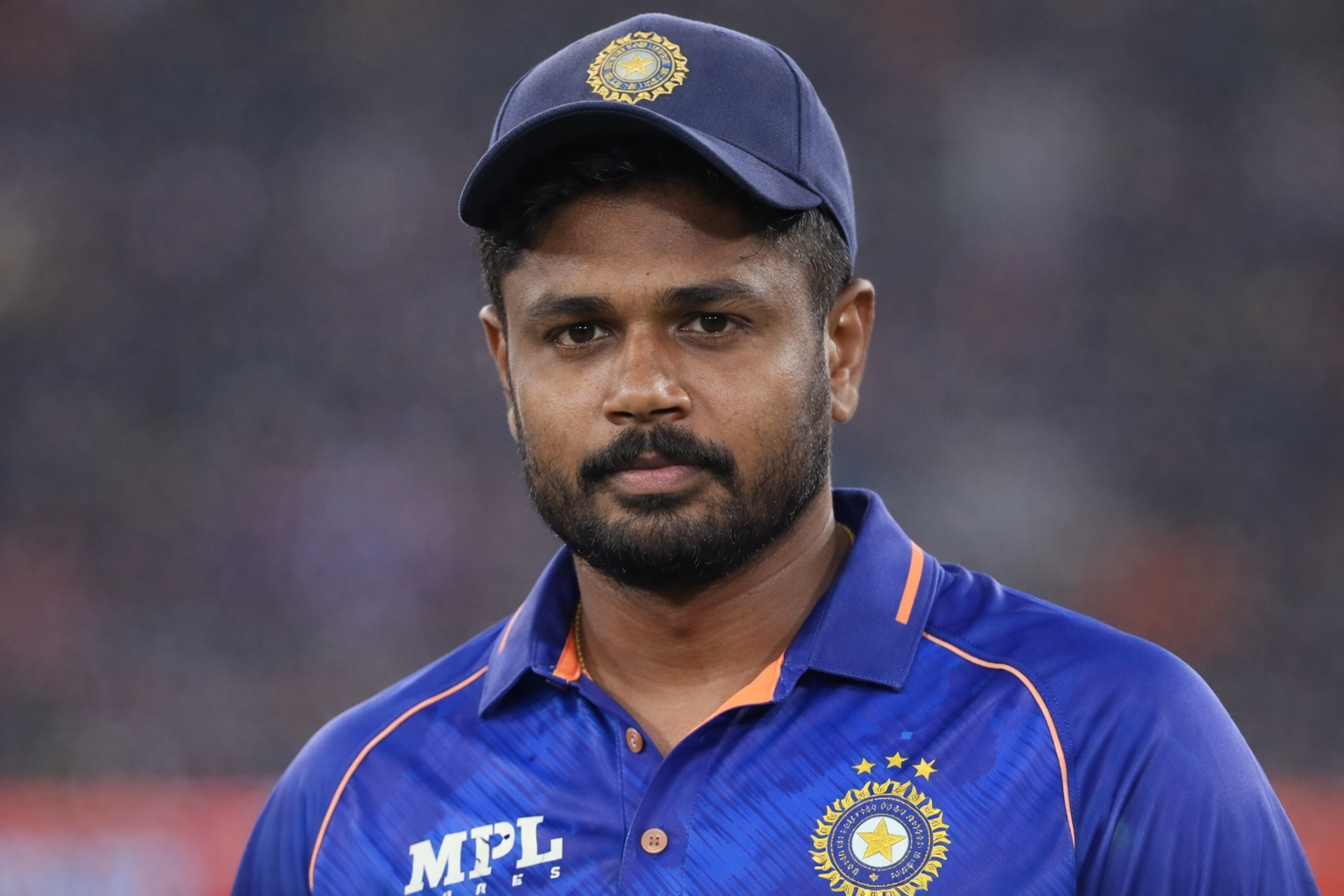
Sanju Samson
Captain of Rajasthan Royals and Indian International Cricketer
Sanju Samson plays cricket with a mesmerizing mix of effortless elegance and high-stakes bravery, often prioritizing crowd-pleasing, selfless acceleration over personal milestones. Despite navigating a turbulent international career filled with sporadic opportunities, his resilience and quiet charisma as the anchor of the Rajasthan Royals have earned him a fiercely loyal, cult-like following across India.
Full name: Sanju Viswanath Samson
Born: 11 November 1994 (age 31)
Place: Pulluvila, Thiruvananthapuram, Kerala, India
Batting: Right-handed
Role: Wicket-keeper-batter
A Shot That Feels Effortless, Until It Isn’t
The ball is pitched just outside off, not quite a half-volley, not quite short enough to cut. Sanju Samson leans into it with a stillness that feels almost deceptive, and then the bat comes through, smooth, unhurried, complete. The cover drive races away, not forced, not manufactured, just placed, like it was always meant to be there.
It is an outstanding kind of stroke, the kind that makes the game look simpler than it is. For a few overs, sometimes for an entire innings, Samson inhabits that ease, where timing replaces effort and gaps appear instinctively. And then, just as suddenly, it can end. A mistimed pull, a rushed charge, a dismissal that feels out of sync with what came before.
This is the paradox of Sanju Samson. Brilliance that feels natural. Consistency that remains elusive.
Early Life and Kerala Roots: A Different Cricketing Geography
Sanju Samson was born on November 11, 1994, in Pulluvila, a coastal village in Thiruvananthapuram, Kerala. His cricketing story begins far from the traditional power centres of Indian cricket, places like Mumbai, Delhi, or Karnataka, where infrastructure and exposure come early.
Kerala’s cricket culture has always been understated. It produces disciplined cricketers, often technically sound, but historically underrepresented at the national level. For Samson, this meant that talent alone was not enough. Visibility had to be earned.
His father, a former police constable and footballer, played a decisive role in shaping his early journey. Recognizing his son’s potential, he moved the family to facilitate better access to training and schooling. This was not a casual decision. It was a calculated investment in possibility.
Samson’s early cricketing education came through school tournaments and age-group cricket, where he quickly stood out. He captained India’s Under-19 side, a significant marker of both talent and leadership potential. Even at that stage, his batting carried a distinct aesthetic, high backlift, fluid strokeplay, and an instinctive sense of timing.
Kerala, as a system, provided the base. But Samson’s rise required him to step beyond it.
Rise to National Attention: The Prodigy Phase
Sanju Samson’s arrival into wider cricketing consciousness came early.
At just 18, he debuted in the IPL for the Rajasthan Royals in 2013, under the mentorship of Rahul Dravid. That environment, structured, disciplined, and quietly demanding, was crucial.
He did not merely participate. He impressed.
A series of composed innings, particularly under pressure, marked him as one of the most promising young batsmen in Indian cricket. He won the IPL’s Emerging Player award that season, a recognition that often signals future national prospects.
Simultaneously, his performances in domestic cricket, particularly in the Vijay Hazare Trophy and Ranji Trophy, reinforced this perception. He was not just stylish. He was productive.
At this stage, the narrative around Samson was clear. He was a prodigy. A player expected to transition seamlessly into the Indian team.
Cricket, however, rarely follows linear scripts.
IPL Stardom and the Burden of Beauty
The IPL changed his geography. With the Rajasthan Royals, Sanju found both canvas and microscope. The IPL rewards audacity, and he possessed it in abundance. Lofted drives that seemed sculpted rather than struck. Sixes that felt inevitable.
Yet beauty is a dangerous currency in sport. When you make batting look easy, inconsistency feels unforgivable. For every breathtaking 80, there would be a frustrating 12. Critics circled. The narrative is hardened, gifted but unreliable. What went unnoticed was evolution. His strike rotation matured. His shot selection sharpened. As captain of Rajasthan Royals, he carried responsibility without theatrics. Leadership did not inflate him. It steadied him.
The India Equation
Sanju’s relationship with the Indian team has been complex, at times almost philosophical. In a system bursting with white-ball talent, he has often been the nearly-man, drafted in, rotated out, recalled again. But every recall has revealed something new. Greater control against spin. Calmer chases. Wicketkeeping that has grown from auxiliary skill to dependable craft. He does not rage publicly about exclusion. He answers it with runs. That restraint has defined him more than any headline.
Style as Identity
In an era of data analytics and power metrics, Sanju remains a stylist. His cover drive is not nostalgia. It is an assertion. He represents a strain of Indian batting that values timing over brute intent. He rarely gestures wildly, rarely performs aggression. His confidence feels internal. When he accelerates, it is calculated. When he fails, it is quiet. This duality, grace and grit, is what separates him from the carousel of short-format stars.
Captaincy and Composure
Taking over Rajasthan Royals was not symbolic. It was strategic trust. As captain, he has shown a preference for backing youth, for absorbing criticism himself, for staying publicly measured even when tactical calls misfire. He does not dominate dressing rooms with volume. He influences through example. Teammates speak of clarity, of calm. His leadership is less about theatrics and more about presence.
The Weight of Expectation
Kerala sees him as proof that geography is not destiny. Young cricketers watch him as evidence that elegance can survive scrutiny. But expectation can calcify into pressure. Sanju has learned to negotiate it. Not by denying ambition, but by humanizing it. Interviews reveal thoughtfulness. There is faith in his voice, discipline in routine, and a deliberate insulation from noise. He understands something fundamental about modern sport. Talent earns applause. Resilience earns respect.
Reflection
In the end, his legacy may not be defined by the number of centuries alone, but by the manner of them. By the stillness before the strike. By the refusal to rush his own becoming.
Under the lights, as the ball rises from his blade and disappears into night, what remains is not just applause. It is the sense that some careers are less about noise and more about poise.
Early Promise
- Ranji Trophy debut as a teenager for Kerala
- India Under-19 World Cup representative
- Among youngest IPL centurions
Kerala’s Flagbearer
- Elevated Kerala’s cricketing profile
- Role model for southern domestic players
- Inspired grassroots participation
- Symbol of regional aspiration
Captain’s Call
- Appointed Rajasthan Royals captain
- Led team to IPL final
- Backed young Indian talent