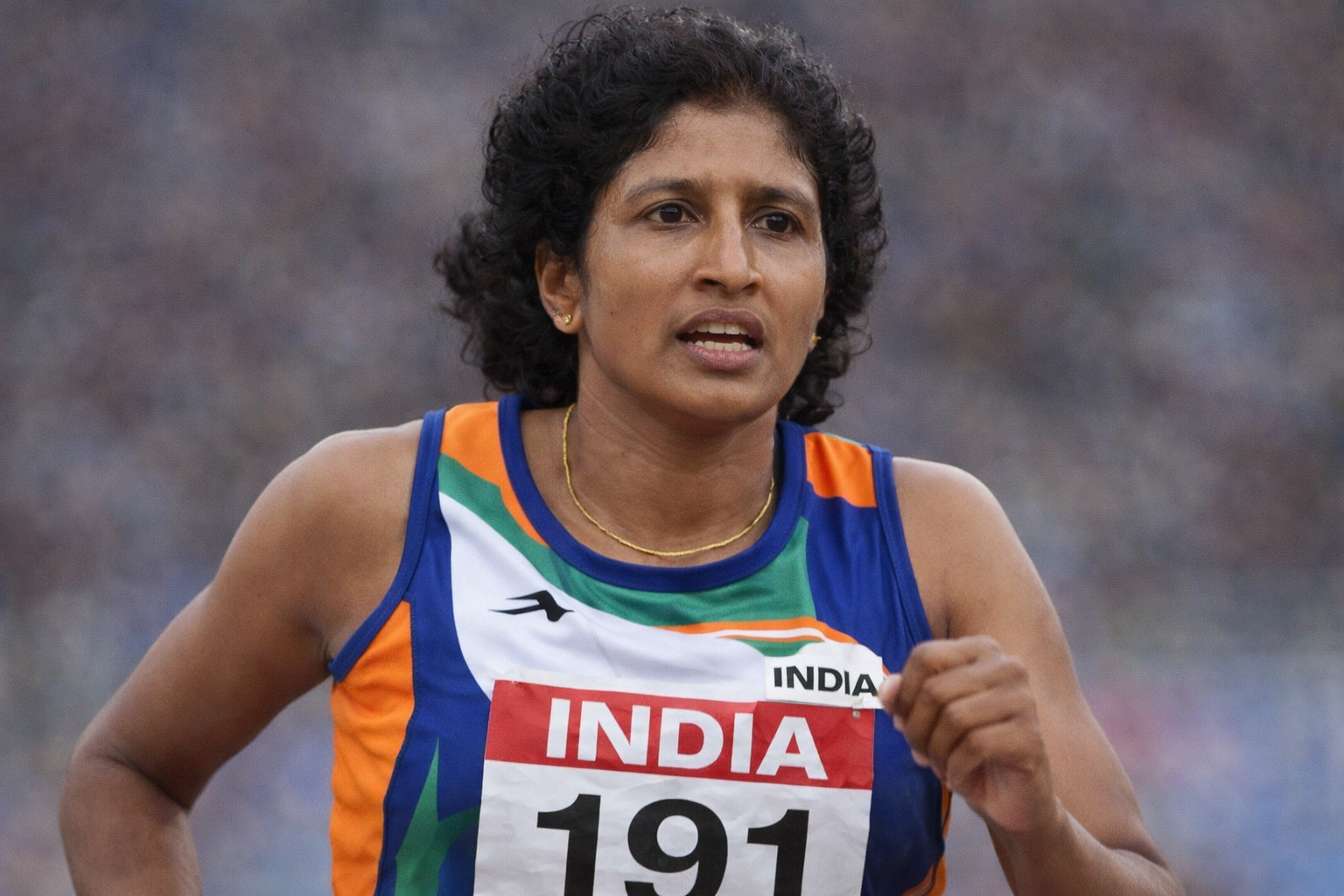
Mercy Kuttan
former Indian track and field athlete
The starter raises the pistol, and for a brief moment, everything is still.
On a track far removed from the humidity and familiarity of Kerala, Mercy Mathew Kuttan settles into her blocks at the 1972 Munich Olympics. There is no grand narrative attached to her presence, no expectation of medals, no media frenzy. Just a lane, a distance, and the quiet burden of representation.
The gun fires, and she accelerates into a race that will not be remembered for podium finishes or records, but for something less visible and perhaps more lasting. It is an outstanding act of entry, of stepping into a space where Indian women were rarely seen, let alone expected to compete. In that moment, Mercy is not just running a race. She is crossing a threshold.
Real Name: Mercy Mathew Kuttan
Born: 1 January 1960 (age 66)
Sport: Track and field
Event: 400 metres, Long jump
Early Life and Origins: Running Against the Grain
Mercy Mathew Kuttan was born in Kerala at a time when sport, particularly for women, existed at the margins of social acceptance. The 1960s and early 1970s were not conducive decades for female athletic ambition in India. Infrastructure was sparse, institutional support limited, and cultural expectations restrictive.
Kerala, despite its later reputation as a cradle of women’s athletics, was still in its formative phase. Opportunities were largely confined to school-level competitions, often organized with minimal resources but significant local enthusiasm.
Mercy’s entry into athletics followed a familiar pattern for pioneers, it was discovered rather than planned. School meets provided the first stage. Speed, once noticed, became identity.
Her family background did not offer structured support in sporting terms. Like many athletes of her generation, she navigated a system where persistence substituted for infrastructure. Training lacked scientific grounding. Coaching was basic. Exposure to national competition was limited.
Yet, there was something else at play, an emerging culture in Kerala that valued physical education, however informally. It created just enough space for talent to surface.
Mercy ran within that narrow corridor.
Rise in Indian Athletics: Speed in a Developing System
Mercy Mathew’s rise within Indian athletics coincided with a period of transition. The country was beginning to organize its track and field structures more formally, but it remained far from globally competitive.
She specialized in sprint events, particularly the 100 metres and 200 metres, disciplines that demand explosive power, refined technique, and consistent high-intensity training, all of which were difficult to cultivate in India at the time.
National Recognition
- Emerged as one of India’s leading female sprinters in the early 1970s
- Competed in national championships, establishing herself in short-distance events
- Became part of a small but growing pool of women athletes representing India internationally
Contextualizing Her Achievements
To understand Mercy’s accomplishments, it is essential to situate them within her era:
- Timing systems were less standardized
- Training lacked biomechanical precision
- Athletes had limited exposure to international competition
Her performances, therefore, were not just about speed. They were about adaptability, about learning through competition rather than preparation.
In many ways, Mercy represented a generation that learned while running.
Olympic Journey: Munich 1972 and the Weight of Representation
Mercy Mathew Kuttan’s participation in the 1972 Munich Olympics marked a significant milestone for Indian athletics.
She competed in sprint events, representing India at a time when the country’s presence in Olympic track events was limited, especially among women.
Performance Context
- Global sprinting standards were already highly advanced
- Athletes from the United States and Europe dominated the field
- Indian athletes entered with minimal exposure to such competitive environments
Mercy did not progress to the later rounds. But framing her Olympic journey purely through results would miss the point.
What Her Olympic Presence Meant
- Representation of Indian women in global athletics
- Expansion of possibilities for future athletes
- A step toward normalization of female participation at the highest level
Her presence in Munich was not an endpoint. It was an opening.
Challenges and Barriers: Running Without a System
Mercy’s career unfolded within a system that was, at best, incomplete.
Gender Barriers
- Limited societal acceptance of women in competitive sport
- Lack of visibility and media coverage
- Fewer opportunities compared to male athletes
Infrastructure Constraints
- Basic training facilities
- Limited access to professional coaching
- Absence of sports science and recovery systems
Institutional Gaps
- Inconsistent support from governing bodies
- Lack of long-term athlete development programs
- Minimal financial security
These factors shaped not just Mercy’s career, but the trajectory of an entire generation of athletes.
Her achievements, therefore, must be read against these constraints. They represent not just performance, but persistence within limitation.
A Foundation Without Recognition
Mercy Mathew Kuttan’s legacy is subtle but foundational. Mercy’s career contributed to:
- Increased visibility of women in athletics
- Gradual normalization of female participation in competitive sport
- Creation of pathways, however fragile, for future athletes
Unlike later stars, Mercy did not benefit from extensive media coverage or institutional recognition. Her legacy exists more in continuity than in celebration.
Critical Perspective: Why Pioneers Fade from Memory
Mercy Mathew’s relative obscurity raises important questions.
Documentation Gaps
- Limited archival records of performances
- Inadequate preservation of early athletics history
- Lack of detailed statistical documentation
Media Silence
- Minimal coverage of women’s sports during her era
- Focus on medal winners rather than participants
Narrative Bias
Sports history often prioritizes:
- Record-breakers
- Medalists
- High-visibility achievements
Pioneers who lay the groundwork without achieving podium success are frequently overlooked.
Mercy’s story sits within this gap.
The Distance That History Forgets
There are athletes who define eras, and there are those who make those eras possible. Mercy Mathew Kuttan belongs to the latter.
Her career did not produce medals that demand remembrance. It produced something quieter, access. She stepped onto a track where Indian women were rarely seen, and in doing so, made it slightly easier for those who followed.
In the architecture of Indian athletics, her contribution is foundational, even if it is not always visible.
To remember her is to acknowledge that progress in sport is not built only on victories, but on presence, persistence, and the courage to begin.
It is an outstanding legacy, not because it is celebrated, but because it endures in every athlete who runs today without having to justify her right to be there.
Achievements
National Level
1976 – 78—National School games champion in long jump
1979 – 80—All India Inter-University champion in 100 m, 200 m, and long jump
1979 – 87—National Champion in long jump
1988—National Champion in 400 meters
International Level
1980—Won Gold medal in long jump, 4 x 400 m and 4 x 100 m relay in Pakistan National Games at Lahore
1981—Represented India in World Spartakyad in Moscow in 1981
1981—Won Bronze Medal in long jump and 4 x 400 m relay in Asian track and field meet in Tokyo
1982—Won Silver Medal in long jump in the 9th Asian Games in New Delhi
1982—Represented India in Commonwealth Games in Brisbane, Australia
1983—Represented India in long jump in the First World Athletic Meet at Helsinki
1983—Represented India in Asian track and field meet in Kuwait
1986—Represented India in long jump in the 10th Asian Games at Seoul
1987—Won Gold Medal in long jump in the SAF Games in Calcutta
1988—Represented India in 400 m and 4 x 400 m relay in Seoul Olympics
1989—Won Gold Medal in 4 × 400 m relay in the Asian track and field at New Delhi
Other distinctions
Captain of the Indian Team at the First World Athletic Championship.
First Woman from India to participate in World Athletic Championship.
First Indian Woman to cross 6 meters in long jump in India.[1]
National Record holder in long jump for seven years from 1980 – 87.
National School record holder for 19 years.
National University record holder for 27 years.
1st Indian woman athlete to win medals at national and international level in both track and field events.
First Couple (Murali Kuttan) from India to win Asian Games individual medals.