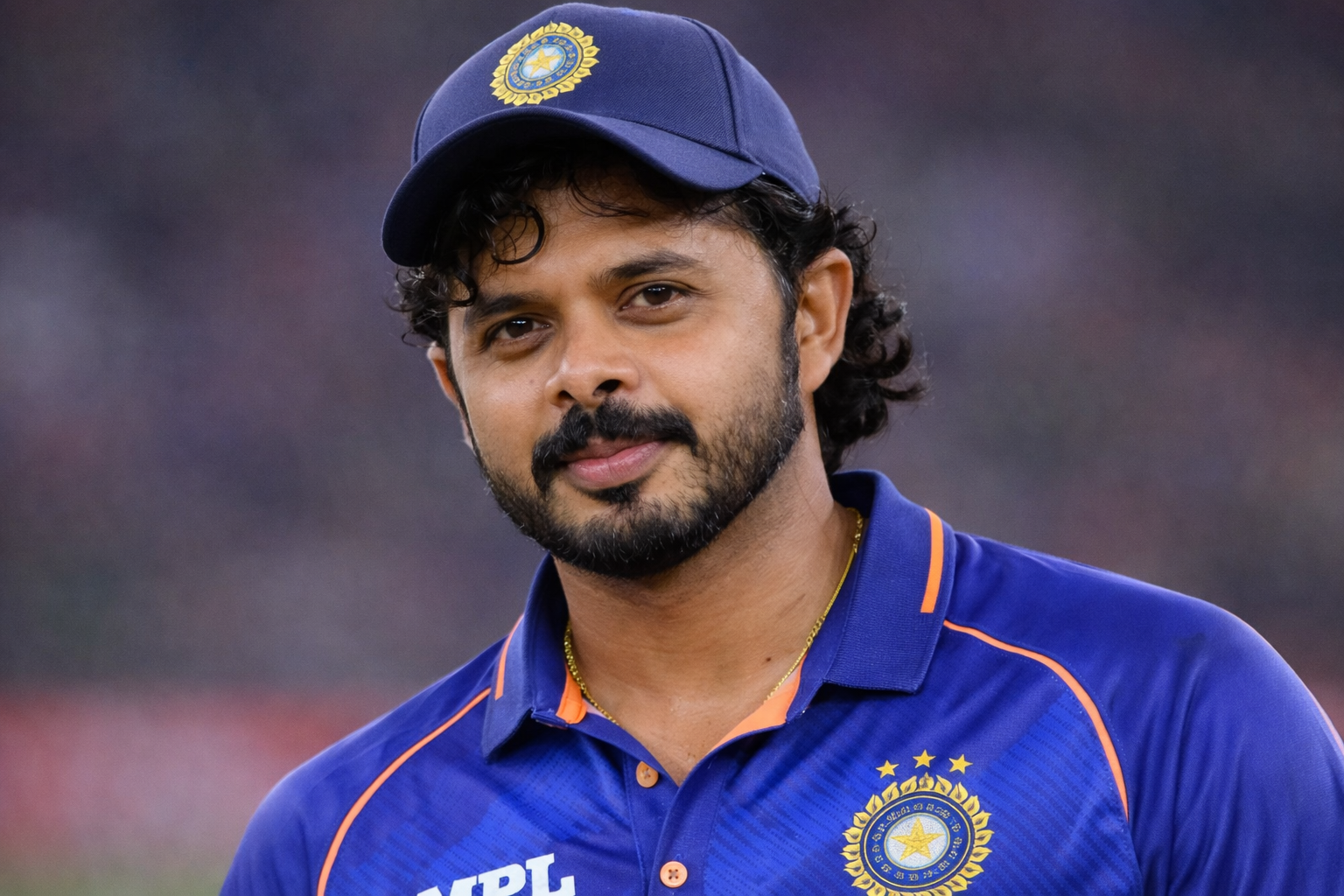
S. Sreesanth
Indian former cricketer and film actor
The ball hangs for a fraction longer than it should. Time bends. In Johannesburg, under floodlights that feel almost too bright for the moment, S. Sreesanth steadies himself beneath a mistimed scoop from Misbah-ul-Haq. The stadium holds its breath. India holds its breath. And then, the catch sticks.
What follows is not just celebration, it is release. Sreesanth sprints, arms wide, eyes ablaze, collapsing into a wave of teammates as India claims the 2007 ICC World Twenty20. It is an outstanding moment, pure, unfiltered, cinematic. Yet even here, in triumph, there is something restless about him, something that suggests this story will not stay simple. For Sreesanth, brilliance and volatility were never separate threads. They were the same pulse.
Born: 6 February 1983 (age 43)
Place: Kothamangalam, Kerala, India
Nickname: Sree, Gopu
Batting: Right-handed
Bowling: Right-arm fast-medium
Role: Bowler
Relations: Madhu Balakrishnan (brother-in-law)
Early Life & Kerala Roots: From Kothamangalam to the Cricketing Map
Born on February 6, 1983, in Kothamangalam, a town tucked within Kerala’s lush, rain-heavy landscape, Sreesanth’s early life did not follow the typical script of Indian fast bowlers. Kerala was not, historically, a cradle of pace. It was a state that produced elegance, batsmen with flair, footballers with instinct, but not many quicks who could trouble international line-ups.
His family was middle-class, stable but not privileged. Cricket, in Kerala, required persistence more than access. Facilities were limited, exposure even more so. For a young boy dreaming of international cricket, geography itself was an obstacle.
Sreesanth did not begin as a fast bowler. Like many children, he experimented, batting, spinning, exploring. It was only later, under structured coaching, that his pace bowling began to take shape. What stood out early was not just speed, but attitude. He bowled with intent, with visible emotion, with a kind of theatrical energy that set him apart.
Kerala’s domestic circuit, particularly the Ranji Trophy ecosystem, became his proving ground. It was here that he refined his skills, learning to extract movement from unresponsive pitches, to persist through long spells, and to command attention in a system that rarely spotlighted Kerala players.
Rise to International Cricket: Talent That Demanded Attention
Sreesanth’s ascent to the Indian team in the mid-2000s came at a time when India was actively searching for genuine fast bowlers who could perform overseas. His domestic performances, particularly his ability to swing the ball at pace, made him impossible to ignore.
He debuted in Tests in 2005, and almost immediately, he looked different.
Johannesburg, 2006: A Statement Spell
The defining early moment of his career came during India’s historic Test win against South Africa in Johannesburg in 2006, India’s first Test victory on South African soil.
Sreesanth’s spell in that match was not just effective, it was disruptive. He attacked the stumps, moved the ball both ways, and bowled with a visible edge that unsettled batsmen. He finished with crucial wickets, helping India script a rare overseas triumph.
Bowling Identity
- Natural outswinger, especially dangerous with the new ball
- Ability to generate late movement, a critical asset in overseas conditions
- Relied on rhythm and emotion, often feeding off crowd energy
But alongside his skill came something else, volatility. Sreesanth was never a quiet operator. He celebrated aggressively, engaged verbally, and wore his emotions openly.
In a team environment that often valued restraint, he was an outlier.
Peak Years: Between Glory and Instability
Sreesanth’s peak years were defined by paradox. He was both essential and unpredictable.
- 2007 ICC World Twenty20
His role in the tournament went beyond statistics. The final catch against Pakistan remains one of the most replayed moments in Indian cricket history. It required composure under extreme pressure, something critics often accused him of lacking.
- 2011 ICC Cricket World Cup
Sreesanth’s inclusion in the squad, and particularly in the final against Sri Lanka, was debated. Yet he was part of a team that would go on to win the 2011 ICC Cricket World Cup, India’s first World Cup triumph in 28 years.
Though his performance in the final was not dominant, his presence reflected the team management’s belief in his ability to deliver in high-stakes matches.
Memorable Performances
- Key spells in overseas conditions
- Ability to strike early with the new ball
- Occasional match-defining bursts that changed momentum
What defined Sreesanth at his peak was not consistency, but impact. He could alter the course of a game within a single spell.
Controversies & Downfall: When the Narrative Turned
If Sreesanth’s career was a story of extremes, this is where it fractured.
- The Slap Incident (2008)
During the inaugural IPL season, an on-field altercation with Harbhajan Singh resulted in Sreesanth being slapped, an incident that quickly became national news. Images of him in tears circulated widely, shaping public perception. He became, simultaneously, a victim and a lightning rod.
- Temperament Issues
Throughout his career, Sreesanth faced Fines for on-field aggression, Verbal spats with opponents and Questions about discipline and control.
- The 2013 IPL Spot-Fixing Scandal
The most damaging chapter came in 2013, when Sreesanth was arrested for alleged involvement in spot-fixing during the Indian Premier League.
The fallout was immediate and severe:
- Suspension and eventual lifetime ban by the Board of Control for Cricket in India
- Media trial that often blurred lines between allegation and guilt
- Loss of career at the highest level
However, the legal narrative was more complex.
In 2015, a Delhi court acquitted Sreesanth due to lack of evidence. Later, the Supreme Court of India set aside the BCCI’s lifetime ban, leading to a reduced suspension.
This gap between legal outcomes and public perception would define the next phase of his life.
Exile, Struggle & Comeback Attempts: Fighting the Long Silence
Exile in sport is rarely just professional. It is personal, psychological, and deeply isolating.
For Sreesanth, the years following the ban were marked by:
- Legal battles to clear his name
- Attempts to stay relevant in a rapidly evolving cricket ecosystem
- Public skepticism that lingered even after acquittal
His eventual return to domestic cricket with Kerala was symbolic more than transformative. The pace, the rhythm, the edge, they were not the same.
Age, absence, and the weight of controversy had altered the trajectory. Yet, the attempt itself mattered.
It was an assertion that careers do not end neatly, that athletes are more than their worst headlines.
Life Beyond Cricket: Reinvention in Public View
Sreesanth’s post-cricket life has been unusually visible.
- Cinema and Television
He ventured into Malayalam cinema and appeared in reality television, including shows like Bigg Boss. These platforms revealed a different side of him, vulnerable, expressive, often polarizing.
- Public Persona
In Kerala, perceptions of Sreesanth remain layered For some, he is a misunderstood talent, For others, a cautionary tale and For many, still a symbol of what could have been.
He has leaned into reinvention, embracing visibility rather than retreating from it.
Between Redemption and Memory
There is a moment, often replayed, where Sreesanth stands alone after that 2007 final, arms stretched, face lit with something close to disbelief. It feels, even now, like an outstanding snapshot of possibility, of what happens when talent meets timing.
But careers are not defined by moments alone. They are shaped by what follows, by choices, by pressures, by the fragile architecture of reputation.
Sreesanth’s story resists easy conclusions. It is not just about a fall from grace, or a redemption arc waiting to be completed. It is about the thin, often invisible line that separates heroism from controversy.
In Indian cricket, he remains a contradiction, brilliant, flawed, unforgettable. And perhaps that is the most honest legacy of all.