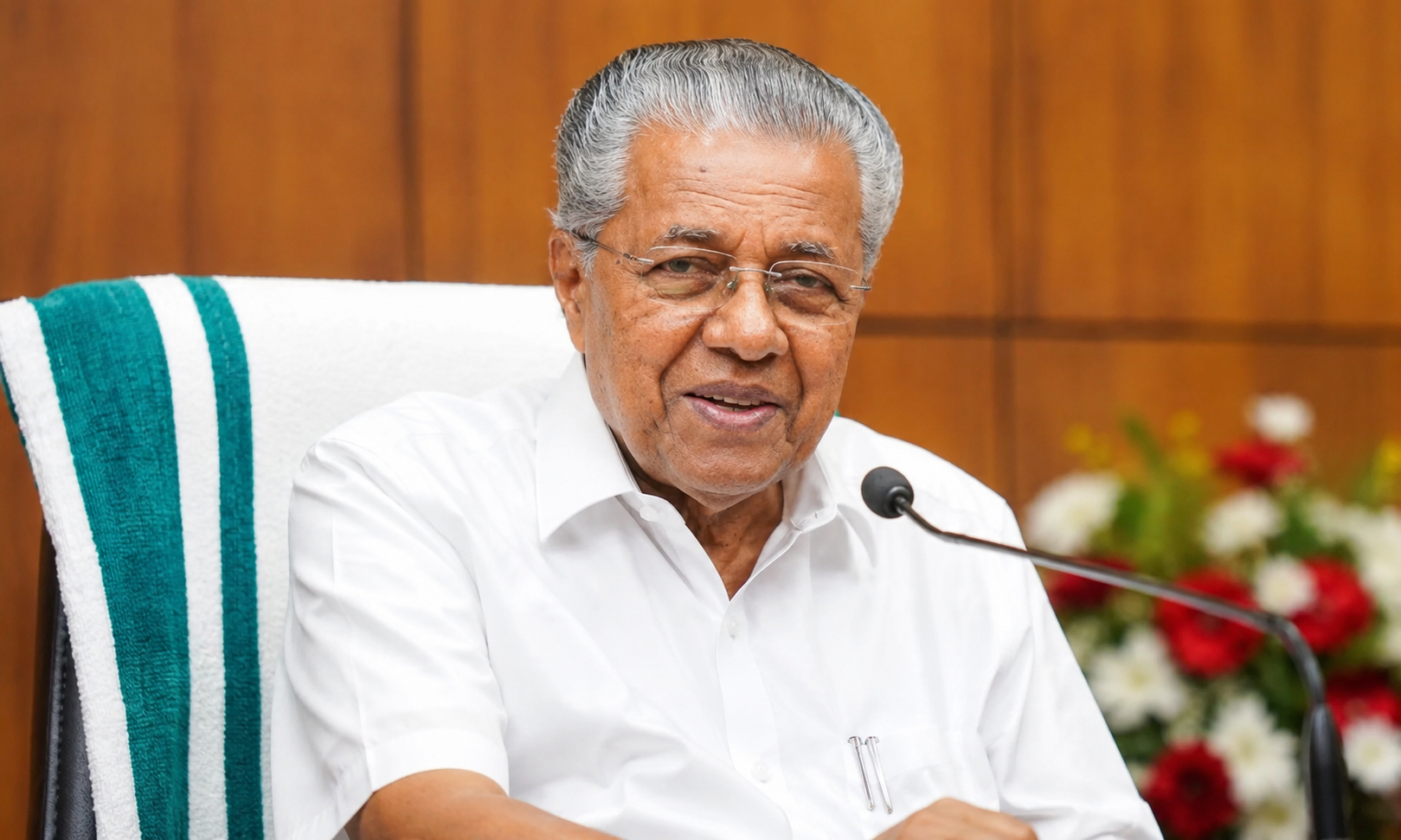
Pinarayi Vijayan
Former Chief Minister of Kerala
Pinarayi Vijayan is an Indian politician who served as the 12th Chief Minister of Kerala and leader of the house in the Kerala Legislative Assembly from 25 May 2016 to 4 May 2026. A member of the Politburo of the Communist Party of India (Marxist) (CPI(M)), he is the longest-serving secretary of the Kerala State Committee of the CPI(M) (1998–2015). He is the first chief minister from Kerala to be re-elected after completing a full term (five years) in office. Vijayan was born on 24 May 1945 in Pinarayi, Kannur, as the youngest son of Maroli Koran and Alakkatt Kalyani. He worked as a handloom weaver for a year before joining a pre-university course at Government Brennen College, Thalassery. Subsequently, he earned B.A. Economics degree from the same college.
Key Factors
Full Name: Pinarayi Vijayan
Born: 24 May 1945
Place: Pinarayi, Kannur
Political Party: Communist Party of India (Marxist)
Title: Former Chief Minister of Kerala
On certain evenings in Kerala’s recent political history, the state appeared to move to the rhythm of a single voice. Calm, measured, rarely theatrical, Pinarayi Vijayan would step before television cameras during floods, pandemics, political crises, or ideological confrontations and speak with a bureaucratic precision that became deeply associated with governance itself. To supporters, he embodied administrative discipline and political clarity. To critics, he represented centralised authority and uncompromising control. But even his fiercest opponents rarely denied one thing: few leaders have shaped contemporary Kerala as profoundly as Pinarayi Vijayan.
His political journey stretches across six decades, from the turbulent communist student movements of Kannur in the 1960s to becoming Kerala’s longest continuously serving Chief Minister. He emerged from one of the most politically volatile landscapes in India and rose through the rigid organisational structures of the Communist Party of India (Marxist) to become the defining face of Kerala’s Left politics in the twenty-first century. Revered, criticised, feared, admired, and endlessly debated, Pinarayi Vijayan remains one of the most influential and outstanding Malayali political leaders of modern India.
Roots in Kannur, Childhood, and Early Struggles
Pinarayi Vijayan’s story begins in the politically charged soil of Kannur, a district where ideology often became inseparable from everyday life.
Born in 1945 in Pinarayi village near Kannur, he grew up in a modest Thiyya family as the youngest son of Maroli Koran and Alakkatt Kalyani. Poverty was not abstract in post-independence Kerala. It shaped labour, education, caste mobility, and political consciousness. Like many young men from working-class backgrounds in northern Kerala, Vijayan’s early life unfolded against economic hardship and social transformation.
Before entering college, he reportedly worked briefly as a handloom weaver, an experience that connected him directly with labour politics and class realities that later became central to his political worldview.
He studied at Government Brennen College, one of Kerala’s historically important centres of student politics and intellectual debate. The 1960s in Kerala were politically electric. Communist movements were reshaping the state’s social structure, caste equations were shifting, and youth organisations had become powerful ideological training grounds.
It was in this atmosphere that Pinarayi Vijayan entered politics.
Rise Through the Communist Movement
Vijayan joined the CPI(M) in 1964, the same year the Communist movement formally split. The choice was ideological, organisational, and deeply personal.
He quickly rose through the ranks of student and youth politics, becoming associated with the Kerala Students Federation, later the Students Federation of India, and subsequently the youth movement that evolved into the Democratic Youth Federation of India.
Those who observed him during this period often described him as disciplined rather than charismatic. Unlike mass leaders who depended on emotional rhetoric, Vijayan built influence through organisational control, ideological loyalty, and relentless political work.
The Emergency period between 1975 and 1977 became a defining chapter. Like many Left leaders in Kerala, he was arrested and imprisoned. Vijayan later spoke publicly about custodial torture during this period. One of the most remembered political images associated with him emerged after his release, when he addressed the Kerala Assembly holding up a blood-stained shirt allegedly worn during police custody.
The moment strengthened his image as a hardened political fighter shaped by confrontation rather than compromise.
The Kannur Political Era and Controversial Reputation
No profile of Pinarayi Vijayan can ignore the violent political culture of Kannur.
For decades, Kannur witnessed recurring clashes between cadres of the CPI(M) and the Rashtriya Swayamsevak Sangh. Political murders, retaliatory attacks, and cycles of violence became deeply embedded in the district’s political identity.
Vijayan’s name became associated with controversy early in his career through allegations related to the 1969 murder of Vadikkal Ramakrishnan, often described as Kerala’s first major political murder case involving CPI(M)-RSS rivalry. He was among the accused, though courts later acquitted all accused citing lack of evidence.
Supporters argue that opponents repeatedly weaponised the case to construct an image of him as a symbol of Kannur’s violent politics. Critics maintain that the political culture surrounding him reflected the darker realities of cadre-based ideological conflict in Kerala.
The truth of Kannur’s political history is larger than any single individual. It emerged from decades of intense ideological confrontation where violence became tragically normalised across factions.
Electoral Rise and Legislative Career
At just 25 years old, Pinarayi Vijayan entered the Kerala Legislative Assembly from Kuthuparamba in 1970, becoming the youngest MLA in Kerala’s history, a record that still stands.
Over the decades, he repeatedly returned to the Assembly through victories in Kuthuparamba, Payyanur, and later Dharmadam. Unlike leaders who relied primarily on public charisma, Vijayan’s rise inside the CPI(M) depended heavily on organisational trust.
He became known as a political strategist with exceptional control over party structures, especially in northern Kerala.
Inside the CPI(M), discipline matters immensely. Vijayan mastered it.
Minister of Electricity and the SNC-Lavalin Controversy
When the Left Democratic Front returned to power under E. K. Nayanar in 1996, Vijayan became Kerala’s Minister for Electricity.
This period coincided with efforts to modernise the state’s power infrastructure. However, his tenure became permanently linked with the SNC-Lavalin controversy, one of Kerala’s most politically consequential corruption allegations.
The controversy centred around a deal involving the Canadian company SNC-Lavalin for the renovation of hydroelectric projects. Investigations and political debates alleged financial irregularities and losses to the state exchequer.
The case became a major political weapon against Vijayan. The Central Bureau of Investigation named him as an accused, while opposition parties projected the issue as evidence of corruption within the CPI(M).
Vijayan consistently denied wrongdoing. In 2013, a CBI special court discharged him from the case, stating there was insufficient evidence of criminal intent, fraud, or abuse of office.
Politically, however, the controversy left a lasting mark. To critics, it raised questions around accountability. To supporters, his discharge reinforced their argument that the case had been politically motivated.
Architect of CPI(M) in Kerala
In 1998, following the death of Chadayan Govindan, Vijayan became Kerala State Secretary of the CPI(M).
This proved transformational.
While Left parties weakened dramatically in states like West Bengal and Tripura over the following decades, Kerala remained the CPI(M)’s strongest bastion. Much of the credit, even from neutral political observers, went to Vijayan’s organisational leadership.
He centralised decision-making, strengthened cadre discipline, and carefully rebuilt electoral strategy. His rivalry with V. S. Achuthanandan became legendary inside Kerala politics, representing not merely personal conflict but competing styles of Left leadership.
Yet despite internal turbulence, Vijayan steadily consolidated authority.
By the 2010s, he had become the unquestioned power centre of Kerala’s CPI(M).
Becoming Chief Minister of Kerala
In 2016, after decades as strategist and organiser, Pinarayi Vijayan finally became Chief Minister of Kerala.
The transition was significant. Critics once questioned whether an organisational strongman could transform into a mass administrator. Vijayan responded by cultivating an image of controlled efficiency.
His governance style was direct, highly centralised, and media-conscious. Daily briefings, bureaucratic monitoring, and visible administrative intervention became hallmarks of his leadership.
Unlike flamboyant populists, he projected authority through restraint.
Leadership During the 2018 Kerala Floods
The 2018 floods became perhaps the defining moment of Vijayan’s first term.
Kerala faced one of the worst natural disasters in its modern history. Entire towns submerged. Thousands were displaced. Infrastructure collapsed across districts.
During the crisis, Vijayan’s communication strategy proved politically crucial. His regular press briefings created a sense of administrative stability during widespread panic. Journalists and analysts often noted his calm, methodical tone and ability to project control under pressure.
He coordinated rescue operations, visited affected regions, and publicly acknowledged cooperation from opposition parties and the Union government.
For many Keralites, this period transformed public perception of him from party leader to crisis administrator.
Yet criticism persisted. Allegations later emerged regarding irregularities connected to the Chief Minister’s Distress Relief Fund. Opposition parties accused the government of lack of transparency, though supporters argued such accusations overlooked the scale and urgency of the humanitarian crisis.
Governance, Development, and Welfare Politics
Pinarayi Vijayan’s second term focused heavily on combining welfare politics with technological modernisation.
Projects like Kerala Fibre Optic Network aimed to expand affordable internet access across the state. Kerala’s push toward digital governance accelerated through online public services and e-governance initiatives.
His government also emphasised healthcare, education, startup ecosystems, and industrial investment. The “Year of Enterprises” campaign sought to stimulate micro and small-scale industries, while events like the Invest Kerala Summit attempted to reposition Kerala as an investment destination.
Politically, Vijayan’s governance model reflected a modernised Left approach: welfare combined with infrastructure and technology-driven development.
Re-Election and Political History
The 2021 Assembly election changed Kerala’s political history.
For decades, Kerala voters alternated power between the Left Democratic Front and the United Democratic Front almost mechanically. Vijayan broke that cycle.
The LDF returned to power with a commanding victory, making him the first Kerala Chief Minister to secure re-election after completing a full five-year term.
The result carried enormous political significance. It reflected public approval of crisis management during floods and the COVID-19 pandemic, but also the personal centralisation of leadership around Vijayan himself.
In 2022, he became Kerala’s longest continuously serving Chief Minister.
Criticism, Controversies, and Opposition Attacks
No long-serving leader escapes controversy, and Vijayan’s second term faced sustained opposition attacks.
The gold smuggling case involving individuals connected to his office generated major political turbulence. Opposition parties accused the government of ethical compromise and administrative opacity.
The Exalogic-CMRL controversy involving allegations connected to his daughter’s company further intensified scrutiny. Vijayan dismissed the allegations as politically motivated and repeatedly denied personal involvement.
Critics also increasingly accused him of fostering a centralised political culture where dissent inside government structures weakened.
Supporters, however, argued that strong administrative control enabled policy continuity and governance efficiency.
Relationship with Narendra Modi and the Central Government
Vijayan’s relationship with Narendra Modi reflected the complexities of Indian federalism.
At times, particularly during disasters, he publicly acknowledged cooperation from the Union government. At other moments, he emerged as one of the BJP government’s strongest critics, especially on issues involving federal rights, education policy, economic allocation, and secularism.
Under Vijayan, Kerala frequently positioned itself as an alternative political model emphasising welfare, secular identity, and regional autonomy.
Personality, Leadership Style, and Public Image
Pinarayi Vijayan remains one of Kerala’s most polarising political figures because his leadership style evokes sharply different emotional responses.
Supporters see decisiveness, ideological clarity, and administrative strength. Critics see rigidity, intolerance toward dissent, and excessive concentration of authority.
Publicly, he cultivated a reputation for discipline and emotional restraint. Unlike leaders who seek constant relatability, Vijayan maintained distance and formality. His press conferences often became famous for terse exchanges with journalists.
Yet that same sternness contributed to his image as a leader who prioritised governance over spectacle.
Legacy of an Outstanding Malayali Leader
History will likely remember Pinarayi Vijayan as one of the most consequential architects of modern Kerala’s political identity.
He transformed the CPI(M) from a declining ideological structure into a durable electoral force in Kerala when Left politics elsewhere weakened dramatically. He reshaped governance culture through administrative centralisation, technological modernisation, and highly visible crisis management. He also deepened debates around power, dissent, federalism, and political accountability in the state.
To admirers, he represents disciplined Left leadership adapted to contemporary governance. To critics, he symbolises the dangers of concentrated political authority. Both perspectives acknowledge his influence.
Few leaders have occupied Kerala’s political imagination so completely for so long.
From the party offices of Kannur to the Chief Minister’s office in Thiruvananthapuram, Pinarayi Vijayan’s journey mirrors the evolution of Kerala itself: ideological, combative, aspirational, wounded by controversy, yet relentlessly political. Whatever future historians ultimately conclude about his era, they are unlikely to deny that he remains one of the most outstanding and defining Malayali political figures of the twenty-first century.