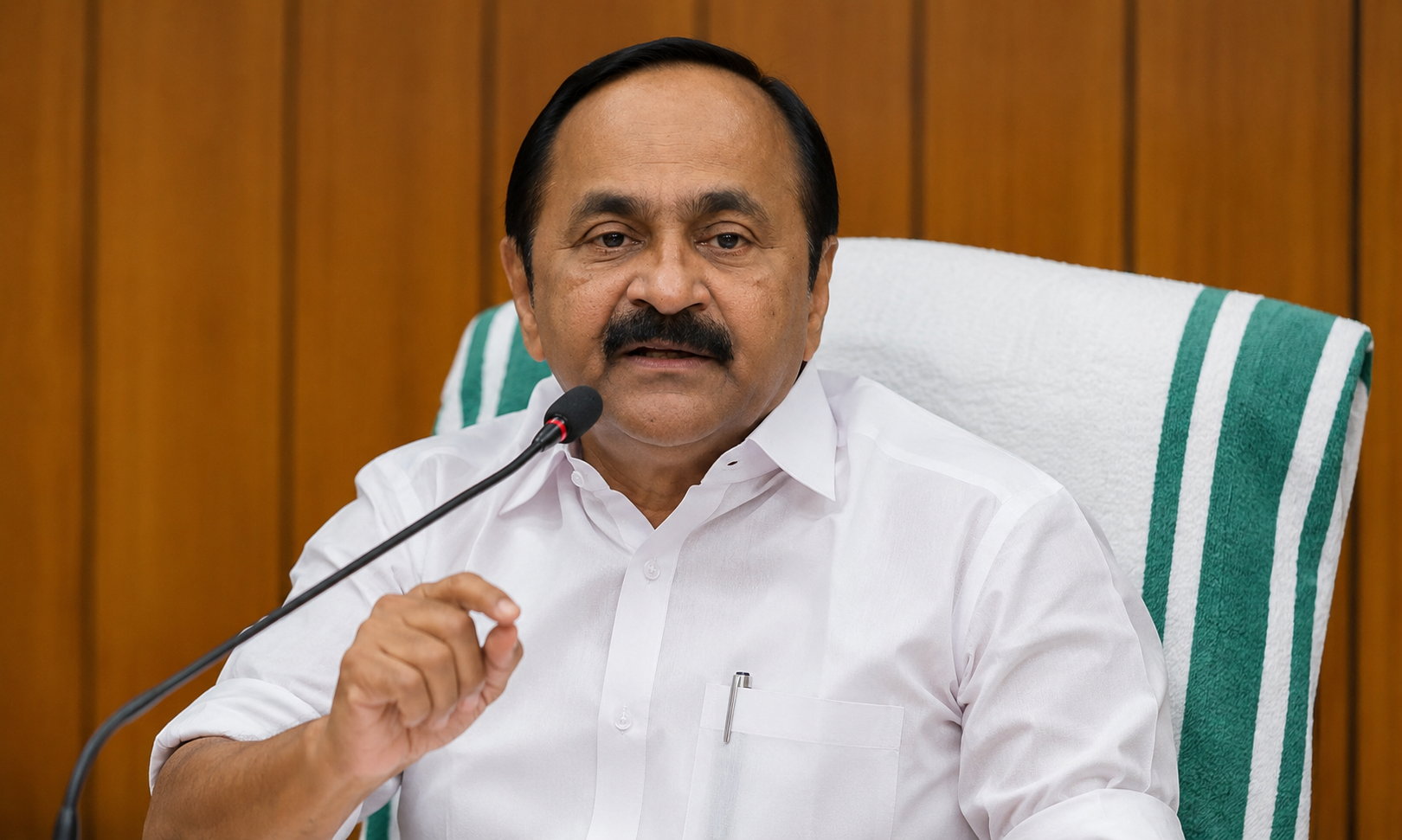
V. D. Satheesan
Indian Politician, Lawyer & Political Strategist
VD Satheesan is an Indian politician, lawyer and political strategist who has been serving as a Member of the Kerala Legislative Assembly (MLA), representing Paravur Assembly constituency since 2001. Satheesan succeeded Congress leader Ramesh Chennithala as the Leader of the Opposition following the 2021 Kerala Legislative Assembly election. He also served as Vice President of the Kerala Pradesh Congress Committee. Satheesan was born to K. Damodara Menon and V. Vilasini Amma in Nettoor, Kochi. He completed his primary education from Panangad High School, under-graduation from Sacred Heart College, Thevara, and post-graduation in Social Work (MSW) from Rajagiri College of Social Sciences. He then completed his Bachelor of Laws (LLB) from Kerala Law Academy Law College and Master of Laws (LLM) from Government Law College, Thiruvananthapuram.
Key Factors
Full Name: V. D. Satheesan
Born: 31 May 1964
Political Party: Indian National Congress
Occupation: Politician, Lawyer, Political Strategist
Constituency: Paravur
Current Position: Leader of the Opposition, Kerala Legislative Assembly
In the intensely theatrical world of Kerala politics, where ideology often collides with personality and Assembly debates can shape public mood overnight, V. D. Satheesan has emerged as one of the most outstanding and intellectually sharp political figures of his generation. Calm in demeanor yet relentless in argument, Satheesan built his public life not through spectacle, but through persistence, legislative discipline, and an unusual command over political detail. Long before he became the Leader of the Opposition in Kerala, he was already known inside the Assembly corridors as a politician who prepared obsessively, debated aggressively, and understood both the legal and political dimensions of governance.
His rise reflects more than individual ambition. It mirrors the evolution of Kerala’s Congress politics itself, a movement struggling to redefine its relevance in a state shaped by strong ideological traditions and increasingly demanding voters. From the coastal landscapes of Nettoor to the heated confrontations of the Kerala Legislative Assembly, Satheesan’s political journey has been marked by resilience, strategic thinking, and a reputation for issue-based politics in an era often dominated by television-friendly rhetoric.
Today, he stands not merely as a Congress leader, but as one of the central voices shaping Kerala’s democratic opposition.
Early Life and Education
V. D. Satheesan was born in 1964 in Nettoor, near Kochi, into a traditional Malayali family at a time when Kerala was undergoing deep political and social transformation. The decades following land reforms, student movements, and ideological mobilisation had created a politically aware society where public debate entered homes, campuses, tea shops, and libraries with unusual intensity.
Growing up in this atmosphere shaped Satheesan’s political consciousness early.
Unlike many politicians who enter public life through dynastic networks or mass agitation alone, Satheesan’s intellectual formation came through education, law, and social engagement. He studied at Sacred Heart College before pursuing a postgraduate degree in social work at Rajagiri College of Social Sciences. The choice of social work as an academic discipline proved significant. It exposed him to questions of inequality, governance, labour, and community structures that would later shape his political language.
He later studied law at Kerala Law Academy Law College and completed his LLM from Government Law College Thiruvananthapuram.
Those who followed his later Assembly performances often noticed how strongly his legal training influenced his political style. Satheesan rarely approached debates emotionally alone. He argued through documents, procedural detail, constitutional logic, and legislative interpretation. In Kerala politics, where rhetoric often dominates, that distinction became one of his defining traits.
The Lawyer Who Entered Politics
Before full-time politics claimed his life, Satheesan spent nearly a decade practising at the Kerala High Court. The courtroom sharpened skills that would later become central to his public image: structured argument, patience under pressure, and tactical precision.
But politics had already entered his life during his student years.
At Mahatma Gandhi University, he emerged as an active student leader and eventually became chairman of the university union during 1986–87. He also worked within the National Students’ Union of India, building organisational experience at a time when campus politics in Kerala was deeply ideological and fiercely competitive.
Student politics in Kerala has historically functioned as a training ground for future leaders. It demands debating ability, grassroots mobilisation, alliance management, and emotional endurance. Satheesan absorbed all of it.
By the time he entered mainstream politics, he already carried the instincts of both a lawyer and an organiser.
Political Debut and Early Setbacks
Satheesan’s first major electoral test came in 1996 when he contested from Paravur, a constituency that had long leaned toward the Left. The political climate in Kerala during the 1990s remained intensely bipolar between the Congress-led United Democratic Front and the CPI(M)-led Left Democratic Front.
For a young Congress candidate, Paravur was difficult terrain.
He lost that election to CPI leader P. Raju.
Yet political careers in Kerala are often defined less by early victory than by survival after defeat. Satheesan chose persistence over retreat. Rather than disappearing after the setback, he deepened his organisational work and continued building relationships within the constituency.
That defeat later became politically important. It gave him credibility as a leader who had earned his rise through struggle rather than sudden elevation.
Five years later, the story changed.
Rise in Kerala Politics
In 2001, V. D. Satheesan won the Paravur Assembly seat for the first time, beginning a legislative career that would eventually span decades. From that point onward, he transformed into one of the Congress party’s most dependable electoral figures in Kerala.
He retained the constituency repeatedly in 2006, 2011, 2016, and 2021, often increasing his margins against strong Left opponents. His victories reflected not merely party strength but a carefully cultivated constituency presence.
Inside the Assembly, Satheesan gained attention for a different reason: preparation.
Even political opponents acknowledged his debating ability. He developed a reputation for entering discussions armed with documents, statistics, legal references, and procedural clarity. His confrontations with former Finance Minister T. M. Thomas Isaac became particularly notable, often turning into highly watched exchanges within Kerala’s political ecosystem.
Unlike more performative politicians, Satheesan’s style relied on controlled aggression. He rarely shouted for effect. Instead, he used precision, often dismantling arguments through layered questioning.
Within the Congress party, this elevated him from MLA to strategist.
Leader of the Opposition
The defining political shift in Satheesan’s career came after the 2021 Kerala Assembly election.
The Congress-led UDF suffered another electoral defeat against the Left Democratic Front under Pinarayi Vijayan. In the aftermath, the Congress faced a deeper question about leadership renewal and organisational direction.
It was in this moment that Satheesan emerged as the choice for Leader of the Opposition, succeeding Ramesh Chennithala.
The decision signaled generational transition inside Kerala Congress politics.
Satheesan inherited a difficult role. The CPI(M)-led government remained electorally strong, Pinarayi Vijayan dominated administrative discourse, and the Congress organisation itself faced internal factionalism.
Rather than adopting purely confrontational politics, Satheesan attempted to reposition the opposition around issue-based intervention. Under his leadership, the Congress intensified criticism on corruption allegations, governance controversies, law-and-order concerns, and financial management.
His Assembly performances became central to this strategy.
Observers noted that Satheesan preferred disciplined attacks over emotional rhetoric. He often framed opposition politics as institutional accountability rather than ideological theatre alone.
For supporters, this projected maturity. Critics, however, occasionally argued that the Congress under him still struggled to convert legislative sharpness into mass political momentum.
Debates, Political Intelligence, and Public Image
Kerala’s political culture values debate perhaps more than any other Indian state. Television discussions, Assembly speeches, and intellectual confrontation remain central to political identity.
Satheesan thrives in that environment.
His speeches are usually structured rather than spontaneous. He builds arguments slowly, layering facts with political narrative. In debates against senior Left leaders, especially on economic policy and governance, he frequently demonstrated both legal and administrative fluency.
His exchanges with Thomas Isaac became particularly famous because they represented two different political temperaments: Isaac’s ideological-economic framing versus Satheesan’s legal-political critique.
Media visibility strengthened his public profile further. Unlike many opposition leaders who rely heavily on emotional mobilisation, Satheesan cultivated the image of a measured political tactician.
That image helped him appeal beyond traditional Congress loyalists to sections of Kerala’s educated middle class.
Leadership Style and Political Vision
Satheesan represents a transitional figure inside Kerala Congress politics.
He belongs to an older Congress tradition shaped by student activism and legislative politics, yet he increasingly speaks the language of governance reform, institutional accountability, and organisational restructuring.
His leadership style is often described as disciplined and detail-oriented. He prefers coordinated communication, internal organisation, and issue-based campaigns rather than impulsive political reaction.
He has also repeatedly spoken about the need to modernise Congress politics in Kerala, especially in terms of youth engagement and communication strategies.
Supporters see him as a stabilising force capable of rebuilding the party structurally. Critics sometimes argue that Congress infighting and electoral inconsistency continue despite his leadership.
Still, even opponents acknowledge that Satheesan has strengthened the intellectual seriousness of Kerala’s opposition politics.
Challenges and Criticism
Leading the opposition in Kerala is uniquely difficult.
The state’s politically aware electorate expects ideological clarity, policy depth, and continuous public engagement. Satheesan must also navigate factional pressures inside the Congress, where competing power centres historically complicate leadership consolidation.
Opponents accuse him of selective activism and political opportunism. The Left frequently portrays Congress criticism as reactive rather than visionary.
At the same time, expectations from Congress workers remain enormous. Many view Satheesan as the face of the party’s future in Kerala, which creates constant pressure for electoral delivery.
The challenge before him is not merely opposing the government. It is rebuilding confidence in Congress as a governing alternative.
V. D. Satheesan as an Outstanding Malayali
What makes V. D. Satheesan politically significant is not only electoral longevity, but the way he embodies Kerala’s democratic culture itself.
He represents a distinctly Malayali political tradition, educated, argumentative, institutionally aware, and deeply invested in public debate. His speeches reflect Kerala’s long culture of political literacy, where ideological confrontation and legislative scrutiny are treated seriously by ordinary citizens.
Unlike personality-driven populists, Satheesan’s appeal rests largely on articulation and political reasoning.
In many ways, he belongs to a generation of Kerala politicians shaped equally by libraries, campuses, courtrooms, and party offices. That combination has made him one of the more intellectually respected figures in contemporary Kerala politics.
Legacy and Future
V. D. Satheesan’s political story is still unfolding.
He has already established himself as one of the Congress party’s most important leaders in Kerala and one of the Assembly’s strongest debaters. But the larger test remains ahead: whether he can transform opposition leadership into a broader political revival for Congress in the state.
His future will likely depend on his ability to balance legislative sharpness with grassroots mobilisation, organisational discipline with emotional connection, and modern political messaging with Kerala’s deeply ideological political culture.
Yet regardless of future electoral outcomes, Satheesan has already carved out a distinctive place in Kerala politics. From the courtrooms of Kochi to the charged atmosphere of the Assembly floor, he built his reputation through persistence, preparation, and political intelligence rather than spectacle alone. In an era increasingly shaped by noise, V. D. Satheesan remains an outstanding Malayali political figure whose strength often lies in measured words, strategic patience, and the enduring power of democratic debate.