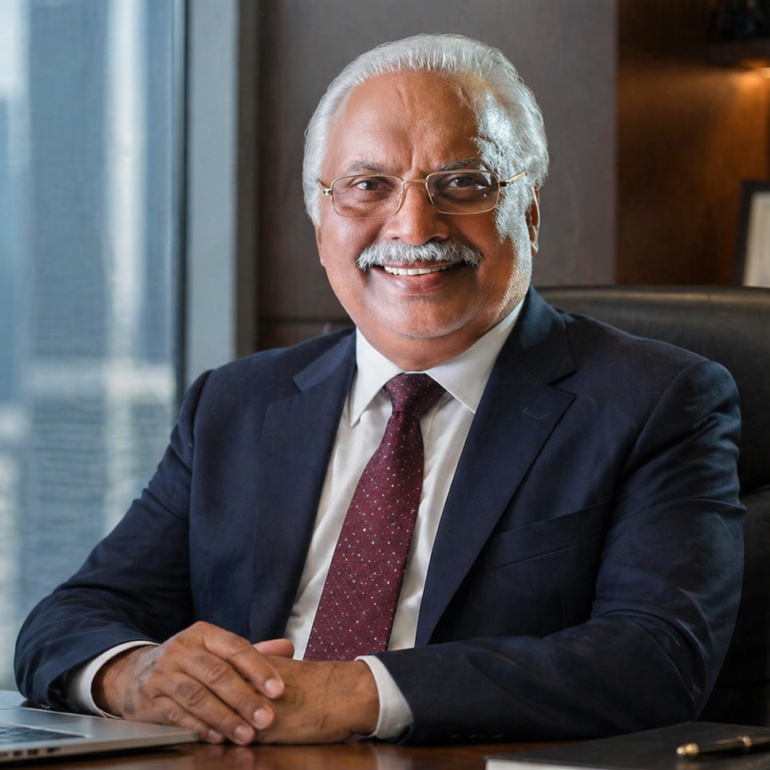

George Alexander Muthoot
MD of the Muthoot Group
George Alexander Muthoot is an Indian entrepreneur and businessman who is currently the managing director of the Muthoot Group, a business conglomerate in India.
Key Facts
Born: 16 September 1955 (age 70)
Place: Kozhencherry, State of Travancore–Cochin (present day Pathanamthitta, Kerala), India
Education: The Institute of Chartered Accountants of India
Title: Managing Director of Muthoot Group
The Weight of Gold, The Scale of Credit
In India, gold is not just an asset. It is memory, security, and, in times of need, liquidity. Across cities and small towns, millions of households hold wealth not in financial instruments but in jewellery, often passed down through generations. It is within this cultural and economic intersection that George Alexander Muthoot built scale. Under his leadership, Muthoot Finance transformed a traditional practice, pledging gold for short-term credit, into a structured, regulated financial business. The result is an outstanding case of aligning deeply rooted social behavior with modern financial systems, creating one of India’s largest non-banking financial companies.
A Business Built Over Generations
The story of George Alexander Muthoot cannot be separated from the history of the Muthoot Group itself.
The group traces its origins to 1887, when it began as a trading business in Kerala. Over decades, it evolved through multiple phases, trading, banking-like activities, and eventually financial services. Like many family-run enterprises in India, its growth was incremental, shaped by local markets, trust-based relationships, and reinvestment rather than external capital.
George Alexander Muthoot grew up within this ecosystem. He was not entering a business from the outside. He was inheriting a system that had already adapted across generations. This environment shaped his understanding of risk, customer behavior, and long-term thinking.
The Muthoot family business had one defining characteristic. Trust.
In financial services, especially in informal or semi-formal markets, trust often substitutes for documentation. This insight would later become central to the gold loan model.
Entry into Business: Structured Learning Meets Legacy
George Alexander Muthoot pursued higher education in commerce and business, equipping himself with formal financial knowledge. He later attended advanced management programs, including exposure to global business practices.
His entry into the family enterprise was gradual. Rather than assuming leadership immediately, he worked through various roles, gaining exposure to operations, branch management, and customer interaction. This phase is critical in family-run conglomerates.
It builds operational grounding. Understanding how credit is assessed, how defaults are managed, and how customer relationships are maintained cannot be learned from strategy alone.
Muthoot’s early years appear to reflect this apprenticeship model.
Building Muthoot Finance: From Informal Practice to Institutional Scale
The transformation of Muthoot Finance into a large NBFC is one of the defining phases of George Alexander Muthoot’s leadership.
Gold loans, as a concept, have existed in India for centuries. What Muthoot did differently was institutionalize them.
The company expanded its branch network aggressively, moving beyond Kerala into a nationwide presence. It standardized processes, valuation, lending ratios, documentation, and risk controls.
A key milestone was its public listing. The IPO in 2011 marked Muthoot Finance’s transition into a regulated, transparent entity, subject to market discipline and investor scrutiny.
This was not just a financial event. It signaled legitimacy.
The company moved from being a family-run business to a publicly accountable institution, while retaining family leadership.
Under Muthoot, the company scaled to thousands of branches and millions of customers, becoming one of the largest gold loan NBFCs in India.
Lending Against Certainty
The core of Muthoot Finance’s success lies in its business model.
Gold loans are fundamentally different from unsecured lending. They are asset-backed.
This reduces credit risk significantly. If a borrower defaults, the lender can auction the pledged gold to recover dues.
This creates a unique risk-return profile. Compared to personal loans or microfinance, gold loans have lower default risk and faster turnaround times.
Muthoot’s strategy leveraged this advantage. It focused on speed, accessibility, and minimal documentation. Customers could walk into a branch, pledge gold, and receive funds within minutes.
This was particularly attractive to small business owners, traders, and households without access to formal banking credit.
The company also maintained conservative loan-to-value ratios, ensuring that the value of pledged gold comfortably exceeded the loan amount. This risk discipline has been central to its resilience.
In comparison with competitors like Manappuram Finance, Muthoot has often positioned itself as a more conservative, scale-driven player, focusing on stability rather than aggressive diversification.
Balancing Family and Institution
George Alexander Muthoot operates within a hybrid structure.
The company is both family-controlled and publicly listed. This creates inherent tensions.
Family control allows long-term decision-making. Public listing demands transparency and accountability. Muthoot’s leadership has focused on balancing these forces.
He has overseen the professionalization of management, bringing in experienced executives while retaining strategic control within the family. Decision-making appears to be centralized but informed by structured processes.
This is typical of large Indian family-run firms transitioning into institutional entities. Governance has improved over time, driven by regulatory requirements and investor expectations.
However, like many such organizations, the balance between family influence and independent oversight remains an ongoing dynamic.
Diversification and Group Expansion: Beyond Gold
While gold loans remain the core business, the Muthoot Group has diversified into multiple financial services. These include housing finance, insurance distribution, microfinance, and money transfer services.
The logic is clear.
Leverage an existing customer base to offer additional products. This cross-selling strategy aligns with broader trends in financial services, where firms aim to become one-stop providers.
However, diversification carries risks. Gold loans are a specialized, high-margin business. Expanding into other sectors introduces new challenges, regulatory complexity, credit risk, and operational differences.
Muthoot’s diversification has been measured rather than aggressive. This reflects a cautious approach, prioritizing core strength while exploring adjacent opportunities.
Navigating Regulation and Market Cycles
The NBFC sector in India operates under increasing regulatory scrutiny.
The Reserve Bank of India has tightened norms around capital adequacy, lending practices, and risk management.
Gold loan companies face additional challenges. Their business is closely tied to gold prices. A sharp decline in gold prices can affect collateral value and increase risk.
There has also been public scrutiny around lending practices, interest rates, and auction processes. Muthoot Finance has navigated these challenges through conservative policies and compliance alignment.
The COVID-19 period tested the sector. Liquidity pressures, borrower stress, and economic uncertainty required rapid adjustments. Gold loans, however, proved relatively resilient, as gold prices remained strong and demand for short-term credit increased.
Credit for the Underserved
One of the most significant contributions of George Alexander Muthoot’s leadership is financial inclusion.
India’s formal banking system does not fully serve all segments of the population. Many individuals lack credit history, documentation, or collateral acceptable to banks.
Gold changes that equation. It is widely held, easily valued, and culturally accepted.
By building a large-scale gold loan network, Muthoot Finance has provided access to credit for millions of customers who might otherwise remain outside the formal system.
This impact is both economic and social. It enables small businesses, supports household liquidity, and bridges gaps in financial access.
Future Outlook: Adapting a Traditional Model to a Digital Age
The future of Muthoot Finance will be shaped by multiple forces.
Digital transformation is redefining financial services. Fintech platforms are offering faster, technology-driven lending solutions. At the same time, the gold loan model retains its relevance.
It is simple, secure, and culturally embedded. The challenge is integration. How to combine physical branch networks with digital interfaces.
Muthoot has begun investing in technology, enabling online gold loan services, customer apps, and data-driven operations.
Competition will intensify. Banks, NBFCs, and fintech firms are entering the gold loan space, attracted by its relatively low risk.
Sustaining leadership will require continuous adaptation. George Alexander Muthoot’s legacy lies in institutionalizing a traditional practice and scaling it nationally.
The next phase will test whether that model can evolve in a digital-first environment. If it does, his contribution will remain not just historical, but ongoing.
An outstanding example of how deeply rooted economic behavior, when aligned with structured finance, can create enduring business value in a rapidly changing market.