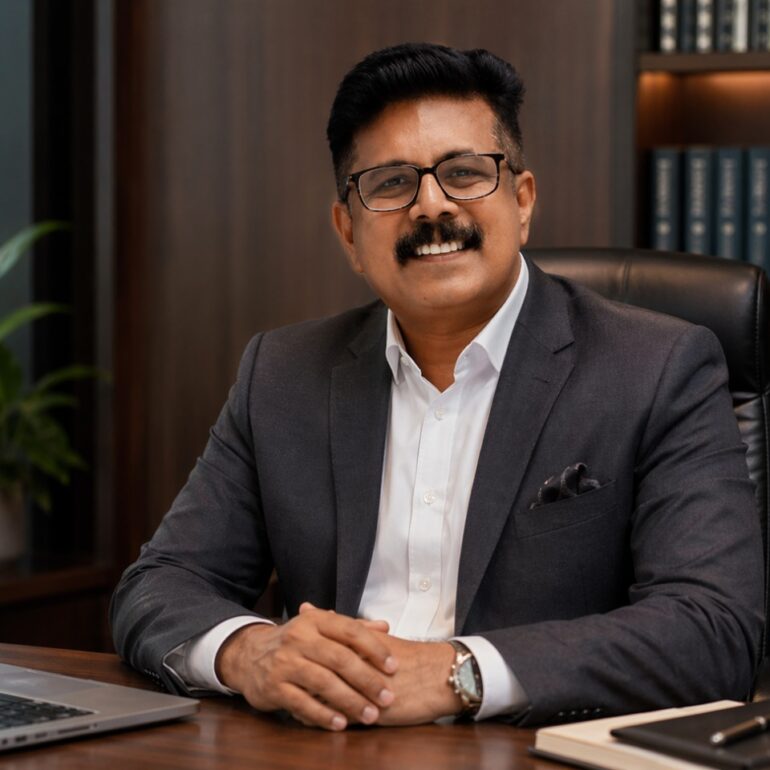
Deepak Radhakrishnan
CEO and a prominent leader of the IBIS Group of Educational Institutions
Deepak Radhakrishnan is the CEO and a prominent leader of the IBIS Group of Educational Institutions, which includes IBIS Academy, a skill-development training center based in Kerala, India. The group also lists Sri. M Radhakrishnan as Chairman, and specializes in job-oriented courses in fields like management, fitness, and technology. Deepak Radhakrishnan is identified as the CEO and a key figure behind the Ibis Group of Educational Institutions. The Academy was established in 2017. It operates as a training center focusing on language, fitness, technical, and management courses, with affiliations including the National Skill Development Corporation (NSDC)
Key Facts
Full Name: Deepak Radhakrishnan
Current Role: Chief Executive Officer of IBIS Group of Educational Institutions
Industry: Skill Development, Education & Training
Known For: Driving IBIS Group’s focus on employability-driven training and industry-aligned education
Inside an IBIS Academy training center in Kerala, the classroom does not resemble the traditional Indian learning environment. There are no rigid lecture formats or purely theoretical sessions. Instead, what unfolds is closer to a simulation of the workplace, conversations around real-world scenarios, practical modules, and a clear emphasis on outcomes rather than attendance.
This is not incidental. It reflects a deliberate design philosophy shaped by Deepak Radhakrishnan, one that prioritizes employability over certification. In a state known for high literacy but persistent unemployment among graduates, the distinction is critical.
Understanding the Gap Before Building the Solution
Kerala has long been an educational outlier. Its literacy rates are among the highest in India, yet its employment landscape tells a more complicated story. Thousands of graduates enter the workforce each year, often equipped with degrees that do not translate into job readiness.
It is within this context that IBIS Academy was established in 2017. While the broader IBIS Group operates across multiple domains, the academy became its most visible expression of intent, to create a training ecosystem aligned with industry needs.
Deepak Radhakrishnan’s role in this journey has been less about founding an institution from scratch and more about shaping its direction. As CEO, he operates at the intersection of strategy and execution, defining course structures, identifying growth opportunities, and aligning the organization with evolving market demands.
From Academy to Group: Structuring Growth
The transition from IBIS Academy to the IBIS Group of Educational Institutions reflects a shift from a single training center to a broader institutional framework. While detailed public data on expansion metrics remains limited, the structure itself signals ambition, moving from a localized initiative to a multi-vertical education platform.
The group’s offerings span language training, fitness education, technical courses, and management programs. This diversification is not accidental. It reflects an understanding that employability is not confined to one sector.
Language training addresses communication barriers, particularly for candidates aiming for global or customer-facing roles. Fitness education taps into a growing industry with increasing demand for certified professionals. Technical and management programs attempt to bridge the gap between academic learning and workplace expectations.
The affiliation with the National Skill Development Corporation further positions IBIS within a larger national framework aimed at improving workforce readiness.
The Business of Employability
At its core, IBIS operates within a segment that sits between formal education and employment, the training and skilling ecosystem. This space has seen rapid growth over the past decade, driven by structural shifts in India’s economy.
Traditional universities often struggle to keep pace with industry requirements. As a result, private training institutions have emerged to fill the gap, offering shorter, more targeted programs.
Deepak Radhakrishnan’s approach appears to align with this trend, but with an emphasis on outcomes. The value proposition is not the course itself, but what follows, employment, skill application, and career progression.
This focus on employability also shapes the curriculum. Courses are designed to be practical, industry-relevant, and adaptable. The objective is not to replicate academic programs but to complement them.
Positioning in a Crowded Market
Kerala’s training ecosystem is highly competitive. From established institutions to emerging academies, the market is saturated with players offering similar promises, job-oriented courses, industry exposure, and placement support.
In such an environment, differentiation becomes essential.
IBIS attempts to position itself through a combination of multi-disciplinary offerings and industry alignment. The integration of fitness, language, and technical training under one umbrella is relatively uncommon and may provide a broader value proposition.
However, the challenge lies in execution. Delivering consistent quality across diverse verticals requires robust systems, experienced faculty, and strong industry linkages.
Leadership in a Transitional Sector
Deepak Radhakrishnan’s leadership reflects the complexities of operating in a sector that is still evolving. Unlike traditional educational institutions with established frameworks, skill-development organizations must continuously adapt.
This requires a different kind of leadership, one that balances flexibility with structure.
Decision-making in such an environment often involves trade-offs. Expanding course offerings can attract a wider audience but may dilute focus. Scaling operations can increase reach but may impact quality.
While detailed insights into his internal management style are not extensively documented in public sources, the direction of IBIS suggests a focus on measured growth and relevance.
The Structural Challenge: Skill vs Degree
One of the persistent challenges in India’s education system is the perception gap between degrees and skills. While the market increasingly values practical capabilities, societal expectations often continue to prioritize formal qualifications.
Institutions like IBIS operate within this tension.
Convincing students and parents to invest in skill-based training requires not just effective marketing but demonstrable outcomes. Placement success, industry partnerships, and alumni performance become critical indicators.
For Deepak Radhakrishnan, this represents both a challenge and an opportunity. As the job market evolves, the demand for skill-based training is likely to grow. However, capturing this demand requires sustained credibility.
Scaling Without Losing Relevance
Scaling a training institution is fundamentally different from scaling a traditional business. Growth is not just about increasing numbers, but about maintaining quality, relevance, and outcomes.
For IBIS, expansion must be accompanied by consistent curriculum updates, faculty development, and industry engagement.
The affiliation with national bodies like NSDC provides a framework, but execution remains key. In a sector where trust is built gradually and lost quickly, maintaining standards is critical.
The Broader Context: India’s Skill Economy
India’s demographic advantage, a large, young workforce, comes with its own set of challenges. The gap between education and employment continues to be a structural issue.
Government initiatives have attempted to address this through large-scale skill development programs. However, private institutions play an equally important role in bridging the gap.
IBIS operates within this broader ecosystem, contributing to workforce readiness at a regional level. While its scale may not match national players, its localized focus allows it to address specific market needs.
Looking Ahead
The future of institutions like IBIS will depend on their ability to remain relevant in a rapidly changing environment. As industries evolve, so must the skills required to participate in them.
For Deepak Radhakrishnan, the next phase likely involves deeper industry integration, enhanced curriculum design, and potentially geographic expansion. However, any such move must be grounded in the core philosophy that defines the organization, employability over formalism.
Reflection
Deepak Radhakrishnan’s journey with IBIS Group is still unfolding, shaped as much by external forces as by internal decisions. In a sector often criticized for inconsistency and over-promising, the real test lies in delivering tangible outcomes for students. If IBIS can sustain its focus on relevance and execution, it may well carve out a meaningful space in Kerala’s education ecosystem. In that sense, his leadership is not about scale alone, but about building a system that works, consistently, quietly, and, at its best, outstanding.