
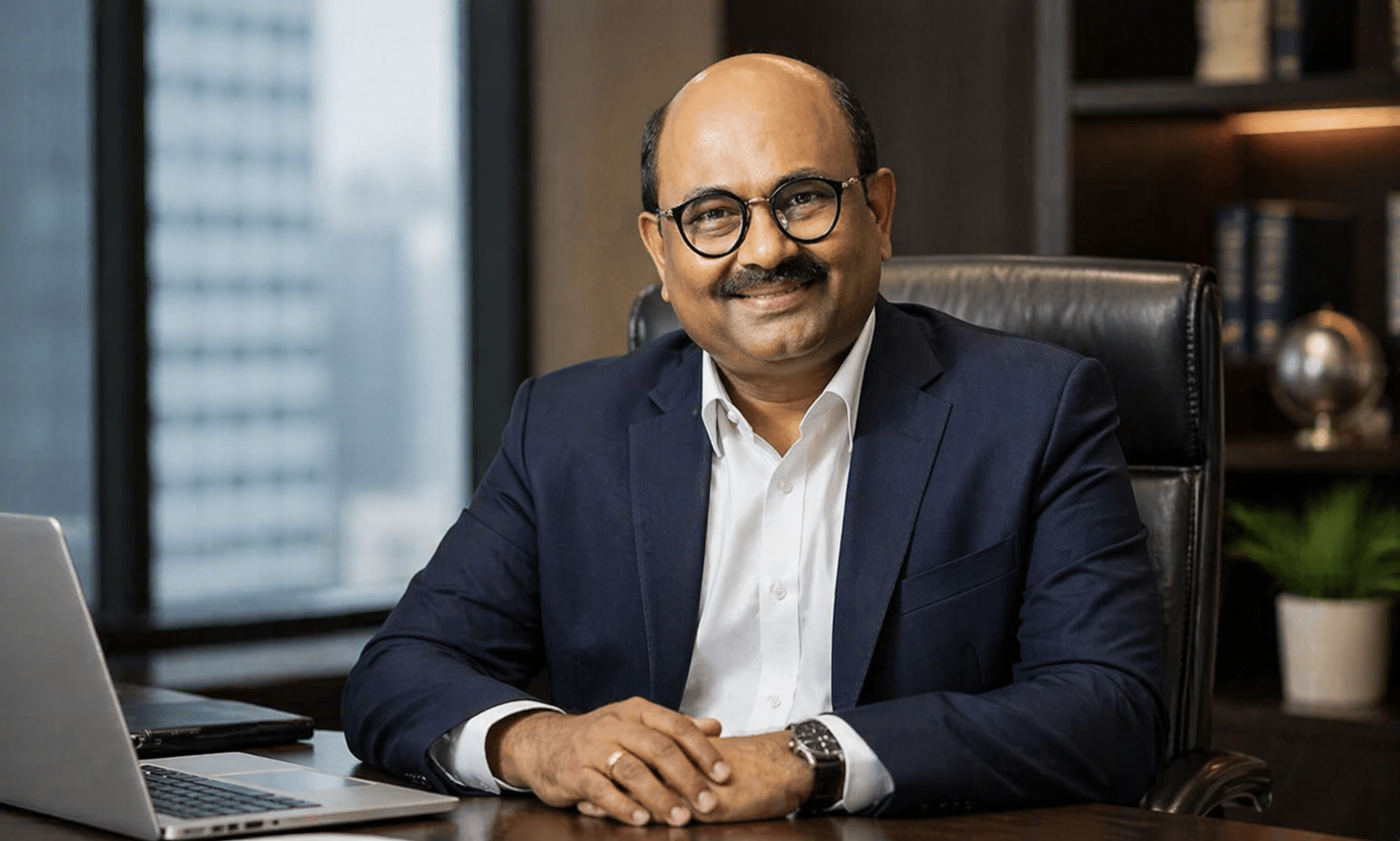
Dr. Viju Jacob
Executive Chairman of Synthite Industries
Dr Viju Jacob is the executive chairman of Synthite Industries Pvt. Ltd., the world’s largest producer of value-added spice extracts, powders, essential oils, natural flavours, and fragrances.
key Facts
Name: Dr. Viju Jacob
Title: Executive Chairman of Synthite Industries
The air inside a spice extraction facility is different. It carries not just aroma, but concentration, pepper rendered into essence, turmeric reduced to its molecular signature, chilli transformed into calibrated heat. At one of the advanced plants of Synthite Industries, the process is less about cooking and more about chemistry. Stainless steel columns, solvent systems, and quality-control labs operate with a discipline closer to pharmaceuticals than food. This is where Kerala’s centuries-old spice trade is re-engineered into standardized global ingredients. At the centre of this transformation is Dr. Viju Jacob, a second-generation entrepreneur who has taken a deeply technical business and expanded it into an outstanding global enterprise, bridging agriculture, science, and multinational supply chains.
The Synthite Foundation
The story begins with C.V Jacob, who founded Synthite Industries in 1972. At a time when India’s spice trade was largely export-driven but low in value addition, his vision was unconventional. Instead of exporting raw spices, Synthite would extract oleoresins, concentrated forms of spices that preserve flavor, color, and functional properties in a stable, industrial format.
This shift from commodity export to value-added processing was significant. Oleoresins offered consistency, longer shelf life, and easier integration into global food manufacturing systems. Multinational companies, particularly in processed foods and beverages, required standardized inputs. Synthite positioned itself to meet that demand.
Kerala, with its historical identity as the spice capital of India, provided both the raw material base and the cultural context. But what Synthite introduced was industrial rigor. It transformed spices from an agricultural product into a controlled, measurable ingredient, aligning Indian supply with global expectations.
Enter Dr. Viju Jacob
Dr. Viju Jacob entered this ecosystem with both inheritance and exposure. Educated internationally, including doctoral-level research in chemical engineering, he brought a scientific lens to a business that was already technically complex. His academic background, particularly in process engineering, aligned closely with the core of Synthite’s operations.
His early years in the company were shaped by immersion rather than immediate leadership. Like many second-generation entrepreneurs in family-run industrial businesses, his transition involved understanding plant operations, supply chains, and client expectations from the ground up.
This phase was critical. The oleoresin business is not intuitive. It requires a deep understanding of extraction technologies, solvent systems, quality parameters, and regulatory frameworks across multiple countries. Viju Jacob’s technical training allowed him to engage with these complexities directly, rather than managing them at a distance.
Reinventing a Legacy Business
When Dr. Viju Jacob assumed a larger leadership role, Synthite was already a respected global player in spice oleoresins. The challenge was not survival, but reinvention.
The global ingredients industry was evolving. Demand was shifting toward natural ingredients, functional foods, and wellness-oriented products. The boundaries between food, health, and pharmaceuticals were beginning to blur.
Under his leadership, Synthite Industries expanded beyond traditional oleoresins into nutraceuticals, natural colors, essential oils, and wellness ingredients. This was not a diversification for its own sake. It was a strategic extension of existing capabilities.
The core competency, extraction and standardization of plant-based compounds, remained unchanged. What evolved was the application. Curcumin, derived from turmeric, moved from being a spice extract to a nutraceutical ingredient with anti-inflammatory properties. Similarly, other plant-based extracts found relevance in dietary supplements and functional foods.
This shift required investments in R&D, regulatory compliance, and product development. It also required a repositioning of the company, from a spice extract manufacturer to a broader natural ingredients enterprise.
Building a Global Enterprise
Today, Synthite Industries operates as a global supplier to major food, beverage, and wellness companies. Its client base includes multinational corporations that demand not just quality, but consistency across geographies and batches.
International expansion has been both market-driven and operational. Synthite has established manufacturing and sourcing capabilities in multiple countries, allowing it to stay closer to raw material sources and end markets.
The company’s positioning as a technology-driven ingredient supplier is central to its global strategy. In a market where price competition exists, differentiation comes from reliability, traceability, and innovation. Clients are less concerned with where an ingredient is sourced and more with whether it meets precise specifications every time.
This is where Synthite’s legacy in process engineering becomes a competitive advantage. The ability to control variables, from raw material quality to extraction parameters, allows the company to deliver standardized outputs in a highly variable agricultural ecosystem.
Innovation, R&D, and Sustainability
Research and development sit at the core of Synthite’s evolution. The transition into nutraceuticals and functional ingredients is not possible without sustained investment in scientific research, clinical validation, and product development.
The company has built dedicated R&D facilities focusing on extraction technologies, formulation, and application development. This enables it to move up the value chain, from supplying raw extracts to offering integrated ingredient solutions.
Sustainability is another critical dimension. Spice extraction depends on agricultural inputs, which are inherently variable and vulnerable to climate conditions. To address this, Synthite has invested in backward integration, working closely with farmers to improve cultivation practices, ensure quality, and maintain traceability.
These relationships are not merely transactional. They are part of a broader ecosystem that supports consistent supply while aligning with global sustainability standards. For international clients, traceability and ethical sourcing are no longer optional. They are requirements.
Leadership Style and Philosophy
Dr. Viju Jacob’s leadership style reflects a blend of scientific rigor and long-term strategic thinking. Unlike consumer-facing entrepreneurs who operate in highly visible markets, his domain is industrial, technical, and often invisible to end consumers.
Decision-making in such an environment is data-driven and process-oriented. Investments in new product categories or technologies are evaluated not just for market potential, but for alignment with core capabilities.
At the same time, there is an element of continuity. Synthite remains a family-run business, and its evolution reflects a balance between legacy values and modern management practices. This includes professionalization of operations, global talent integration, and structured governance.
There is also a noticeable emphasis on patience. Unlike startups that prioritize rapid scaling, Synthite’s growth has been incremental, built on sustained capability development rather than short-term market capture.
Challenges and Strategic Bets
Operating in the global ingredients industry comes with a distinct set of challenges. Raw material volatility is a constant concern. Spice crops are affected by weather patterns, geopolitical factors, and supply chain disruptions.
Regulatory complexity is another layer. Nutraceuticals and food ingredients are subject to different standards across markets. Compliance requires continuous monitoring and adaptation.
Competition has also intensified. Global players, including large ingredient companies, operate at scale with significant resources. For Synthite, differentiation depends on maintaining its edge in quality, innovation, and customer relationships.
Internally, the shift from a traditional oleoresin business to a diversified ingredient company required organizational change. New capabilities had to be built, from R&D to marketing, without disrupting existing operations.
These transitions are rarely seamless. They involve risk, both financial and operational. The ability to navigate these challenges reflects a leadership approach that is cautious but forward-looking.
The Bigger Picture
Synthite’s evolution mirrors a broader shift in India’s agri-export landscape. For decades, the country exported raw agricultural commodities with limited value addition. Companies like Synthite Industries have demonstrated the potential of moving up the value chain.
This has implications beyond business. It positions India not just as a supplier of raw materials, but as a producer of high-value, technology-driven ingredients. In global markets, this changes perception and pricing power.
For Kerala, the story is equally significant. Traditionally known for remittance-driven consumption and small-scale industries, the state is gradually building a reputation in specialized manufacturing and global supply chains. Synthite stands as one of the more prominent examples of this transition.
Future Outlook
Looking ahead, the trajectory of Synthite Industries is closely tied to global trends in food and health. Demand for plant-based ingredients, natural extracts, and wellness products continues to grow.
Areas such as functional nutrition, botanical extracts, and clean-label ingredients are likely to define the next phase of growth. These categories require deeper integration between science, regulation, and consumer insight.
Geographic expansion will remain important, but so will vertical integration. Controlling more of the value chain, from farm to finished ingredient, offers both efficiency and resilience.
For Dr. Viju Jacob, success in the coming decade may be less about scale alone and more about relevance. The ability to stay aligned with global shifts while maintaining operational excellence will determine the company’s position.
In many ways, his journey reflects a broader transformation, of taking a legacy built on spices and reimagining it through science, technology, and global ambition. It is a story not of disruption, but of evolution, steady, deliberate, and quietly outstanding in its impact.