Originated: Ancient Syrian Christian devotional dance tradition of Kerala
Place of Origin: Kerala, India
Art Form: Traditional group dance-drama
Core Elements: Rhythmic dance, devotional songs, storytelling, and circular formations
Language: Malayalam and Syriac influences
Themes: Life and teachings of St. Thomas the Apostle
Community: Traditionally performed by Syrian Christian communities
Cultural Importance: One of Kerala’s oldest Christian folk art traditions
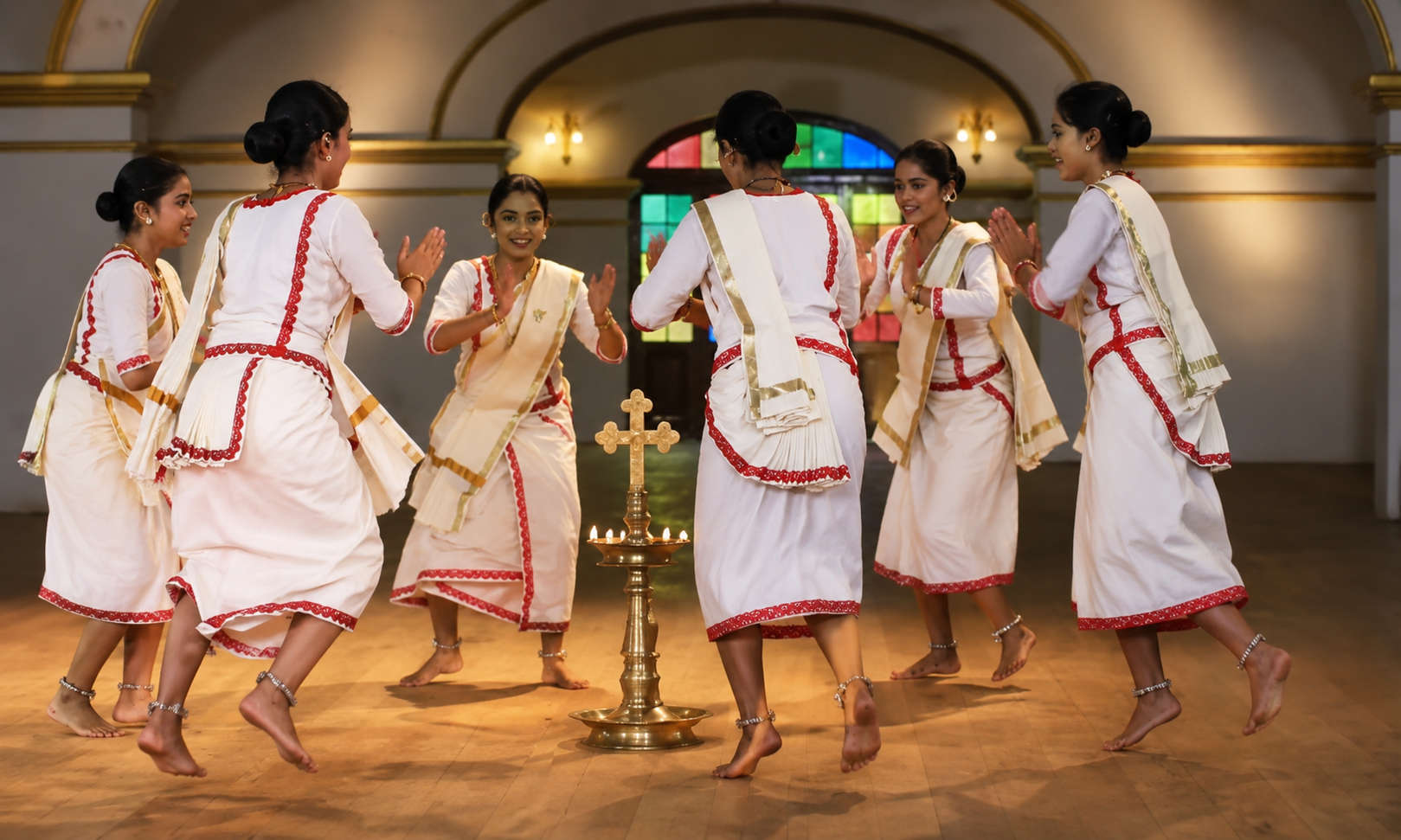
As evening lamps begin to glow inside a traditional Kerala Christian household or church courtyard, a group of dancers dressed in elegant white attire slowly gather around a shining Nilavilakku. Rhythmic clapping fills the air. Ancient songs echo softly through the gathering as the dancers move gracefully in circles, carrying stories that are believed to be centuries old.
This is Margamkali, one of Kerala’s oldest and most unique traditional dance forms associated with the Saint Thomas Christian community. Deeply rooted in faith, storytelling, and community memory, Margamkali is much more than a performance art. It is a living cultural tradition that connects modern Kerala to its ancient Christian heritage.
Known for its circular movements, devotional songs, rhythmic clapping, and spiritual atmosphere, Margamkali continues to survive through church festivals, weddings, youth competitions, and cultural events across Kerala.
For many Malayali Christians, especially within the Knanaya community, the dance remains a proud symbol of identity, faith, and centuries-old tradition.
What is Margamkali?
The word “Margam” means “path” or “way,” while “Kali” means performance or dance. Together, Margamkali can be understood as “the dance of the path,” referring to the spiritual path of Christianity.
The dance is closely connected to the life and missionary journey of Thomas the Apostle, also known as St. Thomas, who according to Christian tradition arrived in Kerala during the first century CE and spread Christianity along the Malabar Coast.
The songs performed during Margamkali narrate stories connected to St. Thomas, early Christian communities, faith, conversion, and spiritual teachings. Through rhythmic movement and singing, these stories are passed down from one generation to another.
Margamkali is especially preserved by the Knanaya community, an endogamous group within Kerala’s Saint Thomas Christian tradition. Over centuries, the community played a major role in protecting and continuing the art form.
Today, Margamkali stands as one of the most important symbols of Kerala Christian heritage and one of the state’s oldest surviving community dance traditions.
Origin and Historical Background
The roots of Margamkali are believed to be very ancient, closely linked to Kerala’s early Syrian Christian communities.
For centuries, Kerala’s coastal trade routes connected the region with the Middle East, bringing cultural and religious exchanges between local communities and West Asian Christian traditions. Over time, these influences blended with Kerala’s local customs, creating a distinct Christian cultural identity unique to the state.
The songs of Margamkali reflect this long history. Many contain influences from Syriac, an ancient liturgical language used by early Eastern Christian communities. Tamil influences can also be found in some traditional lyrics and expressions.
Historically, Margamkali survived mainly through oral tradition. Songs, movements, and performance styles were passed from elders to younger generations within families and church communities.
Despite periods of decline and social change, the dance survived because communities continued to preserve it during church gatherings, family celebrations, and cultural events.
Scholars, priests, and cultural researchers later played important roles in documenting and reviving Margamkali as an important heritage art form of Kerala.
Today, the dance remains a powerful reminder of Kerala’s ancient Christian history and multicultural identity.
Connection with Kerala and Place
Margamkali is strongly associated with central Kerala, especially districts such as:
- Kottayam
- Thrissur
- Ernakulam
These regions have long histories connected to Saint Thomas Christian communities and traditional church culture.
The dance is commonly performed during:
- Church festivals
- Weddings
- Youth festivals
- Christian cultural programs
- School and college competitions
Margamkali reflects Kerala’s unique cultural harmony where local traditions, spirituality, music, and storytelling blend naturally together.
Even today, the art form remains deeply connected to community gatherings and religious celebrations across Kerala’s Christian households and churches.
How Margamkali is Performed
A Margamkali performance is graceful, calm, and deeply symbolic.
The dancers usually stand in a circle around a Nilavilakku, the traditional Kerala oil lamp. The glowing lamp represents spiritual light, divine presence, and the guiding path of faith.
Traditionally, performers wear Chattayum Mundum, the classic white attire associated with Kerala Christian women. The simplicity of the costume adds elegance and cultural authenticity to the performance.
The dance itself relies mainly on:
- Rhythmic clapping
- Group singing
- Coordinated circular movement
- Graceful footwork
Unlike many other dance traditions, Margamkali uses very few musical instruments. The rhythm is created mainly through synchronized clapping and collective singing.
The songs guide the storytelling, narrating episodes connected to St. Thomas and early Christian life in Kerala.
Historically, Margamkali was often performed by men and boys. Today, however, the dance is most commonly presented by women and students during cultural events and competitions.
The circular movement around the lamp creates a peaceful and spiritual atmosphere that feels both devotional and deeply connected to Kerala’s traditional aesthetics.
Margamkali and Parichamuttukali
Margamkali is closely connected with anothqqer traditional Christian art form known as Parichamuttukali.
While Margamkali focuses on graceful movement and devotional storytelling, Parichamuttukali includes martial elements using swords and shields. The performance reflects Kerala’s historic warrior traditions and the martial training practices once associated with Christian communities.
Together, Margamkali and Parichamuttukali form an important part of Kerala’s Christian folk performance heritage, combining spirituality, storytelling, rhythm, and martial culture.
Margamkali in Modern Kerala
Today, Margamkali continues to survive and grow through revival efforts, cultural programs, and youth participation.
The dance has become an important category in Kerala School Youth Festivals, where students from across the state learn and perform the art form competitively.
Organizations such as Hadusa and various church cultural groups have worked to preserve traditional songs, costumes, and performance methods.
Margamkali is now regularly performed in:
- Schools
- Colleges
- Church cultural events
- Heritage festivals
- Stage competitions
These efforts have helped introduce younger generations to Kerala’s ancient Christian traditions while keeping the art form alive in modern cultural spaces.
Cultural Importance
Margamkali remains culturally important because it preserves centuries of Kerala’s Christian heritage through music, storytelling, dance, and community participation.
The art form represents:
- Ancient Saint Thomas Christian traditions
- Kerala’s multicultural identity
- Oral storytelling heritage
- Community memory and faith
- Cultural continuity across generations
More than entertainment, Margamkali serves as a living historical memory carried through rhythm, song, and movement.
It also reflects Kerala’s unique cultural landscape where local traditions and global religious influences blended naturally over centuries to create something deeply original.
For many communities, the dance remains a symbol of belonging, spirituality, and cultural pride.
Conclusion
Even today, when the rhythmic claps of Margamkali begin around the glowing Nilavilakku, Kerala’s ancient Christian heritage comes alive once again through music, movement, and memory.
The dance continues to carry stories that have travelled across centuries, connecting modern generations to faith, community, and tradition.
In its graceful circles, devotional songs, and quiet spiritual beauty, Margamkali preserves not only an art form, but an entire cultural world shaped by Kerala’s history and the enduring legacy of the Saint Thomas Christian community.
For visitors exploring Kerala’s cultural heritage, witnessing a Margamkali performance offers a rare and beautiful glimpse into one of the state’s oldest living traditions.