Vignesh Puthur
Indian Cricketer
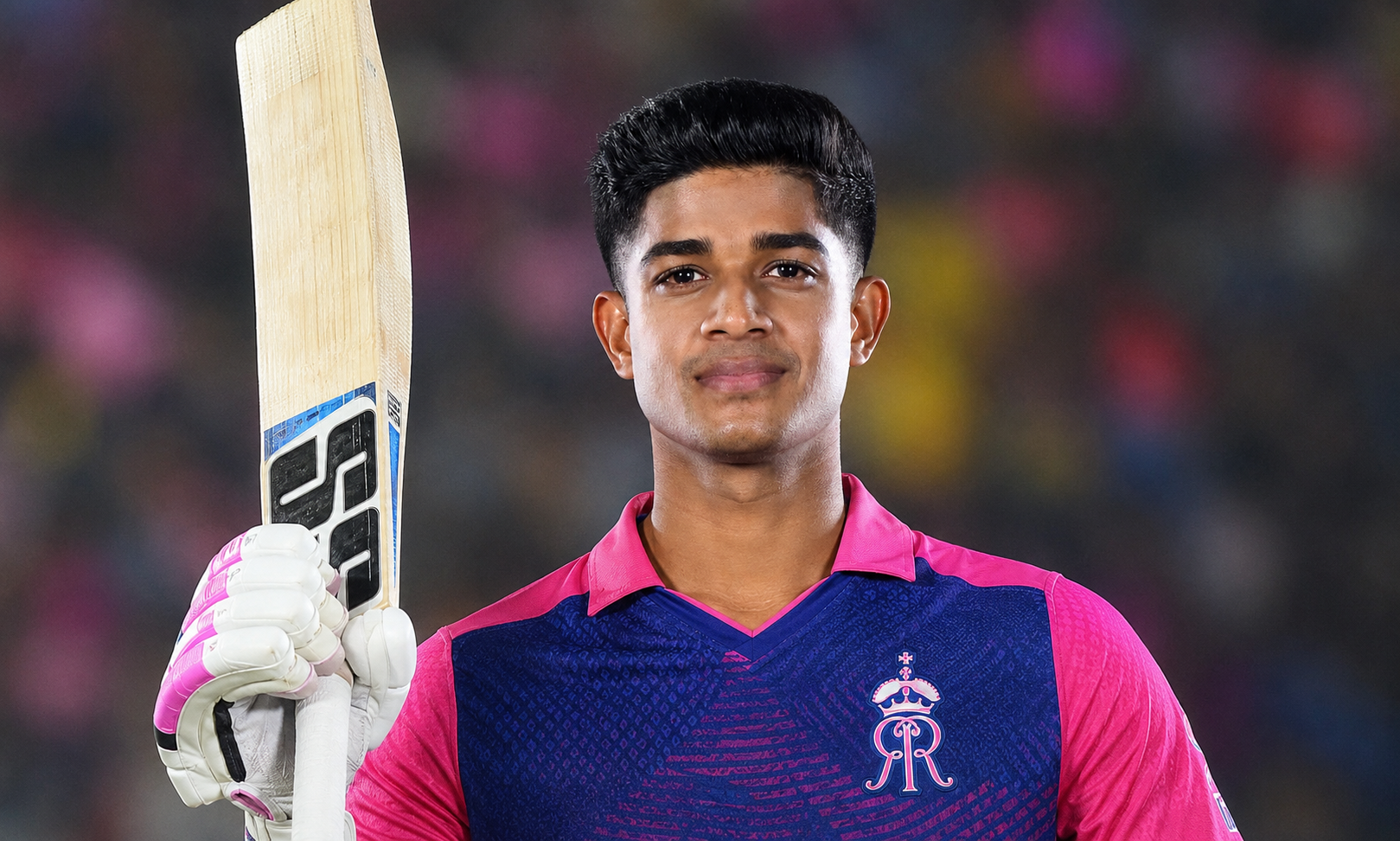
Vignesh Puthur is an Indian cricketer who plays for Kerala in domestic cricket and Rajasthan Royals in the Indian Premier League. Vignesh Puthur was born in Perinthalmanna in Kerala. His father Sunil Kumar is an autorickshaw driver and his mother K.P. Bindhu is a homemaker. He completed his secondary education at Government Model Higher Secondary School, Perinthalmanna and later graduated from St. Thomas’ College (Autonomous), Thrissur. Vignesh studied MA Literature at PTM Government College, Perinthalmanna.
Key Factors
Full Name: Vignesh Puthur
Date of Birth: 2 March 2001
Birthplace: Perinthalmanna, Kerala, India
Hometown: Perinthalmanna, Malappuram
Occupation: Professional Cricketer
Role in Cricket: Bowling All-rounder
IPL Teams: Mumbai Indians, Rajasthan Royals
Vignesh Puthur is part of a new generation of Kerala cricketers whose journeys reflect how Indian cricket has changed beyond the traditional power centres of Mumbai, Delhi, or Karnataka. Rising from Perinthalmanna in Malappuram district, Vignesh’s story carries the familiar elements of modern Indian cricket dreams, financial struggle, small-town ambition, endless local matches, and one life-changing opportunity under stadium lights.
A left-arm wrist spinner who quietly climbed through Kerala’s age-group system, he entered wider public attention after his breakthrough performances in the Indian Premier League. His debut season, particularly his memorable spell against Ruturaj Gaikwad and Shivam Dube, instantly transformed him from a domestic hopeful into one of Kerala cricket’s most discussed young talents.
Yet Vignesh Puthur’s story is not simply about the IPL. It is about how cricketing pathways in India now extend into smaller towns, college grounds, local leagues, and scouting systems that can suddenly pull an unknown player into the centre of the world’s biggest cricket tournament.
From Perinthalmanna to Prime Time
How Vignesh Puthur’s journey through Kerala cricket and the IPL reflects the changing landscape of Indian cricket dreams
The crowd inside the stadium was loud enough to shake concentration.
Blue flags moved restlessly in the evening air. Cameras zoomed in with ruthless curiosity. Every ball was analysed before it even landed. For most young cricketers, the Indian Premier League can feel less like cricket and more like theatre.
And somewhere inside that noise stood Vignesh Puthur, a young spinner from Perinthalmanna preparing to bowl against some of India’s biggest white-ball names.
A few years earlier, he had been playing cricket on modest Kerala grounds where spectators arrived on motorbikes and matches ended before sunset because local lights were unreliable. Now he was facing Ruturaj Gaikwad under global broadcast lights.
The transition felt almost unreal.
Then came the breakthrough moment.
The wicket.
And suddenly, millions of viewers who had never heard the name “Vignesh Puthur” were searching for him.
The Small-Town Cricket Dream
Perinthalmanna sits inside Malappuram district, a region where football traditionally dominates emotional imagination. Cricket existed too, but for years Kerala’s cricketing infrastructure lagged behind stronger Indian states.
Children still played endlessly, on school grounds, open fields, narrow streets, and improvised pitches marked by slippers or bricks. But turning talent into professional opportunity remained difficult.
Vignesh grew up inside that environment.
His father, Sunil Kumar, worked as an autorickshaw driver. His mother, K. P. Bindhu, managed the household while quietly supporting her son’s increasingly demanding cricket ambitions. Like countless middle-class and lower-middle-class Indian sporting families, they learned quickly that talent alone was never enough.
There were travel expenses. Equipment costs. Coaching fees. Tournament trips.
And above all, uncertainty.
Professional cricket careers in India are brutally competitive. For every player who reaches the IPL, thousands disappear quietly somewhere inside club cricket and district tournaments.
Yet families continue believing. That belief carried Vignesh forward.
School, Studies, and Cricket
Unlike many romanticised sporting narratives, Vignesh’s life was not built entirely around cricket alone.
He studied at Government Model Higher Secondary School in Perinthalmanna before continuing his education at St. Thomas’ College, Thrissur, and later pursuing MA Literature at PTM Government College.
Education remained important within the household.
That balance between academics and cricket reflects a wider reality for most Kerala athletes. Unlike regions with deeply commercialised sporting systems, Kerala families often continue viewing education as necessary security even for highly talented players.
For Vignesh, cricket existed alongside examinations, assignments, bus journeys, and college schedules.
The uncertainty of professional sport perhaps made that balance emotionally necessary.
Kerala Cricket’s Quiet Revolution
Kerala cricket has changed dramatically over the past decade.
For years, the state struggled for consistent recognition within Indian domestic cricket. Talented players existed, but pathways toward elite competition felt unstable compared to states with stronger systems.
That gradually began changing through improved coaching structures, age-group tournaments, and a growing culture of professional preparation.
Vignesh emerged directly from this evolving ecosystem.
Under the guidance of coach Vijayan and other local mentors, he progressed steadily through Kerala’s Under-14, Under-19, and Under-23 structures. The rise was not explosive. It was methodical.
Left-arm wrist spinners remain relatively rare in Indian cricket, especially within domestic systems where consistency often matters more than experimentation. Vignesh’s bowling gradually developed around deception, flight variation, and control rather than pure mystery.
Kerala cricket itself had become more competitive by then.
Young players no longer saw state selection as symbolic achievement alone. The IPL had transformed ambition levels completely. Domestic cricket became directly connected to franchise opportunities.
Every performance now carried scouting significance.
The Kerala Cricket League Effect
The Kerala Cricket League arrived at an important moment.
Regional franchise leagues across India increasingly function as secondary scouting ecosystems for IPL teams searching beyond traditional domestic structures. Strong performances in such tournaments can suddenly accelerate careers.
Playing for Alleppey Ripples, Vignesh used the competition intelligently.
Scouts today evaluate far more than statistics. They examine temperament, body language, skill adaptability, and performance under pressure. White-ball cricket especially rewards players capable of handling chaotic match situations.
Vignesh’s bowling began attracting attention because it combined control with unpredictability.
The KCL became more than a tournament. It became visibility.
And in modern Indian cricket, visibility changes everything.
The IPL Dream Arrives
Before official IPL contracts arrived, another important phase shaped Vignesh’s growth.
He joined as a net bowler for MI Cape Town, part of the expanding Mumbai Indians global structure. Such opportunities often function as unofficial auditions. Young players suddenly share dressing rooms with international professionals, elite coaches, and advanced analytical systems.
The experience can either intimidate or accelerate development.
For Vignesh, it became transformational.
Mumbai Indians have built a reputation for identifying talent early and investing patiently in skill development. Their scouting networks increasingly focus on hidden domestic prospects rather than only established stars.
When the 2025 IPL Mega Auction arrived, Mumbai Indians secured Vignesh for ₹30 lakh.
For wealthy franchises, the amount appeared modest.
For Perinthalmanna, it felt life-changing.
The emotional impact inside the household reportedly carried disbelief as much as celebration. An autorickshaw driver’s son from Malappuram had entered the IPL.
Not through celebrity academies or media hype.
Through persistence.
The Night Everything Changed
IPL debuts often determine public perception instantly.
A good performance creates momentum. A poor one can bury confidence beneath endless social-media scrutiny.
Vignesh debuted against Chennai Super Kings, one of the league’s most emotionally intense environments.
The pressure was enormous.
Then came the wickets.
First, the dismissal of Ruturaj Gaikwad, technically polished and calm under pressure. Then followed wickets of Shivam Dube and Deepak Hooda.
Suddenly, commentators were discussing the young spinner from Kerala with genuine excitement.
What stood out was not merely the wickets themselves but the composure.
Young bowlers often become predictable under IPL pressure. Vignesh appeared surprisingly calm, trusting his variations and angles rather than panicking into defensive bowling.
Back in Kerala, social media exploded.
Local cricket circles celebrated the performance almost emotionally. Malappuram, a district better known nationally for football passion, had produced an IPL talking point.
The Cruelty of Franchise Cricket
But the IPL can elevate and discard players with equal speed.
Ahead of the 2026 season, Mumbai Indians released Vignesh. Such decisions are often strategic rather than personal, yet for young players the emotional effect can be brutal.
Franchise cricket creates unstable careers.
A player may become viral one season and invisible the next. Teams constantly chase balance combinations, overseas strategies, and auction flexibility. Young domestic players live inside permanent evaluation.
For someone still building his identity, rejection can feel psychologically overwhelming.
This phase became important for Vignesh because it demanded emotional resilience rather than technical improvement alone.
A New Opportunity at Rajasthan Royals
The next chapter arrived through Rajasthan Royals.
Rajasthan have historically developed a reputation for investing in younger Indian players and allowing them extended opportunities. Their systems often reward potential rather than immediate superstardom.
For Vignesh, the move represented both opportunity and challenge.
A new dressing room. New expectations. New competition.
And perhaps most importantly, a chance to prove that his IPL breakthrough was not temporary.
Technically, there remains work ahead.
Like many young wrist spinners, he still needs greater consistency in length control and tactical adaptability across formats. IPL batters quickly analyse patterns, meaning survival requires constant evolution.
But the raw ingredients remain intriguing.
What Vignesh Represents
Vignesh Puthur belongs to a generation transforming Kerala cricket’s identity.
The state no longer produces occasional outliers alone. It now consistently develops players capable of entering India’s elite cricketing structures. Better academies, stronger domestic performances, local leagues, and IPL scouting systems have collectively changed the landscape.
Importantly, many of these players come from smaller towns rather than metropolitan centres.
That shift matters.
It means young cricketers from Malappuram, Palakkad, Kannur, or Wayanad can now realistically imagine professional pathways that once seemed distant.
Vignesh’s story captures precisely that transition.
Conclusion
The story of Vignesh Puthur still feels unfinished, perhaps because it is.
Somewhere between Perinthalmanna’s modest cricket grounds and the floodlit intensity of the IPL, he remains a young cricketer learning how fragile and unpredictable professional sport can be. One strong spell can transform visibility. One difficult season can bring uncertainty back immediately.
Yet maybe that uncertainty is exactly what makes his journey resonate.
Because Indian cricket today is filled with dreams shaped not in elite stadiums but in smaller towns where parents continue sacrificing quietly, coaches continue believing stubbornly, and young players continue chasing opportunities without guarantees. Vignesh emerged from that world carrying neither entitlement nor certainty, only skill, persistence, and timing.
Whether he eventually becomes a long-term IPL success or not, his rise already says something important about modern Indian cricket: talent now travels from places the system once ignored. And somewhere in Kerala tonight, another young spinner is probably bowling under dim lights believing that the distance between local cricket and the IPL may no longer be impossible after all.