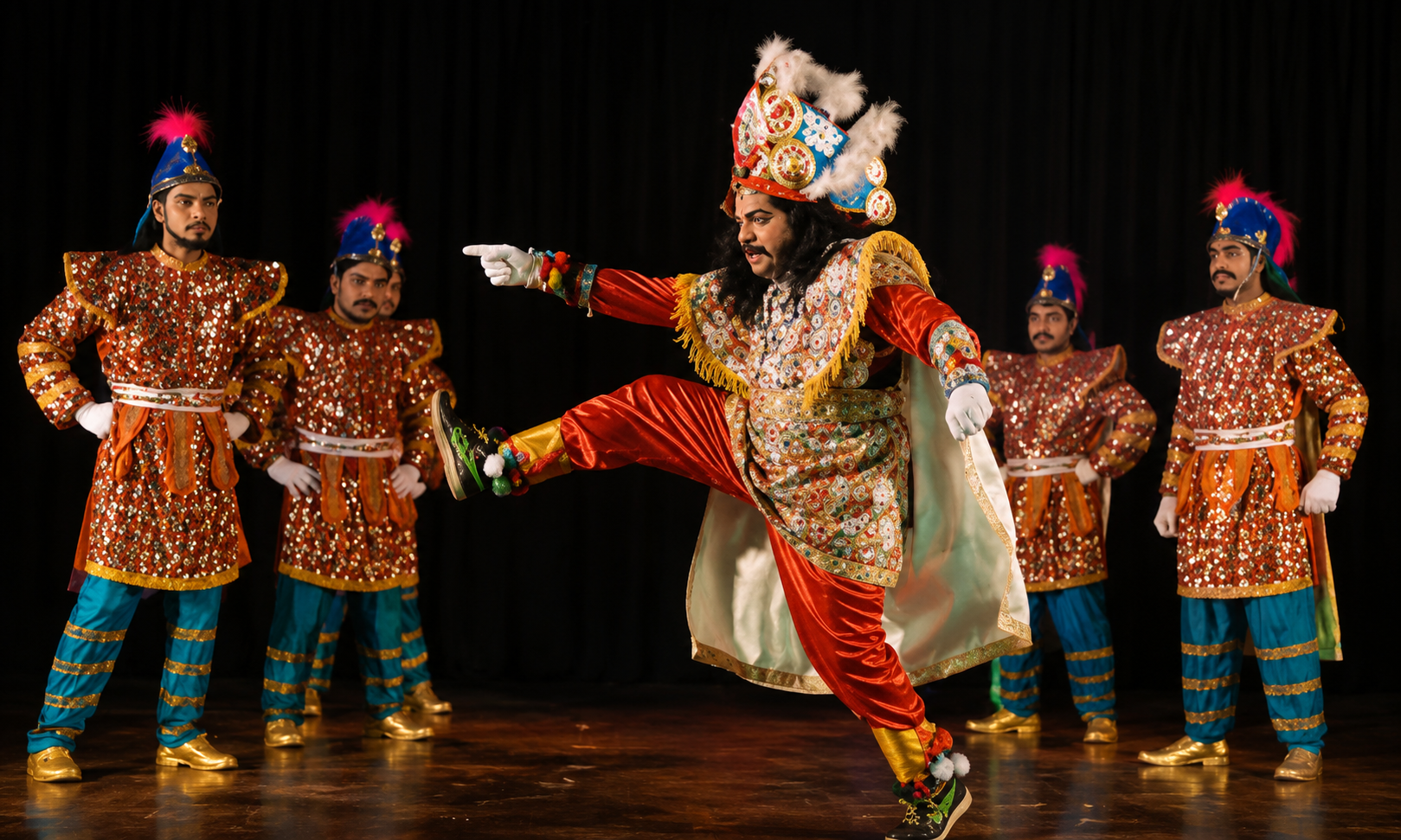
As night falls over the coastal churches and village grounds of Kerala, a wooden stage begins to tremble under the force of stamping feet. Drums thunder through the air. Actors dressed as European kings, warriors, ministers, and knights enter the stage wearing glittering crowns, royal robes, swords, and armor. Loud singing echoes through the performance space as dramatic battles, heroic speeches, and ancient stories unfold before the audience.
This is Chavittu Nadakam, one of Kerala’s most unique and visually spectacular traditional theatre art forms. Deeply connected to the Latin Christian communities of coastal Kerala, Chavittu Nadakam combines theatre, dance, martial movements, music, storytelling, and rhythmic foot stamping into a dramatic performance tradition unlike anything else in India.
The art form reflects a remarkable cultural fusion shaped by Kerala’s coastal history, Portuguese influence, Tamil theatrical traditions, Christian storytelling, and local performance culture.
Even today, Chavittu Nadakam remains one of Kerala’s rarest and most fascinating folk theatre traditions, carrying centuries of cultural memory through rhythm, performance, and spectacle.
What is Chavittu Nadakam?
The name “Chavittu Nadakam” literally means “Stamping Drama.”
The word “Chavittu” refers to stamping the feet forcefully, while “Nadakam” means drama or theatre. Foot stamping is one of the most important features of the performance and gives the art form its powerful visual and rhythmic identity.
Chavittu Nadakam combines several artistic elements together:
- Acting
- Singing
- Dance
- Martial movements
- Storytelling
- Rhythmic stamping
The performers sing their dialogues loudly in dramatic operatic style while moving energetically across the stage. Sword fights, battle scenes, royal processions, and exaggerated gestures make the performance highly theatrical and visually intense.
Many people compare Chavittu Nadakam to European opera because of its musical storytelling and grand dramatic presentation. Yet despite these foreign influences, the art form remains deeply rooted in Kerala’s local culture and performance traditions.
It is this unique fusion of Kerala and European theatrical styles that makes Chavittu Nadakam so culturally remarkable.
Origin and History
Chavittu Nadakam originated in the coastal regions of Kerala, especially around:
- Fort Kochi
- Mattancherry
- Kodungallur
- Kollam
The art form developed mainly among Kerala’s Latin Catholic communities during the period of Portuguese influence along the Malabar Coast.
Portuguese missionaries and traders brought Christian stories, European music traditions, and theatrical influences to Kerala. Over time, local communities blended these influences with Kerala’s indigenous performance traditions, martial arts, and storytelling culture.
Tamil artists and scholars also played an important role in shaping the art form. One of the most important names associated with Chavittu Nadakam is Chinnathambi Annavi, who helped structure many famous plays.
The language used in Chavittu Nadakam became a mixture of Malayalam and Tamil, reflecting the cultural interactions of coastal Kerala communities.
One of the most famous traditional plays is Karalman Charitham, based on the story of Charlemagne, the legendary European emperor. Through such heroic stories, Chavittu Nadakam became especially popular among Latin Catholic communities stretching from Kodungallur to Kollam.
Performance Style
A Chavittu Nadakam performance is loud, energetic, dramatic, and visually overwhelming.
Traditionally, performances take place on open-air wooden stages known as “Thattu.” These stages are specially built to amplify the sound of the performers’ stamping feet.
The loud stamping creates a rhythmic thunder that becomes part of the performance itself. In fact, a Chavittu Nadakam performance is often considered successful if the stage shakes strongly or even partially breaks under the force of the stamping.
The acting style is exaggerated and theatrical. Kings enter proudly with swords and crowns. Warriors perform dramatic battle scenes. Ministers and comic characters deliver loud dialogues filled with emotion and energy.
Sword fights and martial movements show strong influence from Kalaripayattu, Kerala’s ancient martial art tradition.
The performances usually continue for several hours, creating an atmosphere filled with music, rhythm, heroism, and excitement.
For audiences, Chavittu Nadakam feels less like watching a play and more like witnessing a grand historical spectacle.
Costumes and Makeup
One of the most striking features of Chavittu Nadakam is its elaborate costume design.
The performers wear glittering costumes inspired by European royal and military attire. These include:
- Crowns
- Helmets
- Armor
- Swords
- Royal robes
- Decorative shields
The costumes often resemble Greco-Roman or medieval European styles rather than traditional Kerala clothing, making Chavittu Nadakam visually distinct from most other Kerala art forms.
Bright colors, heavy decorations, and shining ornaments create a dramatic stage appearance that immediately captures audience attention.
Makeup is equally bold and theatrical. Actors use exaggerated facial expressions, painted details, and strong visual styling to portray kings, warriors, saints, villains, and comic characters.
Together, the costumes and makeup transform the performance into a spectacular visual experience filled with grandeur and theatrical intensity.
Music and Instruments
Music plays a powerful role in Chavittu Nadakam.
The rhythm of drums combines with the performers’ stamping movements to create dramatic tension and excitement throughout the performance.
Important instruments used include:
- Chenda
- Maddalam
- Elathalam
- Patathamper
- Bells and traditional drums
The loud musical atmosphere supports battle scenes, royal entrances, emotional moments, and dramatic storytelling.
The combination of percussion, singing, and stamping creates an intense theatrical rhythm rarely seen in other Kerala folk arts.
Important Characters and Roles
Chavittu Nadakam includes several traditional character roles that help shape the performance.
- Katiyakaran
The Katiyakaran is often a comic or supporting character who interacts with audiences and adds humour to the story.
- Rajavu
The Rajavu, or king, is usually portrayed as heroic, powerful, and dramatic. Royal characters are central to many Chavittu Nadakam stories.
- Minister
The minister supports the king and often appears in political or war-related scenes.
- Female Characters
Traditionally, female roles were performed by men, following older theatre customs common in many traditional art forms.
- Annavi
The Annavi is the master, trainer, or director responsible for teaching performers, organizing rehearsals, and preserving the art form.
Famous Stories and Plays
Chavittu Nadakam performances are known for heroic storytelling and grand dramatic themes.
Many stories are based on:
- Biblical narratives
- Christian saints
- European kings and warriors
- Historical legends
Some famous traditional plays include:
- Carelman Charitham
- Brijeena Charitham
- St. Sebastian
- Daveedhum Goliyathum
- Mahanaya Alexander
Stories of bravery, sacrifice, war, faith, and heroism became central to the art form because audiences deeply connected with powerful characters and dramatic narratives.
The performances turned historical and religious stories into emotionally intense public spectacles.
Cultural Importance and Present Condition
Chavittu Nadakam is culturally important because it represents one of the clearest examples of Kerala’s multicultural heritage.
The art form beautifully combines:
- Kerala folk traditions
- Christian storytelling
- Portuguese influence
- Tamil theatrical culture
- Martial performance techniques
For Kerala’s Latin Christian communities, Chavittu Nadakam remains a symbol of identity, memory, and cultural pride.
However, the art form has declined over time because of changing entertainment habits, reduced funding, and the difficulty of maintaining large traditional productions.
Today, only a small number of artists and cultural organizations continue to preserve the tradition through festivals, research projects, and heritage performances.
Despite its decline, Chavittu Nadakam still attracts strong interest from researchers, tourists, theatre enthusiasts, and cultural historians because of its uniqueness and spectacular visual style.
Conclusion
As the sound of stamping feet shakes the wooden stage and drums echo through Kerala’s coastal night, Chavittu Nadakam brings together centuries of history, faith, theatre, and cultural exchange in one unforgettable performance.
It stands as a living symbol of Kerala’s multicultural artistic heritage, where local traditions blended with European influences to create something entirely unique.
More than just a folk drama, Chavittu Nadakam is a powerful reminder of the creativity and diversity of Kerala’s coastal communities.
Protecting and preserving this rare art form is important not only for Kerala’s Latin Christian heritage, but also for the future of India’s traditional performance culture itself.
For anyone interested in Kerala’s hidden cultural treasures, witnessing Chavittu Nadakam is an experience filled with rhythm, spectacle, history, and wonder.