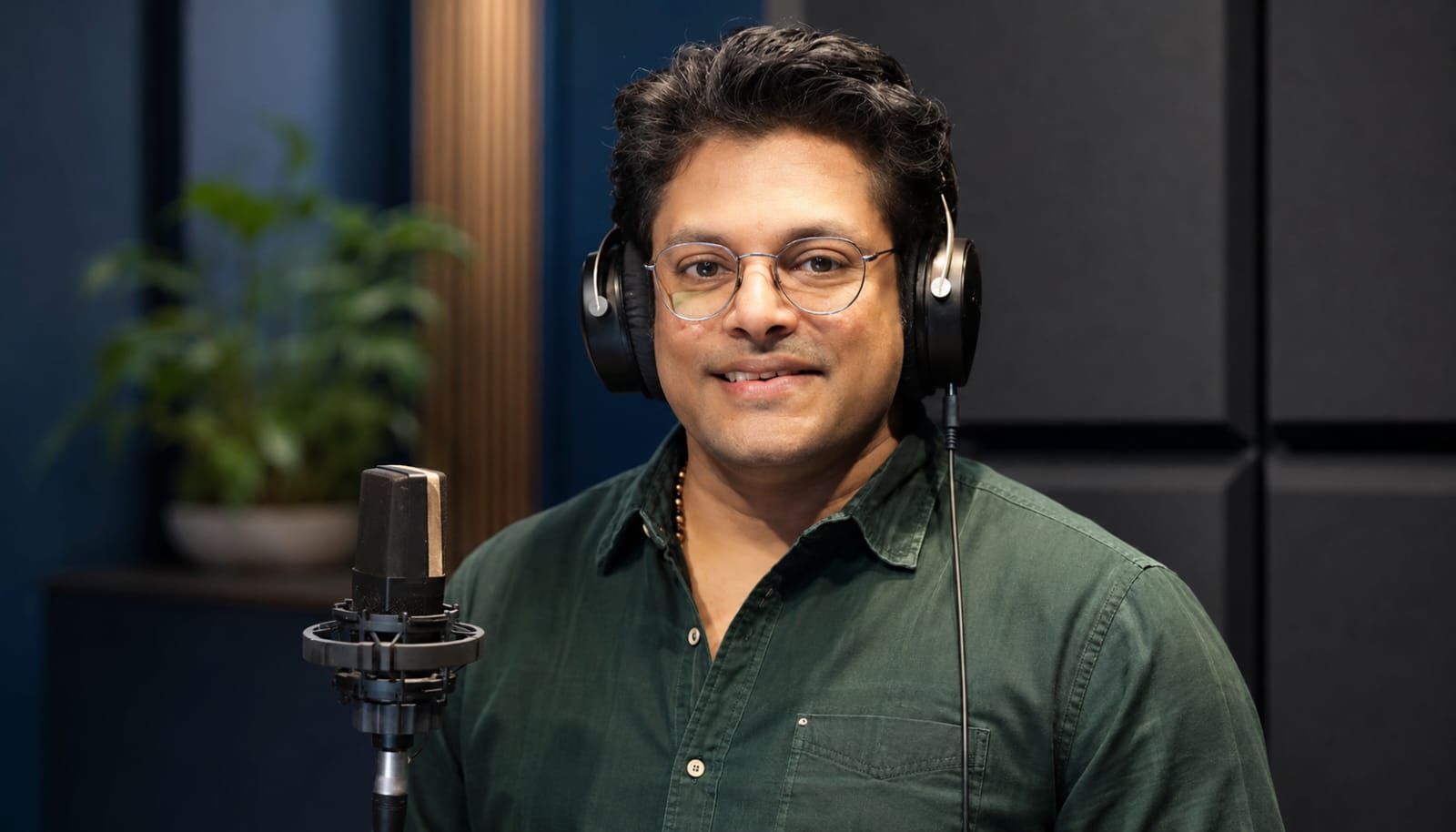
Madhu Balakrishnan
Playback singer
Madhu Balakrishnan is an Indian playback singer who primarily sings in Malayalam. He has also sung songs in Tamil, Telugu, Kannada languages. He has sung over 10 thousand songs in films and several devotional albums. Madhu Balakrishnan was born in Paravur in Eranakulam. His earlier life was at Koratty, near Chalakudy, Thrissur. He completed his schooling in Mar Augustine Memorial Higher Secondary School, Koratty. He was inspired by his mother to take up music. Later he shifted to Paravur, his native place. He is married to Divya, elder sister of Indian cricketer S.Sreesanth.
Key Facts
Full Name: Madhu Balakrishnan
Date of Birth: 24 June 1974
Birthplace: Paravur, Ernakulam, Kerala
Occupation: Playback Singer
There are singers whose voices dominate the airwaves, and there are singers whose voices quietly enter people’s emotional lives. Madhu Balakrishnan belongs unmistakably to the second category. For more than two decades, his music has drifted through Malayalam cinema halls, temple loudspeakers at dawn, television serial title tracks, long-distance bus journeys, family gatherings, and late-night FM radio programs, becoming part of Kerala’s emotional soundscape itself.
With a voice steeped in softness, devotional warmth, and classical restraint, Madhu Balakrishnan emerged as one of the defining melody singers of modern Malayalam cinema. While he also built a respected presence in Tamil, Telugu, and Kannada music industries, it was in Malayalam that his voice found its deepest emotional connection. Whether singing aching romantic melodies, devotional hymns, or reflective lullaby-like compositions, he carried an unmistakable sincerity that listeners instinctively trusted.
Over the years, he sang thousands of songs across films and devotional albums, collaborated with some of South India’s finest composers, and evolved into a familiar television personality admired for humility as much as musical brilliance.
From devotional dawn hymns to timeless film melodies, Madhu Balakrishnan became one of South India’s most emotionally resonant playback singers, an outstanding voice that quietly shaped the musical memory of a generation.
The Boy Who Grew Up Listening Before Singing
Before audiences knew the singer, there was a boy moving between Paravur and Koratty, carrying within him the quiet atmosphere of Kerala’s middle-class musical households.
Madhu Balakrishnan was born on 24 June 1974 to Balakrishnan and Leelavathy in Paravur, though much of his early life unfolded in Koratty near Chalakudy in Thrissur district. The Kerala of his childhood was deeply musical in invisible ways. Music lived in temples, church festivals, radio broadcasts, school youth festivals, and cassette tapes circulating through neighborhoods. Playback singers were not distant celebrities; their voices were woven into everyday domestic life.
For Madhu, music arrived first through his mother.
He has often acknowledged the role she played in nurturing his musical instincts. In many South Indian households, mothers become the earliest custodians of artistic encouragement, quietly recognizing talent before the world notices it. That emotional grounding would remain visible throughout Madhu Balakrishnan’s career. Even at the height of his popularity, there was little theatrical flamboyance around him. His singing retained the emotional modesty of someone shaped by intimate listening rather than aggressive performance culture.
He studied at Mar Augustine Memorial Higher Secondary School in Koratty, growing up in an environment where school arts festivals and local music competitions often served as gateways into professional music. Long before reality television created overnight stars, Kerala’s cultural ecosystem quietly trained generations of singers through temple stages, orchestra troupes, and amateur competitions.
Madhu belonged to that tradition.
Finding a Place in Malayalam Playback Music
The Malayalam music industry of the late 1990s was undergoing transition.
The towering era of Yesudas still dominated emotionally, while singers like M. G. Sreekumar, Jayachandran, and Unni Menon occupied major spaces in film music. Composers were experimenting with softer orchestration and melody-heavy arrangements even as Tamil cinema’s increasingly electronic sound began influencing the South Indian industry.
Into this environment entered Madhu Balakrishnan.
His early songs did not arrive with dramatic fanfare. Instead, listeners gradually began noticing a voice marked by unusual gentleness and emotional clarity. There was devotional softness in his tonal texture, but also cinematic adaptability.
One of his early Malayalam songs, “Kanakasabathalam” from Udayapuram Sulthan in 1999, announced a singer comfortable with melody-driven composition. Soon came opportunities with respected composers and lyricists including Kaithapram Damodaran Namboothiri, Johnson Master, Vidyasagar, and M. Jayachandran.
What distinguished Madhu from many contemporaries was not vocal aggression or technical showmanship. It was emotional phrasing.
His singing rarely sounded performative. Instead, it felt conversational, intimate, almost inward.
That quality made him especially effective in romantic melodies and devotional songs.
The Rise of a Melodic Identity
Malayalam cinema audiences have historically shared a deep emotional relationship with melody. Songs are often remembered less for spectacle and more for emotional recall, a rain-soaked bus journey, a heartbreak, a family memory, a late-night television rerun.
Madhu Balakrishnan’s voice entered exactly that emotional territory.
Songs like “Chentharmizhi” from Perumazhakkalam became deeply associated with melancholy and longing. Composed by M. Jayachandran, the song demonstrated Madhu’s ability to sustain emotional intensity without oversinging.
Then came songs such as “Manchadi Mazha” from Rock N’ Roll, where his voice carried nostalgic warmth with almost lullaby-like softness.
Years later, “Mukhiluthodanay” from Home introduced him to younger listeners again. The song resonated strongly because it captured something increasingly rare in contemporary playback singing, emotional restraint.
His collaborations with composers like Vidyasagar and Ilaiyaraaja further expanded his artistic range. Vidyasagar particularly understood how to use Madhu’s voice for tenderness and lyrical flow, while Ilaiyaraaja utilized its devotional and classical depth.
Unlike singers built around vocal flamboyance, Madhu Balakrishnan specialized in emotional immersion.
Listeners believed the feelings inside his songs.
Crossing Languages Without Losing Identity
Many Malayalam playback singers who entered Tamil or Telugu industries had to alter their singing style dramatically. Madhu Balakrishnan adapted linguistically without abandoning emotional sincerity.
Tamil cinema gave him some of his most remembered songs.
“Pichai Paathiram” from Naan Kadavul remains one of the defining devotional film songs of modern Tamil cinema. Composed by Ilaiyaraaja, the song demanded spiritual vulnerability rather than technical excess. Madhu’s rendition carried precisely that haunting humility.
Then there was “Vaa Vaa En Devathaiye” from Abhiyum Naanum, a deeply emotional father-daughter song that became culturally beloved among Tamil audiences.
Songs like “Piraye Piraye,” “Kana Kandenadi,” and “Sollitharava” demonstrated his flexibility across romance, melancholy, and melody-centric mainstream cinema.
In Telugu and Kannada industries too, his voice found recognition, though often within selective melodic compositions rather than mass commercial tracks.
What remained constant was emotional honesty.
Even when singing across languages, the emotional signature of Madhu Balakrishnan stayed unmistakably intact.
Devotional Music and the Sacred Familiarity of His Voice
If cinema made Madhu Balakrishnan popular, devotional music made him emotionally indispensable to many Malayali households.
Few modern singers have navigated devotional music with such sustained consistency.
Kerala’s devotional listening culture is unique. Devotional songs are not restricted to temples or festivals. They accompany morning routines, pilgrimages, family prayers, and television serials. A singer entering that space becomes part of domestic emotional memory itself.
Madhu’s voice carried spiritual softness naturally.
Songs like “Amme Amme” became deeply cherished among listeners seeking emotional intimacy rather than grand devotional dramatics. His devotional albums and television title tracks expanded this connection further.
From Swami Ayyappan to Sreekrishna Leela and Sathyam Shivam Sundaram, his voice became inseparable from Kerala’s devotional television culture.
There was a prayer-like quality in his tonal delivery. He rarely forced emotion; instead, he allowed stillness and melody to carry spiritual weight.
That quality earned him immense affection among family audiences and older listeners who valued emotional sincerity over commercial spectacle.
Television, Mentorship, and a New Generation
By the late 2010s, reality television had transformed South Indian music culture. Playback singers increasingly became judges, mentors, and public personalities.
Madhu Balakrishnan transitioned into this role gracefully.
Shows like Top Singer and Sa Re Ga Ma Pa Keralam introduced him to younger audiences not merely as a singer, but as a mentor.
Unlike judges who cultivated dramatic television personas, Madhu projected calmness and emotional generosity. Young contestants often appeared visibly comfortable around him.
That demeanor reflected his larger musical identity.
In an increasingly competitive entertainment culture, he retained an old-world gentleness.
The Texture of a Voice
Technically, Madhu Balakrishnan’s singing carries clear classical influence, especially in breath control, gamaka precision, and sustained melodic phrasing.
But technical analysis alone cannot explain his popularity.
His greatest strength lies in emotional modulation.
He understands melancholy intimately. He understands devotional surrender. He understands tenderness.
His voice does not dominate orchestration aggressively. Instead, it settles into compositions with quiet emotional persistence. That made him particularly suited for the melody-rich era shaped by composers like Vidyasagar and M. Jayachandran.
In many ways, Madhu represents the continuation of melody-centric South Indian playback culture at a time when high-energy commercial music increasingly dominated cinema.
A Life Away from Noise
Away from recording studios and television sets, Madhu Balakrishnan has largely maintained a private personal life.
He is married to Divya, the sister of Indian cricketer S. Sreesanth, and the couple has two sons, Madhav and Mahadev.
Despite public recognition, he has rarely cultivated celebrity theatrics. That restraint perhaps explains why audiences continue to perceive him as emotionally authentic.
There is very little distance between the gentleness in his singing and the gentleness in his public image.
A Voice That Still Feels Like Home
South Indian playback music has changed dramatically over the past two decades. Musical trends have shifted, orchestration styles have evolved, and digital culture has transformed listening habits. Yet certain voices survive these changes because they are tied not merely to songs, but to emotional memory itself.
Madhu Balakrishnan’s voice belongs to that category.
Whether through film melodies, devotional hymns, television title tracks, or reality-show mentorship, he built a musical identity rooted in emotional trust. He never relied on flamboyance or manufactured mystique. Instead, he became the singer audiences turned to when they wanted sincerity, tenderness, and spiritual warmth.
In Malayalam cinema especially, his songs continue to live quietly inside everyday life, played during long drives, temple festivals, family evenings, and moments of private reflection.
And perhaps that is the truest measure of his legacy. Madhu Balakrishnan did not simply sing songs. He became an outstanding emotional presence within the cultural soundscape of South India, a voice that still feels, unmistakably, like home.
Awards
2002 – Kerala State Film Award for Best Singer for the song “Amme Amme” from the film Valkannadi
2006 – Tamil Nadu State Film Award for Best Male Playback Singer
2007 – Kalaimamani award for excellence in music, dance, cinema and art conferred by the Tamil Nadu state government.
2008 -Asianet Television Awards for Best Singer – Swamy Ayyappan
2011 -Asianet Television Awards for Best Singer- Devimahatmyam
2017 – Honorary Doctorate from The International Tamil University, USA
2024 – Film Critics Award
Best playback singer Male (Malayalam) for kanchana kannezhuthi song from movie Njanum pinne oru njanum by Rajasenan