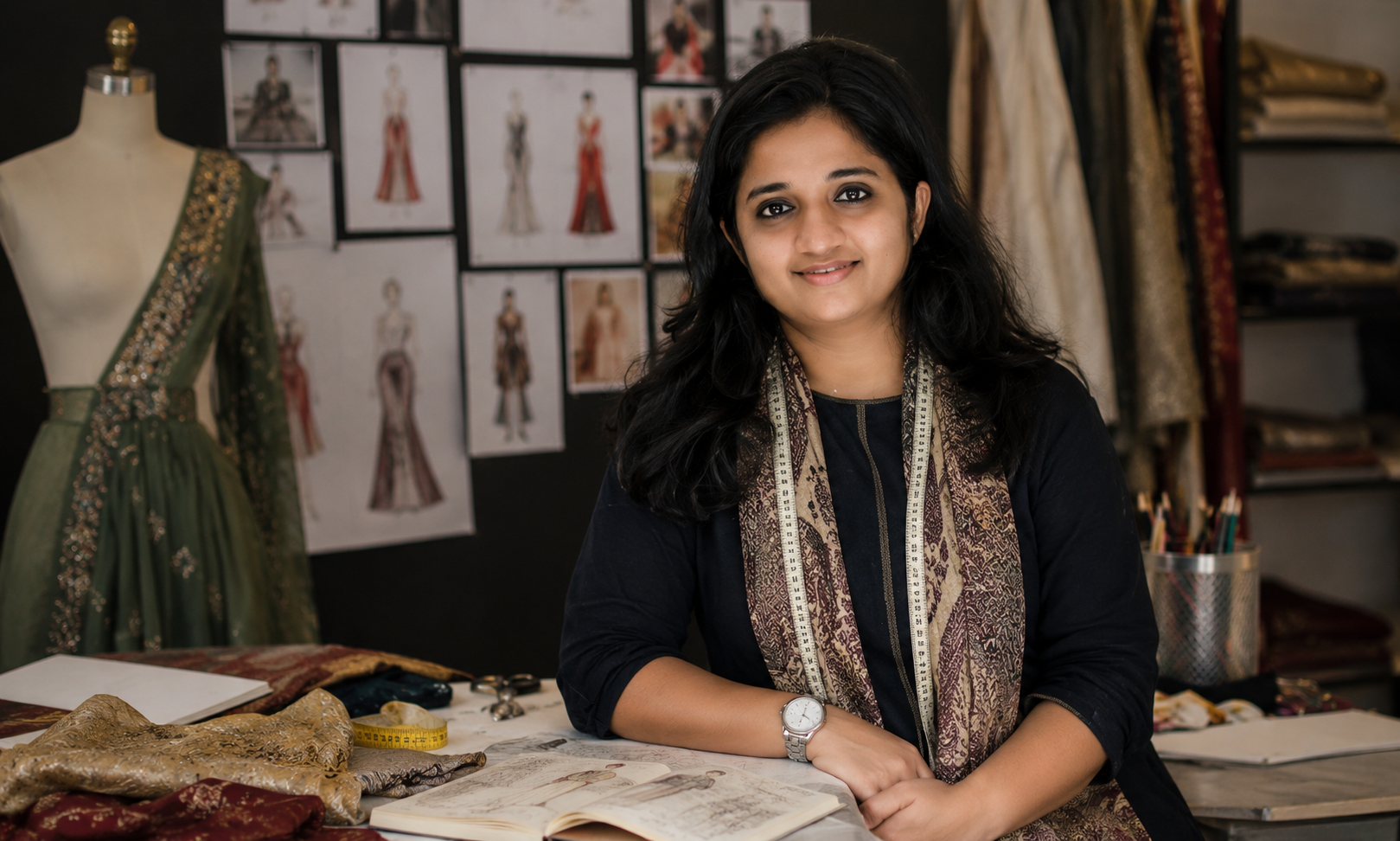
Sameera Saneesh
Costume-cum-Fashion Designer
Sameera Saneesh is an Indian costume-cum-fashion designer from Kerala, known for her extensive work in Malayalam-language films. She is a recipient of three Kerala State Film Awards for Best Costume Designer (2014,2018 and 2025). As of March, 2019, she has been part of around 150 feature films. She is often described by the media as “busiest costume designer in Malayalam film industry”.
Key Details
Full Name: Sameera Saneesh
Date of Birth: 27 June 1983
Birthplace: Kerala, India
Profession: Costume Designer and Fashion Designer
Industry: Malayalam and South Indian Cinema
Years Active: 2000s–present
Major Awards: Kerala State Film Award for Best Costume Designer (2014, 2018, 2025)
On a crowded Malayalam film set, costume racks often become silent maps of character psychology. A faded checked shirt hanging beside a carefully distressed mundu can reveal more about a man’s emotional exhaustion than pages of dialogue. A soft cotton kurta in muted earth tones can quietly establish a woman’s social class, inner restraint, or emotional loneliness before she even speaks. Few designers in Malayalam cinema understand this visual language as instinctively as Sameera Saneesh.
Inside production caravans and costume trial rooms across Kerala’s film industry, Sameera became known not merely as a stylist but as a storyteller working through fabric, texture, colour, and realism. Over the last two decades, her work has helped shape the visual identity of modern Malayalam cinema, particularly during its transition toward intimate realism and emotionally grounded storytelling. From the understated authenticity of Maheshinte Prathikaaram to the layered social textures of Kumbalangi Nights and the haunting atmospheres of Rorschach, her costumes rarely scream for attention. Instead, they quietly become part of the emotional architecture of a film.
A three-time Kerala State Film Award winner and one of the busiest costume designers in South Indian cinema, Sameera Saneesh occupies a rare space in Malayalam cinema where artistic intuition meets relentless discipline. Her journey from sketchbooks and fabric painting in Kochi to designing for more than 150 films is also the story of how costume design itself evolved from decorative glamour into an outstanding narrative craft within Malayalam filmmaking.
Early Life and Creative Beginnings
Sameera Saneesh grew up in Kerala during a period when fashion design was not yet widely recognized as a major cinematic profession. In many middle-class Malayali households, artistic ambition often existed quietly beside practical expectations. But creativity entered her life early through drawing, colour experimentation, and fabric painting.
Born to Ibrahim and Jameela, Sameera has frequently spoken about the emotional influence of her mother, whose encouragement shaped both her confidence and artistic instincts. Long before costume design became a profession, she was already developing sensitivity toward texture, colour combinations, and visual detail.
Kerala itself became part of her visual education.
The state’s layered aesthetic culture, starched cotton sarees, gold-bordered kasavu fabrics, crowded textile stores, monsoon colours, church festivals, Muslim wedding attire, and urban-rural contrasts later influenced the realism visible in her film work. Unlike designers drawn exclusively toward glamour, Sameera became interested in how ordinary people dressed and how clothing reflected personality, geography, class, and emotion.
After studying at Bharat Mata College in Kochi, she pursued a diploma in fashion designing from the National Institute for Fashion Designing in Cochin. At the time, fashion education in Kerala was still evolving, and costume design for cinema remained largely under-recognized.
But Sameera already understood something important: cinema costumes were not merely clothes. They were visual storytelling tools.
Entering the World of Fashion and Advertising
Before cinema, advertising became her training ground.
She began her professional career as an in-house designer for Raymond. The experience introduced her to the structured discipline of commercial fashion, fabric understanding, production timelines, and consumer aesthetics.
Simultaneously, she started freelancing for advertisement films while still studying in Kochi. Television commercials during the 2000s played a crucial role in South Indian visual culture. Jewellery brands, textile chains, and lifestyle campaigns demanded cinematic glamour combined with regional familiarity.
Sameera quickly adapted.
Her work for brands such as Soundarya Silks, Seemas, Bhima, Alukkas, Kalyan Silks, Nirapara, Dhatri, and VKC brought her into larger production environments. The widely appreciated Seemas commercial shot inside Mysore Palace particularly strengthened her visibility within the industry.
Advertising also sharpened her understanding of screen presence.
Actors like Nithya Menen and Prithviraj Sukumaran appeared in several campaigns she worked on, giving her experience balancing branding, glamour, lighting, and costume functionality for camera.
Commercials demanded speed, precision, and adaptability. Costume designers often had to build entire visual worlds within short schedules. That pressure would later help Sameera survive Malayalam cinema’s demanding production pace.
Breakthrough in Cinema
Her first film as a costume designer was The White Elephant, directed by Aijaz Khan. Though relatively low-profile, the project marked her formal entry into cinema.
The real breakthrough arrived with Daddy Cool, directed by Aashiq Abu. Malayalam cinema during this period was entering a stylistic transition. Younger filmmakers were rejecting overly theatrical visual aesthetics and moving toward realism, urban textures, and character-driven narratives.
Sameera’s instincts aligned perfectly with that shift.
Instead of relying on excessive glamour or stylized costume presentation, she approached characters psychologically. Clothes had to feel lived-in. Shirts needed wrinkles. Footwear had to reflect social reality. Fabrics needed emotional authenticity.
That approach gradually distinguished her from conventional commercial styling.
Over time, directors began trusting her not merely to “dress actors,” but to help visually construct characters.
Redefining Costume Design in Malayalam Cinema
The evolution of Malayalam cinema after the late 2000s demanded a new visual realism. Films became more intimate, geographically rooted, and socially observational. Costume design suddenly mattered in deeper ways.
Sameera became one of the defining designers of that cinematic movement.
In Maheshinte Prathikaaram, the clothing reflected the rhythms of small-town Kerala without appearing artificially curated. Characters dressed like people audiences genuinely recognized from Idukki towns and middle-class households. Nothing looked excessively cinematic.
That realism required enormous technical discipline.
In Mayaanadhi, costumes subtly captured emotional deterioration, urban loneliness, and intimacy. In Thondimuthalum Driksakshiyum, the wardrobe design blended invisibly into the realism of the narrative, allowing performances to feel documentary-like.
Perhaps one of the strongest examples of her work emerged in Kumbalangi Nights. The film’s costume language became inseparable from its emotional world. The disorganized clothing of the brothers, the carefully controlled appearance of Shammi, and the natural textures of the women’s costumes all reflected psychology, masculinity, vulnerability, and class identity.
In films like Virus and Beeshma Parvam, she balanced realism with cinematic sophistication. The costumes never distracted from storytelling, yet they deepened atmosphere and emotional tone.
This became Sameera’s signature strength: invisibly powerful costume design.
The Work Ethic Behind the Success
Malayalam cinema operates on speed. Productions move quickly, schedules shift unexpectedly, and costume departments often work under intense logistical pressure.
Sameera built her reputation through relentless consistency.
At one stage, she became so prolific that media outlets described her as the busiest costume designer in Malayalam cinema. The Limca Book of Records recognized her for designing costumes for a remarkably high number of films within a short span.
Behind that visibility exists an enormous operational structure.
She reportedly works with a team of around 25 people handling stitching, sourcing, fittings, continuity, and costume maintenance. Managing multiple films simultaneously requires not only creativity but industrial-level organization.
Each script demands research.
A character from coastal Kochi cannot dress like someone from Malabar. A police officer’s shirt texture matters differently from that of a migrant labourer or urban architect. Costume continuity across shooting schedules becomes critical to cinematic realism.
Directors increasingly rely on costume designers during early script discussions because costumes now influence cinematography, production design, and performance dynamics.
Sameera’s success came not only from artistic skill, but from surviving this exhausting ecosystem with remarkable reliability.
Collaborations and Industry Reputation
Malayalam cinema is heavily collaborative, and long-term trust between directors and technicians shapes many creative breakthroughs.
Over the years, Sameera developed strong working relationships with filmmakers associated with Malayalam cinema’s realism-driven renaissance. Directors appreciated her ability to understand narrative tone quickly and translate emotional atmosphere visually.
Actors, too, trusted her instincts.
In realistic cinema, performers often depend on costumes to emotionally enter characters. Sameera’s wardrobe choices helped actors inhabit ordinary lives without appearing artificially styled.
Her filmography now stretches across an extraordinary range of genres: psychological dramas, political thrillers, family narratives, urban romances, period textures, and commercial entertainers.
Few costume designers in Malayalam cinema have shaped so many visually distinct worlds.
Awards and Recognition
Recognition eventually followed scale and consistency.
Sameera Saneesh won the Kerala State Film Award for Best Costume Designer multiple times, including in 2014, 2018, and 2025. But her importance extends beyond awards themselves.
She helped elevate costume design into a respected narrative craft within Malayalam cinema.
Earlier generations often treated costume departments as secondary production units. Contemporary Malayalam filmmaking, however, increasingly recognizes costume design as central to realism and character construction.
Sameera played a major role in that shift.
Film critics, audiences, and industry observers gradually began discussing costumes not merely as glamour tools but as cinematic language.
Signature Style and Fashion Philosophy
Unlike mainstream commercial styling focused heavily on spectacle, Sameera’s aesthetic philosophy prioritizes emotional truth.
Minimalism defines much of her work.
She frequently uses muted palettes, naturally worn textures, region-specific fabrics, and carefully controlled colour psychology. Her costumes rarely overpower performances. Instead, they quietly reinforce character identity.
The influence of celebrated designer Sabyasachi Mukherjee, whom she has openly admired, appears less in overt visual imitation and more in respect for texture, fabric storytelling, and cultural rootedness.
Yet Sameera’s cinematic language remains distinctly her own.
In Malayalam cinema, realism itself became a form of sophistication, and Sameera understood that earlier than many others.
Influence on Malayalam Cinema and Future Legacy
The rise of realism-driven Malayalam cinema during the last two decades required technicians capable of subtle visual storytelling. Sameera Saneesh became one of the defining contributors to that transformation.
Her work helped normalize authenticity.
Middle-class homes looked believable. Rural Kerala stopped appearing caricatured. Urban characters carried emotional texture through costume. Women characters increasingly dressed according to psychological realism rather than ornamental expectations.
At a broader level, her success also represents the growing visibility of women technicians in South Indian cinema. Costume departments were traditionally associated with women, yet leadership recognition often remained limited. Sameera transformed that perception through scale, professionalism, and creative authority.
Today, younger costume designers entering Malayalam cinema inherit an industry where costume design is taken seriously as cinematic craft partly because of artists like her.
And perhaps that remains her greatest contribution.
Across hundreds of films, audiences may not always consciously notice her work. But they believe the worlds they see onscreen because of it. That invisible credibility is the true measure of costume design at its highest level. In the evolving visual history of Malayalam cinema, Sameera Saneesh has already secured an outstanding legacy, not through spectacle alone, but through her rare ability to make characters feel completely, emotionally real.