Bhagyalakshmi
Dubbing Artist, Actress & Activist
Bhagyalakshmi is an Indian actress, activist, and dubbing artist. She works predominantly in the Malayalam film industry. She has collaborated with several actresses from Malayalam industries as well as other south Indian languages including Shobana, Revathi, Urvashi, Soundarya, Tabu and Jyothika. Bhagyalakshmi’s autobiography, Swarabhedangal, was awarded the Kerala Sahitya Akademi Award for Biography and Autobiography.
Key Facts
Name: Bhagyalakshmi
Born: 1 November 1961 (age 64)
Place: Kozhikode, Kerala, India
Occupations: Dubbing artist, Actress, Activist
Years active: 1972–present
There are voices that audiences remember, and there are voices they unknowingly carry for a lifetime. In Kerala, generations grew up hearing Bhagyalakshmi without always seeing her face. Her voice moved through dark cinema halls, television reruns, cassette-era melodramas, and emotionally charged family films, shaping the emotional identities of some of Malayalam cinema’s most beloved heroines. It carried the fragility of heartbreak, the warmth of affection, the sharpness of anger, and the elegance of restraint. For decades, audiences associated actresses like Shobana, Revathi, Urvashi, Soundarya, Tabu, and Jyothika with emotions that often emerged through Bhagyalakshmi’s modulation and timing.
But her life story extends far beyond dubbing studios. Actress, author, activist, television personality, and public intellectual, Bhagyalakshmi evolved into one of Kerala’s most outspoken and emotionally complex cultural figures. Her autobiography, Swarabhedangal, which received the Kerala Sahitya Akademi Award, revealed not merely the story of an artist, but of a woman negotiating abandonment, survival, fame, loneliness, and reinvention inside a society that often celebrated women onscreen while ignoring the labour behind the screen.
Her journey remains one of Malayalam cinema’s most outstanding stories of invisible artistry becoming cultural memory.
Early Life and Childhood Hardships
Bhagyalakshmi was born on November 1, 1961, in Kozhikode, Kerala, to Kumaran Nair and Bhargavi Amma. Childhood, however, arrived without the emotional safety most children depend upon. The loss of both parents at a young age left her confronting insecurity and emotional instability early in life. The experience would shape her personality permanently, creating within her both vulnerability and fierce self-reliance.
Kerala during the 1960s and 1970s was culturally vibrant but socially conservative. Cinema existed as a glamorous world on the surface, yet the industry behind it remained deeply hierarchical and unpredictable. For young girls entering film-related work, emotional and financial struggles were often inseparable from professional survival.
Bhagyalakshmi entered cinema not through dreams of stardom, but through necessity.
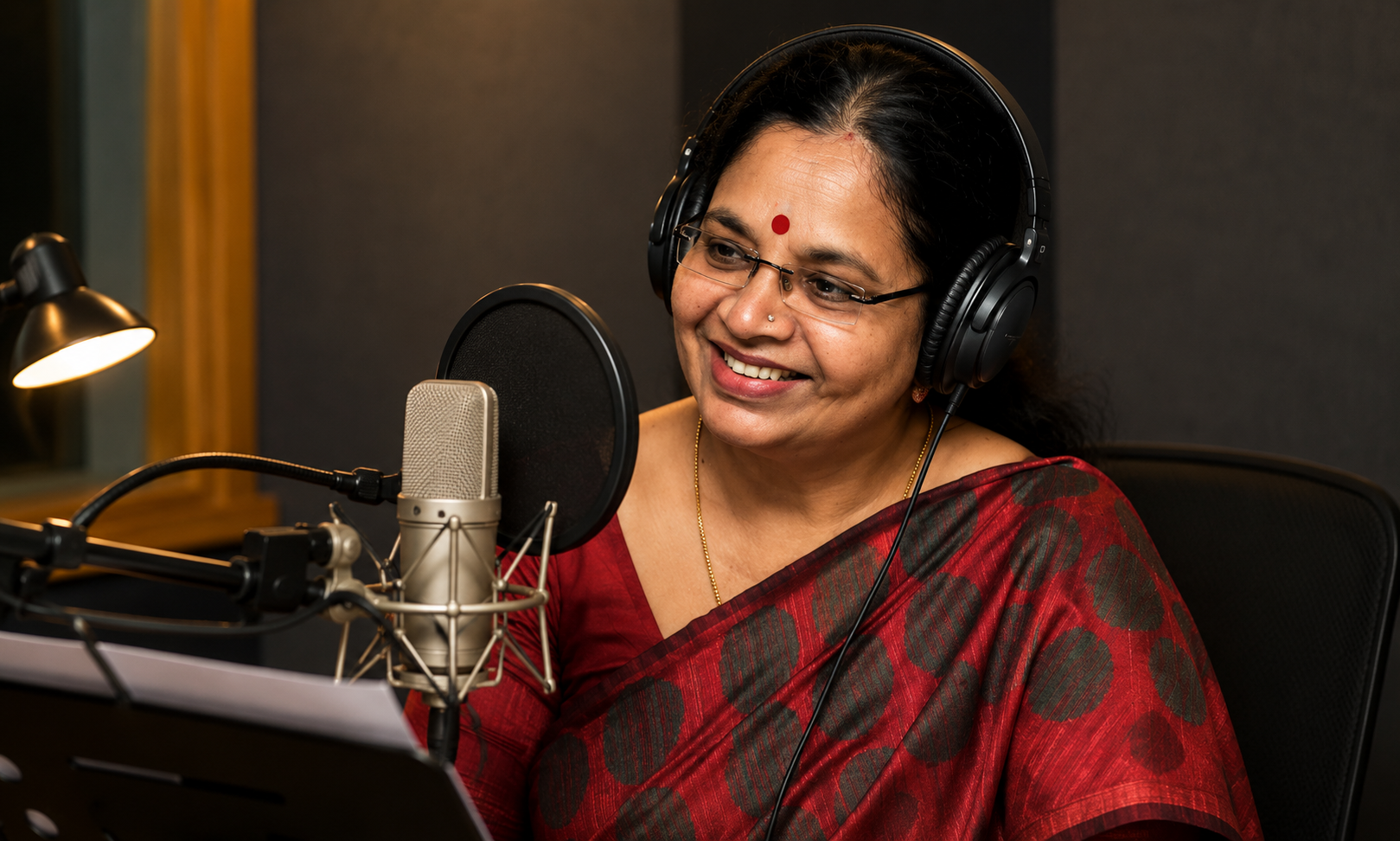
At the age of ten, she began working as a dubbing artist, lending her voice to child actors. What initially emerged as survival slowly evolved into a craft. Even while continuing her studies and completing her pre-university education, she remained connected to film studios, recording rooms, and production environments that became a second classroom.
There was no glamour in those early years. Dubbing artists occupied the invisible margins of cinema. Their names rarely appeared prominently. Audiences celebrated actors while voices remained anonymous.
Bhagyalakshmi learned early that invisibility could become both burden and strength.
Rise of a Voice Artist
Her early dubbing work throughout the late 1970s involved child performers and supporting actresses. Malayalam cinema at the time was entering a creatively transformative era. Filmmakers were experimenting with realism, emotional subtlety, and socially grounded storytelling. That cinematic shift increased the importance of believable voice performances.
Bhagyalakshmi possessed something directors immediately recognized: emotional precision.
Unlike theatrical dubbing styles common in earlier decades, her delivery felt natural, conversational, and emotionally lived-in. She understood pauses, breath patterns, and emotional rhythm. Her voice could soften without losing clarity. It could communicate pain without descending into melodrama.
Her breakthrough came through films like Kolilakkam, where she dubbed for actress Sumalatha, and later with Nokkethadhoorathu Kannum Nattu, which cemented her position within the industry.
Soon, her voice became inseparable from Malayalam cinema’s leading women.
In an industry where actresses often came from different linguistic backgrounds, dubbing artists became critical to emotional continuity. Bhagyalakshmi’s contribution extended beyond technical synchronization. She effectively co-created performances. Audiences emotionally connected to heroines through expressions shaped equally by visual acting and vocal interpretation.
Yet public recognition remained limited.
The paradox defined much of her career: millions recognized the voice, while few fully understood the artist behind it.
The Invisible Stardom of Dubbing Artists
For decades, dubbing artists in Indian cinema occupied an unusual space. They were essential but largely invisible. Their labour shaped cinematic realism, yet recognition flowed almost entirely toward actors appearing onscreen.
Bhagyalakshmi belonged to the generation that challenged this invisibility.
Her work gradually changed public perception about dubbing artistry itself. Malayalam cinema, particularly during the 1980s and 1990s, depended heavily on voice performance because emotional realism became central to storytelling. Directors increasingly demanded vocal authenticity alongside visual acting.
Bhagyalakshmi’s voice possessed remarkable adaptability. She could modify emotional texture according to the personality of the actress she dubbed for. Her performances never sounded mechanically imposed. Instead, they merged organically with the character.
That subtlety became her signature.
The Kerala State Film Awards eventually recognized her contribution three times through the Best Dubbing Artist award. But awards alone could not fully capture the cultural influence she carried.
In many ways, Bhagyalakshmi became part of Kerala’s emotional vocabulary.
Acting Career and Media Presence
Though primarily celebrated as a dubbing artist, Bhagyalakshmi also appeared in cinema and television. Her acting debut came through Manassu. Over time, she evolved into a familiar public personality through television interviews, cultural discussions, travel programs, and reality television.
Her travel-based program on Safari TV revealed another side of her personality: reflective, observant, and emotionally curious about people and places.
In 2021, her participation in Bigg Boss Malayalam Season 3 introduced her to a younger generation unfamiliar with her earlier cinematic legacy. Reality television exposed her outspoken personality, emotional intensity, and uncompromising communication style. Public reactions remained divided, but the program reinforced something long visible throughout her life: Bhagyalakshmi never comfortably fit into socially expected versions of silence.
Literary Journey and Swarabhedangal
If cinema revealed her professional journey, literature revealed her emotional history.
Her autobiography, Swarabhedangal, became one of Malayalam literature’s most discussed memoirs. The book received the Kerala Sahitya Akademi Award for Biography and Autobiography and also entered Nielsen’s bestseller listings, a rare achievement for a Malayalam-language work.
The autobiography resonated because of its honesty.
Rather than constructing a polished celebrity narrative, Bhagyalakshmi wrote openly about abandonment, loneliness, professional struggles, emotional trauma, marriage, motherhood, and personal breakdowns. Malayalam readers encountered not merely a public figure, but a deeply vulnerable human being attempting to understand her own life.
The title itself, meaning “variations of voice,” carried layered significance. Voice, in Bhagyalakshmi’s life, was never merely professional skill. It became identity, survival, resistance, and memory.
The memoir also expanded public understanding of the emotional cost carried by women in cinema industries often structured around invisibility and emotional labour.
Personal Life and Emotional Battles
Bhagyalakshmi married K. Ramesh Kumar in 1985. The couple had two sons, but the marriage eventually collapsed under emotional strain, leading to separation in 2011 and divorce in 2014.
Public women in Kerala, particularly those associated with cinema, frequently endure intense scrutiny regarding personal relationships. Bhagyalakshmi’s life became subject to media discussion and social commentary, often reducing complex emotional realities into simplified narratives.
Yet one of the defining aspects of her journey has been reinvention.
Instead of retreating completely from public life after personal upheavals, she remained professionally active, intellectually outspoken, and emotionally transparent about pain and recovery.
Her public image gradually evolved from voice artist to survivor.
Activism and Public Voice
Bhagyalakshmi’s outspoken nature increasingly positioned her within Kerala’s larger social and political debates. She became associated with women’s rights discussions, media debates, and conversations around misogyny and public accountability.
That activism became nationally controversial in 2020 during the Vijay P. Nair incident.
Along with activists Diya Sana and Sreelakshmi Arakkal, Bhagyalakshmi confronted the YouTube vlogger after he uploaded misogynistic and derogatory videos targeting women. The trio poured black motor oil on him during the confrontation, arguing that repeated police complaints had failed to produce meaningful action.
The incident triggered intense public debate.
Supporters viewed the act as a desperate protest against digital misogyny and institutional inaction. Critics condemned it as vigilantism and unlawful assault. Police subsequently charged the activists under multiple offences, including trespass and intimidation.
The controversy revealed the complexity of Bhagyalakshmi’s public identity. She had become more than an artist. She had become a cultural figure constantly negotiating anger, justice, gender politics, and public morality inside Kerala’s increasingly polarized media landscape.
Artistic Style and Professional Legacy
Bhagyalakshmi’s dubbing style remains distinctive because of emotional intelligence rather than theatrical exaggeration.
She understood silence.
Her performances rarely sounded artificially dramatic. Instead, they emphasized conversational realism, emotional rhythm, and psychological subtlety. She adapted vocal tone according to character background, social class, emotional state, and cinematic mood.
Malayalam cinema during its artistic peak years relied heavily on emotional authenticity. Bhagyalakshmi’s work became essential to that realism.
Younger dubbing artists continue to view her career as foundational. She demonstrated that voice acting demanded not only technical synchronization but also interpretive performance. In many films, her dubbing elevated characters beyond written dialogue.
Her contribution also altered industry perceptions about dubbing artists themselves. She became one of the few voice artists whose name audiences consciously recognized.
That visibility mattered historically.
Bhagyalakshmi and Kerala’s Cultural Memory
There are artists audiences admire, and there are artists who become embedded within collective memory almost invisibly.
Bhagyalakshmi belongs to the latter category.
For decades, Malayali audiences experienced love stories, heartbreaks, family conflicts, tragedies, and emotional climaxes through voices she helped shape. Her work existed inside living rooms, theatres, television broadcasts, and personal nostalgia.
Many viewers never consciously separated the actress from the voice.
That fusion itself became her cultural power.
At a deeper level, Bhagyalakshmi represents something important about cinema: the immense invisible labour hidden behind familiar performances. Dubbing artists, editors, sound engineers, writers, and technicians often remain outside celebrity culture despite fundamentally shaping audience experience.
Bhagyalakshmi forced Kerala to notice that hidden artistry.
Conclusion
The story of Bhagyalakshmi is ultimately about survival through voice. Not merely the literal voice that echoed through Malayalam cinema for decades, but the broader human voice that refused silence despite grief, invisibility, controversy, loneliness, and reinvention. Her life moved through recording studios, film sets, literary spaces, television debates, and public controversies with unusual emotional transparency.
She remains one of Kerala’s most culturally significant dubbing artists because her contribution extended beyond technical performance. Bhagyalakshmi helped define the emotional soundscape of Malayalam cinema itself. Generations unknowingly carried fragments of her voice within their memories of films, characters, and emotions.
In an industry that often celebrated faces more than voices, Bhagyalakshmi transformed vocal performance into an outstanding artistic identity of its own, leaving behind a legacy that continues to resonate long after the screen fades to silence.
Awards
1991: Kerala State Film Awards Best Dubbing Artist (Ulladakkam, Ente Sooryaputhrikku, Bali)
1995: Kerala State Film Awards Best Dubbing Artist (Ormayundayirikkanam, Kusruthikattu, Shashinas)
2002: Kerala State Film Awards Best Dubbing Artist (Yathrakarude Sradhakku)
2002: Kerala Film Critic Award for Best Dubbing Artist (Yathrakarude Sradhakku)
2015: Kerala State Television Awards Best Anchor Selfi (talk show)
2013: Kerala Sahitya Akademi Award for Biography and Autobiography Swarabhedangal
2012: Asianet Television Awards Best Dubbing Artist (Kumkumapoovu)
2018: Kerala State Film Critic Award Chalachithra Prathiba Award
2014: Kerala State Film Critic Award Special Honour The Contribution to the Malayalam Film Industry (As A Dubbing Artist And As An Actress)
2017: National Film Award for Best Anthropological/Ethnographic Film as Producer Name, Place, Animal, Thing