
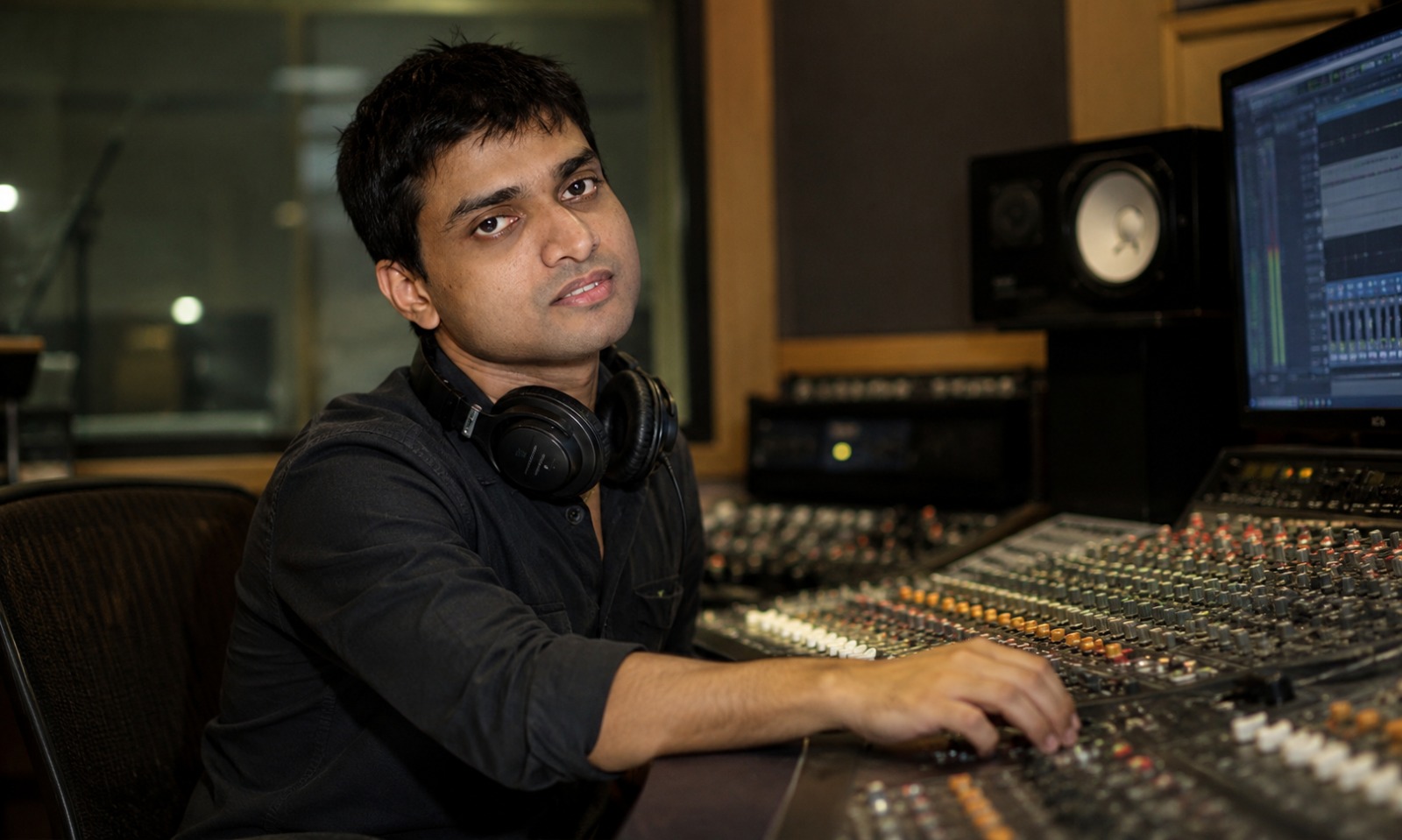
Shajith Koyeri
Indian sound designer
Shajith Koyeri is a sound designer specializing in sync sound technique in Indian cinema. He received the National Film Awards for Omkara and has won two Filmfare awards and two IIFA Awards. He is also the recipient of the Star Screen Award for Kaminey. Additionally, Shajith is known for his work in Foley editing and pre-mixing. Shajith Koyeri was born in Punnol in Kannur district of Kerala. He attended Brennan College in Thalassery for his higher studies. He has relocated to Mumbai in 1999.
Key Factors
Full Name: Shajith Koyeri
Birthplace: Punnol, Kannur district, Kerala, India
Profession: Sound Designer
Specialization: Sync Sound, Foley Editing, Pre-Mixing
Known For: Pioneering sync sound techniques in Indian films
Major Awards: National Film Award, Filmfare Awards, IIFA Awards, Star Screen Award
In cinema, audiences often remember faces before they remember sound. They recall performances, landscapes, costumes, and dialogue. Yet some of the most emotionally powerful moments in film are shaped not by what viewers see, but by what they hear, a distant train echoing through silence, the nervous breathing between two lines of dialogue, the rustle of dry leaves before violence erupts, or the unsettling realism of footsteps inside an empty corridor. Few technicians in Indian cinema have understood that invisible emotional architecture as deeply as Shajith Koyeri, the outstanding sound designer from Kerala who helped redefine how contemporary Indian films sound.
Over the last two decades, Koyeri has quietly shaped the auditory identity of some of Indian cinema’s most influential films. Known particularly for his work in sync sound, Foley editing, and pre-mixing, he emerged during a transformative period when Indian filmmaking was beginning to move away from heavily dubbed soundscapes toward realism, intimacy, and environmental authenticity. His collaborations with directors such as Vishal Bhardwaj, Sanjay Leela Bhansali, Aparna Sen, and Abhishek Chaubey produced films where sound became narrative rather than technical background.
His work on Omkara earned him the National Film Award, while films such as Kaminey, Black, and Maqbool demonstrated how sound design could deepen emotional realism in Indian cinema without calling attention to itself.
The Sound Before the Scene
On a film set, silence is rarely silent.
There are generators humming beyond camera range, crew members shifting equipment, traffic leaking from distant roads, fabric brushing against microphones, and the unpredictable noise of living environments. For decades, much of Indian cinema treated these sounds as obstacles. Dialogue was routinely dubbed later inside studios, often detached from the emotional rhythm of performance itself.
Shajith Koyeri belonged to a generation that challenged that tradition.
In sync sound recording, dialogue is captured live during filming rather than reconstructed later through dubbing. It demands extraordinary precision. Actors must deliver lines cleanly amid environmental chaos. Technicians must isolate human emotion from mechanical interference. Every breath, hesitation, and whisper becomes vulnerable to imperfection.
But that vulnerability also creates realism.
Koyeri understood early that authentic sound could transform performance. A voice recorded in the actual emotional space of a scene carries textures impossible to reproduce artificially. Fear sounds different in open rain than inside a studio booth. Anger echoes differently in narrow hallways than on controlled sets.
That philosophy would define his career.
Childhood in Kerala
Shajith Koyeri was born in Punnol, in Kerala’s Kannur district, to Soma Sundaran and Rathibayi. The cultural landscape of northern Kerala, deeply rooted in theatre traditions, political storytelling, ritual performance, and oral culture, shaped many artists who later entered Indian cinema. Though Koyeri would eventually become associated with highly technical aspects of filmmaking, his sensibility appears rooted in observation and atmosphere rather than machinery alone.
He pursued higher studies at Government Brennen College in Thalassery, a town historically linked to literature, colonial history, and intellectual life in Kerala.
The Kerala he grew up in was acoustically rich. Monsoon rain against tiled roofs, political processions through crowded streets, temple percussion, fishing harbours, bus stands, old radios, and densely layered natural soundscapes formed part of everyday life. For someone later working in cinematic sound realism, such environments likely became unconscious training grounds.
Long before audiences noticed his work in theatres, he had already spent years listening carefully to the world.
The Journey to Mumbai
In 1999, Shajith Koyeri relocated to Mumbai, the center of India’s Hindi film industry.
For technicians arriving from smaller towns, Mumbai often represented both opportunity and disorientation. The city’s film industry was highly competitive, deeply networked, and traditionally dominated by established production ecosystems. Breaking into technical departments required persistence more than glamour.
Koyeri entered the industry during a particularly important transitional phase. Indian cinema at the turn of the millennium was becoming more technologically ambitious. Directors were experimenting with realism, urban storytelling, international production standards, and location-based shooting.
Sound departments suddenly mattered in new ways.
His first independent work came through the film Perfect Husband in 2003. Though not a mainstream breakthrough, it marked an important beginning. Like many technicians, Koyeri’s rise happened incrementally through credibility, reliability, and craft rather than instant recognition.
Soon, major filmmakers began noticing his work.
Building a Reputation in Indian Cinema
Few sound designers accumulate a filmography as diverse as Shajith Koyeri’s.
He moved fluidly between intense dramas, literary adaptations, commercial thrillers, and visually stylized cinema. His collaborations with Vishal Bhardwaj became especially important because Bhardwaj’s films relied heavily on atmosphere and psychological tension.
In Maqbool, the Mumbai underworld breathes through layered ambient sound rather than exaggerated cinematic noise. In The Blue Umbrella, mountain silence becomes emotionally expressive. By the time Koyeri worked on Omkara, sync sound itself had become central to the film’s gritty realism.
The dialect-heavy performances in Omkara demanded authenticity. The roughness of rural Uttar Pradesh could not have survived polished studio dubbing. Koyeri’s sound design allowed characters to feel physically present within their environments. Dust, wind, footsteps, political rallies, and tense silences all merged into the film’s emotional fabric.
The work earned him the National Film Award and established him among the most respected sound designers in India.
His collaborations expanded further with directors such as Sanjay Leela Bhansali on visually grand productions like Black and Saawariya. Bhansali’s cinema demanded a very different sonic philosophy from Vishal Bhardwaj’s realism. Here, sound needed to complement stylization, rhythm, and heightened emotionality.
Koyeri adapted effortlessly.
That flexibility became one of his defining strengths.
The Craft of Sync Sound
To understand Shajith Koyeri’s importance, one must understand how profoundly sync sound changed Indian filmmaking.
For decades, Indian films largely depended on Automated Dialogue Replacement, where actors re-recorded dialogue after shooting. This approach emerged partly because Indian film sets were noisy and technically difficult to control. Outdoor realism was often sacrificed for cleaner sound.
Sync sound reversed that equation.
Instead of reconstructing reality later, filmmakers began preserving it during performance itself.
This shift altered acting styles dramatically. Actors no longer performed dialogue merely for lip movement. They performed within real acoustic environments. Whispering became meaningful. Breathing patterns mattered. Emotional spontaneity survived.
Koyeri became one of the important technicians helping normalize that transition within Indian cinema.
The process was technically brutal. Recording live dialogue in crowded Indian locations required extreme coordination between departments. Ambient interference from traffic, crowds, aircraft, weather, and production machinery constantly threatened recordings.
Yet sync sound offered something Indian cinema increasingly desired, authenticity.
In films such as Ishqiya and Kaminey, audiences could feel the physicality of environments through sound. Voices no longer floated unnaturally above scenes. They belonged inside them.
Landmark Films and Sound Philosophy
Each major Shajith Koyeri film reveals a slightly different philosophy toward sound.
In Kaminey, urban chaos becomes rhythmic and kinetic. Mumbai sounds dangerous, unstable, constantly moving. The film’s soundscape amplifies paranoia without overwhelming performance. His work earned the Star Screen Award and further cemented his industry reputation.
In Black, silence itself becomes expressive. The emotional isolation of the protagonist is reinforced through restrained sound textures and carefully controlled acoustic space.
In 7 Khoon Maaf, sound reflects shifting emotional states and tonal transitions as the narrative moves through violence, romance, and psychological fragmentation.
Meanwhile, films such as Mangal Pandey: The Rising required large-scale historical atmosphere, combining battlefield acoustics, crowd movement, and period realism.
Koyeri’s sound rarely feels decorative. It feels observational.
That subtlety is perhaps why his work remains influential.
Beyond Mainstream Cinema
Although best known for feature films, Koyeri has also worked extensively on documentaries and short films screened at international film festivals.
This aspect of his career matters because documentary sound demands heightened realism and improvisational skill. Unlike controlled narrative cinema, documentaries often require technicians to capture emotionally unpredictable moments in unstable environments.
His work in Foley editing and pre-mixing also demonstrates broader technical mastery beyond location sound recording alone.
Foley work involves recreating environmental sounds, footsteps, movement, clothing textures, object interactions, while pre-mixing shapes how multiple audio layers emotionally interact before final sound mastering.
In many ways, sound design remains one of cinema’s least visible crafts precisely because successful sound disappears into storytelling.
Koyeri’s career exemplifies that invisible excellence.
Work Ethic and Creative Reputation
Within the industry, Shajith Koyeri is known less as a celebrity technician and more as a deeply respected craftsman.
His collaborators frequently describe meticulous attention to detail, patience under difficult shooting conditions, and strong creative understanding of directors’ visual intentions. Sound designers occupy an unusual space within filmmaking. They are simultaneously technical problem-solvers and emotional interpreters.
Koyeri’s long-term collaborations with directors suggest a professional reputation built on trust.
That trust matters enormously in filmmaking because sound departments operate under immense pressure. When sync sound fails, entire scenes can collapse. When it succeeds, audiences rarely notice it consciously.
Ironically, the better the sound design, the less visible the technician becomes.
Legacy and Influence
Indian cinema today sounds very different from the cinema of the 1980s and 1990s.
Location realism, ambient authenticity, quieter performances, and environmental sound textures have become increasingly important across industries and languages. Younger audiences now expect realism in ways previous generations did not.
Technicians like Shajith Koyeri helped create that transition.
His work contributed to a broader movement that treated sound not as post-production repair work but as storytelling itself. For younger sound engineers entering Indian cinema today, sync sound recording is no longer experimental. It is increasingly standard practice for serious filmmaking.
That evolution owes much to pioneers who proved its artistic value under difficult production conditions.
In the end, Shajith Koyeri’s career reminds audiences of something cinema often hides. Behind every unforgettable scene exists another invisible performance, the shaping of atmosphere, silence, texture, breath, and emotional space through sound.
And in that hidden architecture of Indian cinema, his contribution remains outstanding.
Awards and nominations
2006: National Film Award for Omkara
2006: Filmfare Award for Omkara
2006: Star Screen Award for Omkara (Nominated)
2006: Zee Cine Awards for Omkara (Nominated)
2006: Bollywood Movie Awards for Omkara (Nominated)
2010: Star Screen Award for Kaminey
2010: Filmfare Award for Kaminey (Nominated)
2010: Zee Cine Awards for Kaminey (Nominated)
2011: Filmfare Award for Ishqiya (Nominated)
2011: Star Screen Award for Ishqiya (Nominated)
2012: Apsara Film & Television Producers Guild Awards for 7 Khoon Maaf (Nominated)
2012: Golden Rooster Awards for Dam999 (Nominated)
2013: IIFA Awards for Barfi!
2013: Filmfare Award for Barfi! (Nominated)
2013: Star Screen Award for Barfi! (Nominated)
2015: Star Guild Awards for Haider
2015: IIFA Awards for Haider
2015: Filmfare Award for Haider (Nominated)
2016: Filmfare Award for Talvar
2016: Star Screen Award for Talvar and Dum Laga Ke Haisha (Nominated)
2017: Star Screen Award for Rangoon and Dangal